
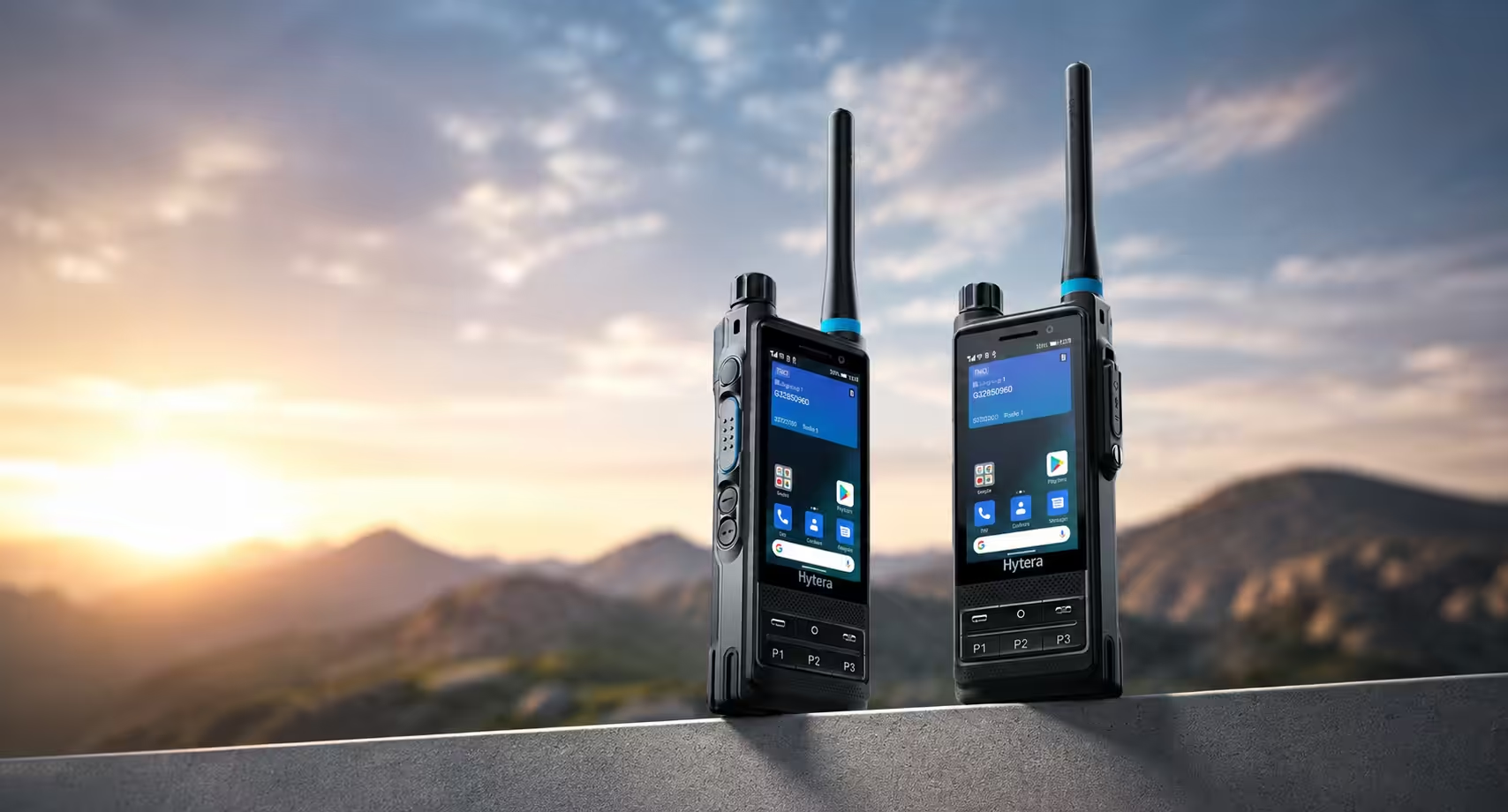
Walkie Talkie
A Walkie Talkie is a portable two-way radio that allows users to communicate with each other using radio signals. Unlike a mobile phone, a walkie talkie normally communicates directly with another compatible radio or through a radio systemA Radio System is a complete communication solution comprising two-way radios and, where required, equipment such as repeaters, antennas, base stations, mobile radios and network infrastructure. such as a repeaterA Repeater receives a two-way radio transmission and retransmits it, usually from an elevated location, to extend the coverage and reliability of a radio communication system..
The term “walkie talkie” is commonly used to describe handheld two-way radios, from simple consumer devices to professional business radios used by organisations across the UK.
What is a walkie talkie?
A walkie talkie is essentially a handheld Two-Way Radio.
It normally contains:
- Transmitter
- ReceiverA Receiver is the part of a two-way radio that detects and processes incoming radio signals, converting them into audible voice or usable data for the user.
- AntennaAn antenna transmits and receives radio-frequency signals, allowing a two-way radio to communicate. Antenna type, frequency, height and location can all affect radio performance and coverage.
- Battery
- Microphone
- Speaker
- Push-to-Talk (PTT)Push-to-Talk (PTT) is the button or control used to activate a two-way radio's transmitter. Press it to speak and release it to listen. control
The user presses the PTT button to transmit and releases it to listen.
How does a walkie talkie work?
A walkie talkie converts the user’s speech into a radio signal and transmits it using a designated radio frequencyAn antenna transmits and receives radio-frequency signals, allowing a two-way radio to communicate. Antenna type, frequency, height and location can all affect radio performance and coverage..
Another compatible radio receives the signal and converts it back into audio.
The basic process is:
Speak → Transmit → Radio signal → Receive → Listen
Most conventional walkie talkies cannot transmit and receive simultaneously. Users normally take turns speaking.
Walkie talkie vs two-way radio
“Walkie talkie” and “two-way radio” are often used interchangeably, but two-way radio is the broader technical term.
Walkie talkie usually refers specifically to a handheld portable radioA Portable Radio is a battery-powered two-way radio designed to be carried and operated by an individual, providing mobile communication for professional and operational users..
Two-way radio can also include:
- Portable radios
- Mobile radios
- Base stations
- Repeaters
- Radio networks
- Dispatch systems
A professional business radioBusiness Radio refers to professional two-way radio systems used by businesses and organisations for instant communication, often using licensed frequencies and equipment designed for commercial use. is therefore a two-way radio and can also commonly be described as a walkie-talkie.
Professional walkie talkies
Professional walkie talkies are designed for business and operational use rather than casual recreational communication.
They can provide features such as:
- Multiple channels
- Digital radio
- Talk groups
- Emergency alerts
- Lone WorkerA Lone Worker is someone who works without direct supervision or immediate assistance nearby. Compatible two-way radios can provide safety features such as timed check-ins, emergency alerts and GPS location.
- Man DownMan Down is a safety feature on some professional two-way radios that can detect a possible fall or unusual radio position and automatically raise an alert if the user does not respond.
- GPS
- EncryptionEncryption protects two-way radio communications by converting voice or data into a secure form that can only be understood by authorised radios with the correct encryption capability and keys.
- Noise cancellationNoise Cancellation is technology used in two-way radios and communication equipment to reduce unwanted background noise and make speech easier to hear, particularly in noisy working environments.
- Rugged construction
- Long battery life
The exact features depend on the radio model and system.
Walkie talkie channels
A walkie talkie can be programmed with one or more channels.
A channelA two-way radio channel is a programmed set of communication settings, typically including frequency and signalling, that allows compatible radios to communicate with one another. normally represents a specific programmed radio configuration, which can include a frequencyFrequency is the number of cycles a radio wave completes each second, measured in Hertz. In two-way radio, frequency determines where a transmission operates within the radio spectrum. and other settings.
Users select the appropriate channel before transmitting.
Walkie talkie frequencies
Walkie talkies can operate on different frequency bands.
Professional radios commonly use:
- VHF (Very High Frequency)VHF (Very High Frequency) is the 30 MHz to 300 MHz radio-frequency range. VHF two-way radios are widely used for professional communications across outdoor, rural and open areas.
- UHF (Ultra High Frequency)UHF (Ultra High Frequency) is the 300 MHz to 3 GHz radio-frequency range. UHF two-way radios are widely used for professional communications, particularly in buildings and urban environments.
The appropriate band depends on the environment and coverageRadio Coverage is the geographical area in which a two-way radio system can provide reliable communication. Coverage depends on the radios, antennas, frequency, terrain, buildings and system infrastructure. requirements.
VHF walkie talkies
VHF walkie-talkies can be suitable for outdoor, rural and open-area communications.
They are commonly considered for applications such as:
- Agriculture
- Utilities
- Construction
- Transport
- Outdoor events
Terrain and system design remain important factors in determining coverage.
UHF walkie talkies
UHF walkie talkies are commonly used in buildingsAn antenna transmits and receives radio-frequency signals, allowing a two-way radio to communicate. Antenna type, frequency, height and location can all affect radio performance and coverage., urban environments and commercial premises.
They can be particularly useful for:
- Hotels
- Retail
- Security
- Warehouses
- Events
- Construction
- Manufacturing
UHF can often perform well where signals need to travel through buildings, although actual performance depends on construction and the radio system.
Licence-free walkie talkies
Some walkie talkies can operate on Licence-Free RadioA Licence-Free Radio is a two-way radio that can be used without an individual radio licence when it complies with the applicable licence-exempt rules. In the UK, PMR446 is the main licence-free radio service. services.
In the UK, PMR446 is a licence-exempt service designed for short-range personal and business communications.
PMR446 equipment must comply with the applicable technical requirements.
Licensed walkie talkies
Professional walkie talkies can operate using licensed business-radio frequencies.
In the UK, OfcomOfcom (Office of Communications) is the UK's communications regulator. For two-way radio users, Ofcom manages and regulates access to radio spectrum and the use of radio frequencies in the UK. regulates radio spectrumSpectrum is the range of radio frequencies used for wireless communication. Two-way radios operate within specific parts of the radio spectrum, subject to frequency allocation and licensing requirements. and business-radio licensing.
Licensed radioA Licensed Radio is a two-way radio operated under an appropriate radio licence. Licensed systems can provide greater control over frequencies, coverage and infrastructure than licence-free radio services such as PMR446. systems can provide capabilities and coverage more appropriate for professional applications than basic licence-free radios.
Walkie talkie range
There is no single range for a walkie talkie.
Manufacturers may advertise maximum ranges under ideal conditions, but actual operating range can be significantly different.
Coverage depends on:
- Frequency
- Transmitter powerAn antenna transmits and receives radio-frequency signals, allowing a two-way radio to communicate. Antenna type, frequency, height and location can all affect radio performance and coverage.
- Antenna
- Terrain
- Buildings
- Radio height
- InterferenceRadio interference occurs when unwanted radio-frequency signals or electrical noise disrupt two-way radio communications, causing distorted audio, broken transmissions, reduced coverage or loss of communication.
- Receiver sensitivity
- Repeater infrastructureRadio infrastructure is the equipment and supporting systems behind a professional two-way radio network, including repeaters, antennas, base stations, network connections, power systems and dispatch equipment.
Walkie talkies and line of sight
Radio signals can be affected by physical obstructions.
Open terrain can allow communications over greater distances than dense buildings or heavily obstructed environments.
An elevated antenna or repeater can significantly improve coverage.
Walkie talkie repeaters
A Repeater can extend the coverage of walkie talkies.
Instead of communicating directly:
Walkie Talkie A → Walkie Talkie B
radios can communicate through a repeater:
Walkie Talkie A → Repeater → Walkie Talkie B
This can allow communications across larger sites or areas where direct radio-to-radio coverage is insufficient.
Walkie talkie digital radio
Modern professional walkie talkies can use digital radio technologies such as DMR (Digital Mobile RadioA Mobile Radio is a two-way radio designed to be installed in a vehicle. It normally uses the vehicle's power supply and an external antenna to provide reliable communication while travelling or working in the field.).
Digital radios can provide features including:
- Talk groups
- Private calls
- Data
- GPS
- Emergency signalling
- Improved spectrum efficiency
- Encryption where supported
Walkie talkie analogue radio
Analogue walkie talkies are still used for straightforward voice communications.
Analogue systems can be simple to operate and may be appropriate where advanced digital functionality is unnecessary.
Walkie talkie talk groups
Digital walkie talkies can use Talk Groups to organise users into communication groups.
For example:
Security
Operations
Maintenance
Management
A user can select the appropriate talk groupA Talk Group is a predefined group of users or radios within a two-way radio system that share a common communication group, allowing teams to communicate without involving other users. and communicate with the relevant team.
Walkie talkie private calls
Compatible digital walkie talkies can support Private Calls, allowing one radio to communicate directly with another individual radio.
This is different from a group call, where multiple radios can hear the communication.
Walkie talkie Push-to-Talk
The Push-to-Talk (PTT) button is one of the defining controls on a conventional walkie talkie.
The user presses PTT to transmit and releases it to return to receiving.
This provides deliberate control over radio transmissions.
Walkie talkie Voice Activation
Some walkie talkies support Voice Activation (VOX)Voice Activation (VOX) allows a two-way radio to transmit automatically when it detects speech, providing hands-free communication without pressing the Push-to-Talk (PTT) button..
VOX allows the radio to begin transmitting automatically when it detects speech.
This can provide hands-free communication when used with a compatible microphone or headsetA radio headset combines a microphone and speaker or earpiece, allowing two-way radio users to communicate conveniently while keeping the radio away from their face or using hands-free operation..
Walkie talkie headsets
A walkie talkie can be used with compatible:
- Headsets
- Earpieces
- Speaker microphones
- Remote Speaker Microphones
- Throat microphones
- Hands-free accessories
The appropriate accessory depends on the radio and working environment.
Walkie talkie speaker microphone
A Speaker MicrophoneA Speaker Microphone is a two-way radio accessory combining a microphone, loudspeaker and usually a Push-to-Talk button, allowing convenient radio operation without handling the radio itself. allows the user to operate the radio through an accessory connected to the portable radio.
A Remote Speaker Microphone (RSM)A Remote Speaker Microphone (RSM) is an external radio accessory combining a microphone, speaker and Push-to-Talk button, allowing users to operate a two-way radio without handling the radio itself. can position the speaker and microphone closer to the user’s mouth while the radio remains attached to clothing or equipment.
Rugged walkie talkies
Professional Rugged Radios are designed for demanding working environments.
Depending on the model, they can offer protection against:
- Dust
- Water
- Impact
- Vibration
- Harsh working conditions
Protection levels vary between models.
Intrinsically Safe walkie talkies
Specialist Intrinsically Safe Radios are available for use in specified hazardous environments.
These radios are designed and certified to reduce the risk of the equipment creating an ignition source.
The correct certification must match the intended hazardous environment.
Walkie talkie battery
Walkie talkies normally use rechargeable batteries.
Modern professional radios commonly use Lithium-Ion Batteries.
Battery operating time depends on factors including:
- Battery capacity
- Transmit time
- Receive time
- Standby time
- Transmitter power
- Radio features
- Battery age
Walkie talkie charger
A walkie talkie can be charged using a compatible desktop charger, multi-unit charging station or Vehicle ChargerA Vehicle Charger is a charging system that recharges a compatible two-way radio or battery from a vehicle's electrical supply, helping mobile users keep radios ready for use..
Professional radio fleets may use several charging arrangements to keep radios available throughout the working day.
Walkie talkie emergency button
Professional walkie talkies may include a dedicated emergency buttonAn Emergency Button is a dedicated two-way radio control that allows users to quickly send an emergency alert to a dispatcher, control room or authorised radio users..
Depending on the radio system, pressing it can initiate an emergency transmissionTransmission is the process of sending voice, data or signalling from a radio using a radio-frequency signal to another radio, repeater or communication system. or alert to other radios or a control room.
Walkie talkie Man Down
Some professional walkie talkies support Man Down functionality.
The radio can detect a specified abnormal orientation or lack of movement and initiate an alert where the feature is configured and supported.
Walkie talkie Lone Worker
Lone Worker functionality can provide additional protection for employees working alone.
A compatible radio can prompt the user for a response or send an alert when configured conditions are met.
Walkie talkie GPS
Some professional digital walkie talkies include GPS.
This can allow the radio system to report the location of individual radios to a compatible control or dispatch system.
GPS availability depends on the radio and networkA Network is a connected system of radios, equipment and infrastructure that allows users to communicate across a defined area. Radio networks can range from simple radio-to-radio systems to large multi-site networks..
Walkie talkie encryption
Professional digital walkie talkies may support Encryption to protect radio communications from unauthorised listening.
The type and strength of encryption depend on the equipment and configuration.
Encryption does not automatically make every radio communication secure; the entire system must be appropriately configured.
Walkie talkie noise cancellation
Noise Cancellation can improve speech intelligibility by reducing unwanted background noise captured by the microphone.
This can be particularly useful in environments such as:
- Construction sites
- Warehouses
- Factories
- Transport operations
- Outdoor events
Walkie talkie scan
A Scan ListA Scan List is a programmed collection of channels or talkgroups that a two-way radio monitors automatically when its scanning function is enabled. allows a radio to monitor multiple programmed channels or talk groups.
This can allow users to monitor more than one operational group without manually changing channels.
Walkie talkie User ID
Digital radios can have a User IDA User ID is a unique identifier used to identify an individual radio or user within a digital communication system. In DMR, the radio's ID can be used for individual calls, alerts and system management. or Radio ID that identifies the individual radio within the system.
This can support functions such as:
- Private calls
- Emergency alerts
- GPS reporting
- Radio identification
- Dispatch
Walkie talkie radio hire
Professional Radio HireRadio Hire is the temporary rental of two-way radios and related communication equipment for events, projects and operational requirements, providing professional communication without purchasing the equipment. provides temporary access to walkie talkies and associated equipment.
Hire radios are commonly used for:
- Events
- Construction
- Security
- Hospitality
- Film and television
- Transport
- Temporary sites
A hire provider can normally pre-program the radios before deployment.
Walkie talkie for events
Walkie talkies are widely used by event teams for rapid communication between staff.
Different talk groups can be assigned to teams such as:
- Security
- Stewards
- Production
- Catering
- Management
- Event control
Larger events may require repeaters to provide adequate coverage.
Walkie talkie for construction
Construction teams use professional walkie talkies to communicate across sites.
A suitable system can help workers coordinate:
- Site operations
- Deliveries
- Plant movements
- Security
- Supervisors
- Emergency situations
Large or complex construction sites may require a repeater.
Walkie talkie for security
Security teams can use professional walkie talkies for communication between patrols, supervisors and control rooms.
Features such as emergency alerts, Man Down and Lone Worker can be useful where supported.
Walkie talkie for hospitality
Hotels, restaurants and venues can use walkie talkies to coordinate staff across different areas of a property.
UHF radios are often considered for applications involving multiple buildings or indoor areas.
Walkie talkie for agriculture
Farm and estate workers can use walkie talkies to communicate across large outdoor areas.
VHF may be considered where extensive outdoor or rural coverage is required, although the correct choice depends on terrain and system design.
Walkie talkie for warehouses
Walkie talkies allow warehouse teams to communicate without relying on mobile-phone networks.
They can be used for:
- Stock movements
- Loading
- Deliveries
- Supervisors
- Maintenance
- Security
Walkie talkie for transport
Transport operators can use walkie talkies across depots, stations, yards and other operational areas.
Vehicle-mounted radios, repeaters and multi-site systems can be used where wider coverage is required.
Walkie talkie vs mobile phone
Walkie talkies and mobile phones provide different types of communication.
A walkie talkie can provide instant push-to-talk communication with a group without requiring users to dial individual numbers.
A mobile phone normally relies on a cellular network and is better suited to one-to-one calls, messaging and internet services.
Professional radio systems can also operate independently of public mobile networks, depending on their design.
Walkie talkie vs smartphone PTT
Push-to-Talk over Cellular (PoC)Push-to-Talk over Cellular (PoC) provides radio-style push-to-talk communication over cellular or IP networks, allowing users to communicate across wide areas where suitable network connectivity is available. services can provide walkie-talkie-style communication using cellular or Wi-FiWi-Fi is a wireless networking technology that connects compatible devices to a local or wider network. In radio systems, it can support programming, updates, data services and IP-based communications. networks.
PoC can provide wide-area communication but depends on network connectivity.
Conventional professional radio can provide local radio coverage without relying on a public cellular network.
Walkie talkie range vs mobile phone
A walkie talkie does not necessarily have greater range than a mobile phone.
A mobile phone can communicate over very large geographical areas through cellular networks.
A professional radio system can also provide wide-area coverage when repeaters and networked sites are used.
Walkie talkie and radio systems
A walkie talkie can form part of a much larger Radio System.
For example:
Portable Radios → Repeater → Network → Control Room
The handheld radio is therefore only one component of a professional communications system.
Walkie talkie and radio interoperability
Different walkie talkies are not automatically compatible.
Compatibility depends on factors including:
- Frequency
- Analogue or digital technology
- Channel configuration
- Signalling
- Talk groups
- Encryption
- Radio standards
Two radios that look similar may not be able to communicate with each other.
Walkie talkie brands
Professional walkie talkies are manufactured by companies including:
- Motorola SolutionsMotorola Solutions is a global communications technology company that develops professional two-way radios, radio systems, dispatch platforms and other communication and safety technologies.
- KenwoodKenwood is a manufacturer of professional two-way radio equipment, including handheld radios, mobile radios, repeaters and accessories for business and commercial communication.
- Hytera
- IcomIcom is a Japanese manufacturer of two-way radios and communication equipment, producing professional analogue and digital radios, repeaters and accessories for business, industrial, marine, aviation and other specialist applications.
- Tait
- Sepura
Different manufacturers offer equipment for different applications and radio technologies.
Walkie talkie programming
Professional walkie talkies are normally programmed with the channels, frequencies and features required for the particular application.
Programming can include:
- Frequencies
- Channel names
- Talk groups
- Power settings
- Scan lists
- Emergency functions
- User IDs
- Encryption settings
Walkie talkie licensing in the UK
Whether a walkie talkie requires a licence depends on the frequency, service and equipment being used.
PMR446 equipment can operate licence-free when it meets the relevant requirements.
Professional business radios operating on licensed frequencies require the appropriate Ofcom authorisation.
Are walkie talkies legal in the UK?
Walkie talkies are legal to use in the UK, but users must operate them within the relevant regulatory requirements.
Licence-free PMR446 radios must meet the applicable technical specifications.
Licensed professional radios must operate under the appropriate Ofcom licence and conditions.
Choosing a walkie talkie
The best walkie talkie depends on the application.
Important considerations include:
- Indoor or outdoor use.
- Required coverage.
- Number of users.
- VHF or UHF.
- Licence-free or licensed operation.
- Analogue or digital.
- Repeater requirements.
- Battery life.
- Ruggedness.
- Emergency features.
- Accessories.
- Need for GPS or other data services.
Professional walkie talkies vs consumer models
Consumer walkie talkies are generally designed for simple short-range communications.
Professional walkie talkies can provide:
- Greater durability
- Better audio
- Professional accessories
- Licensed-frequency operation
- Repeaters
- Digital communication
- Emergency functions
- Fleet managementFleet Management is the process of managing a two-way radio fleet, including equipment, users, programming, maintenance, firmware, security and radio system configuration.
- System integration
For demanding business applications, the radio should be selected according to the complete communication requirement rather than simply advertised range.
Walkie talkie limitations
A walkie talkie does not guarantee communication over a particular distance.
Performance can be reduced by:
- Buildings
- Hills
- Trees
- Underground areas
- Metal structures
- Interference
- Poor antenna positioning
- Low battery
- Inadequate system design
A Site SurveyA Site Survey is an assessment of a location to determine whether a two-way radio system will provide the required coverage, reliability and performance. may be appropriate where reliable coverage is important.
Walkie talkie and DCS
DCS supplies professional two-way radio equipment and radio systems for businesses and organisations across the UK.
Depending on the application, a DCS walkie talkie system can include portable radios, accessories, repeaters, licensing, programming and wider radio infrastructure.