
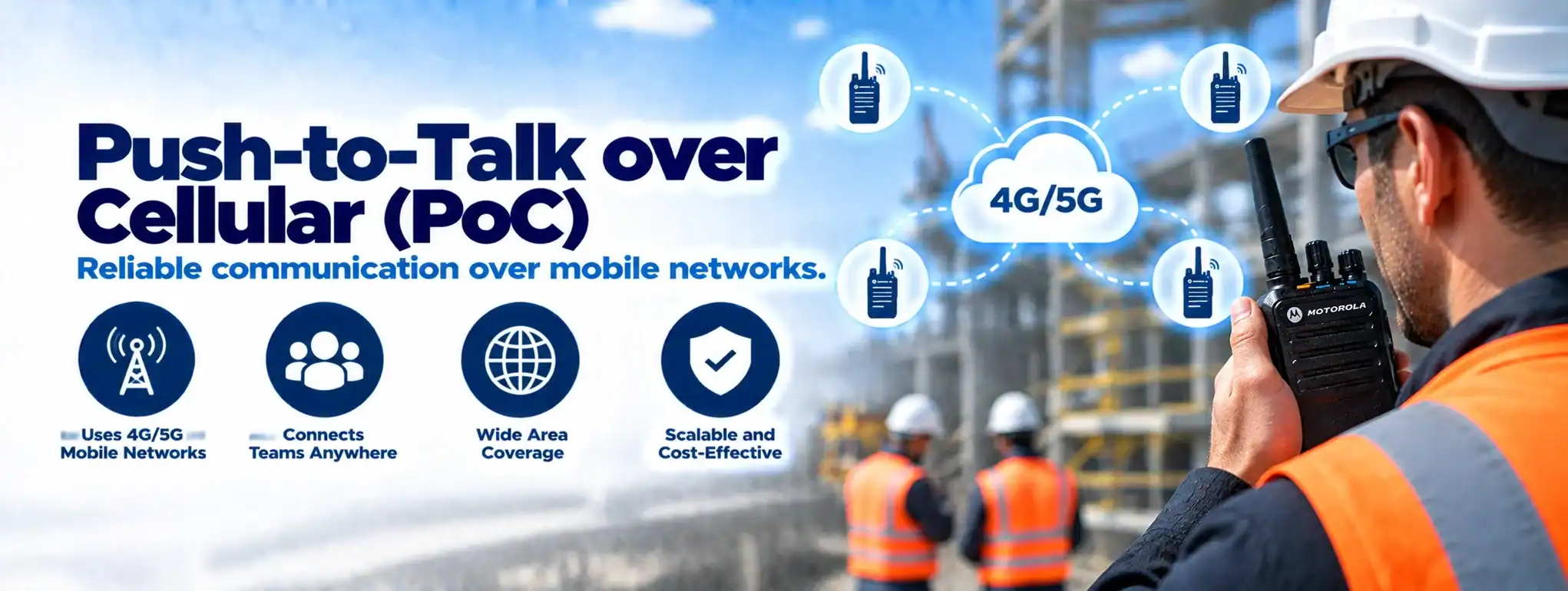
Push-to-Talk over Cellular (PoC)
Push-to-Talk over Cellular (PoC) is a communication technology that provides two-way, push-to-talk communication over cellular networks or other IP-based networks rather than relying solely on traditional radio frequencies.
PoC gives users a radio-style communication experience: press a button to speak and release it to listen. Depending on the service, communication can take place across much larger geographical areas than a conventional local radio systemA Radio System is a complete communication solution comprising two-way radios and, where required, equipment such as repeaters, antennas, base stations, mobile radios and network infrastructure., provided suitable cellular or internet connectivity is available.
What is Push-to-Talk over Cellular?
PoC uses a cellular or IP data connection to carry voice communications.
The basic principle is:
Press PTT → Voice transmitted over mobile data → Recipient receives communication
Unlike a conventional two-way radio system, the communication does not necessarily travel directly between radios or through a dedicated radio repeaterA Repeater receives a two-way radio transmission and retransmits it, usually from an elevated location, to extend the coverage and reliability of a radio communication system..
Instead, the communication is carried through a cellular or IP networkA Network is a connected system of radios, equipment and infrastructure that allows users to communicate across a defined area. Radio networks can range from simple radio-to-radio systems to large multi-site networks..
How does PoC work?
A typical PoC system consists of:
- PoC handset or device
- Push-to-talk button
- Cellular network
- PoC application or service platform
- Server or cloud infrastructureRadio infrastructure is the equipment and supporting systems behind a professional two-way radio network, including repeaters, antennas, base stations, network connections, power systems and dispatch equipment.
- Other authorised users
For example:
PoC Radio → 4G/5G → PoC Platform → 4G/5G → Other PoC Radios
The exact architecture depends on the service provider and equipment.
PoC vs traditional two-way radio
The main difference is how the communication is transported.
Traditional radio:
Radio → Radio / Repeater → Radio
PoC:
Device → Cellular/IP Network → PoC Platform → Cellular/IP Network → Device
Traditional radio systems use dedicated radio spectrumSpectrum is the range of radio frequencies used for wireless communication. Two-way radios operate within specific parts of the radio spectrum, subject to frequency allocation and licensing requirements..
PoC uses existing cellular or IP connectivity.
PoC and mobile networks
PoC systems can use cellular networks such as:
- 4G
- 5G
- Other supported mobile-data networks
This can allow communication between users who are geographically separated.
For example, a user in Manchester could potentially communicate with another authorised user in London through the cellular network.
Actual coverageRadio Coverage is the geographical area in which a two-way radio system can provide reliable communication. Coverage depends on the radios, antennas, frequency, terrain, buildings and system infrastructure. depends on the cellular networks and service being used.
PoC and Wi-Fi
Some PoC services can also operate over Wi-FiWi-Fi is a wireless networking technology that connects compatible devices to a local or wider network. In radio systems, it can support programming, updates, data services and IP-based communications..
This can be useful inside:
- Hotels
- Warehouses
- Offices
- Industrial facilities
- Shopping centres
- Other locations with suitable Wi-Fi coverage
A compatible device can potentially switch between cellular and Wi-Fi connectivity depending on the service.
PoC and geographical coverage
One of the main advantages of PoC is that communication does not have to be limited to the coverage of a local radio repeater.
If users have suitable cellular or IP connectivity, they can potentially communicate over much larger distances.
This can be particularly useful for organisations operating across multiple towns, cities or regions.
However, PoC coverage is dependent on the availability and reliability of the underlying network.
PoC and traditional radio coverage
A conventional radio system may require:
Radio → Repeater → Radio
PoC may instead use:
PoC Device → Cellular Network → PoC Platform → PoC Device
This can remove the need for an organisation to install and maintain its own radio repeater infrastructure for PoC users.
PoC and dead spots
PoC devices can experience Dead Spots where cellular or Wi-Fi connectivity is unavailable or unreliable.
This is an important difference from conventional radio.
A location with poor mobile coverage may be unsuitable for PoC even though a properly designed professional radio system could provide coverage there.
PoC and latency
PoC communications can introduce network latencyLatency is the delay between a radio transmission being sent and the resulting voice or data being received. It can be introduced by digital processing, repeaters, IP networks, gateways and cloud systems..
The voice communication must travel through the cellular or IP network and, depending on the system, through a server or cloud platform before reaching the recipient.
The amount of latency depends on:
- Network conditions
- Cellular coverage
- Data connection
- PoC platform
- Device
- Internet connectivity
Modern systems can provide rapid communication, but they may not behave exactly like a conventional direct radio system.
PoC and Push-to-Talk
The user experience is based around Push-to-Talk (PTT)Push-to-Talk (PTT) is the button or control used to activate a two-way radio's transmitter. Press it to speak and release it to listen..
The user presses the PTT button to transmit and releases it to listen.
This provides the familiar radio-style communication method without requiring a conventional telephone call.
PoC group calling
PoC systems can support group communication.
For example:
Supervisor → Operations Group
Multiple authorised users can receive the same transmissionTransmission is the process of sending voice, data or signalling from a radio using a radio-frequency signal to another radio, repeater or communication system..
Groups can often be configured according to departments, locations or operational roles.
PoC private calling
Many PoC systems support individual or Private CallPrivate Call is a two-way radio feature that allows one radio user to communicate directly with another individual radio user rather than making the conversation part of a general group call. communication.
For example:
Control Room → Individual Worker
This allows users to communicate directly without sending the message to an entire group.
PoC priority communication
Depending on the platform, PoC systems may support priority or emergency communications.
The available functionality varies between service providers and devices.
Priority communication should therefore be considered a system feature rather than an inherent characteristic of PoC itself.
PoC and emergency calls
Some PoC devices provide dedicated emergency buttons or functions.
An emergency activation can send an alert to designated users or a control centre.
Depending on the platform, emergency functionality may include:
- Emergency alerts
- Priority communications
- GPS location
- Lone-worker features
- Man DownMan Down is a safety feature on some professional two-way radios that can detect a possible fall or unusual radio position and automatically raise an alert if the user does not respond. alerts
The precise functionality varies by provider.
PoC and GPS
PoC devices commonly support GPS (Global Positioning System)GPS is a satellite-based positioning system that allows compatible two-way radios to determine their location. GPS data can support tracking, dispatch, fleet management and Geo-Fencing. functionality.
Location information can potentially be sent to a central management platform or dispatcher.
This can be useful for organisations managing mobile workers or vehicles.
For example:
Worker → GPS Location → Control Room
The availability and frequencyAn antenna transmits and receives radio-frequency signals, allowing a two-way radio to communicate. Antenna type, frequency, height and location can all affect radio performance and coverage. of location reporting depend on the device and service.
PoC and fleet management
PoC can form part of a wider Fleet ManagementFleet Management is the process of managing a two-way radio fleet, including equipment, users, programming, maintenance, firmware, security and radio system configuration. system.
A control room may be able to communicate with drivers while also viewing their locations.
This can provide a combined communication and location-management solution.
PoC and lone worker protection
PoC devices can support Lone WorkerA Lone Worker is someone who works without direct supervision or immediate assistance nearby. Compatible two-way radios can provide safety features such as timed check-ins, emergency alerts and GPS location. applications.
A lone worker can carry a PoC device that provides voice communication, location information and, where supported, emergency functions.
Some platforms can automatically generate an alert if a configured safety condition occurs.
PoC and Man Down
Compatible PoC devices can provide Man Down functionality.
A device may detect a fall or prolonged period of inactivity and generate an alert.
The exact detection method and response depend on the device and service.
PoC and dispatch
PoC systems can provide centralised Dispatch capabilities.
A dispatcher may be able to:
- Communicate with individual users
- Call groups
- Send alerts
- View locations
- Manage users
- Coordinate incidents
This can make PoC suitable for organisations that require central control over a distributed workforce.
PoC and incident management
PoC can form part of an Incident ManagementIncident Management is the process of coordinating people, communications and resources during an incident. Two-way radios can provide rapid communication between teams, control rooms and responders. system.
For example:
Incident → Control Room → Group Call → Response Team
GPS and other data can potentially be incorporated into the same platform.
PoC and cloud platforms
Cloud infrastructure is commonly used to manage PoC communications.
A cloud platform can provide centralised services such as:
- User management
- Group management
- Device management
- Location services
- Call management
- Reporting
- Administration
The specific features depend on the PoC provider.
PoC and smartphones
PoC does not necessarily require a dedicated radio-style handset.
Some PoC services can operate through applications installed on smartphones or other compatible devices.
A smartphone can therefore provide:
PTT Application + Cellular Data + Smartphone
Dedicated PoC handsets may nevertheless be preferable in demanding operational environments because they can provide physical PTT buttons, rugged construction and other professional features.
PoC dedicated handsets
Professional PoC handsets can resemble conventional two-way radios.
They may include:
- Physical PTT button
- Rugged casing
- Loud speaker
- Emergency buttonAn Emergency Button is a dedicated two-way radio control that allows users to quickly send an emergency alert to a dispatcher, control room or authorised radio users.
- GPS
- Cellular connectivity
- Wi-Fi
- Bluetooth
This allows users to retain a familiar radio-style interface while using cellular networks.
PoC and rugged devices
Professional PoC devices can be designed for demanding working environments.
Depending on the model, they may have protection against:
- Dust
- Water
- Drops
- Vibration
- Temperature extremes
The relevant Ingress Protection (IP) RatingAn Ingress Protection (IP) Rating indicates how well electrical equipment, including two-way radios, is protected against dust, solid objects and water. Higher ratings provide greater protection. should be checked when selecting equipment.
PoC and Bluetooth
Compatible PoC devices can support Bluetooth accessories.
This can allow users to connect:
- Headsets
- Earpieces
- Remote PTT controls
- Vehicle accessories
This can be useful where users need hands-free or discreet communication.
PoC and hands-free operation
Some PoC systems can support Hands-Free OperationHands-Free Operation allows two-way radio users to communicate without holding the radio or continuously pressing its PTT button, using features such as VOX, headsets or remote PTT controls. through compatible accessories or applications.
Voice-activated functionality may also be available depending on the device and platform.
PoC and encryption
PoC communications can use encryptionEncryption protects two-way radio communications by converting voice or data into a secure form that can only be understood by authorised radios with the correct encryption capability and keys. to protect communications while they are transported across networks.
The security architecture depends on the PoC provider and platform.
Encryption should therefore be assessed as part of the service specification rather than assumed simply because a system uses cellular data.
PoC and end-to-end encryption
Some communication platforms can provide End-to-End EncryptionEnd-to-End Encryption protects radio communications between authorised endpoints, keeping voice or data encrypted through the network until it reaches the intended receiving device. (E2EE).
E2EE is designed to protect communication between authorised endpoints.
Not every PoC service provides end-to-end encryption, so organisations with specific security requirements should verify the capabilities of the proposed system.
PoC and traditional radio encryption
Traditional professional radio systems can use dedicated radio encryption technologies.
PoC systems instead rely on the security architecture of their IP and cloud platform.
The two approaches should be assessed according to the security requirements of the organisation.
PoC and DMR
PoC and Digital Mobile Radio (DMR)Digital Mobile Radio (DMR) is an ETSI digital radio standard for professional two-way communications, supporting voice, group calling, data and other features on compatible radio systems. are different communication technologies.
DMR: Uses dedicated radio frequencies and compatible radio infrastructure.
PoC: Uses cellular or IP networks.
Some organisations may use both technologies as part of a Hybrid CommunicationHybrid Communication combines two or more communication technologies, such as two-way radio, DMR, cellular, Wi-Fi or IP networks, allowing different systems or users to communicate through a common platform. system.
PoC and hybrid communication
A hybrid system can combine conventional professional radio with PoC.
For example:
DMR Radios → Radio Network
PoC Devices → Cellular Network
The systems may then be connected through suitable infrastructure or applications where interoperabilityInteroperability is the ability of different communication systems, devices or organisations to work together and exchange information. In two-way radio, it can connect different radio networks, technologies or users through compatible systems or gateways. is supported.
This can allow organisations to use radio where dedicated coverage is required while using cellular connectivity for wider geographical communication.
PoC and repeaters
Traditional radio systems often use Repeaters to extend coverage.
PoC does not normally require a radio repeater because communication is carried through the cellular or IP network.
However, the cellular network itself is still dependent on underlying infrastructure.
PoC and infrastructure
PoC relies on external network infrastructure such as:
- Mobile networks
- Internet connectivity
- Data networks
- Cloud servers
- PoC platforms
This is different from a self-contained conventional radio system.
PoC and network dependency
A major consideration when choosing PoC is dependence on the cellular or IP network.
Communication can be affected by:
- Loss of cellular coverage
- Network congestion
- Data outages
- Internet connectivity
- Platform outages
- Device connectivity
For critical applications, organisations should consider whether PoC should be used alone or alongside another communication system.
PoC and radio licensing
PoC does not normally use dedicated business-radio frequencies in the same way as a conventional licensed radioA Licensed Radio is a two-way radio operated under an appropriate radio licence. Licensed systems can provide greater control over frequencies, coverage and infrastructure than licence-free radio services such as PMR446. system.
Because communication is carried through cellular or IP networks, the regulatory considerations are different.
However, the specific service and equipment still need to comply with applicable UK requirements.
PoC and Ofcom
OfcomOfcom (Office of Communications) is the UK's communications regulator. For two-way radio users, Ofcom manages and regulates access to radio spectrum and the use of radio frequencies in the UK. regulates radio spectrum and telecommunications in the UK.
Because PoC uses cellular and IP networks rather than simply operating as a conventional business-radio service, its regulatory position differs from that of licensed two-way radio.
Organisations should ensure that the service they use is appropriately provided and operated.
PoC and PMR
Professional Mobile Radio (PMR)Professional Mobile Radio (PMR) describes private two-way radio systems designed for business and professional users, ranging from simple radio networks to advanced digital and multi-site systems. is a broad category covering professional radio communication systems.
PoC can provide a similar push-to-talk user experience but uses cellular or IP connectivity rather than relying solely on traditional PMR radio infrastructure.
PoC and PMR446
PoC should not be confused with PMR446.
PMR446 is a specific licence-free radioA Licence-Free Radio is a two-way radio that can be used without an individual radio licence when it complies with the applicable licence-exempt rules. In the UK, PMR446 is the main licence-free radio service. service using designated radio frequencies.
PoC instead uses cellular or IP networks.
PoC and radio hire
PoC devices can be supplied as part of a professional Radio HireRadio Hire is the temporary rental of two-way radios and related communication equipment for events, projects and operational requirements, providing professional communication without purchasing the equipment. or communications-hire service.
This can be useful when users require wide-area communication without establishing a temporary radio repeater network.
For example:
Temporary Workforce → PoC Devices → Cellular Network
The suitability depends on cellular coverage at the operating locations.
PoC for events
PoC can be useful for events where staff are spread across different areas or locations.
Potential users include:
- Event management
- Security
- Production
- Transport
- Site operations
- Contractors
If an event covers several locations, PoC can provide communication across the wider geographical area where cellular connectivity is available.
PoC for construction
Construction companies may use PoC for communication between workers across multiple sites.
For example:
Head Office → Site A
Head Office → Site B
Site A → Site B
This can provide wide-area communication without requiring every site to have its own radio repeater.
PoC for transport
Transport organisations can use PoC to communicate with drivers across wide geographical areas.
GPS location can potentially allow dispatchers to see vehicle or driver locations while communicating with them.
PoC for security
Security companies operating across multiple locations can use PoC to connect teams through cellular networks.
For example, a supervisor could communicate with security staff at different sites through a common PoC platform.
PoC for facilities management
Facilities-management teams can use PoC to communicate with engineers and mobile workers operating across multiple buildingsAn antenna transmits and receives radio-frequency signals, allowing a two-way radio to communicate. Antenna type, frequency, height and location can all affect radio performance and coverage. or sites.
Individual and group communication can be combined with location services where supported.
PoC for logistics
Logistics companies can use PoC to connect drivers, warehouse teams and control rooms.
The wide-area nature of cellular communication can be useful when vehicles operate across different towns or regions.
PoC for agriculture
PoC can be useful for farms and agricultural businesses where workers operate across large geographical areas.
However, rural cellular coverage should be assessed before selecting PoC as the primary communication method.
PoC and job tracking
PoC can integrate with Job TrackingJob Tracking is the process of monitoring the progress, status and, where supported, location of a job or field worker from assignment through to completion, often using GPS, radio and dispatch systems. systems where supported.
A control room may be able to see which worker is assigned to a task and communicate with that worker through the PoC platform.
PoC and job tickets
Integration with Job TicketA Job Ticket is a record of a specific task or work assignment. In radio operations, it can be used alongside dispatch and two-way communications to assign, manage and record field work. systems can allow communication and work assignments to be managed through connected operational platforms.
The exact integration possibilities depend on the software and PoC provider.
PoC and fleet management
PoC can provide both voice communication and location information for mobile workforces.
For example:
Vehicle → GPS → Fleet Platform
Control Room → PTT → Driver
Combining these functions can reduce the need for separate communication and tracking systems.
PoC and failover
Because PoC depends on cellular or IP connectivity, organisations should consider FailoverFailover allows a two-way radio system to switch to backup equipment, infrastructure or communication routes when the primary system fails, helping maintain communications. arrangements for critical communication.
Possible approaches can include:
- Multiple cellular networks
- Dual-SIM devices
- Wi-Fi fallback
- Conventional radio backup
- Alternative communication systems
The available options depend on the PoC platform and device.
PoC and dual-SIM
Some professional PoC devices support multiple SIMs or network profiles.
This can potentially improve connectivity by allowing the device to use more than one cellular network.
The actual behaviour depends on the hardware and service provider.
PoC and multi-network coverage
Using multiple cellular networks can improve the likelihood of obtaining a connection in areas where one network has limited coverage.
This can be particularly useful for mobile workers operating over large geographical areas.
It does not guarantee coverage in every location.
PoC and latency
PoC can have slightly different communication characteristics from direct radio.
The communication may pass through several network components before reaching the recipient.
Good network connectivity is therefore important where rapid communication is critical.
PoC and reliability
PoC reliability depends partly on the reliability of the underlying cellular and data networks.
A well-designed PoC system can provide highly useful operational communication, but organisations should consider the consequences of cellular network loss when selecting it for critical applications.
PoC limitations
PoC can provide excellent wide-area communication, but it is not automatically the best replacement for every professional radio system.
Potential limitations include:
- Dependence on cellular coverage
- Dependence on data connectivity
- Network congestion
- Platform availability
- Subscription costs
- Battery consumption
- Latency
- Security considerations
The operating environment should be assessed before choosing the technology.
PoC vs two-way radio
PoC is best understood as an alternative or complementary technology to traditional two-way radio.
Traditional radio can provide dedicated communication infrastructure and may continue operating independently of public cellular networks.
PoC can provide much wider geographical communication by using existing cellular infrastructure.
The best option depends on the application.
PoC and DCS
DCS can advise on whether Push-to-Talk over Cellular is suitable for your communication requirements.
PoC can be particularly useful for organisations needing wide-area communication, GPS location and centralised management without relying solely on conventional radio infrastructure.
Where required, PoC can also be considered alongside professional DMR or other radio systems as part of a hybrid communication solution.