
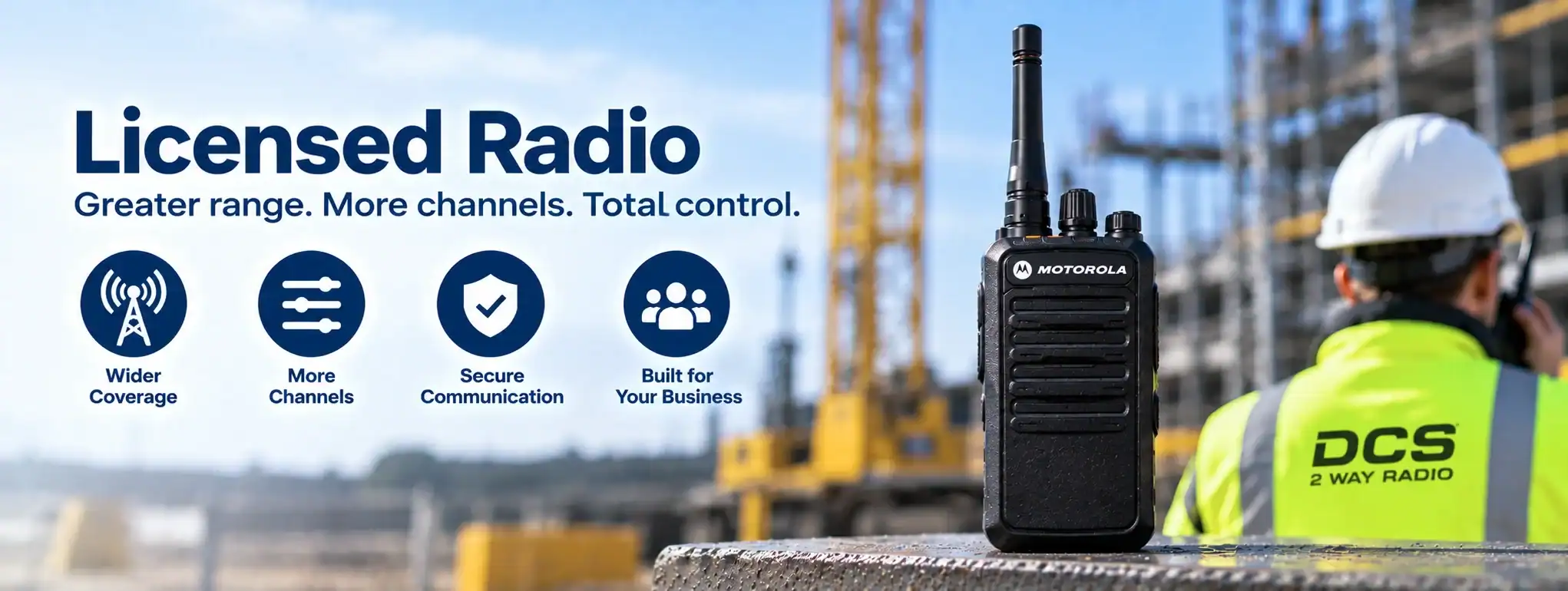
Licensed Radio
A Licensed Radio is a two-way radio that operates under a radio licence issued by the relevant communications regulator. In the UK, businesses and organisations can use licensed radio frequencies through the Business RadioBusiness Radio refers to professional two-way radio systems used by businesses and organisations for instant communication, often using licensed frequencies and equipment designed for commercial use. licensing framework administered by OfcomOfcom (Office of Communications) is the UK's communications regulator. For two-way radio users, Ofcom manages and regulates access to radio spectrum and the use of radio frequencies in the UK..
Licensed radio systems can provide greater control over frequencies, coverageRadio Coverage is the geographical area in which a two-way radio system can provide reliable communication. Coverage depends on the radios, antennas, frequency, terrain, buildings and system infrastructure. and system design than licence-free radioA Licence-Free Radio is a two-way radio that can be used without an individual radio licence when it complies with the applicable licence-exempt rules. In the UK, PMR446 is the main licence-free radio service. services such as PMR446.
They are commonly used by businesses and organisations that require reliable communication across larger sites, busy working environments or multiple locations.
What is a licensed radio?
A licensed radio systemA Radio System is a complete communication solution comprising two-way radios and, where required, equipment such as repeaters, antennas, base stations, mobile radios and network infrastructure. operates on frequencies that are subject to an appropriate radio licence.
The licence sets out the conditions under which the radio system can operate, which can include:
- Frequencies or frequencyAn antenna transmits and receives radio-frequency signals, allowing a two-way radio to communicate. Antenna type, frequency, height and location can all affect radio performance and coverage. bands
- Geographic area
- Transmitter powerAn antenna transmits and receives radio-frequency signals, allowing a two-way radio to communicate. Antenna type, frequency, height and location can all affect radio performance and coverage.
- Number or type of base stations
- Technical conditions
- Other operating restrictions
The exact conditions depend on the type of licence.
Licensed radio in the UK
In the UK, business and professional radio users can obtain licences through Ofcom.
The Business Radio licensing framework covers different types of professional radio use, allowing organisations to select a licence appropriate to their operational requirements.
The licence type and conditions should be checked before deploying a radio system.
Licensed radio vs licence-free radio
Licensed and licence-free radios operate under different regulatory arrangements.
Licensed radio:
- Operates under an appropriate radio licence
- Can provide greater control over frequencyFrequency is the number of cycles a radio wave completes each second, measured in Hertz. In two-way radio, frequency determines where a transmission operates within the radio spectrum. use
- Can support higher-power systems where permitted
- Can support repeaters and wider-area systems
- Can be designed for larger or more demanding operations
Licence-Free Radio:
- Does not require an individual frequency licence when used within the applicable conditions
- Typically uses PMR446
- Has strict technical limitations
- Uses shared frequencies
- Is generally intended for short-range communication
Licensed radio frequencies
A licensed radio system can use frequencies allocated for the particular service and licence.
The frequency used depends on factors such as:
- Location
- Required coverage
- Radio technology
- Existing spectrumSpectrum is the range of radio frequencies used for wireless communication. Two-way radios operate within specific parts of the radio spectrum, subject to frequency allocation and licensing requirements. use
- System design
- Licence conditions
Frequency planning can be important where reliable communication is required.
Licensed radio and dedicated frequencies
One advantage of a licensed radio system is the ability to obtain authorised use of suitable frequencies under the relevant licence conditions.
This can provide greater control than shared licence-free channels.
It does not necessarily mean that interferenceRadio interference occurs when unwanted radio-frequency signals or electrical noise disrupt two-way radio communications, causing distorted audio, broken transmissions, reduced coverage or loss of communication. is impossible, but it can provide a more controlled operating environment.
Licensed radio and coverage
Licensed radio systems can be designed to provide coverage over a defined operational area.
Coverage can be improved using appropriate infrastructureRadio infrastructure is the equipment and supporting systems behind a professional two-way radio network, including repeaters, antennas, base stations, network connections, power systems and dispatch equipment. such as:
- Higher-positioned antennas
- Base stations
- Repeaters
- Additional radio sites
- NetworkA Network is a connected system of radios, equipment and infrastructure that allows users to communicate across a defined area. Radio networks can range from simple radio-to-radio systems to large multi-site networks. connections
The appropriate solution depends on the environment and required coverage.
Licensed radio and repeaters
A RepeaterA Repeater receives a two-way radio transmission and retransmits it, usually from an elevated location, to extend the coverage and reliability of a radio communication system. can extend the effective coverage of a licensed radio system.
It receives a transmissionTransmission is the process of sending voice, data or signalling from a radio using a radio-frequency signal to another radio, repeater or communication system. from a radio and retransmits it from a suitable location.
Repeaters can be particularly useful for:
- Large sites
- Multi-building facilities
- Industrial sites
- Construction projects
- Rural areas
- Multi-floor buildingsAn antenna transmits and receives radio-frequency signals, allowing a two-way radio to communicate. Antenna type, frequency, height and location can all affect radio performance and coverage.
A properly designed repeater system can provide much greater coverage than direct radio-to-radio communication.
Licensed radio and radio infrastructure
A professional licensed radio system can include a combination of:
Handheld Radios → Repeater → AntennaAn antenna transmits and receives radio-frequency signals, allowing a two-way radio to communicate. Antenna type, frequency, height and location can all affect radio performance and coverage. System → Network → Control Room
The infrastructure can be designed around the organisation’s specific operational requirements.
Licensed radio and base stations
A Base StationA base station is a fixed two-way radio installed at a permanent location, allowing an operator to communicate with handheld or mobile radios across a site or operating area. provides a fixed radio communication point.
It can be installed in locations such as:
- Control rooms
- Security offices
- Reception areas
- Workshops
- Depots
- Operations centres
A base station can communicate with mobile and handheld radios within the system’s coverage area.
Licensed radio and mobile radios
Vehicle-mounted mobile radios can form part of a licensed radio system.
They can be installed in:
- Cars
- Vans
- Trucks
- Plant vehicles
- Utility vehicles
Mobile radios can provide reliable communication for drivers and mobile teams.
Licensed radio and handheld radios
Handheld radios provide portable communication for workers operating within the licensed system’s coverage area.
Depending on the radio, features can include:
- Group calling
- Individual calling
- Emergency functions
- GPS
- Bluetooth
- EncryptionEncryption protects two-way radio communications by converting voice or data into a secure form that can only be understood by authorised radios with the correct encryption capability and keys.
- ChannelA two-way radio channel is a programmed set of communication settings, typically including frequency and signalling, that allows compatible radios to communicate with one another. scanning
- Text messaging
The available features depend on the radio and system.
Licensed radio and DMR
DMR (Digital Mobile RadioA Mobile Radio is a two-way radio designed to be installed in a vehicle. It normally uses the vehicle's power supply and an external antenna to provide reliable communication while travelling or working in the field.) is a common technology used in professional licensed radio systems.
DMR can provide features such as:
- Digital voice
- Group calls
- Individual calls
- Two-slot TDMA
- Data services
- GPS
- Emergency signalling
- Encryption
The available functionality depends on the equipment and system configuration.
Licensed radio and analogue radio
Licensed radio systems can also use analogue technology.
Analogue radioAnalogue radio uses continuously varying radio signals to transmit voice communication. It remains widely used for reliable two-way communication across business, industry, events, security and other applications. remains suitable for applications where straightforward voice communication is the main requirement.
Digital radio can provide additional features and system-management capabilities where these are required.
Licensed radio and digital radio
Digital licensed radio converts voice into digital information before transmission.
This can allow additional communication and data functions to be incorporated into the radio system.
The benefits depend on the particular digital technology and system architecture.
Licensed radio and encryption
Compatible licensed digital radio systems can provide Encryption or other communication-security features.
Encryption can help protect radio communications from unauthorised listening.
The available security functions depend on the radio technology, equipment and system configuration.
Licensed radio and emergency functions
Professional licensed radios can support a range of emergency communication features.
Depending on the equipment, these may include:
- Emergency ButtonAn Emergency Button is a dedicated two-way radio control that allows users to quickly send an emergency alert to a dispatcher, control room or authorised radio users.
- Emergency AlarmAn Emergency Alarm allows a two-way radio user to quickly alert a dispatcher, control room or other authorised users that assistance may be required.
- Emergency CallAn Emergency Call is a priority two-way radio function that allows a user to quickly request assistance and, on supported systems, establish an urgent voice communication with a dispatcher or control room.
- Man-Down
- Lone WorkerA Lone Worker is someone who works without direct supervision or immediate assistance nearby. Compatible two-way radios can provide safety features such as timed check-ins, emergency alerts and GPS location.
Emergency functionality should be configured and tested as part of the complete communication system.
Licensed radio and GPS
Compatible licensed radios can include GPS functionality.
GPS information can be transmitted to compatible dispatch or management systems.
This can support:
- Worker location
- Fleet ManagementFleet Management is the process of managing a two-way radio fleet, including equipment, users, programming, maintenance, firmware, security and radio system configuration.
- Job TrackingJob Tracking is the process of monitoring the progress, status and, where supported, location of a job or field worker from assignment through to completion, often using GPS, radio and dispatch systems.
- Dispatch
- Operational coordination
GPS performance depends on the radio, environment and network connection.
Licensed radio and dispatch
A Dispatch system can provide centralised control of a professional radio network.
A dispatcher may be able to:
- Communicate with individual users
- Communicate with groups
- Monitor radio activity
- View GPS locations
- Manage incidents
- Coordinate field workers
The available functions depend on the dispatch platform.
Licensed radio and Cloud Dispatch
Modern licensed radio systems can be connected to Cloud DispatchCloud Dispatch is a cloud-based radio management and communication system that allows authorised dispatchers to communicate with, monitor and manage two-way radio users through an internet-connected platform. platforms.
This can allow authorised users to manage communications and operational information through a cloud-based system.
Depending on the platform, this may include:
- Radio communication
- GPS
- Messaging
- Job Tracking
- User management
- Incident ManagementIncident Management is the process of coordinating people, communications and resources during an incident. Two-way radios can provide rapid communication between teams, control rooms and responders.
Licensed radio and multi-site systems
A licensed radio system can be designed to cover multiple buildings or geographical locations.
Sites can be connected using suitable radio infrastructure and IP networks.
For example:
Site A → IP Network → Site B → IP Network → Site C
This can allow selected users or groups to communicate across multiple locations.
Licensed radio and IP Site Connect
IP Site ConnectIP Site Connect links compatible DMR radio sites using an IP network, allowing selected radio communications to be shared between separate buildings, facilities or geographical locations. can connect compatible radio sites using an IP network.
This can extend communication between geographically separated radio systems.
The performance of an IP-connected radio system depends on the quality and reliability of the underlying network.
Licensed radio and interoperability
Licensed radio systems can be designed to support InteroperabilityInteroperability is the ability of different communication systems, devices or organisations to work together and exchange information. In two-way radio, it can connect different radio networks, technologies or users through compatible systems or gateways. between different communication technologies where appropriate.
This can include connections between:
- Different radio networks
- DMR systems
- PoC platforms
- Dispatch systems
- Telephone systems
- Control-room applications
The required gateways and interfaces depend on the technologies being connected.
Licensed radio and hybrid communication
Hybrid CommunicationHybrid Communication combines two or more communication technologies, such as two-way radio, DMR, cellular, Wi-Fi or IP networks, allowing different systems or users to communicate through a common platform. can combine licensed radio with other communication technologies.
For example:
DMR Radio + Cellular + Wi-FiWi-Fi is a wireless networking technology that connects compatible devices to a local or wider network. In radio systems, it can support programming, updates, data services and IP-based communications. + Cloud Platform
This can provide users with different communication options while allowing the systems to work together where suitable integration is available.
Licensed radio and job tracking
Licensed radios with GPS and data capabilities can form part of a Job Tracking system.
For example:
Job Created → Worker Assigned → Radio Communication → GPS Location → Job Completed
This can help organisations coordinate mobile workers and monitor operational tasks.
Licensed radio and fleet management
Licensed radio systems can be integrated with Fleet Management applications.
This can allow organisations to coordinate vehicles, drivers and operational teams through a combination of radio communication and location information.
Licensed radio and incident management
Professional radio systems can support Incident Management by providing immediate communication during an incident.
A control room can communicate with individual workers or groups while coordinating the wider response.
Where appropriate, radio communications can also be recorded for later review.
Licensed radio and call recording
Call RecordingCall Recording is a two-way radio feature or system function that captures and stores radio communications for later playback, review, incident investigation or record keeping. can provide a record of radio communications.
This can be useful for organisations that need to review operational communications, investigate incidents or maintain records.
Recording arrangements depend on the radio and dispatch system.
Licensed radio and radio coverage surveys
A professional licensed radio system should normally be designed around the actual operating environment.
A Radio Coverage Survey can identify areas where communication may be weak or unavailable.
This can help determine whether additional infrastructure such as repeaters or remote antennas is required.
Licensed radio and dead spots
A Dead SpotA Dead Spot is an area where two-way radio communication is weak, unreliable or unavailable. Dead spots can be caused by buildings, terrain, distance, interference or inadequate radio coverage. is an area where reliable radio communication is unavailable.
Licensed systems provide more options for addressing coverage problems than licence-free systems.
Possible solutions can include:
- Repeater installation
- Antenna improvements
- Additional radio sites
- Distributed antenna systems
- Network-connected infrastructure
The appropriate solution depends on the cause of the coverage problem.
Licensed radio and interference
A licensed system can provide greater control over frequency use, but interference can still occur.
Potential sources include:
- Other radio systems
- Electrical equipment
- Industrial machinery
- Poor system design
- Radio-frequency propagation
- Faulty equipment
Frequency planning and professional system design can help minimise interference.
Licensed radio and power
Licensed radio systems can operate at power levels permitted by their particular licence and equipment.
Higher transmitter power can potentially improve coverage, but power alone does not guarantee reliable communication.
Antennas, terrain, buildings and system design can all have a major effect on coverage.
Licensed radio and antennas
Antennas are an important part of a professional radio system.
The appropriate antenna depends on:
- Frequency
- Location
- Required coverage
- Installation height
- Radio equipment
- System design
A correctly installed antenna can have a significant effect on system performance.
Licensed radio and IP networks
Network-connected licensed radio systems may rely on IP connectivity between:
- Radio sites
- Repeaters
- Dispatch systems
- Cloud platforms
- Control rooms
Network performance can therefore become an important part of the radio system.
Licensed radio and latency
Where communications pass through repeaters, IP networks or cloud systems, some LatencyLatency is the delay between a radio transmission being sent and the resulting voice or data being received. It can be introduced by digital processing, repeaters, IP networks, gateways and cloud systems. can be introduced.
A professionally designed system should provide communication performance appropriate to the operational requirements.
Licensed radio and licence conditions
A radio licence does not provide unlimited freedom to operate any equipment on any frequency.
Users must operate the system within the conditions of the relevant licence.
This can include restrictions relating to:
- Frequency
- Location
- Power
- Equipment
- Antenna arrangements
- Operating conditions
Licensed radio and regulatory compliance
Radio equipment must comply with the applicable UK regulatory requirements.
The equipment, frequency use and system configuration should all be appropriate for the licence and intended application.
Organisations should ensure that their radio system remains compliant throughout its operation.
Licensed radio and businesses
Licensed radio is commonly used by organisations where dependable communication is important.
Typical applications include:
- Construction
- Security
- Transport
- Manufacturing
- Utilities
- Facilities management
- Hospitality
- Events
- Warehousing
- Agriculture
The required system varies significantly between industries.
Licensed radio for construction
Construction sites can require reliable communication across large and complex areas.
A licensed radio system can provide:
- Site-wide communication
- Repeaters
- Group calling
- Emergency functions
- Rugged handheld radios
- Vehicle radios
- Control-room communication
Coverage should be assessed against the actual site.
Licensed radio for security
Security organisations can use licensed radios to coordinate:
- Security officers
- Supervisors
- Control rooms
- Mobile patrols
- Incident response teams
Dedicated communication groups and emergency functions can support larger security operations.
Licensed radio for transport
Transport organisations can use licensed radio systems to connect:
- Drivers
- Control rooms
- Depots
- Maintenance teams
- Supervisors
Vehicle-mounted radios can be particularly useful for mobile operations.
Licensed radio for manufacturing
Manufacturing sites can use professional licensed radios to connect production, maintenance, security and management teams.
Large industrial environments may benefit from repeaters and carefully planned coverage.
Licensed radio for utilities
Utility companies often operate over large geographical areas.
Licensed radio systems can provide communication between field workers, vehicles and control centres where suitable coverage and infrastructure are available.
Licensed radio for events
Large events can require reliable communication between multiple operational teams.
Licensed radio can provide separate communication groups for:
- Security
- Event management
- Production
- Technical teams
- Medical teams
- Transport
- Site operations
Temporary radio systems can be designed around the event’s specific requirements.
Licensed radio and radio hire
Licensed radio systems can be used for Radio HireRadio Hire is the temporary rental of two-way radios and related communication equipment for events, projects and operational requirements, providing professional communication without purchasing the equipment. where a temporary operation requires greater coverage or functionality than licence-free radios can provide.
For example, a large event or construction project may require:
Handheld Radios + Repeater + Base Station + Accessories
The licensing arrangements depend on the radio system and operating requirements.
Licensed radio vs mobile phones
Two-way radio provides immediate push-to-talk communication without requiring users to dial individual telephone numbers for every transmission.
Licensed radio can also provide group communication, allowing one user to speak to multiple members of a team simultaneously.
Mobile phones can provide wider geographical coverage where cellular service is available, while professional radio can provide a dedicated communication system designed around a specific operational environment.
The two technologies can also be used together.
Licensed radio vs licence-free radio
The choice depends on the communication requirements.
Licence-free radio can be suitable for simple, short-range communication.
Licensed radio is generally more appropriate where an organisation requires greater control, wider coverage, dedicated system design or advanced radio infrastructure.
Choosing a licensed radio system
When selecting a licensed radio system, consider:
- Required coverage area.
- Number of users.
- Indoor and outdoor environments.
- Analogue or digital operation.
- Required frequencies.
- Repeater requirements.
- Number of sites.
- Emergency functions.
- GPS requirements.
- Dispatch requirements.
- Encryption requirements.
- Accessories.
- Vehicle communication requirements.
- Future expansion.
- Licensing and regulatory requirements.
Licensed radio and DCS
DCS can provide professional licensed two-way radio systems for businesses and organisations that require reliable communication beyond the capabilities of typical licence-free radios.
Solutions can include handheld radios, mobile radios, repeaters, base stations, accessories and wider radio infrastructure.
The appropriate licensed radio system depends on the operating environment, required coverage, number of users and communication features required.