
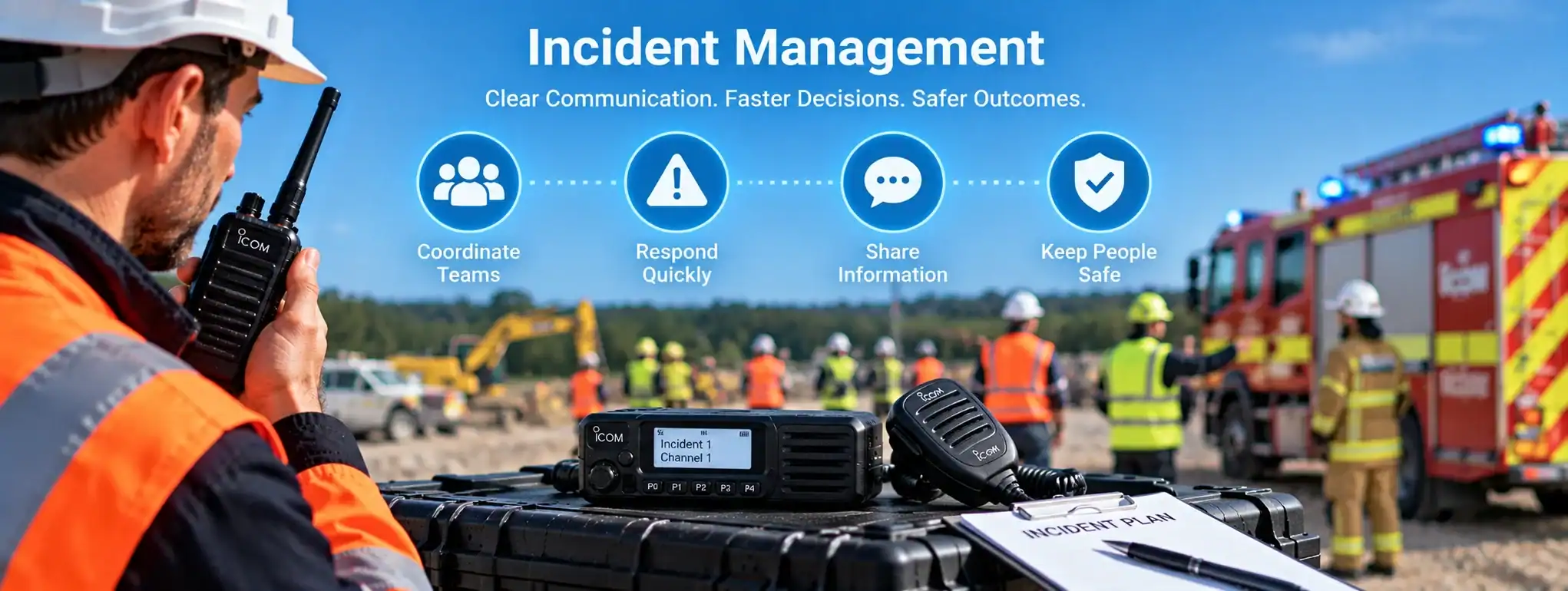
Incident Management
Incident Management is the process of identifying, responding to, managing and resolving incidents that could affect people, operations, property or business continuity.
In professional two-way radio systems, Incident Management refers to the organised use of communication and operational procedures to coordinate people and resources during an incident.
Radio communication can provide a fast and reliable way for teams to share information, issue instructions and coordinate their response.
What is an incident?
An incident is an event that requires a response or could disrupt normal operations.
Examples can include:
- Fire or smoke
- Medical emergencies
- Security incidents
- Equipment failure
- PowerAn antenna transmits and receives radio-frequency signals, allowing a two-way radio to communicate. Antenna type, frequency, height and location can all affect radio performance and coverage. loss
- Severe weather
- Traffic incidents
- Evacuation
- Missing persons
- Site emergencies
- Operational disruptions
The appropriate response depends on the nature and severity of the incident.
Incident Management and two-way radio
Two-way radios can form an important part of an Incident Management system.
During an incident, radio users can communicate quickly without relying on individual telephone calls or text messages.
A typical structure might include:
Incident → Radio user → Team → Control / Dispatch → Response
This allows information to be shared rapidly between people involved in managing the situation.
Incident Management and radio control
A central control point can coordinate communications during an incident.
This may be:
- A control room
- Security office
- Event control
- Site office
- Operations centre
- Mobile command vehicle
A dispatcher or control operator can communicate with different teams and coordinate the response.
Incident Management and Dispatch
Dispatch systems can provide a central point for managing radio communications.
Depending on the system, a dispatcher may be able to:
- Communicate with individual users
- Communicate with groups
- Prioritise communications
- Receive emergency alerts
- View GPS locations
- Record communications
- Coordinate resources
This can be particularly useful during larger or more complex incidents.
Incident Management and Cloud Dispatch
A Cloud DispatchCloud Dispatch is a cloud-based radio management and communication system that allows authorised dispatchers to communicate with, monitor and manage two-way radio users through an internet-connected platform. system can provide remote access to radio communications through a network-connected platform.
This can allow authorised operators to communicate with radio users across multiple locations.
Cloud-based systems can be particularly useful for organisations operating across geographically separated sites.
Incident Management and Emergency Calls
Professional digital radio systems can provide Emergency CallAn Emergency Call is a priority two-way radio function that allows a user to quickly request assistance and, on supported systems, establish an urgent voice communication with a dispatcher or control room. functionality where supported.
An emergency call can give an incident higher priority than routine communications.
The exact behaviour depends on the radio systemA Radio System is a complete communication solution comprising two-way radios and, where required, equipment such as repeaters, antennas, base stations, mobile radios and network infrastructure. and configuration.
Incident Management and Emergency Button
An Emergency ButtonAn Emergency Button is a dedicated two-way radio control that allows users to quickly send an emergency alert to a dispatcher, control room or authorised radio users. on a compatible radio can allow a user to raise an emergency alert quickly.
Depending on the system, activating the button may:
- Send an emergency signal
- Alert a control room
- Identify the radio
- Open a priority communication channelA two-way radio channel is a programmed set of communication settings, typically including frequency and signalling, that allows compatible radios to communicate with one another.
- Trigger other programmed actions
The precise functionality varies between radio systems.
Incident Management and Emergency Alarm
An Emergency AlarmAn Emergency Alarm allows a two-way radio user to quickly alert a dispatcher, control room or other authorised users that assistance may be required. can notify other authorised users or a control operator that a radio user requires assistance.
The alarm may be generated manually or automatically by certain radio safety features.
For example, a compatible radio may generate an alarm following a man-down or lone-worker event.
Incident Management and Lone Worker
Lone WorkerA Lone Worker is someone who works without direct supervision or immediate assistance nearby. Compatible two-way radios can provide safety features such as timed check-ins, emergency alerts and GPS location. functionality can support Incident Management where employees work without nearby colleagues.
A radio can be configured to monitor user activity and raise an alert if the expected interaction does not occur.
This can provide an additional method of identifying situations where a lone worker may require assistance.
Incident Management and Man-Down
Man-Down functionality can automatically generate an alert if a compatible radio detects that it has been placed in an unusual orientation or remains inactive for a configured period.
This can be particularly relevant in environments where workers may be exposed to physical hazards.
The system should be configured and tested according to the requirements of the organisation.
Incident Management and GPS
GPS can provide location information for compatible radios.
During an incident, knowing the approximate location of a radio user can help control personnel understand where assistance may be required.
For example:
Emergency alert → GPS location → Control room → Response
GPS accuracy and availability depend on the equipment, environment and system configuration.
Incident Management and Geo-Fencing
Geo-FencingGeo-Fencing uses GPS and a virtual geographical boundary to identify when a radio user or tracked device enters or leaves a defined area, triggering alerts or other actions where supported. can be used to define geographical areas within a communication or management system.
For example, an organisation may create a defined area around a construction site or event venue.
The system may then generate an alert when a compatible device enters or leaves the designated area, where this functionality is supported.
Incident Management and radio recording
Call RecordingCall Recording is a two-way radio feature or system function that captures and stores radio communications for later playback, review, incident investigation or record keeping. can provide a record of radio communications during an incident.
Recorded communications can potentially help organisations:
- Review what happened
- Establish a timeline
- Investigate incidents
- Review operational decisions
- Identify communication problems
- Support training
Recording requirements should take account of applicable legal and organisational requirements.
Incident Management and talkgroups
Talkgroups allow radio users to be organised into communication groups.
During an incident, different teams can communicate on separate talkgroups while a control operator coordinates the overall response.
For example:
- Security
- Operations
- Maintenance
- Medical
- Event control
The exact arrangement depends on the organisation.
Incident Management and Dynamic Group Calls
A Dynamic Group CallDynamic Group Call allows selected two-way radio users to be temporarily grouped together for a specific conversation, incident or task without permanently reprogramming their radios. can allow a communication group to be created or modified when required.
This can be useful during an incident when users from different teams need to communicate with one another temporarily.
The availability of dynamic group functionality depends on the radio system.
Incident Management and priority communications
During a serious incident, emergency or priority communications may need to take precedence over routine traffic.
Professional radio systems can provide priority mechanisms that help ensure important communications are noticed.
The precise implementation varies between analogue, digital and network-based systems.
Incident Management and Channel Scan
Channel ScanChannel Scan is a two-way radio feature that automatically monitors multiple programmed channels for activity, allowing users to hear communications without manually switching between channels. can allow users to monitor multiple radio channels.
This can be useful where an operator needs awareness of activity across several operational teams.
However, scanning multiple channels can also make it easier to miss parts of a conversation, so channel arrangements should be designed carefully.
Incident Management and encryption
EncryptionEncryption protects two-way radio communications by converting voice or data into a secure form that can only be understood by authorised radios with the correct encryption capability and keys. can protect radio communications from unauthorised interception where supported.
This can be particularly important when incident communications contain sensitive operational information.
Encryption should be considered as part of the wider security design rather than as a replacement for good communication procedures.
Incident Management and End-to-End Encryption
End-to-End EncryptionEnd-to-End Encryption protects radio communications between authorised endpoints, keeping voice or data encrypted through the network until it reaches the intended receiving device. can provide protection between the intended communication endpoints.
In systems involving multiple networks, gateways or dispatch platforms, the complete communication path should be assessed to understand where encryption is applied.
Incident Management and hybrid communication
Hybrid CommunicationHybrid Communication combines two or more communication technologies, such as two-way radio, DMR, cellular, Wi-Fi or IP networks, allowing different systems or users to communicate through a common platform. can combine different communication technologies during an incident.
For example:
Two-way radio + cellular + IP networkA Network is a connected system of radios, equipment and infrastructure that allows users to communicate across a defined area. Radio networks can range from simple radio-to-radio systems to large multi-site networks. + Cloud Dispatch
This can allow different types of users to participate in the same operational response where the systems support interoperabilityInteroperability is the ability of different communication systems, devices or organisations to work together and exchange information. In two-way radio, it can connect different radio networks, technologies or users through compatible systems or gateways..
Incident Management and interoperability
Interoperability allows different communication systems or organisations to work together.
This can be important during incidents involving multiple teams or organisations.
For example, a site operator may need to coordinate with contractors, emergency services or external response teams.
The ability to communicate across systems must be established in advance; it should not be assumed that unrelated radio systems will automatically interoperate.
Incident Management and failover
FailoverFailover allows a two-way radio system to switch to backup equipment, infrastructure or communication routes when the primary system fails, helping maintain communications. provides an alternative communication method when the primary system becomes unavailable.
A resilient Incident Management system may use more than one communication path.
For example:
Primary: Professional radio
Alternative: Cellular or IP-based Push-to-Talk
The backup method should be tested regularly.
Incident Management and coverage
Reliable communication depends on adequate CoverageRadio Coverage is the geographical area in which a two-way radio system can provide reliable communication. Coverage depends on the radios, antennas, frequency, terrain, buildings and system infrastructure..
Dead spots can create serious communication problems during an incident.
Organisations should therefore identify coverage limitations before an emergency occurs and consider solutions such as:
- Repeaters
- Additional radio sites
- External antennas
- Network-connected systems
- Alternative communication methods
Incident Management and repeaters
A RepeaterA Repeater receives a two-way radio transmission and retransmits it, usually from an elevated location, to extend the coverage and reliability of a radio communication system. can extend radio coverage across a site or wider geographical area.
For larger sites, a repeater can allow radio users who are outside direct radio range of one another to communicate.
Repeater coverage should be tested throughout the operational area rather than assumed from theoretical specifications.
Incident Management and dead spots
A Dead SpotA Dead Spot is an area where two-way radio communication is weak, unreliable or unavailable. Dead spots can be caused by buildings, terrain, distance, interference or inadequate radio coverage. is an area where radio communication is unreliable or unavailable.
Dead spots should be identified during system testing.
If a dead spot occurs in a critical area, organisations should consider whether additional infrastructureRadio infrastructure is the equipment and supporting systems behind a professional two-way radio network, including repeaters, antennas, base stations, network connections, power systems and dispatch equipment. or an alternative communication method is required.
Incident Management and radio control rooms
A control room can act as the central coordination point during an incident.
Control operators may:
- Monitor radio traffic
- Communicate with teams
- Receive emergency alerts
- Coordinate personnel
- Record communications
- Escalate incidents
- Track radio users where supported
A well-designed control room can provide a central overview of operational communications.
Incident Management and event radio
Large events often require structured Incident Management because multiple teams may need to respond quickly to changing situations.
Radio systems can be organised around operational groups such as:
- Security
- Stewards
- Medical
- Production
- Traffic
- Event control
A central control team can coordinate these groups.
Incident Management and radio hire
Temporary Radio HireRadio Hire is the temporary rental of two-way radios and related communication equipment for events, projects and operational requirements, providing professional communication without purchasing the equipment. systems can be used as part of Incident Management for events, construction projects and other short-term operations.
A hired radio system can be configured with appropriate channels, accessories and infrastructure before the operation begins.
For larger deployments, repeaters, control stations or specialist accessories may be required.
Incident Management in construction
Construction sites can experience incidents involving equipment, vehicles, workers, weather or site access.
Two-way radios can allow workers and supervisors to communicate rapidly during an incident.
Radio systems may also support emergency buttons, man-down, lone-worker and GPS functionality where required.
Incident Management in security
Security teams frequently rely on rapid communication when dealing with incidents.
A radio system can allow security personnel to communicate with control rooms and other members of the team.
Discrete earpieces, emergency buttons and location features can be used where appropriate.
Incident Management at events
Event control can use radio communications to coordinate responses to:
- Medical incidents
- Crowd problems
- Security issues
- Lost children
- Equipment failures
- Evacuations
- Traffic problems
Clear channel structures and agreed procedures are particularly important when large numbers of staff are involved.
Incident Management in transport
Transport organisations can use radio communication to coordinate incidents involving vehicles, passengers, infrastructure or traffic.
Drivers can communicate with control centres while operational teams coordinate the response.
Network-connected radio systems can also allow communication across larger geographical areas.
Incident Management in manufacturing
Manufacturing environments may require rapid communication when machinery, safety or production problems occur.
Radio communication can allow operators, maintenance teams and supervisors to coordinate the response.
Incident Management and business continuity
Incident Management is closely connected with Business Continuity.
A communication system should continue to provide an effective method of coordinating people when normal operations are disrupted.
This means considering:
- Backup communications
- Power resilience
- Network availability
- Radio coverage
- Spare equipment
- Battery capacity
- Alternative communication methods
- Emergency procedures
Incident Management and power failure
A power failure can affect radio infrastructure, network equipment and control rooms.
Where communication is operationally critical, organisations should consider backup power for relevant infrastructure.
Handheld radios can continue operating from their batteries, but repeaters, chargers and network equipment may require separate power arrangements.
Incident Management and battery management
Radio batteries should be adequately charged before an operation begins.
For extended incidents, organisations should consider:
- Spare batteries
- Additional chargers
- Multi-unit charging
- Vehicle charging
- Battery rotation
A radio system is only as effective as its available equipment and power.
Incident Management procedures
Technology is only one part of Incident Management.
Organisations should establish clear procedures covering:
- How incidents are reported
- Who takes control
- Which radio channel should be used
- How emergency calls are raised
- How information is escalated
- Who communicates with external organisations
- How incidents are recorded
- How the system is returned to normal operation
Users should be trained in these procedures before an incident occurs.
Incident Management training
Radio users should understand how to:
- Operate their radio
- Use the PTT
- Select the correct channel
- Raise an emergency alert
- Use their assigned accessories
- Communicate clearly
- Follow radio discipline
- Report an incident
- Follow escalation procedures
Regular training and exercises can help identify weaknesses before a real incident occurs.
Incident Management limitations
A radio system does not replace an organisation’s formal emergency or Incident Management procedures.
Radio communication provides a method of coordinating people, but the organisation must determine:
- What constitutes an incident
- Who is responsible
- What action should be taken
- How the incident should be escalated
- Which external services should be contacted
The radio system should support these procedures.
Incident Management and DCS
DCS can provide professional two-way radio systems designed to support operational communication and Incident Management.
Depending on the application, a system can incorporate features such as emergency alerts, GPS, dispatch, recording, repeaters and appropriate radio accessories.
For larger or more complex operations, DCS can help design the radio infrastructure and communication procedures around the organisation’s operational requirements.
From events and festivals to construction and security, hire two way radios to give your team reliable communication when it matters.