
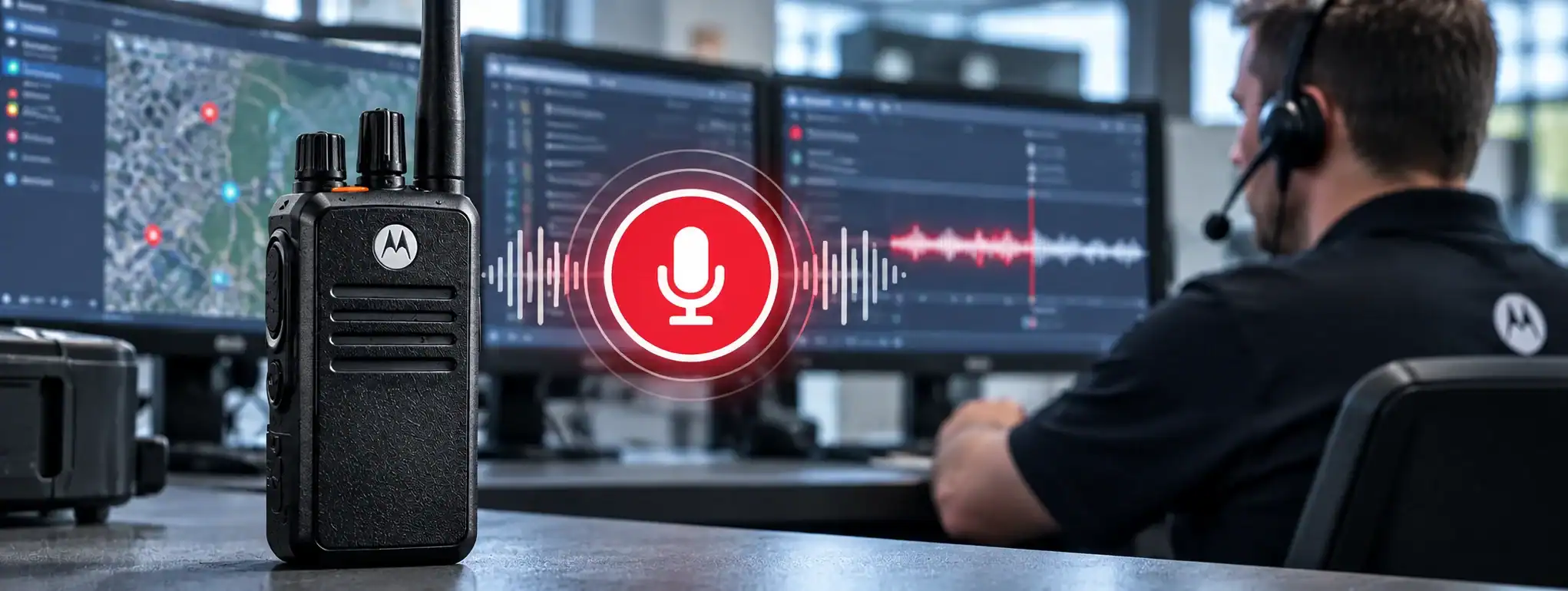
Call Recording
Call Recording is a feature that allows two-way radio communications to be recorded and stored for later playback or review.
Call recording can be used to create an audio record of radio conversations, providing organisations with a way to review communications after an incident, investigate events, support operational procedures or maintain a record of important transmissions.
Call recording is most commonly associated with professional radio systems that use a control room, dispatch console, repeaterA Repeater receives a two-way radio transmission and retransmits it, usually from an elevated location, to extend the coverage and reliability of a radio communication system. infrastructureRadio infrastructure is the equipment and supporting systems behind a professional two-way radio network, including repeaters, antennas, base stations, network connections, power systems and dispatch equipment. or digital radio networkA Network is a connected system of radios, equipment and infrastructure that allows users to communicate across a defined area. Radio networks can range from simple radio-to-radio systems to large multi-site networks.. The exact recording capabilities depend on the radio systemA Radio System is a complete communication solution comprising two-way radios and, where required, equipment such as repeaters, antennas, base stations, mobile radios and network infrastructure., equipment and software being used.
How does radio call recording work?
A call recording system captures audio transmitted over a radio communication system and stores the recording for later retrieval.
The recording equipment may be connected to a radio, repeater, base stationA base station is a fixed two-way radio installed at a permanent location, allowing an operator to communicate with handheld or mobile radios across a site or operating area., dispatch system or communications platform.
A simplified arrangement is:
Radio user → radio network → recording system → stored audio
Depending on the system, recordings may include transmissions from individual users, group conversations, dispatcher communications or other radio traffic.
What can be recorded?
The type of communication that can be recorded depends on the radio system and recording equipment.
A professional system may be able to record:
- Individual radio calls
- Group calls
- Dispatcher communications
- Control-room conversations
- Repeater traffic
- Emergency transmissions
- Selected radio channels or talkgroups
- Multiple channels simultaneously
Some systems can also record information associated with the communication, such as the radio ID, talkgroup, channelA two-way radio channel is a programmed set of communication settings, typically including frequency and signalling, that allows compatible radios to communicate with one another., date and time.
Call Recording and digital radio
Call recording is particularly useful with digital two-way radio systems because digital radio networks can provide additional information alongside the voice communication.
On systems such as DMR, a recording solution may be able to associate a transmissionTransmission is the process of sending voice, data or signalling from a radio using a radio-frequency signal to another radio, repeater or communication system. with the individual radio or talkgroup that made the call.
This can make it easier to identify who transmitted a particular message and when the communication took place.
The available information depends on the radio system, recording software and configuration.
Call Recording and analogue radio
Call recording is not limited to digital radio.
Analogue two-way radio communications can also be recorded using suitable equipment.
The recording system captures the audio received from the radio system and stores it for later playback.
However, analogue systems generally provide less accompanying digital information than a modern digital radio system, so identifying individual users may require additional system configuration or records.
Call Recording and control rooms
Call recording is particularly valuable in environments where radio communications are managed through a control room or dispatch operation.
A recording system can provide a historical record of communications between field users and the control room.
For example, a security control room could record radio traffic between security officers, supervisors and the control room. If an incident occurs, authorised personnel can subsequently review the relevant communications.
Call Recording for incident investigation
Recorded radio communications can provide useful information when investigating an incident.
A recording can help establish:
- What was communicated
- When a message was transmitted
- Which users were involved
- What instructions were given
- How an incident developed
- Whether an emergency message was received
- What actions were communicated
This can be particularly valuable where events happen quickly and staff may not remember the precise wording or sequence of radio transmissions afterwards.
Call Recording and emergency communications
Some professional radio recording systems can capture emergency transmissions alongside normal radio traffic.
An emergency callAn Emergency Call is a priority two-way radio function that allows a user to quickly request assistance and, on supported systems, establish an urgent voice communication with a dispatcher or control room. or alert may be given priority within the radio system, while the associated audio can be recorded for later review.
This can provide an important record of communications during an emergency or major incident.
The exact recording behaviour depends on the radio infrastructure and system configuration.
Call Recording and time stamps
Professional recording systems can associate recordings with the date and time of the communication.
Time stamps make it easier to search for a particular transmission and establish the sequence of communications during an incident.
More advanced systems can combine the recording with other information, such as radio identification, talkgroup or channel information.
Call Recording and radio identification
On supported digital radio systems, recordings can potentially be associated with the identity of the radio making the transmission.
For example, a recording system may display information such as:
Radio ID → User → Talkgroup → Date/time → Recorded audio
This can make searching and reviewing communications considerably easier than listening through an unidentified recording of an entire radio channel.
Call Recording and storage
Recorded radio communications need to be stored securely.
Depending on the system, recordings may be stored on a local computer, dedicated recording server, network storage or a secure cloud-based platform.
Storage requirements depend on factors including:
- Number of channels
- Number of users
- Amount of radio traffic
- Recording quality
- Retention period
- Number of simultaneous recordings
Organisations should consider how recordings will be protected against unauthorised access, accidental deletion or equipment failure.
Call Recording and data protection
Radio recordings may contain personal information, confidential business information or other sensitive communications.
Organisations using call recording should therefore consider applicable data-protection and privacy requirements.
Appropriate policies should cover matters such as:
- Why communications are being recorded
- Who is permitted to access recordings
- How recordings are secured
- How long recordings are retained
- When recordings should be deleted
- How recordings may be disclosed or used
The specific legal requirements depend on how the system is used and the organisation operating it.
Call Recording and evidence
Where recorded communications may be required as evidence, the recording system should be designed and managed appropriately.
Access controls, audit trails, secure storage and appropriate retention procedures can help maintain the integrity and reliability of recorded communications.
For particularly sensitive applications, organisations may require a recording platform specifically designed for evidential or regulated environments.
Call Recording and radio hire
Call recording can be useful for temporary radio operations where communications need to be reviewed after an event or operational period.
For example, a large event may use a radio system with several communication groups. Recording the relevant channels can provide an operational record that can be reviewed after the event.
Not every radio hireRadio Hire is the temporary rental of two-way radios and related communication equipment for events, projects and operational requirements, providing professional communication without purchasing the equipment. system includes call recording, so this requirement should be specified when arranging the radio system.
Call Recording and radio repeaters
A recording system can sometimes be connected to a repeater or associated radio infrastructure.
This allows communications passing through the relevant radio system to be captured and recorded.
The exact connection method depends on the repeater, radio technology and recording equipment.
On larger systems, recording can be integrated into the central radio network rather than connecting a separate recorder to every individual handheld radio.
Call Recording and dispatch systems
Professional dispatch systems can combine radio control and recording functions.
A dispatcher may be able to communicate with multiple radio groups while the system records the associated communications.
This can provide a centralised record of radio activity and make it easier for authorised staff to locate and review specific transmissions.
Continuous vs selective Call Recording
A radio system may be configured to record communications continuously or only record selected channels, groups or types of calls.
Continuous recording provides a complete history of the selected radio traffic but requires greater storage capacity.
Selective recording can reduce storage requirements and focus recording on communications that are considered operationally important.
The appropriate approach depends on the organisation’s requirements and applicable privacy policies.
Call Recording and radio system design
Call recording should be considered when designing the overall radio communication system rather than added as an afterthought.
The system designer may need to consider:
- Which channels should be recorded
- Which talkgroups should be recorded
- Number of simultaneous calls
- Required storage capacity
- Recording retention
- User identification
- Date and time information
- Security and access controls
- Backup requirements
- Integration with dispatch systems
This ensures that the recording system captures the communications that are actually required.
Call Recording and DCS
DCS can advise on professional two-way radio systems where recording of radio communications is required.
Call recording can be incorporated into suitable radio, repeater, dispatch and control-room solutions, depending on the equipment and operational requirements.
For organisations that need a record of communications for security, incident managementIncident Management is the process of coordinating people, communications and resources during an incident. Two-way radios can provide rapid communication between teams, control rooms and responders. or operational review, call recording can form an important part of the overall radio system.