
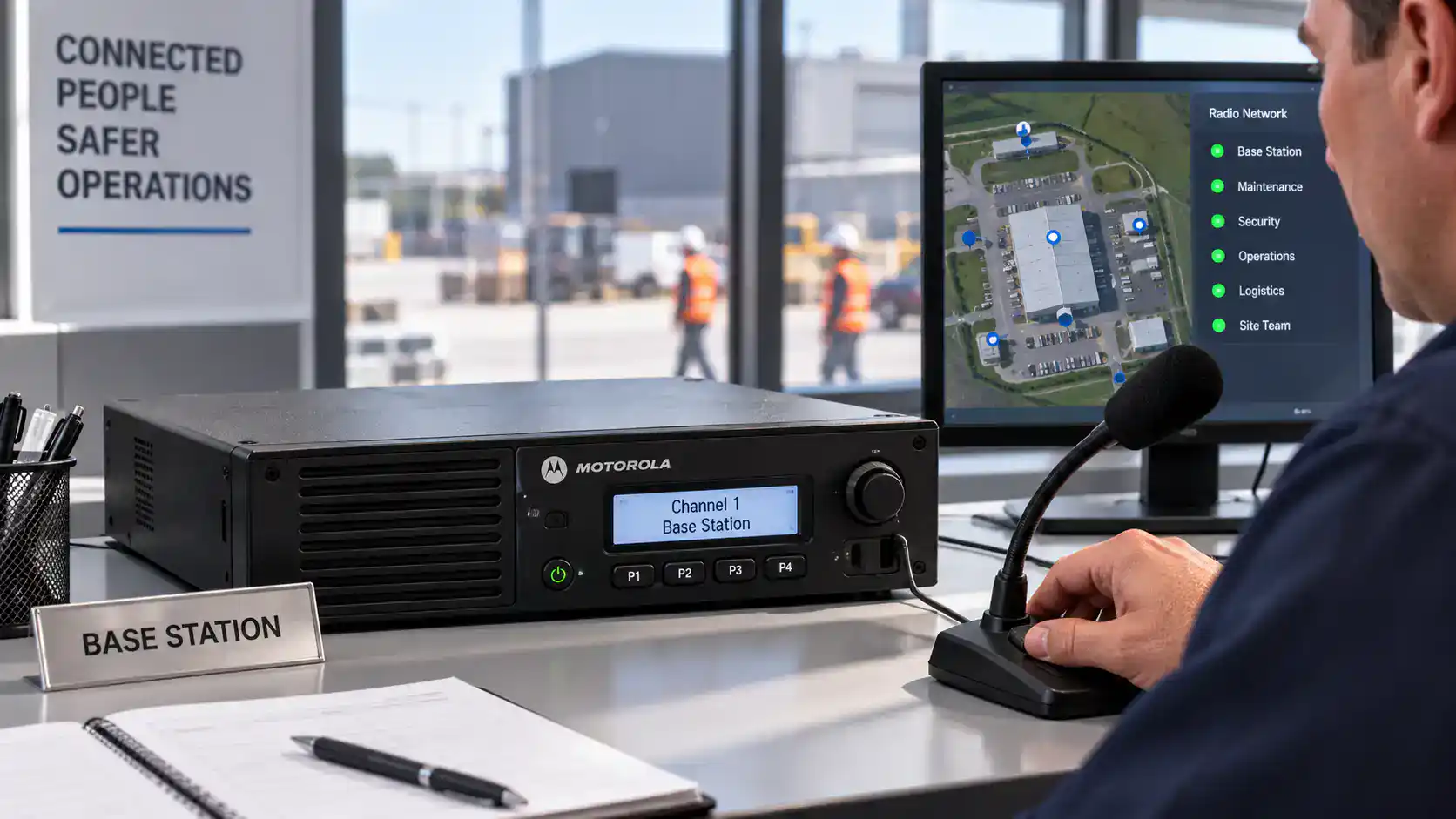
Base Station
A base station is a fixed two-way radio unit installed at a permanent location and used to communicate with mobile or portable radios. Unlike a handheld or vehicle-mounted radio, a base station remains in a fixed position and is normally connected to a suitable powerAn antenna transmits and receives radio-frequency signals, allowing a two-way radio to communicate. Antenna type, frequency, height and location can all affect radio performance and coverage. supply and antennaAn antenna transmits and receives radio-frequency signals, allowing a two-way radio to communicate. Antenna type, frequency, height and location can all affect radio performance and coverage. system.
Base stations are commonly used in control rooms, offices, reception areas, security offices, warehouses, factories, transport operations and other locations where someone needs to communicate with radio users in the field.
A base station can operate as part of a conventional radio systemA Radio System is a complete communication solution comprising two-way radios and, where required, equipment such as repeaters, antennas, base stations, mobile radios and network infrastructure. or, depending on the equipment and system design, can form part of a larger communications networkA Network is a connected system of radios, equipment and infrastructure that allows users to communicate across a defined area. Radio networks can range from simple radio-to-radio systems to large multi-site networks..
How does a base station work?
A base station performs the same fundamental transmit and receive functions as other two-way radios.
An operator can use the base station to transmit to other radios by pressing the push-to-talk button. Incoming transmissions from other users are received by the base station and played through its speaker.
A typical arrangement might be:
Base station → antenna → radio users
and:
Radio users → antenna → base station
Because the base station is fixed and can use a suitable external antenna, it can be positioned and installed to provide reliable communications with users across the required operating area.
Base station vs handheld radio
The main difference between a base station and a handheld radio is how the equipment is installed and used.
A handheld radio is designed to be carried by an individual and normally has an integral battery and antenna.
A base station is installed at a fixed location and is normally powered from mains electricity or another permanent power source. It may also use an external antenna mounted in a suitable position.
A base station can therefore provide a convenient communications point for staff who remain in one location while other radio users move around a site.
Base station vs mobile radio
A mobile radioA Mobile Radio is a two-way radio designed to be installed in a vehicle. It normally uses the vehicle's power supply and an external antenna to provide reliable communication while travelling or working in the field. is generally designed to be installed in a vehicle, while a base station is designed for fixed-location use.
Both can provide higher-performance communications than a simple handheld radio in certain applications, but their installation and operating environments are different.
A vehicle-mounted mobile radio normally uses the vehicle’s electrical system and an externally mounted vehicle antenna. A base station normally uses a fixed power supply and an antenna installed at the building, mast or other suitable location.
Some radio equipment can be configured or installed for either mobile or fixed operation, depending on the manufacturer’s specifications and the installation requirements.
Base station antenna
The antenna is an important part of a fixed base station installation.
A base station may use an external antenna mounted on a building, mast or other suitable structure. Raising the antenna can sometimes improve coverageRadio Coverage is the geographical area in which a two-way radio system can provide reliable communication. Coverage depends on the radios, antennas, frequency, terrain, buildings and system infrastructure. by providing a clearer path between the base station and mobile or portable radios.
The antenna type, frequencyAn antenna transmits and receives radio-frequency signals, allowing a two-way radio to communicate. Antenna type, frequency, height and location can all affect radio performance and coverage., height, location and surrounding environment all affect radio performance.
For this reason, a base station should be considered as part of a complete radio installation rather than simply as a standalone radio unit.
Base stations and radio coverage
A base station does not automatically provide unlimited radio range.
Coverage depends on factors such as:
- Antenna height and position
- Operating frequencyFrequency is the number of cycles a radio wave completes each second, measured in Hertz. In two-way radio, frequency determines where a transmission operates within the radio spectrum.
- Transmitter power
- Antenna type and efficiency
- Terrain
- BuildingsAn antenna transmits and receives radio-frequency signals, allowing a two-way radio to communicate. Antenna type, frequency, height and location can all affect radio performance and coverage. and other obstructions
- Radio receiverA Receiver is the part of a two-way radio that detects and processes incoming radio signals, converting them into audible voice or usable data for the user. sensitivity
- InterferenceRadio interference occurs when unwanted radio-frequency signals or electrical noise disrupt two-way radio communications, causing distorted audio, broken transmissions, reduced coverage or loss of communication.
- The location of the portable or mobile radios
For larger areas, a base station may be used alongside a repeaterA Repeater receives a two-way radio transmission and retransmits it, usually from an elevated location, to extend the coverage and reliability of a radio communication system. or other radio infrastructureRadio infrastructure is the equipment and supporting systems behind a professional two-way radio network, including repeaters, antennas, base stations, network connections, power systems and dispatch equipment. to provide wider or more consistent coverage.
Base station and repeaters
A base station and a repeater perform different functions, although they may form part of the same radio system.
A base station is primarily an end-user radio installed at a fixed location. A repeater is radio infrastructure designed to receive transmissions and retransmit them, extending or improving coverage.
For example, a security control room might have a base station that communicates with handheld radios around a site, while a repeater positioned elsewhere provides the coverage required for the entire property.
The base station may therefore be one of several components in a larger radio communications system.
Base stations in control rooms
Base stations are particularly useful in control-room environments.
A fixed radio can provide the operator with a permanent communications point from which they can coordinate mobile staff, security personnel, engineers, event teams or other field users.
Depending on the radio system, the operator may be able to communicate with individuals or groups of users.
A suitable base station installation can also provide easier access to the radio than a handheld unit, particularly where an operator spends most of their working time at a desk or control position.
Base stations and dispatch
A base station can form part of a dispatch or control system, allowing an operator to manage radio communications with users in the field.
The exact capabilities depend on the radio equipment and system architecture. More advanced systems may provide dedicated dispatch consoles or computer-based control systems rather than relying solely on a conventional radio.
For smaller operations, however, a fixed base radio may provide a straightforward and effective way for a control-room or office-based operator to communicate with mobile teams.
Base station power supply
Because a base station remains at a fixed location, it will normally use a permanent power source rather than relying entirely on a rechargeable battery.
Some installations may incorporate a backup battery or other standby power arrangement so that radio communications can continue during a mains power failure.
The need for backup power depends on how critical the radio system is and the operating requirements of the organisation.
Base station radio hire
Base stations can also be used as part of temporary two-way radio hireRadio Hire is the temporary rental of two-way radios and related communication equipment for events, projects and operational requirements, providing professional communication without purchasing the equipment. systems.
For example, an event may have a fixed control point where an organiser or operations team needs to communicate with radio users around the venue.
A base station can provide a convenient central communications point while handheld radios are distributed to staff working throughout the site.
Where greater coverage is required, the base station can be combined with other radio infrastructure such as repeaters and suitable external antennas.
Choosing a base station
When selecting a base station, important considerations include:
- The radio system and frequency
- Required coverage
- Number of users
- Antenna location
- Available power supply
- Indoor or outdoor installation
- Required accessories
- Whether a repeater is required
- Whether backup power is needed
- Whether individual, group or dispatch communications are required
The correct equipment should be selected according to the complete communication requirement rather than simply the radio’s transmitter power.
Base station vs repeater
The terms base station and repeater are sometimes used interchangeably, but they describe different functions.
A base station is a fixed radio used by an operator at a particular location.
A repeater is infrastructure that receives and retransmits radio signals to extend or improve the coverage of a radio system.
A radio installation can contain both. For example, a control room may use a base station while a remotely positioned repeater provides coverage across a large site.
Base stations and two-way radio systems
A base station provides a practical fixed communications point within a two-way radio system.
For smaller operations, it may be all that is required for communication between a central office and a group of portable radios. For larger operations, it can form part of a more sophisticated system incorporating repeaters, external antennas, dispatch facilities and multiple radio sites.
DCS can advise on base stations and complete two-way radio systems based on the required coverage, environment and method of operation.