
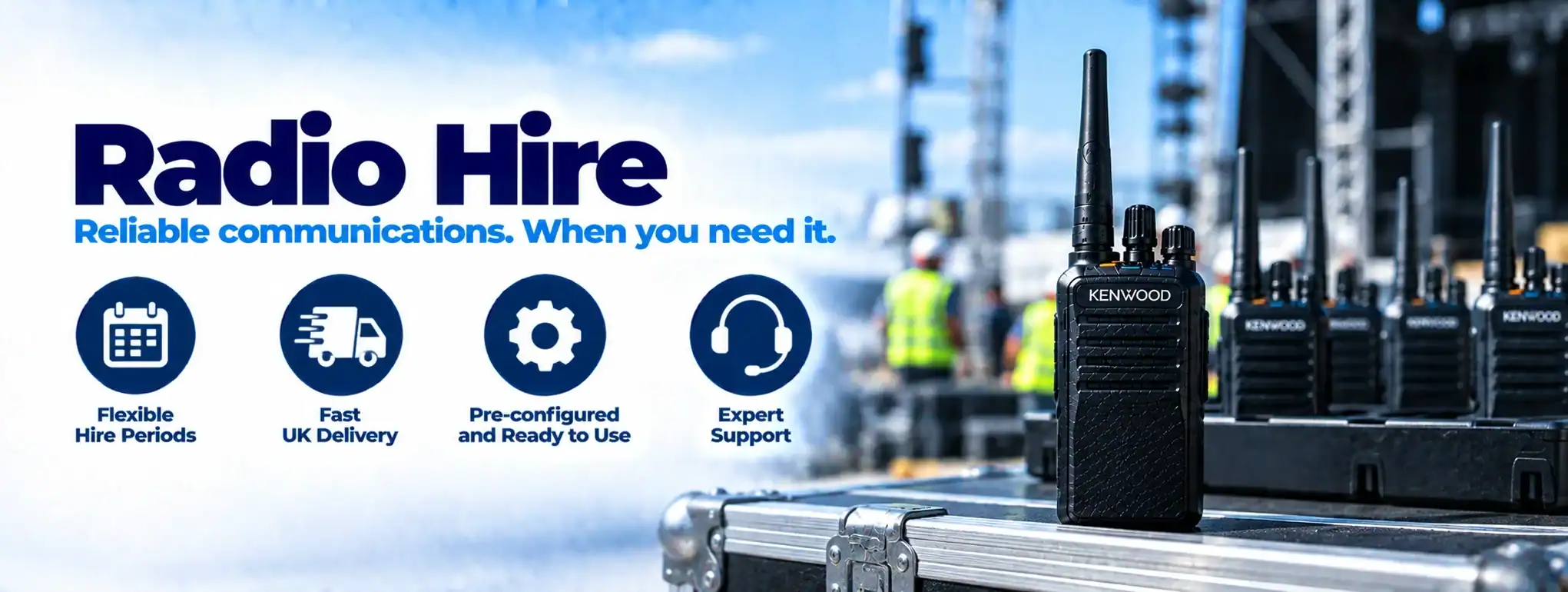
Radio Hire
Radio Hire is the temporary rental of two-way radios and associated communication equipment for a defined period. It provides organisations with access to professional radio communication without requiring them to purchase, own and maintain the equipment themselves.
Radio hire can be used for anything from a single-day event to a longer-term project or ongoing operational requirement. Depending on the application, a hire package can include handheld radios, mobile radios, repeaters, base stations, batteries, chargers, headsets, earpieces and other accessories.
What is radio hire?
Radio hire provides a ready-to-use communication system for temporary or changing requirements.
A typical hire system might include:
- Two-way radios
- Batteries
- Chargers
- Radio antennas
- Earpieces or headsets
- Carrying accessories
- Repeaters where additional coverageRadio Coverage is the geographical area in which a two-way radio system can provide reliable communication. Coverage depends on the radios, antennas, frequency, terrain, buildings and system infrastructure. is required
- Base or control stations where required
The equipment is normally programmed and prepared for the customer’s particular requirements before being supplied.
How does radio hire work?
The basic process is:
Requirement → System design → Radio programming → Equipment preparation → Delivery → Use → Return
For more complex requirements, the system may also include a site surveyA Site Survey is an assessment of a location to determine whether a two-way radio system will provide the required coverage, reliability and performance., repeaterA Repeater receives a two-way radio transmission and retransmits it, usually from an elevated location, to extend the coverage and reliability of a radio communication system. installation, control-room equipment or additional technical support.
Why hire two-way radios?
Cheap radio hire can be useful when an organisation needs reliable communication for a temporary period but does not want to purchase a complete radio systemA Radio System is a complete communication solution comprising two-way radios and, where required, equipment such as repeaters, antennas, base stations, mobile radios and network infrastructure..
Common reasons for hiring include:
- Temporary events
- Construction projects
- Security operations
- Festivals
- Film and television production
- Hospitality
- Transport operations
- Emergency or contingency communications
- Short-term projects
- Seasonal operations
Radio hire vs buying radios
Buying radios can make sense when communication equipment is required continuously over a long period.
Hiring can be more appropriate when the requirement is:
- Temporary
- Seasonal
- Project-based
- Event-specific
- Uncertain
- Subject to changing user numbers
Hiring can also allow an organisation to use equipment suited to a particular operation without making a long-term capital purchase.
Short-term radio hire
Short-term hire can cover periods ranging from a single day to several weeks.
This is particularly common for:
- Events
- Conferences
- Exhibitions
- Concerts
- Sporting events
- Security operations
- Temporary construction work
The exact minimum hire period depends on the supplier and equipment required.
Long-term radio hire
Radio equipment can also be hired for longer periods.
Longer-term hire can be suitable where an organisation requires professional communication but prefers not to purchase and maintain the equipment itself.
For example, a company may hire radios for the duration of a construction project.
Event radio hire
Events are one of the most common applications for radio hire.
Different teams can be provided with dedicated communication groups, such as:
Security → Security Group
Production → Production Group
Event Management → Management Group
Stewards → Stewarding Group
This allows teams to communicate without everyone necessarily sharing the same channelA two-way radio channel is a programmed set of communication settings, typically including frequency and signalling, that allows compatible radios to communicate with one another..
Festival radio hire
Large festivals can cover substantial areas and involve hundreds or thousands of staff, contractors and volunteers.
A professional radio system can provide communication between:
- Security
- Production
- Site management
- Medical teams
- Catering
- Transport
- Contractors
Depending on the site, a repeater may be required to provide suitable coverage.
Construction radio hire
Construction projects often need communication between workers operating across a large site.
Radio hire can provide communication between:
- Site managers
- Supervisors
- Ground workers
- Plant operators
- Security
- Contractors
Temporary repeater systems can be installed where the site size or terrain makes direct radio-to-radio communication insufficient.
Security radio hire
Security teams require rapid communication between officers and supervisors.
Hired radios can be configured with separate groups for:
- Security officers
- Supervisors
- Control rooms
- Management
Features such as emergency buttons, lone-worker functions and GPS may be available on compatible equipment.
Film and television radio hire
Production environments require coordination between multiple departments.
Radio hire can provide communication for:
- Production
- Location management
- Security
- Transport
- Camera teams
- Sound
- Lighting
- Stage management
Headsets and earpieces can be particularly useful where discreet or hands-free communication is required.
Hospitality radio hire
Hotels, venues and hospitality operations can use hired radios for temporary or seasonal requirements.
Typical users include:
- Security
- Maintenance
- Housekeeping
- Operations
- Event teams
- Management
Transport radio hire
Transport operations can use radio hire to connect drivers, supervisors and control teams.
Applications can include:
- Shuttle services
- Temporary transport operations
- Event transport
- Logistics
- Car parks
- Depots
Sporting event radio hire
Sporting events often require communication between teams operating in different areas.
Radio users may include:
- Event management
- Security
- Stewards
- Medical teams
- Transport
- Ground staff
- Production
Emergency and contingency radio hire
Radio hire can provide temporary communications during planned or unexpected situations.
For example, organisations may require additional radios during:
- Major incidents
- InfrastructureRadio infrastructure is the equipment and supporting systems behind a professional two-way radio network, including repeaters, antennas, base stations, network connections, power systems and dispatch equipment. work
- Severe weather
- Emergency exercises
- Business continuity situations
- Temporary loss of normal communications
Radio hire and coverage
The required radio coverage should be assessed before selecting equipment.
Coverage depends on factors such as:
- Site size
- BuildingsAn antenna transmits and receives radio-frequency signals, allowing a two-way radio to communicate. Antenna type, frequency, height and location can all affect radio performance and coverage.
- Terrain
- Radio frequencyAn antenna transmits and receives radio-frequency signals, allowing a two-way radio to communicate. Antenna type, frequency, height and location can all affect radio performance and coverage.
- AntennaAn antenna transmits and receives radio-frequency signals, allowing a two-way radio to communicate. Antenna type, frequency, height and location can all affect radio performance and coverage. position
- Transmitter powerAn antenna transmits and receives radio-frequency signals, allowing a two-way radio to communicate. Antenna type, frequency, height and location can all affect radio performance and coverage.
- Radio model
- Repeater availability
A higher-powered radio does not automatically guarantee reliable coverage.
Radio hire and repeaters
A Repeater can extend the usable coverage of a radio system.
A typical arrangement is:
Handheld Radio → Repeater → Handheld Radio
The repeater receives a transmissionTransmission is the process of sending voice, data or signalling from a radio using a radio-frequency signal to another radio, repeater or communication system. and retransmits it, allowing radios to communicate over greater distances.
Repeaters are particularly useful for:
- Large events
- Construction sites
- Multi-building facilities
- Large estates
- Rural sites
- Complex terrain
Radio hire and site surveys
A Site Survey can be carried out where radio coverage needs to be confirmed before an event or project.
A survey can identify:
- Coverage areas
- Dead spots
- Suitable repeater locations
- Building-related signal problems
- Potential interferenceRadio interference occurs when unwanted radio-frequency signals or electrical noise disrupt two-way radio communications, causing distorted audio, broken transmissions, reduced coverage or loss of communication.
This can help determine the equipment and infrastructure required.
Radio hire and DMR
Digital Mobile Radio (DMR)Digital Mobile Radio (DMR) is an ETSI digital radio standard for professional two-way communications, supporting voice, group calling, data and other features on compatible radio systems. is commonly used for professional communication systems.
DMR hire systems can provide features such as:
- Digital voice
- Group calls
- Private calls
- Emergency functions
- EncryptionEncryption protects two-way radio communications by converting voice or data into a secure form that can only be understood by authorised radios with the correct encryption capability and keys.
- GPS
- Repeater operation
The available features depend on the equipment supplied.
Radio hire and analogue radios
Analogue two-way radios remain suitable for some straightforward applications.
They can provide simple push-to-talk communication without some of the additional functionality available on digital systems.
The appropriate technology depends on the application and required features.
Radio hire and PMR446
PMR446 is a licence-free radioA Licence-Free Radio is a two-way radio that can be used without an individual radio licence when it complies with the applicable licence-exempt rules. In the UK, PMR446 is the main licence-free radio service. service operating under specific technical conditions.
PMR446 equipment can be useful for relatively simple, short-range communication requirements.
However, professional licensed radioA Licensed Radio is a two-way radio operated under an appropriate radio licence. Licensed systems can provide greater control over frequencies, coverage and infrastructure than licence-free radio services such as PMR446. systems can provide additional coverage, capacity and functionality where required.
Radio hire and licensed radio
Professional radio hire systems may operate under an appropriate Ofcom Business Radio LicenceAn Ofcom Business Radio Licence authorises businesses and organisations in the UK to use specified radio frequencies for professional two-way radio communication, subject to the licence conditions..
Licensed radio can provide access to suitable frequencies for professional communication applications.
The licensing arrangements depend on the equipment, frequencyFrequency is the number of cycles a radio wave completes each second, measured in Hertz. In two-way radio, frequency determines where a transmission operates within the radio spectrum. and system being used.
Radio hire and Ofcom
OfcomOfcom (Office of Communications) is the UK's communications regulator. For two-way radio users, Ofcom manages and regulates access to radio spectrum and the use of radio frequencies in the UK. regulates the use of radio spectrumSpectrum is the range of radio frequencies used for wireless communication. Two-way radios operate within specific parts of the radio spectrum, subject to frequency allocation and licensing requirements. in the UK.
A professional radio-hire provider should ensure that the radio system operates within the relevant regulatory and licensing requirements.
Customers should not assume that any radio can legally be used on any frequency.
Radio hire and channels
Hired radios are normally programmed before delivery.
The supplier can configure channels according to the operational requirements.
For example:
Channel 1 → Operations
Channel 2 → Security
Channel 3 → Management
The number and configuration of channels depend on the equipment and system.
Radio hire and talkgroups
Digital radios can use Talkgroups to separate communications between teams.
This allows several departments to operate on the same overall radio system while maintaining separate conversations.
For example:
Security Talkgroup
Production Talkgroup
Operations Talkgroup
Radio hire and Push-to-Talk
The primary control on most two-way radios is the Push-to-Talk (PTT)Push-to-Talk (PTT) is the button or control used to activate a two-way radio's transmitter. Press it to speak and release it to listen. button.
Pressing PTT activates transmission.
Releasing it returns the radio to receive mode.
This provides rapid communication without requiring users to dial telephone numbers.
Radio hire and emergency buttons
Professional radios may include a dedicated Emergency ButtonAn Emergency Button is a dedicated two-way radio control that allows users to quickly send an emergency alert to a dispatcher, control room or authorised radio users..
Pressing the button can initiate an emergency procedure depending on the radio and system.
Possible functions include:
- Emergency alert
- Priority transmission
- Notification to other users
- Control-room alert
The precise behaviour depends on the radio system.
Radio hire and lone workers
Radios with Lone WorkerA Lone Worker is someone who works without direct supervision or immediate assistance nearby. Compatible two-way radios can provide safety features such as timed check-ins, emergency alerts and GPS location. functionality can provide additional protection for people working alone.
A compatible radio may require the user to confirm their status periodically.
If the user fails to respond, the system can generate an alert according to its configuration.
Radio hire and Man Down
Some professional radios support Man DownMan Down is a safety feature on some professional two-way radios that can detect a possible fall or unusual radio position and automatically raise an alert if the user does not respond. functionality.
The radio can detect conditions such as a prolonged tilt or possible fall and trigger an alert.
This can be particularly useful for security personnel, lone workers and people working in potentially hazardous environments.
Radio hire and GPS
Compatible radios can provide GPS (Global Positioning System)GPS is a satellite-based positioning system that allows compatible two-way radios to determine their location. GPS data can support tracking, dispatch, fleet management and Geo-Fencing. location information.
This can allow authorised personnel to see the approximate location of radios or users where the system supports location tracking.
GPS functionality can be particularly useful for:
- Security
- Transport
- Mobile workers
- Large events
- Fleet operations
Radio hire and dispatch
A Dispatch or control-room system can provide central management of radio communications.
A dispatcher may be able to:
- Communicate with individuals
- Call groups
- Monitor radio activity
- Coordinate incidents
- View GPS locations
- Manage communication channels
Radio hire and encryption
Digital radio systems can provide Encryption to protect communications.
Encryption prevents unauthorised users from readily understanding protected radio traffic.
The type and level of encryption available depend on the equipment and system.
Radio hire and accessories
A radio-hire package can include a range of accessories.
Common accessories include:
- Spare batteries
- Multi-way chargers
- Earpieces
- Headsets
- Remote speaker microphones
- Carrying cases
- Vehicle chargers
- Covert accessories
- Remote PTT controls
The appropriate accessories depend on how the radios will be used.
Radio hire and earpieces
An EarpieceAn earpiece is a two-way radio audio accessory that lets users hear radio communications discreetly, often with a microphone and Push-to-Talk button for transmitting. allows users to hear radio communication discreetly.
This can be useful for:
- Security
- Hospitality
- Event staff
- Front-of-house teams
- Production crews
Radio hire and headsets
A HeadsetA radio headset combines a microphone and speaker or earpiece, allowing two-way radio users to communicate conveniently while keeping the radio away from their face or using hands-free operation. can combine a microphone and speaker for more controlled communication.
Headsets can be useful in noisy environments or where users need to keep their hands free.
Radio hire and hands-free operation
Compatible equipment can support Hands-Free OperationHands-Free Operation allows two-way radio users to communicate without holding the radio or continuously pressing its PTT button, using features such as VOX, headsets or remote PTT controls..
This can be particularly useful for users who need to operate equipment or vehicles while communicating.
Radio hire and batteries
Radio hire suppliers normally provide the required batteries and chargers.
For long operating periods, additional batteries can be supplied so that users can continue working while depleted batteries are being charged.
Radio hire and charging
Large radio deployments may require multi-unit charging systems.
A charging plan should consider:
- Number of radios
- Number of spare batteries
- Working hours
- Shift patterns
- Charging time
- Availability of mains power
Radio hire and waterproof radios
Where radios will be used outdoors or in wet environments, suitable protection should be selected.
The Ingress Protection (IP) RatingAn Ingress Protection (IP) Rating indicates how well electrical equipment, including two-way radios, is protected against dust, solid objects and water. Higher ratings provide greater protection. indicates the level of protection provided against solids and water under defined test conditions.
The required IP rating depends on the working environment.
Radio hire and intrinsically safe radios
Where radios are required in potentially explosive atmospheres, specially approved Intrinsically Safe Radios may be required.
Standard commercial radios should not be used in hazardous environments unless they are specifically suitable and approved for that application.
Radio hire and vehicle radios
Some applications require communication from vehicles.
A Mobile RadioA Mobile Radio is a two-way radio designed to be installed in a vehicle. It normally uses the vehicle's power supply and an external antenna to provide reliable communication while travelling or working in the field. can provide greater flexibility than a handheld radio in certain vehicle-based applications.
Vehicle-mounted systems can use an external antenna and vehicle power supply.
Radio hire and base stations
A Base StationA base station is a fixed two-way radio installed at a permanent location, allowing an operator to communicate with handheld or mobile radios across a site or operating area. can provide a fixed communication point at an office, control room or site compound.
It can be useful where a supervisor or dispatcher needs a permanent radio position.
Radio hire and temporary systems
One advantage of radio hire is that the system can be configured specifically for the duration of the project.
For example:
Day 1 → Equipment delivered
Project period → Radios in operation
Final day → Equipment collected
This can avoid the need to permanently install infrastructure for a temporary requirement.
Radio hire and system programming
Before delivery, radios can be programmed according to the agreed system design.
Programming may include:
- Channel configuration
- Talkgroups
- Radio IDs
- Emergency functions
- Scan lists
- Encryption settings
- Repeater parameters
Radio hire and testing
Professional radio-hire equipment should be checked and tested before being supplied.
Testing can include:
- Radio operation
- Batteries
- Chargers
- Audio
- PTT controls
- Channel programming
- Accessories
- Repeater operation where applicable
Radio hire and support
More complex hire systems may require technical support during deployment.
Support can include:
- Equipment setup
- Repeater installation
- On-site engineering
- System testing
- User assistance
- Fault replacement
The level of support depends on the hire requirement.
Radio hire and delivery
Equipment can be prepared and delivered before the start of the operational period.
For large deployments, delivery and setup should be planned so that the communication system is operational before users require it.
Radio hire and collection
At the end of the hire period, the equipment can be collected or returned according to the supplier’s arrangements.
The radios can then be checked, serviced and prepared for future use.
Radio hire and radio programming
Programming is particularly important when multiple groups need to communicate separately.
A properly configured system can make the radios easier for users to operate because channels and functions can be preconfigured.
Radio hire and interoperability
Where radios from different manufacturers or systems need to communicate, InteroperabilityInteroperability is the ability of different communication systems, devices or organisations to work together and exchange information. In two-way radio, it can connect different radio networks, technologies or users through compatible systems or gateways. should be confirmed before the hire.
Not all radio equipment can communicate simply because it operates within the same frequency band.
Radio hire and interference
Radio systems can be affected by Interference from other transmitters or electrical equipment.
Professional frequency planning and system configuration can help minimise interference.
Radio hire and frequency
The Radio Frequency (RF)Radio Frequency (RF) refers to electromagnetic waves used to transmit voice and data wirelessly. Two-way radios use RF signals to communicate between radios, repeaters and other system infrastructure. used by a hire system must be appropriate for the equipment, location and licensing requirements.
Frequency planning can be particularly important at large events where many radio systems may operate in the same area.
Radio hire and capacity
The number of radios required is not the only factor when planning a hire system.
The system should also consider:
- Number of communication groups
- Simultaneous conversations
- Repeater capacity
- Coverage
- Peak usage
- Emergency communications
Radio hire and large deployments
Large deployments may require a combination of:
- Handheld radios
- Repeaters
- Base stations
- Mobile radios
- Dispatch systems
- Headsets
- Spare batteries
- Charging equipment
A complete communication system should be designed around the operational requirement rather than simply the number of radios.
Radio hire and radio check
Users should carry out a radio check before beginning operations.
A basic check can confirm:
- Radio powers on
- Correct channel is selected
- Audio is working
- PTT operates correctly
- Other users can be heard
- Required coverage is available
Radio hire limitations
Radio hire is not automatically suitable for every application.
The system may be affected by:
- Poor coverage
- Buildings
- Terrain
- Interference
- Insufficient capacity
- Incorrect equipment selection
- Battery limitations
A site assessment can help identify these issues before deployment.
Choosing a radio-hire system
When selecting a radio-hire system, consider:
- Number of users.
- Duration of hire.
- Site size.
- Indoor and outdoor coverage.
- Number of communication groups.
- Required accessories.
- Whether a repeater is required.
- Emergency requirements.
- Licensing.
- Technical support.
- Battery requirements.
- Whether GPS or other digital features are required.
Radio hire and DCS
DCS provides professional two-way radio hire for events, construction, security, transport, hospitality and other temporary communication requirements.
Systems can be configured around the specific application, from straightforward handheld-radio hire through to larger deployments incorporating repeaters, base stations, accessories and wider communication infrastructure.
The aim is to provide a complete, ready-to-use communication system rather than simply supplying a box of radios.