
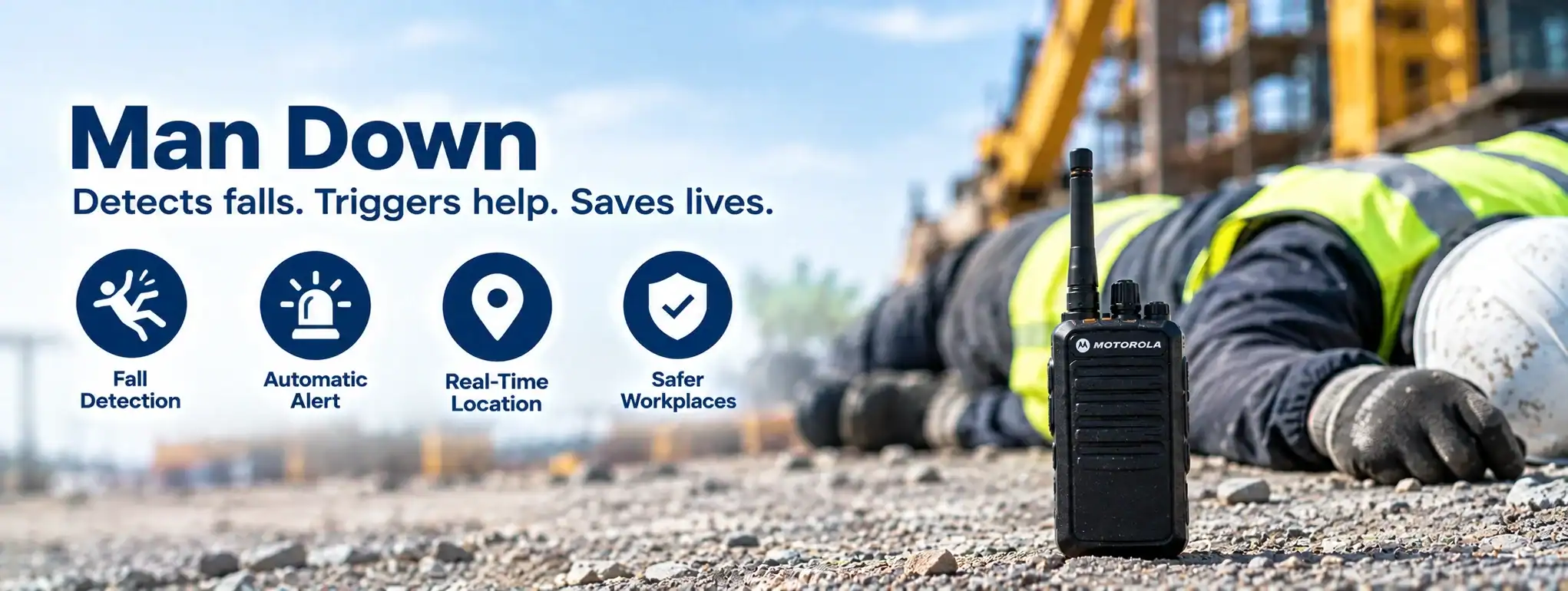
Man Down
Man Down is a safety feature available on some professional two-way radios that can automatically raise an alert if the radio detects that its user may have fallen, become incapacitated or remained in an unusual position for a defined period.
It is commonly used as part of Lone WorkerA Lone Worker is someone who works without direct supervision or immediate assistance nearby. Compatible two-way radios can provide safety features such as timed check-ins, emergency alerts and GPS location. and emergency communication systems, particularly where employees may work alone or in environments where a fall or injury could leave them unable to manually operate their radio.
What is Man Down?
A Man Down function uses sensors within the radio to monitor the radio’s orientation and, on some models, movement.
If the radio detects a condition associated with a possible fall or incapacitation, it can issue a warning to the user.
If the user does not respond or restore the radio to its normal position, the radio can automatically initiate an emergency alert.
A typical sequence is:
Abnormal position detected → Warning → No response → Emergency alert
The exact operation varies between radio manufacturers and models.
How does Man Down work?
Man Down functionality can use sensors such as an accelerometer to detect changes in the radio’s orientation or movement.
For example, if a radio is suddenly tilted and remains in that position, the system may interpret this as a possible fall.
The radio can then provide a warning tone or other indication.
If the user is unable to respond, the system may automatically trigger an emergency transmissionTransmission is the process of sending voice, data or signalling from a radio using a radio-frequency signal to another radio, repeater or communication system..
Man Down warning
Before raising an emergency alert, many Man Down systems provide a warning period.
This gives the user an opportunity to cancel the alert if the radio has detected a normal activity as a possible emergency.
For example:
Radio tilted → Warning tone → User returns radio to normal → Alert cancelled
This helps reduce false alarms.
Man Down emergency alert
If the warning is not cancelled, the radio can initiate an emergency condition.
Depending on the system, the alert may be sent to:
- Other radios
- A supervisor
- A control room
- A dispatcher
- A dispatch or monitoring platform
The available options depend on the radio and communication system.
Man Down and Lone Worker
Man Down is commonly used alongside Lone Worker functionality.
The two features provide different forms of protection.
Lone Worker can monitor whether a worker responds to scheduled prompts.
Man Down can detect certain physical conditions that may indicate a fall or incapacitation.
Using both can provide complementary safety functions.
Man Down and the Emergency Button
The Emergency ButtonAn Emergency Button is a dedicated two-way radio control that allows users to quickly send an emergency alert to a dispatcher, control room or authorised radio users. provides a manual way for the user to raise an alert.
Man Down is different because it can potentially raise an alert automatically.
For example:
Manual emergency:
Worker presses Emergency Button → Alert transmitted
Automatic emergency:
Man Down condition detected → Warning → No response → Alert transmitted
Man Down and Emergency Alarm
A Man Down event can trigger an Emergency AlarmAn Emergency Alarm allows a two-way radio user to quickly alert a dispatcher, control room or other authorised users that assistance may be required. on compatible radio systems.
The alarm can notify designated users that the radio has detected a possible emergency.
The exact notification method depends on the radio and system configuration.
Man Down and Emergency Call
Some professional radio systems can initiate an Emergency CallAn Emergency Call is a priority two-way radio function that allows a user to quickly request assistance and, on supported systems, establish an urgent voice communication with a dispatcher or control room. when a Man Down condition is detected.
This can provide a voice communication path between the affected radio and a designated person or group.
Where the worker is unable to speak, the emergency alert itself can still provide an indication that assistance may be required.
Man Down and GPS
A compatible radio with GPS (Global Positioning System)GPS is a satellite-based positioning system that allows compatible two-way radios to determine their location. GPS data can support tracking, dispatch, fleet management and Geo-Fencing. can potentially transmit its location when a Man Down alert is generated.
This can help a dispatcher identify where the affected radio is located.
A typical system may provide:
Man Down → Emergency Alert → GPS Location → Dispatcher
GPS accuracy can vary, particularly inside buildingsAn antenna transmits and receives radio-frequency signals, allowing a two-way radio to communicate. Antenna type, frequency, height and location can all affect radio performance and coverage. or areas where satellite signals are obstructed.
Man Down and Dispatch
A Dispatch system can receive and manage Man Down alerts.
Depending on the system, the dispatcher may be able to:
- Identify the radio
- Receive the emergency alert
- View the radio’s location
- Contact the worker
- Notify other personnel
- Record the incident
Man Down and Cloud Dispatch
Modern radio systems can connect Man Down alerts to Cloud DispatchCloud Dispatch is a cloud-based radio management and communication system that allows authorised dispatchers to communicate with, monitor and manage two-way radio users through an internet-connected platform. platforms.
This can allow alerts to be displayed remotely and managed alongside other operational communications.
The system may combine:
- Emergency alerts
- GPS
- Voice communication
- User information
- Incident records
The exact functionality depends on the platform.
Man Down and Incident Management
A Man Down alert can form part of an Incident ManagementIncident Management is the process of coordinating people, communications and resources during an incident. Two-way radios can provide rapid communication between teams, control rooms and responders. process.
For example:
Man Down alert → Incident created → Worker contacted → Assistance dispatched → Incident closed
This can provide a structured response to a potential emergency.
Man Down and radio coverage
Man Down functionality depends on the radio being able to communicate with the wider radio systemA Radio System is a complete communication solution comprising two-way radios and, where required, equipment such as repeaters, antennas, base stations, mobile radios and network infrastructure..
If the radio is in a Dead SpotA Dead Spot is an area where two-way radio communication is weak, unreliable or unavailable. Dead spots can be caused by buildings, terrain, distance, interference or inadequate radio coverage., an emergency alert may not reach the intended recipient.
For safety-critical applications, radio coverageRadio Coverage is the geographical area in which a two-way radio system can provide reliable communication. Coverage depends on the radios, antennas, frequency, terrain, buildings and system infrastructure. should therefore be tested in the areas where lone workers operate.
Man Down and repeaters
A RepeaterA Repeater receives a two-way radio transmission and retransmits it, usually from an elevated location, to extend the coverage and reliability of a radio communication system. can extend radio coverage across larger or more difficult environments.
This can help provide communication for Man Down alerts across:
- Large buildings
- Industrial sites
- Construction sites
- Rural areas
- Multi-building facilities
The repeater itself does not detect the fall; the detection occurs within the compatible radio.
Man Down and licensed radio
Man Down is most commonly associated with professional Licensed RadioA Licensed Radio is a two-way radio operated under an appropriate radio licence. Licensed systems can provide greater control over frequencies, coverage and infrastructure than licence-free radio services such as PMR446. systems.
Licensed radio systems can provide the infrastructureRadio infrastructure is the equipment and supporting systems behind a professional two-way radio network, including repeaters, antennas, base stations, network connections, power systems and dispatch equipment. needed to support emergency alerts, repeaters, GPS and dispatch functions.
The availability of Man Down depends on the particular radio model and system.
Man Down and licence-free radio
Basic licence-free radios such as PMR446 generally provide much simpler functionality.
Man Down is more commonly found on professional radios designed for business and safety-critical applications.
Organisations should check the exact capabilities of the equipment rather than assuming that a radio has automatic Man Down protection.
Man Down and DMR
DMR (Digital Mobile RadioA Mobile Radio is a two-way radio designed to be installed in a vehicle. It normally uses the vehicle's power supply and an external antenna to provide reliable communication while travelling or working in the field.) equipment can support Man Down functionality on compatible professional radios.
The radio can use its internal sensors to detect certain orientation or movement conditions and transmit an emergency signal through the DMR system.
The exact implementation varies between manufacturers.
Man Down and digital radio
Digital radio systems can provide additional signalling capabilities that support emergency functions.
A Man Down event can be transmitted as a digital status or emergency signal, allowing compatible infrastructure or dispatch software to identify the type of alert.
Man Down and analogue radio
Some analogue professional radios may also provide Man Down functionality.
However, the available emergency signalling and integration capabilities depend on the radio model and system.
Man Down sensitivity
Man Down systems can often be configured to suit the working environment.
Settings may control factors such as:
- Detection angle
- Detection time
- Warning duration
- Sensitivity
- Alert behaviour
The appropriate settings depend on the type of work being performed.
Man Down false alarms
False alarms can occur if the radio is placed in an unusual position without the user being in danger.
For example, a worker may deliberately place the radio on the floor or lean it against equipment.
A warning period allows the user to cancel the alert where supported.
Correct configuration and user training can help reduce unnecessary alarms.
Man Down and worker movement
Some Man Down implementations can take movement into account.
A radio that remains stationary or in an unusual position for a configured period may trigger a warning.
However, the exact detection method varies between manufacturers.
Man Down should therefore not be assumed to detect every possible fall or incident.
Man Down limitations
Man Down is an additional safety feature rather than a guarantee that an emergency will be detected.
Limitations can include:
- False alarms
- Missed incidents
- Poor radio coverage
- Low battery
- GPS limitations
- Sensor limitations
- Incorrect configuration
- User positioning
- NetworkA Network is a connected system of radios, equipment and infrastructure that allows users to communicate across a defined area. Radio networks can range from simple radio-to-radio systems to large multi-site networks. failure
It should form part of a wider lone-worker and emergency-response procedure.
Man Down and battery life
Man Down functionality requires the radio to remain powered.
If the battery is depleted, the radio cannot detect or transmit a Man Down alert.
Battery condition should therefore be considered when radios are used for lone-worker applications.
Man Down and Lithium-Ion batteries
Professional handheld radios commonly use Lithium-Ion Batteries.
Where Man Down is being used for long shifts, the battery should have sufficient capacity to support the expected operating period.
Spare batteries and suitable charging arrangements may be required for extended operations.
Man Down and intrinsically safe radios
Workers in hazardous environments may require an Intrinsically Safe RadioAn Intrinsically Safe Radio is a two-way radio designed and certified for use in specified hazardous areas where flammable gases, vapours or combustible dust could create a risk of explosion. with appropriate certification.
If Man Down is required in such an environment, the radio must specifically support the function while maintaining the required certification.
Standard accessories or batteries must not be substituted where they would affect the equipment’s certification.
Man Down and hands-free operation
Hands-Free OperationHands-Free Operation allows two-way radio users to communicate without holding the radio or continuously pressing its PTT button, using features such as VOX, headsets or remote PTT controls. can allow a worker to communicate without physically handling the radio.
This can be useful where the worker’s hands are occupied.
Man Down provides a separate automatic alerting function and can complement hands-free communication.
Man Down and Bluetooth
Some professional radios support Bluetooth®Bluetooth® is a short-range wireless technology used with compatible two-way radios to connect accessories such as headsets, earpieces and microphones without a physical cable. accessories.
Wireless accessories can allow users to communicate without removing the radio from its normal position.
The Man Down function remains dependent on the radio’s own sensors and configuration.
Man Down and job tracking
Where radio systems include Job TrackingJob Tracking is the process of monitoring the progress, status and, where supported, location of a job or field worker from assignment through to completion, often using GPS, radio and dispatch systems., a Man Down alert can potentially be associated with the worker’s current job.
For example:
Job assigned → Worker dispatched → Man Down alert → Location identified
This can provide useful information to a dispatcher responding to an incident.
Man Down and Call Recording
If Call RecordingCall Recording is a two-way radio feature or system function that captures and stores radio communications for later playback, review, incident investigation or record keeping. is enabled, communications associated with a Man Down incident may be recorded.
This can provide a record of communications during the response.
Recording functionality depends on the radio and dispatch system.
Man Down and radio hire
Man Down capable radios can be provided as part of Radio HireRadio Hire is the temporary rental of two-way radios and related communication equipment for events, projects and operational requirements, providing professional communication without purchasing the equipment. arrangements where additional worker-safety functionality is required.
Potential applications include:
- Security
- Construction
- Facilities management
- Utilities
- Industrial sites
- Events
- Remote maintenance
The hire provider should confirm that the equipment, coverage and emergency functions are appropriate for the intended application.
Man Down for security
Security personnel may work alone while patrolling buildings, car parks or remote areas.
Man Down can provide an additional alerting mechanism if a security officer falls or becomes incapacitated.
It should be used alongside established security and emergency procedures.
Man Down for construction
Construction environments can involve uneven surfaces, heights, machinery and partially completed buildings.
Man Down capable radios can provide an additional safety function for workers operating in these environments.
Radio coverage should be checked throughout the site.
Man Down for facilities management
Facilities and maintenance personnel may work alone in plant rooms, service areas or remote parts of a building.
Man Down can provide additional protection where a worker may be unable to manually operate the radio following an incident.
Man Down for utilities
Utility workers can operate alone across large geographical areas.
A professional radio system combining Man Down, emergency alerts and GPS can provide additional information to a control centre where suitable coverage is available.
Man Down for agriculture
Agricultural workers can operate alone across large farms and rural areas.
Terrain and distance can make radio coverage challenging.
Where Man Down is required, the radio system should be designed and tested to provide suitable coverage across the areas where workers operate.
Man Down risk assessment
Man Down should be selected as part of a wider Lone Worker Risk Assessment.
The assessment should consider:
- The nature of the work
- Potential hazards
- Working environment
- Radio coverage
- Expected response time
- Emergency procedures
- User training
- Equipment limitations
The radio should support the overall safety strategy rather than being relied upon as the sole protective measure.
Man Down testing
Man Down functionality should be tested regularly.
Testing can confirm that:
- The radio detects the configured condition
- The warning operates correctly
- The alert is transmitted
- The control room receives the alert
- GPS information is available where required
- Users know how to cancel false alarms
- Batteries remain suitable
Testing should be performed in the environments where the radios are actually used.
Man Down training
Users should understand how the Man Down feature works.
Training should explain:
- What triggers the warning
- How long the warning lasts
- How to cancel a false alarm
- What happens when an alert is triggered
- How to use the Emergency Button
- What to do if radio coverage is lost
Clear training can help reduce false alarms and improve response to genuine incidents.
Man Down and DCS
DCS can provide professional two-way radio systems with Man Down and other lone-worker safety functions where supported by the chosen radio equipment.
Systems can be designed around the required coverage, number of users, emergency procedures and operational environment.
Man Down should be considered as one part of a complete lone-worker communication and safety solution.