
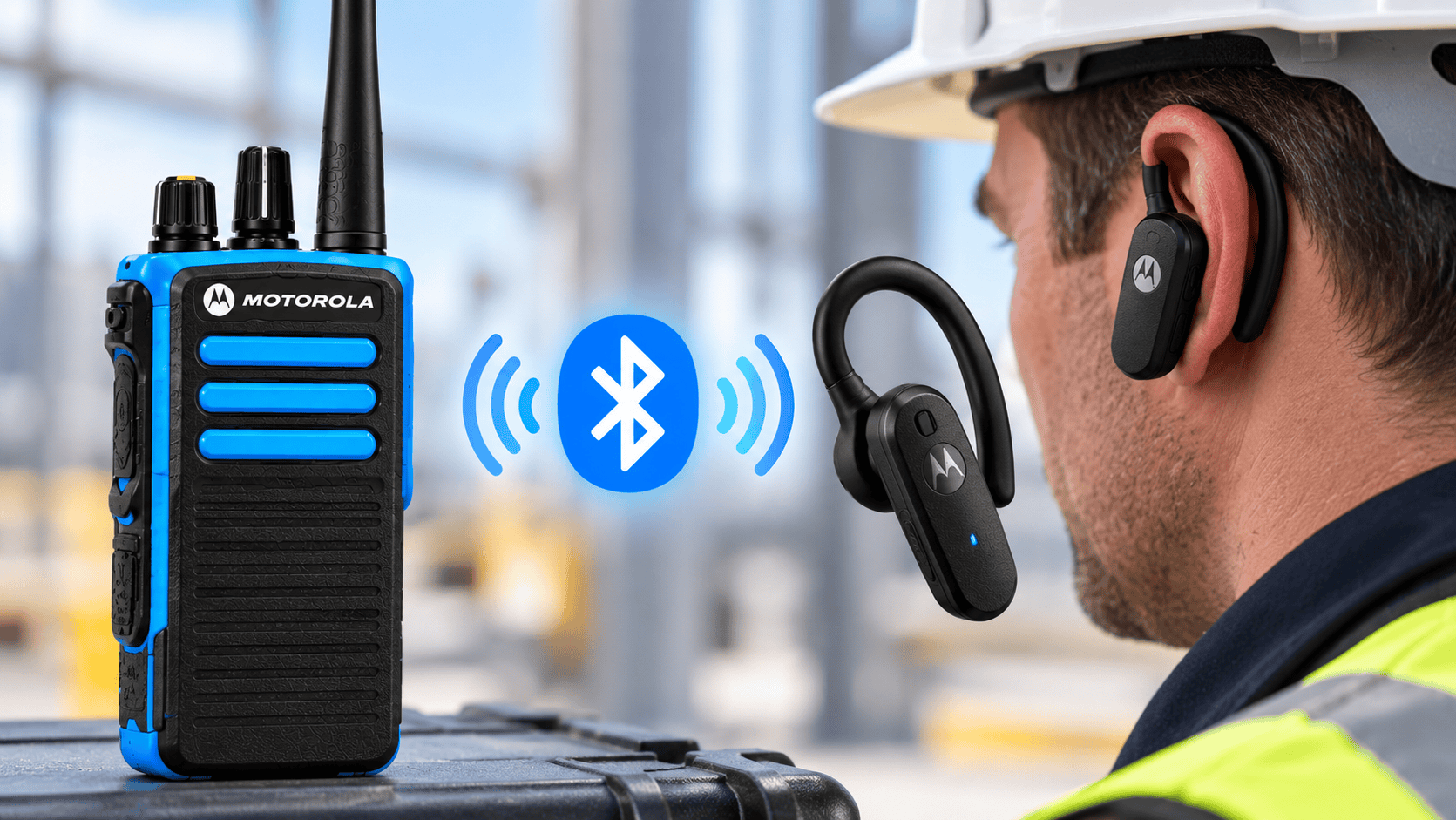
Bluetooth®
Bluetooth® is a short-range wireless technology that allows compatible electronic devices to communicate with each other without a physical cable. In two-way radio systems, Bluetooth can be built into the radio to connect wirelessly to compatible accessories such as headsets, earpieces, remote speaker microphones and other devices.
Bluetooth is particularly useful when radio users need to communicate without being physically connected to the radio by an audio cable. It can improve mobility and reduce the number of cables and connections that a user needs to manage.
Bluetooth is a registered trademark of Bluetooth SIG, Inc.
How is Bluetooth used in two-way radios?
A two-way radio with Bluetooth capability can establish a wireless connection with a compatible Bluetooth accessory.
For example, a user may pair a Bluetooth-enabled radio with a wireless headsetA radio headset combines a microphone and speaker or earpiece, allowing two-way radio users to communicate conveniently while keeping the radio away from their face or using hands-free operation.. The radio can then send received audio to the headset, while the headset’s microphone can be used for outgoing communications where the equipment supports this function.
A typical arrangement is:
Two-way radio → Bluetooth wireless connection → headset or earpieceAn earpiece is a two-way radio audio accessory that lets users hear radio communications discreetly, often with a microphone and Push-to-Talk button for transmitting.
The exact features available depend on the radio and the Bluetooth accessory being used.
Bluetooth radio accessories
Bluetooth can be used with a variety of radio accessories, including:
- Wireless earpieces
- Wireless headsets
- Remote speaker microphones
- Push-to-talk accessories
- Audio adapters
- Other compatible Bluetooth devices
Professional radio manufacturers may also provide purpose-designed Bluetooth accessories that have been tested for use with particular radio models.
Bluetooth and push-to-talk
Some Bluetooth radio accessories include a dedicated push-to-talk (PTT)Push-to-Talk (PTT) is the button or control used to activate a two-way radio's transmitter. Press it to speak and release it to listen. button.
This allows the user to transmit without physically handling the radio. The PTT control may be incorporated into a headset, remote microphone or separate wireless accessory.
The way Bluetooth PTT operates varies between radio manufacturers and models. Some systems support dedicated radio accessories with additional controls, while others may have more limited Bluetooth functionality.
Bluetooth pairing
Before a Bluetooth accessory can normally be used with a radio, the two devices need to be paired.
Pairing establishes a relationship between the radio and accessory so that they can communicate wirelessly.
Once paired, the devices may reconnect automatically when they are within range, depending on the equipment and its settings.
Professional radios may provide additional controls over which Bluetooth devices are permitted to connect, particularly where security and equipment management are important.
Bluetooth range
Bluetooth is designed for short-range wireless communication. Its practical range depends on the Bluetooth version and device capabilities, as well as factors such as obstructions, interferenceRadio interference occurs when unwanted radio-frequency signals or electrical noise disrupt two-way radio communications, causing distorted audio, broken transmissions, reduced coverage or loss of communication., radio design and the environment.
Bluetooth should therefore not be confused with the radio communication range of the two-way radio itself.
A Bluetooth connection between a radio and headset may only need to cover the distance between the radio carried on a user’s body and the accessory being worn. The two-way radio can still communicate with other radios over its normal radio networkA Network is a connected system of radios, equipment and infrastructure that allows users to communicate across a defined area. Radio networks can range from simple radio-to-radio systems to large multi-site networks. or radio frequencyAn antenna transmits and receives radio-frequency signals, allowing a two-way radio to communicate. Antenna type, frequency, height and location can all affect radio performance and coverage..
Bluetooth does not replace the two-way radio
Bluetooth provides the connection between devices; it does not normally provide the long-range radio communication between radio users.
For example, a Bluetooth-enabled handheld radio may communicate with another radio using its normal radio frequencyFrequency is the number of cycles a radio wave completes each second, measured in Hertz. In two-way radio, frequency determines where a transmission operates within the radio spectrum. while simultaneously communicating with the user’s wireless headset using Bluetooth.
The Bluetooth link and the radio communication link therefore perform different functions.
Bluetooth and radio security
Bluetooth connections use security mechanisms designed to help prevent unauthorised connections and interception.
However, Bluetooth should not automatically be regarded as equivalent to the security or encryptionEncryption protects two-way radio communications by converting voice or data into a secure form that can only be understood by authorised radios with the correct encryption capability and keys. used to protect the actual two-way radio communication.
The security features available depend on the Bluetooth implementation, radio manufacturer, accessory and configuration.
Where radio communications are sensitive, the security capabilities of the complete system should be considered.
Bluetooth in professional two-way radios
Bluetooth is increasingly available in professional digital two-way radios, particularly higher-specification models.
Depending on the equipment, Bluetooth may provide more than basic audio connectivity. Some professional radio systems can use Bluetooth for features such as wireless programming, location-related functions, device management or connection to specialist accessories.
The available functions vary considerably between radio platforms and should be checked against the manufacturer’s specifications.
Bluetooth in noisy environments
Bluetooth headsets can be useful in noisy working environments because they allow users to position an appropriate microphone and earpiece close to the user’s head.
However, Bluetooth itself does not remove background noise. The performance of the communication system depends on the microphone, headset design, audio processing and the radio systemA Radio System is a complete communication solution comprising two-way radios and, where required, equipment such as repeaters, antennas, base stations, mobile radios and network infrastructure..
For particularly noisy environments, specialist hearing-protection headsets or other purpose-designed radio accessories may be more appropriate.
Bluetooth and ATEX radios
Bluetooth requires particular consideration when used with ATEX-certified two-way radios.
Not every Bluetooth accessory is suitable for use in a hazardous area. If a radio is certified for potentially explosive atmospheres, accessories used with it must be compatible with the relevant certification and manufacturer’s approved configuration.
A standard consumer Bluetooth headset should not be assumed to be suitable for use in an ATEX environment simply because it can connect to the radio.
Bluetooth radio hire
Bluetooth-enabled radios can be useful when hiring equipment for events, security operations, hospitality and other situations where users benefit from wireless audio accessories.
Wireless accessories can give users greater freedom of movement and remove the cable connecting a conventional earpiece or headset to the radio.
The radio model, accessory compatibility, operating environment and required features should all be considered when specifying a Bluetooth-enabled hire system.
Bluetooth vs conventional wired accessories
A wired radio accessory connects directly to the radio using a physical cable and accessory connectorAn accessory connector is the socket on a two-way radio used to connect external accessories such as speaker microphones, headsets, earpieces and programming equipment..
A Bluetooth accessory communicates wirelessly with the radio.
Bluetooth can provide greater freedom of movement and reduce cable-related wearAn antenna transmits and receives radio-frequency signals, allowing a two-way radio to communicate. Antenna type, frequency, height and location can all affect radio performance and coverage., but it introduces another wireless connection that must be paired, powered and maintained.
A Bluetooth accessory also requires its own battery or powerAn antenna transmits and receives radio-frequency signals, allowing a two-way radio to communicate. Antenna type, frequency, height and location can all affect radio performance and coverage. source, whereas a conventional wired accessory normally draws any required power from the radio.
The best option depends on the user’s environment and operational requirements.