
Antenna
An antenna is the part of a two-way radio that transmits and receives radio-frequency signals. It converts electrical signals from the radio into electromagnetic waves for transmissionTransmission is the process of sending voice, data or signalling from a radio using a radio-frequency signal to another radio, repeater or communication system. and converts incoming radio waves back into electrical signals that the radio can process.
The antenna is therefore a fundamental part of any two-way radio systemA Radio System is a complete communication solution comprising two-way radios and, where required, equipment such as repeaters, antennas, base stations, mobile radios and network infrastructure.. Without a suitable antenna, a radio cannot transmit or receive effectively.
How does a radio antenna work?
When a radio transmits, the transmitter sends a radio-frequency electrical signal to the antenna. The antenna radiates this energy into the surrounding space as an electromagnetic wave.
When receiving, the process works in reverse. Radio-frequency energy arriving at the antenna produces a small electrical signal, which is passed to the radio’s receiverA Receiver is the part of a two-way radio that detects and processes incoming radio signals, converting them into audible voice or usable data for the user. and converted into usable audio or data.
In simple terms:
Transmit: Radio → antenna → radio waves
Receive: Radio waves → antenna → radio
An antenna therefore performs both transmitting and receiving functions on most two-way radios.
Types of two-way radio antenna
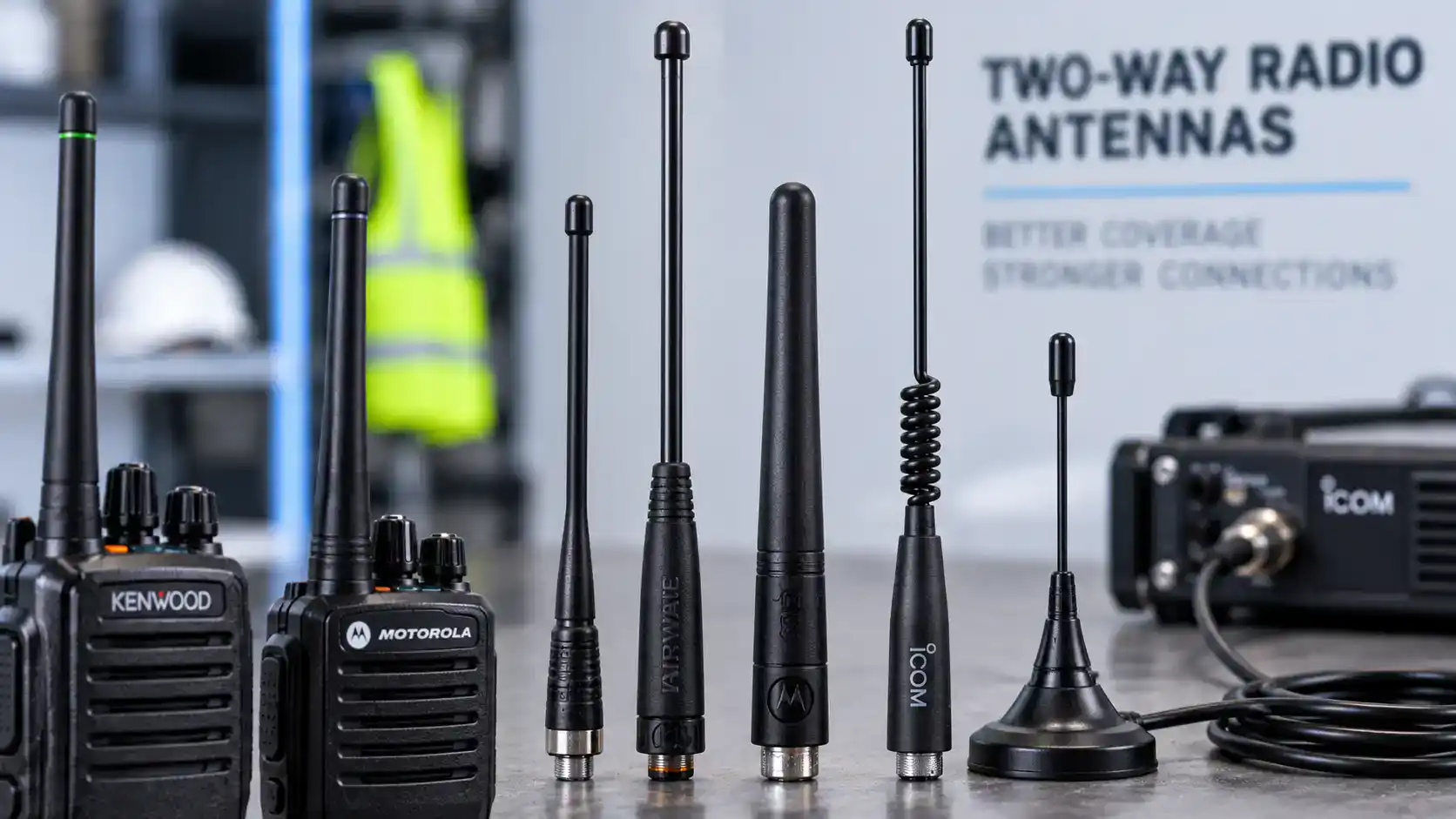
Different radio systems use different types and designs of antenna. The correct antenna depends on factors including the radio’s operating frequencyFrequency is the number of cycles a radio wave completes each second, measured in Hertz. In two-way radio, frequency determines where a transmission operates within the radio spectrum., power, application and physical installation.
Common examples include:
- Whip antennas — flexible antennas commonly fitted to handheld radios.
- Stubby antennas — shorter antennas designed to be more compact and less obtrusive on portable radios.
- Vehicle antennas — externally mounted antennas used with mobile radios installed in vehicles.
- Base-station antennas — antennas installed at a fixed location to provide radio coverageRadio Coverage is the geographical area in which a two-way radio system can provide reliable communication. Coverage depends on the radios, antennas, frequency, terrain, buildings and system infrastructure..
- RepeaterA Repeater receives a two-way radio transmission and retransmits it, usually from an elevated location, to extend the coverage and reliability of a radio communication system. antennas — antennas used with radio repeater installations to transmit and receive over an extended area.
- Directional antennas — antennas designed to concentrate radio energy more strongly in particular directions.
Antenna design varies considerably between radio systems, so an antenna should be selected for the specific radio and frequency being used.
Antenna frequency
An antenna is designed to operate efficiently over a particular range of radio frequencies.
The physical characteristics of an antenna are closely related to the wavelength of the radio signal. This is why an antenna designed for one frequency band may not perform correctly when used on a substantially different frequency.
For professional two-way radio systems, the antenna should therefore be matched to the frequency or frequency range programmed into the radio.
Antenna and radio range
The antenna can have a significant effect on the performance and coverage of a two-way radio system, but changing the antenna does not automatically increase radio range.
Actual coverage depends on many factors, including:
- Operating frequency
- Transmitter power
- Antenna type and efficiency
- Antenna height
- Terrain
- Buildings and other obstructions
- Vegetation
- InterferenceRadio interference occurs when unwanted radio-frequency signals or electrical noise disrupt two-way radio communications, causing distorted audio, broken transmissions, reduced coverage or loss of communication.
- Receiver sensitivity
- Whether a repeater or other infrastructureRadio infrastructure is the equipment and supporting systems behind a professional two-way radio network, including repeaters, antennas, base stations, network connections, power systems and dispatch equipment. is being used
For fixed installations, placing an antenna higher can often improve coverage because it can provide a clearer path between communicating radios.
Handheld radio antennas
Portable two-way radios normally use a small flexible antenna attached directly to the radio.
The antenna must be robust enough to withstand normal handling while providing suitable performance for the radio’s operating frequency.
Different handheld radios may require different antenna designs. Using an incorrect or incompatible antenna can reduce performance and, in some circumstances, may affect the radio’s transmission characteristics.
Vehicle radio antennas
Mobile two-way radios installed in vehicles normally use an external antenna mounted on the vehicle.
The antenna may be installed on the roof, wing or another suitable mounting position, depending on the vehicle and radio system.
A vehicle-mounted antenna can provide advantages over the small antenna used on a handheld radio because it can be physically larger and positioned outside the vehicle. The vehicle itself can also affect radio signals, making antenna positioning an important consideration.
Base and repeater antennas
Fixed radio systems may use an antenna mounted on a building, mast or other suitable structure.
A repeater installation commonly uses an elevated antenna to provide coverage over a wider area. Antenna height and location can have a major effect on the geographical area that a radio system can cover.
For larger sites, choosing the correct antenna location can therefore be just as important as selecting the radio equipment itself.
Antenna gain
Some antennas are described as having gain. Antenna gain describes how effectively an antenna concentrates radio-frequency energy in particular directions compared with a defined reference antenna.
Higher gain does not simply mean that an antenna transmits equally more strongly in every direction. Depending on the antenna design, increased gain can produce a more focused radiation pattern.
This is why antenna selection for a fixed radio system should take the intended coverage area and environment into account.
Antenna connectors
A radio antenna normally connects to the radio or associated equipment through a specific connector.
Different radios and installations use different connector types, and the connector itself must be compatible with the equipment.
For vehicle and fixed installations, additional components such as coaxial cable, connectors, mounting brackets and lightning protection may also form part of the antenna installation.
Antenna maintenance
Antennas used in demanding environments should be inspected periodically for signs of damage, wear, corrosion or loose connections.
A damaged antenna can reduce radio performance and may affect both transmission and reception.
For vehicle-mounted and fixed systems, the condition of the antenna mounting, coaxial cable and connectors should also be checked.
Choosing the right antenna
The correct antenna depends on the radio system and how it is being used. Important considerations include:
- The radio’s operating frequency
- The type of radio
- Portable, vehicle or fixed installation
- Required coverage
- Indoor or outdoor use
- Antenna mounting position
- Physical environment
- Required radiation pattern
- Compatibility with the radio and associated equipment
An antenna should not be selected solely on its physical size or appearance. A properly specified antenna matched to the radio system will generally provide much better results than simply fitting the largest available antenna.
Antennas and two-way radio systems
Although an antenna is a relatively simple component, it can have a significant influence on the effectiveness of a two-way radio system.
For a small group of handheld radios, the supplied antenna may be all that is required. For vehicles, buildings, large sites or systems using repeaters, a professionally selected and installed antenna system can be an important part of achieving reliable coverage.
DCS can advise on antennas and associated equipment when designing or supplying two-way radio systems for different operating environments.
For temporary operations, events and projects, two way radio hire provides a straightforward way to keep everyone connected.