Frequency
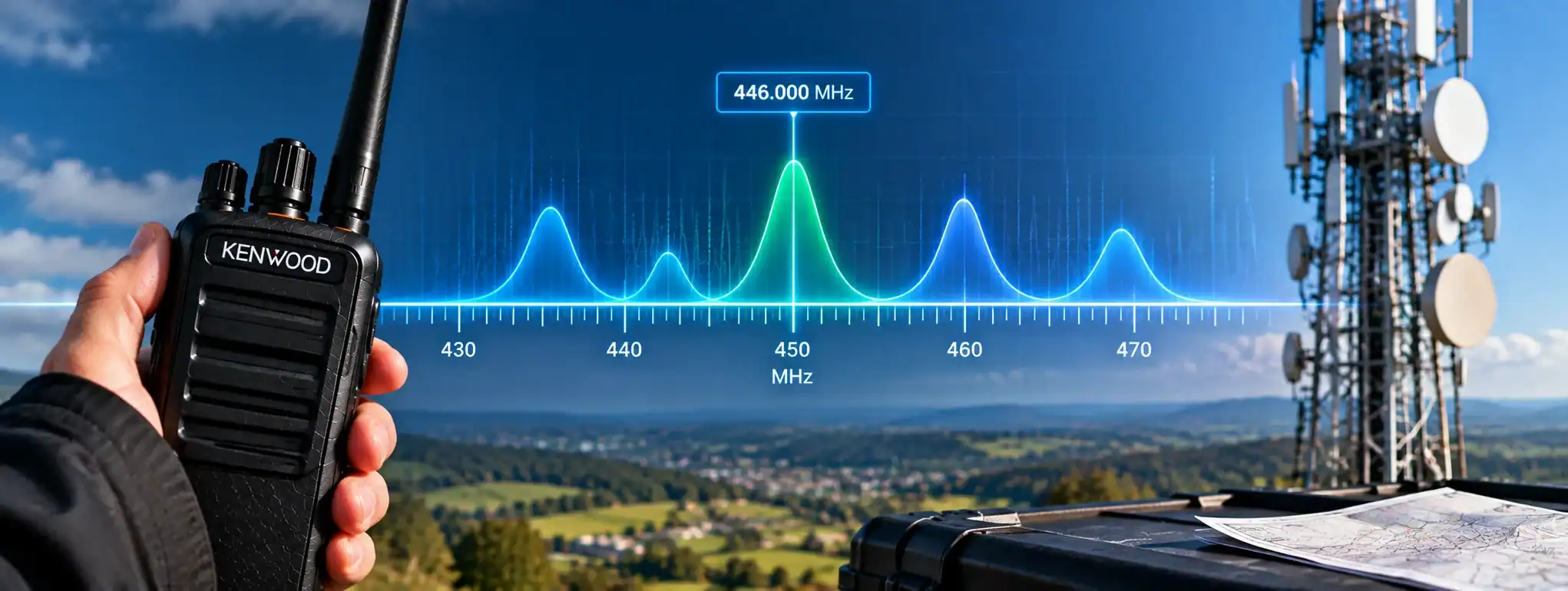
FrequencyAn antenna transmits and receives radio-frequency signals, allowing a two-way radio to communicate. Antenna type, frequency, height and location can all affect radio performance and coverage. is the number of times a radio wave completes a cycle each second. It determines where a radio signal sits within the radio spectrumSpectrum is the range of radio frequencies used for wireless communication. Two-way radios operate within specific parts of the radio spectrum, subject to frequency allocation and licensing requirements. and is measured in Hertz (Hz).
In two-way radio, frequency is fundamental to how radios transmit and receive communications. A radio is configured to operate on particular frequencies, allowing it to communicate with other radios or radio infrastructureRadio infrastructure is the equipment and supporting systems behind a professional two-way radio network, including repeaters, antennas, base stations, network connections, power systems and dispatch equipment. using compatible settings.
Different radio services use different frequency ranges. The frequency selected for a professional radio systemA Radio System is a complete communication solution comprising two-way radios and, where required, equipment such as repeaters, antennas, base stations, mobile radios and network infrastructure. affects factors such as coverageRadio Coverage is the geographical area in which a two-way radio system can provide reliable communication. Coverage depends on the radios, antennas, frequency, terrain, buildings and system infrastructure., antennaAn antenna transmits and receives radio-frequency signals, allowing a two-way radio to communicate. Antenna type, frequency, height and location can all affect radio performance and coverage. requirements, propagation characteristics and the type of licence or authorisation required.
How is radio Frequency measured?
Frequency is measured in Hertz.
Common units used in radio communications include:
- kHz — kilohertz, 1,000 Hz
- MHz — megahertz, 1,000,000 Hz
- GHz — gigahertz, 1,000,000,000 Hz
Professional two-way radio systems commonly operate in the VHF and UHF portions of the radio spectrum.
Frequency and wavelength
Frequency and wavelength are directly related.
As frequency increases, wavelength decreases.
As frequency decreases, wavelength increases.
This relationship affects how radio signals propagate and interact with their surroundings.
For example, lower-frequency radio waves can have different propagation characteristics from higher-frequency signals, which is one reason different frequency bands are selected for different applications.
Frequency and two-way radios
A two-way radio normally needs to be configured with the appropriate frequency or frequencies for the system on which it operates.
For a simple radio-to-radio communication system, compatible radios may transmit and receive on the same frequency.
More advanced systems can use separate transmit and receive frequencies, particularly when operating through a RepeaterA Repeater receives a two-way radio transmission and retransmits it, usually from an elevated location, to extend the coverage and reliability of a radio communication system..
Transmit Frequency
The Transmit Frequency is the frequency on which a radio sends its signal.
When the user presses the Push-to-Talk (PTT)Push-to-Talk (PTT) is the button or control used to activate a two-way radio's transmitter. Press it to speak and release it to listen. button, the radio’s transmitter generates a radio signal at its programmed transmit frequency.
The receiving radio must be configured to listen to the appropriate frequency or receive path.
Receive Frequency
The Receive Frequency is the frequency on which a radio listens for incoming transmissions.
In a simple radio-to-radio system, the transmit and receive frequencies may be the same.
In a repeater system, the radio may transmit on one frequency while receiving on another.
Simplex Frequency
SimplexSimplex is a method of two-way radio communication where radios transmit and receive on the same frequency, communicating directly without a repeater. communication uses the same frequency for transmitting and receiving.
A radio transmits directly to another radio on a particular frequency.
When one user is transmitting, other users on the same channelA two-way radio channel is a programmed set of communication settings, typically including frequency and signalling, that allows compatible radios to communicate with one another. normally need to wait before transmitting.
Simplex operation is commonly used where direct radio-to-radio communication provides sufficient coverage.
Duplex Frequency
A Duplexduplex, duplex radio, duplex communication, duplex frequencies, duplex operation, duplex spacing, frequency offset, repeater duplex, duplex repeater, full duplex, half duplex, radio repeater arrangement uses separate frequencies for transmissionTransmission is the process of sending voice, data or signalling from a radio using a radio-frequency signal to another radio, repeater or communication system. and reception.
This is commonly used with repeaters.
For example:
Radio → Repeater: transmit frequency
Repeater → Radio: receive frequency
The radio is programmed with both frequencies so that it can communicate through the repeater.
Frequency and repeaters
A repeater receives a radio transmission on one frequency and retransmits it on another.
The difference between the transmit and receive frequencies is known as the Frequency Offset or Duplex Offset.
The repeater therefore allows radios to communicate over a greater area than may be possible using direct radio-to-radio communication.
Frequency Offset
A Frequency Offset is the difference between the transmit and receive frequencies used by a repeater system.
For example, a radio might transmit to a repeater on one frequency while receiving the repeater’s retransmission on another.
The exact frequencies and offset depend on the radio system and frequency allocation.
Frequency and channels
A radio Channel normally represents a programmed set of communication parameters.
These can include:
- Transmit frequency
- Receive frequency
- CTCSS or DCS settings
- Digital colour code
- Talkgroup
- Radio ID
- PowerAn antenna transmits and receives radio-frequency signals, allowing a two-way radio to communicate. Antenna type, frequency, height and location can all affect radio performance and coverage. level
- Scan settings
- EncryptionEncryption protects two-way radio communications by converting voice or data into a secure form that can only be understood by authorised radios with the correct encryption capability and keys. settings
The frequency is therefore one part of the complete channel configuration.
Frequency and CTCSS
CTCSS (Continuous Tone-Coded SquelchAnalogue radio uses continuously varying radio signals to transmit voice communication. It remains widely used for reliable two-way communication across business, industry, events, security and other applications. System) adds a low-frequency signalling tone to a radio transmission.
The receiving radio can be configured to open its speaker only when the expected tone is detected.
CTCSS does not change the fundamental radio frequency being used and does not encrypt the communication.
Frequency and DCS
DCS (Digital-Coded Squelch) performs a similar signalling function using a digital code.
Like CTCSS, DCS does not provide encryption and should not be considered a security feature.
It is used to control radio squelch and help manage shared channels.
Frequency and DMR
DMR (Digital Mobile RadioA Mobile Radio is a two-way radio designed to be installed in a vehicle. It normally uses the vehicle's power supply and an external antenna to provide reliable communication while travelling or working in the field.) systems operate using defined radio-frequency channels.
A DMR channel can contain additional digital configuration information, such as:
- Colour Code
- Time Slot
- Talkgroup
- Radio ID
- Encryption settings
The frequency therefore forms part of a wider digital radio configuration.
Frequency and DMR Colour Code
A DMR Colour Code is a digital signalling parameter used to distinguish compatible DMR systems operating on the same frequency.
It is broadly comparable to using a CTCSS or DCS code to control access to a shared channel, although it performs a different technical function.
The Colour Code does not replace the frequency.
Frequency and DMR Time Slots
DMR uses TDMA (Time Division Multiple Access) to divide a radio channel into two alternating time slots.
This allows two separate communications to share the same radio-frequency channel.
The frequency remains the same while the time slot determines which portion of the DMR transmission a particular communication uses.
VHF Frequency
VHF (Very High Frequency)VHF (Very High Frequency) is the 30 MHz to 300 MHz radio-frequency range. VHF two-way radios are widely used for professional communications across outdoor, rural and open areas. refers to radio frequencies from 30 MHz to 300 MHz.
VHF is widely used for professional radio communications and can be particularly useful for outdoor applications.
The actual performance of a VHF system depends on frequency, antenna, terrain, power, equipment and operating environment.
UHF Frequency
UHF (Ultra High Frequency)UHF (Ultra High Frequency) is the 300 MHz to 3 GHz radio-frequency range. UHF two-way radios are widely used for professional communications, particularly in buildings and urban environments. refers to radio frequencies from 300 MHz to 3 GHz.
UHF is widely used for professional two-way radio systems.
UHF can be particularly useful in built-up environments and inside buildingsAn antenna transmits and receives radio-frequency signals, allowing a two-way radio to communicate. Antenna type, frequency, height and location can all affect radio performance and coverage., although actual performance depends on many factors including building construction and system design.
VHF vs UHF
The choice between VHF and UHF depends on the application.
VHF can be advantageous for some outdoor and open-area applications, while UHF can be well suited to many urban and indoor environments.
Neither band is universally better.
The correct frequency should be selected based on the site, coverage requirements, equipment and regulatory requirements.
Frequency and radio coverage
Frequency can influence how a radio signal behaves in a particular environment.
However, frequency alone does not determine radio range.
Coverage is also affected by:
- Transmit power
- Antenna
- Antenna height
- Terrain
- Buildings
- Obstacles
- InterferenceRadio interference occurs when unwanted radio-frequency signals or electrical noise disrupt two-way radio communications, causing distorted audio, broken transmissions, reduced coverage or loss of communication.
- Radio sensitivity
- Repeater infrastructure
- Environmental conditions
A professional radio system should therefore be assessed as a complete system rather than judged solely by its frequency.
Frequency and antennas
The antenna used by a radio is designed to operate effectively over a particular frequency range.
An antenna that is suitable for one frequency band may not perform correctly at another.
The antenna should therefore be matched to the operating frequency of the radio system.
This is particularly important for vehicle-mounted and base-station radios where external antennas are commonly used.
Frequency and radio range
It is a common misconception that a particular frequency automatically provides a fixed radio range.
There is no universal range associated with a specific frequency.
Two radios operating at the same frequency can have very different coverage depending on their antennas, power, location and surrounding environment.
Frequency and interference
Radio-frequency interference occurs when unwanted signals affect the ability of a radio system to communicate effectively.
Interference can originate from:
- Other radio systems
- Electrical equipment
- Industrial machinery
- Poorly configured transmitters
- Nearby high-power transmissions
- Faulty equipment
Professional frequency planning helps reduce the risk of interference.
Frequency coordination
Frequency Coordination is the process of selecting and managing radio frequencies so that communication systems can operate without causing unacceptable interference to one another.
This can be particularly important where many radio users operate within the same geographical area.
The frequency plan should take account of the required coverage, available spectrum and applicable licensing arrangements.
Frequency reuse
The same frequency can sometimes be used at different geographical locations without causing unacceptable interference if sufficient separation exists.
This is known as Frequency Reuse.
Large radio networks can use frequency-reuse principles to provide coverage across multiple areas while making efficient use of available spectrum.
Frequency spectrum
The Radio Spectrum is the range of electromagnetic frequencies used for wireless communication.
Different parts of the spectrum are allocated for different services.
Government and regulatory authorities manage spectrum use to reduce interference and ensure that different radio services can operate effectively.
Frequency allocation
A frequency allocation identifies which parts of the radio spectrum are available for particular radio services.
In the UK, radio spectrum is managed by OfcomOfcom (Office of Communications) is the UK's communications regulator. For two-way radio users, Ofcom manages and regulates access to radio spectrum and the use of radio frequencies in the UK..
Professional radio users must operate within the frequencies and conditions applicable to the relevant radio service or licence.
Frequency and Business Radio
Professional business users can operate on frequencies allocated for Business RadioBusiness Radio refers to professional two-way radio systems used by businesses and organisations for instant communication, often using licensed frequencies and equipment designed for commercial use. services, subject to the applicable authorisation.
The exact frequencies available depend on the type of Business Radio service and licence.
A radio should not simply be programmed to any frequency because that frequency appears unused.
The frequency must be authorised for the intended use.
Frequency and radio licensing
The use of radio frequencies in the UK is regulated.
Depending on the radio system, users may require an appropriate Business Radio LicenceA Business Radio Licence is an Ofcom authorisation allowing professional two-way radios to use specified frequencies and operating conditions for business communications in the UK. or may operate under specific licence-exempt arrangements such as PMR446.
The licensing requirements depend on the frequency, equipment, power, location and intended use.
Frequency and PMR446
PMR446 is a licence-exempt radio service operating within the designated PMR446 frequency range under defined technical conditions.
PMR446 equipment is subject to restrictions including permitted power, antenna arrangements and equipment type.
It is therefore different from professional licensed Business Radio systems.
Frequency and encryption
Encryption protects the content of a radio communication, while frequency determines where the radio signal is transmitted within the radio spectrum.
Encryption does not make a frequency private.
An encrypted radio transmission can still be detected as a radio signal, but an unauthorised receiverA Receiver is the part of a two-way radio that detects and processes incoming radio signals, converting them into audible voice or usable data for the user. should not be able to understand the protected communication without the appropriate security capability and keys.
Frequency and scanning
A radio with Channel ScanChannel Scan is a two-way radio feature that automatically monitors multiple programmed channels for activity, allowing users to hear communications without manually switching between channels. can monitor multiple programmed channels or frequencies.
The radio checks the configured channels for activity and can stop scanning when it detects a transmission that meets the programmed criteria.
Scanning therefore allows one radio to monitor several communication channels without manually selecting each one.
Frequency and busy channels
Professional radios can use features such as Busy Channel Lockout (BCL)Busy Channel Lockout (BCL) is a two-way radio feature that prevents transmission when the selected channel is already being used, helping avoid users talking over one another. to prevent a user from transmitting when another radio is already using the channel.
This helps reduce accidental interference between users sharing the same frequency.
Frequency and dead spots
A Dead SpotA Dead Spot is an area where two-way radio communication is weak, unreliable or unavailable. Dead spots can be caused by buildings, terrain, distance, interference or inadequate radio coverage. is an area where radio communication is weak or unavailable.
Dead spots can occur because of terrain, buildings, distance, interference or other environmental factors.
Changing frequency may sometimes improve coverage, but it is not necessarily a complete solution.
A repeater, improved antenna position or alternative radio-system design may be required.
Frequency and frequency testing
Before deploying a professional radio system, frequency and coverage requirements should be assessed.
Testing can help determine:
- Suitable frequencies
- Coverage
- Interference
- Repeater requirements
- Antenna requirements
- Indoor performance
- Outdoor performance
The results can then be used to design the appropriate radio system.
Frequency and radio programming
Frequencies are normally entered into a radio during programming.
A technician can configure the required transmit and receive frequencies along with the other channel parameters.
Users should not normally change programmed frequencies themselves because incorrect settings can prevent communication or result in unauthorised operation.
Frequency and radio hire
When professional two-way radios are hired, the hire company can configure the equipment with the appropriate frequencies and channels for the intended operation.
For events and temporary deployments, frequency planning can be particularly important where many users or other radio systems are operating nearby.
Frequency limitations
Frequency is only one factor in determining the performance of a radio system.
Selecting a frequency without considering the wider system can result in poor coverage, interference or licensing problems.
A professional radio system should therefore consider frequency alongside equipment, antennas, power, infrastructure, geography and regulatory requirements.
Frequency and DCS
DCS can provide professional radio systems designed around the appropriate frequencies for the customer’s operating environment.
DCS can assess factors such as coverage, radio technology, antennas, repeaters and licensing requirements when designing a two-way radio system.
The correct frequency depends on the application, location, equipment and required coverage.