
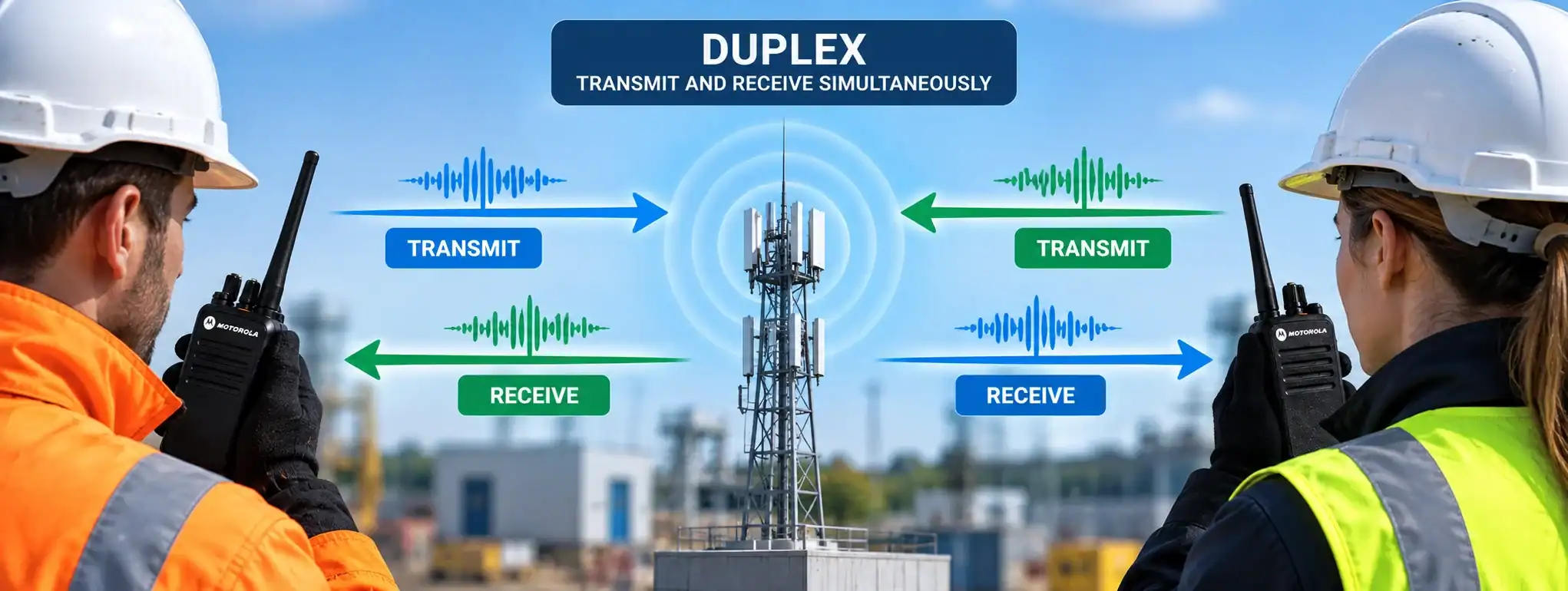
Duplex
Duplex refers to a method of radio communication in which transmissionTransmission is the process of sending voice, data or signalling from a radio using a radio-frequency signal to another radio, repeater or communication system. and reception take place on two separate radio paths or frequencies, allowing communication to take place in both directions.
In two-way radio systems, duplex operation is commonly associated with the use of a repeaterA Repeater receives a two-way radio transmission and retransmits it, usually from an elevated location, to extend the coverage and reliability of a radio communication system.. The radio transmits to the repeater on one frequencyAn antenna transmits and receives radio-frequency signals, allowing a two-way radio to communicate. Antenna type, frequency, height and location can all affect radio performance and coverage., while the repeater retransmits the signal to the other radios on a different frequencyFrequency is the number of cycles a radio wave completes each second, measured in Hertz. In two-way radio, frequency determines where a transmission operates within the radio spectrum..
Duplex should not be confused with full-duplex communication, where both parties can transmit and receive simultaneously, like a telephone conversation. Most conventional professional two-way radio systems are half-duplexHalf-Duplex allows two-way communication in both directions, but users normally take turns transmitting. It is the standard operating method for most Push-to-Talk professional two-way radio systems.: users can hear and speak through the system, but normally only one user transmits at a time.
How does Duplex radio communication work?
In a typical repeater-based duplex radio systemA Radio System is a complete communication solution comprising two-way radios and, where required, equipment such as repeaters, antennas, base stations, mobile radios and network infrastructure., two frequencies are used:
Radio transmit frequency → Repeater → Radio receive frequency
The handheld or mobile radioA Mobile Radio is a two-way radio designed to be installed in a vehicle. It normally uses the vehicle's power supply and an external antenna to provide reliable communication while travelling or working in the field. transmits on one frequency to the repeater.
The repeater receives that transmission and simultaneously retransmits it on another frequency.
Other radios listen to the repeater’s output frequency and receive the retransmitted communication.
This allows the repeater to receive and transmit at the same time without its own transmitted signal interfering with its receiverA Receiver is the part of a two-way radio that detects and processes incoming radio signals, converting them into audible voice or usable data for the user..
Duplex frequencies
A duplex radio channelA two-way radio channel is a programmed set of communication settings, typically including frequency and signalling, that allows compatible radios to communicate with one another. normally consists of a transmit frequency and a receive frequency.
For example:
Radio transmit: 165.000 MHz
Radio receive: 170.000 MHz
The actual frequencies and separation between them depend on the radio band, licensing arrangements and system design.
The difference between the transmit and receive frequencies is known as the duplex spacing or frequency offset.
Duplex spacing
Duplex spacing is the frequency difference between the transmit and receive frequencies used by a repeater system.
The required spacing depends on the frequency band and radio system.
A repeater needs sufficient separation between its receiving and transmitting frequencies, together with appropriate filtering and antennaAn antenna transmits and receives radio-frequency signals, allowing a two-way radio to communicate. Antenna type, frequency, height and location can all affect radio performance and coverage. arrangements, to prevent its transmitter from overwhelming its receiver.
Duplex and repeaters
Duplex operation is fundamental to many repeater-based two-way radio systems.
A repeater can be positioned at a high or strategically selected location to extend radio coverageRadio Coverage is the geographical area in which a two-way radio system can provide reliable communication. Coverage depends on the radios, antennas, frequency, terrain, buildings and system infrastructure..
The basic arrangement is:
Handheld radio → Repeater → Handheld radio
Because the repeater receives and retransmits on different frequencies, it can handle incoming and outgoing radio signals simultaneously.
Duplex vs simplex
The main difference between duplex and SimplexSimplex is a method of two-way radio communication where radios transmit and receive on the same frequency, communicating directly without a repeater. communication is the way the radio frequencies are used.
Simplex:
Radios transmit and receive on the same frequency. Only one radio normally transmits at a time.
Duplex:
Transmission and reception use separate frequencies, normally through a repeater or other infrastructureRadio infrastructure is the equipment and supporting systems behind a professional two-way radio network, including repeaters, antennas, base stations, network connections, power systems and dispatch equipment..
Simplex is often suitable for smaller sites where direct radio-to-radio communication provides sufficient coverage.
Duplex repeater systems are useful when greater coverage is required.
Duplex and half-duplex communication
A conventional repeater-based radio system is usually described as half-duplex from the user’s perspective.
Although the repeater itself can receive and transmit simultaneously, the individual radio user normally presses the Push-to-Talk button to transmit and releases it to listen.
Two users therefore do not normally speak over one another.
This is different from a telephone system, where both parties can normally speak and listen simultaneously.
Duplex vs full duplex
Full duplexFull Duplex allows two-way radio users to transmit and receive simultaneously, providing a continuous, telephone-style conversation rather than requiring users to take turns using Push-to-Talk. communication allows two parties to transmit and receive simultaneously.
A telephone conversation is a familiar example.
Duplex radio can refer to the use of separate transmit and receive frequencies, but that does not necessarily mean that radio users can speak simultaneously.
In conventional professional two-way radio, the term duplex usually describes the frequency arrangement used by the system rather than full-duplex conversation.
Duplex and DMR
DMR (Digital Mobile Radio) systems can operate through repeaters using separate transmit and receive frequencies.
The radio transmits to the repeater on the uplink frequency, while receiving the repeater’s transmissions on the downlink frequency.
DMR also uses TDMA timeslots, which is a separate concept from duplex frequency operation.
For example:
Frequency separation = duplex
Time separation = DMR TDMA timeslots
These should not be confused with one another.
Duplex and DMR timeslots
A DMR repeater can use two TDMA timeslots on a 12.5 kHz physical channel.
The repeater may therefore receive and transmit using separate uplink and downlink frequencies while the DMR system also divides the channel into Timeslot 1 and Timeslot 2.
This combination allows DMR systems to provide multiple logical communication paths within the available radio spectrumSpectrum is the range of radio frequencies used for wireless communication. Two-way radios operate within specific parts of the radio spectrum, subject to frequency allocation and licensing requirements..
Duplex and analogue radio
Duplex operation is not limited to digital radio.
Analogue professional radio systems can also use duplex frequencies and repeaters.
An analogue repeater receives the transmission from a radio on its input frequency and retransmits it on its output frequency.
The receiving radios are programmed to listen to the repeater’s output.
Duplex and radio programming
The transmit and receive frequencies used for duplex operation are normally programmed into the radio’s CodeplugA Codeplug is the configuration data programmed into a two-way radio that defines its channels, frequencies, talkgroups, radio ID and other operating features..
The user may simply see a channel name such as:
Site Operations
Behind that channel name, the radio may contain:
- Transmit frequency
- Receive frequency
- CTCSS or DCS tone
- DMR Colour Code
- DMR Timeslot
- Talkgroup
- Transmit powerAn antenna transmits and receives radio-frequency signals, allowing a two-way radio to communicate. Antenna type, frequency, height and location can all affect radio performance and coverage.
- Other system settings
Correct programming is essential for the radio to access the intended repeater.
Duplex and repeater access tones
A repeater may require an access tone or digital parameter before it will retransmit a signal.
Analogue systems may use CTCSS or DCS.
DMR systems use parameters such as Colour Code and Timeslot.
These settings are separate from the duplex frequency arrangement itself.
Duplex and coverage
Duplex repeater systems can provide significantly greater coverage than direct simplex communication.
A repeater positioned at a suitable height can receive transmissions from radios over a wider area and retransmit them to other users.
The resulting coverage depends on factors such as:
- Repeater location
- Antenna height
- Antenna type
- Transmit power
- Frequency
- Terrain
- BuildingsAn antenna transmits and receives radio-frequency signals, allowing a two-way radio to communicate. Antenna type, frequency, height and location can all affect radio performance and coverage.
- Radio sensitivity
Duplex operation itself does not guarantee greater coverage; it is the repeater infrastructure and its location that provide the coverage improvement.
Duplex and antennas
A repeater operating duplex may use a single antenna with a suitable duplexer, or separate transmit and receive antennas.
A duplexer is a specialised filtering device that allows the repeater’s transmitter and receiver to operate through the same antenna while providing sufficient isolation between them.
The choice of antenna arrangement depends on the repeater design and site requirements.
Duplexer
A Duplexer is a radio-frequency filtering device used in many repeater installations.
It allows a transmitter and receiver operating on different frequencies to share an antenna while reducing the amount of transmitted energy reaching the receiver.
This is particularly important because a repeater transmitter can produce a much stronger signal than the signals it is trying to receive.
Without adequate isolation, the transmitter could interfere with or overload the repeater receiver.
Duplex and repeater sites
A professional repeater site may include:
- Repeater
- Duplexer
- Antenna
- Coaxial cable
- Power supply
- Backup battery
- Lightning protection
- Mast or tower
- Other site equipment
The quality and positioning of these components can affect the performance and coverage of the overall radio system.
Duplex and mobile radios
Mobile radios installed in vehicles can operate through duplex repeaters in the same way as handheld radios.
The vehicle radio transmits to the repeater on its programmed transmit frequency and receives the repeater’s output on its receive frequency.
A properly installed external vehicle antenna can provide good performance when communicating with a repeater.
Duplex and base stations
A Base StationA base station is a fixed two-way radio installed at a permanent location, allowing an operator to communicate with handheld or mobile radios across a site or operating area. can also operate through a duplex repeater.
A base station located at a control room or fixed operational location can communicate with mobile and handheld users through the radio networkA Network is a connected system of radios, equipment and infrastructure that allows users to communicate across a defined area. Radio networks can range from simple radio-to-radio systems to large multi-site networks..
This can provide a central communication point for organisations operating across a larger site.
Duplex and multi-site radio systems
Larger radio systems can use multiple repeater sites, each providing coverage over a particular geographical area.
These sites can be connected using suitable network infrastructure.
Depending on the system, users may be able to communicate across multiple sites while the underlying network handles the connection between them.
Duplex frequency arrangements remain an important part of the radio infrastructure at each repeater site.
Duplex and roaming
Networked radio systems can support RoamingRoaming allows a compatible two-way radio to move between different radio sites or coverage areas, automatically selecting an appropriate site as the user moves., allowing compatible radios to move between different coverage areas.
As the user moves from one repeater site to another, the radio may select another available site according to the system configuration.
The user may therefore remain on the same logical communication service while the underlying radio connection changes.
Duplex and radio licensing
Duplex frequencies used by professional radio systems are normally subject to the relevant radio licensing arrangements.
In the UK, professional radio frequencies are regulated by OfcomOfcom (Office of Communications) is the UK's communications regulator. For two-way radio users, Ofcom manages and regulates access to radio spectrum and the use of radio frequencies in the UK..
The transmit and receive frequencies, power levels and operating conditions must be appropriate for the relevant licence and radio system.
Programming a radio with a frequency does not itself provide authorisation to transmit on that frequency.
Duplex and interference
Correct duplex frequency planning is important to prevent interferenceRadio interference occurs when unwanted radio-frequency signals or electrical noise disrupt two-way radio communications, causing distorted audio, broken transmissions, reduced coverage or loss of communication..
A repeater site must be designed so that its transmitted signal does not interfere with its own receiver or other nearby radio systems.
This involves considerations such as:
- Frequency separation
- Filtering
- Antenna isolation
- Site location
- Transmit power
- Receiver sensitivity
- Nearby radio users
Professional radio engineers can plan and test these factors as part of a repeater installation.
Duplex and radio coverage problems
A duplex repeater can improve coverage, but it cannot automatically eliminate every Dead SpotA Dead Spot is an area where two-way radio communication is weak, unreliable or unavailable. Dead spots can be caused by buildings, terrain, distance, interference or inadequate radio coverage..
Areas can remain outside the effective repeater coverage because of:
- Terrain
- Buildings
- Underground locations
- Distance
- Poor antenna position
- Signal obstruction
- Interference
Where additional coverage is required, further radio infrastructure may be necessary.
Duplex and radio hire
Duplex repeater systems are commonly used when hiring two-way radios for larger events, construction projects and temporary operations.
A repeater can provide wider coverage across the required working area than direct radio-to-radio communication.
The radios are programmed with the appropriate duplex channels before they are issued to users.
For larger or challenging sites, a coverage assessment can determine whether a repeater is required.
Duplex at events
Large events can require radio communication across areas that cannot be reliably covered using handheld radios alone.
A temporary repeater can provide a central coverage point for security, event management, production, medical and other operational teams.
The repeater’s transmit and receive frequencies are configured as a duplex pair.
Duplex on construction sites
Construction sites can contain buildings, steelwork, machinery and changing terrain that affect radio coverage.
A duplex repeater can extend communication between workers operating across a larger site.
As the site develops, coverage may need to be reassessed because newly constructed structures can alter radio propagation.
Duplex limitations
Duplex radio systems require additional infrastructure compared with simple simplex radio communication.
A repeater installation may require:
- Suitable frequencies
- Antennas
- Duplexer or separate antennas
- Power
- Suitable site location
- Licensing
- Maintenance
If the repeater becomes unavailable, communications that depend on it may be affected.
Some radio systems can provide fallback simplex channels for use if repeater service is unavailable.
Duplex and DCS
DCS can design and supply professional duplex radio systems where increased coverage is required.
Depending on the application, this can include handheld radios, mobile radios, base stations, repeaters, antennas and the associated programming.
For larger systems, repeater locations and coverage can be assessed to provide reliable communications throughout the required operating area.
If you’re planning a temporary operation or large event, radio hire for businesses provides a practical alternative to purchasing equipment.