
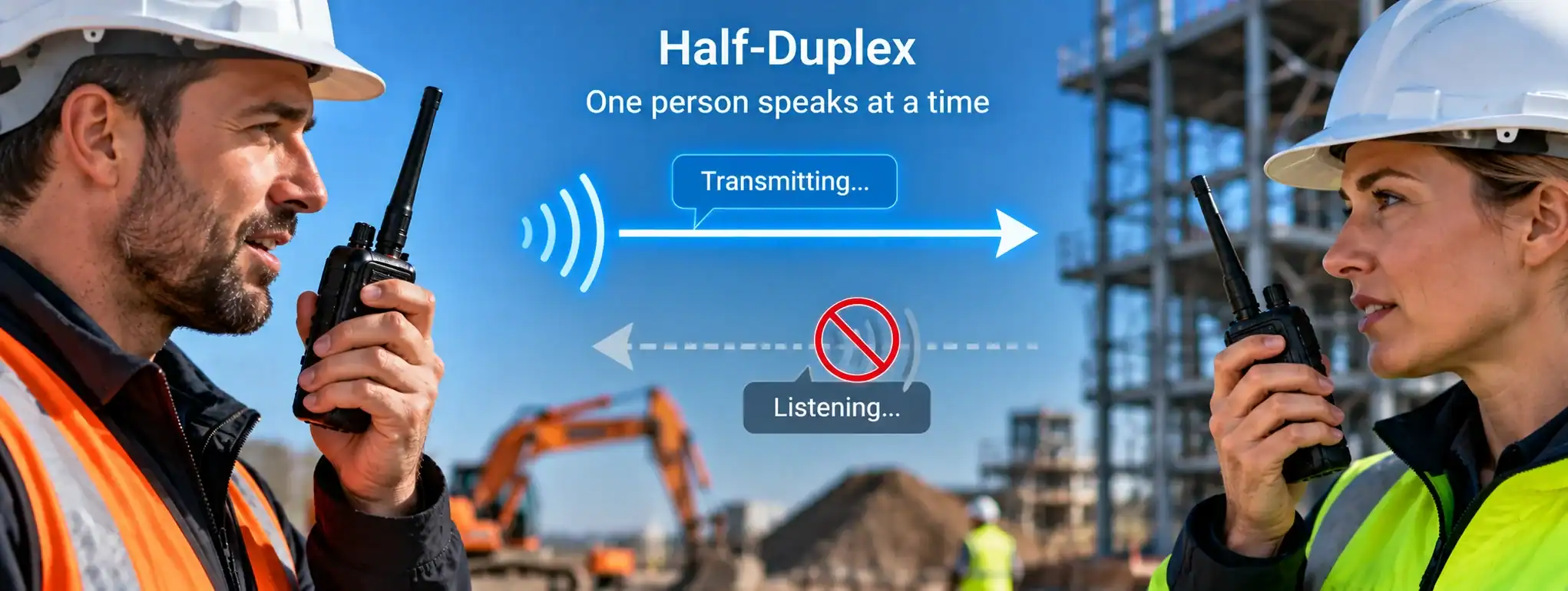
Half-Duplex
Half-Duplex is a method of two-way communication in which information can travel in both directions, but the two directions cannot normally operate at the same time.
This is the standard operating principle of most conventional Push-to-Talk (PTT)Push-to-Talk (PTT) is the button or control used to activate a two-way radio's transmitter. Press it to speak and release it to listen. two-way radio systems. One user presses the PTT button to transmit while other users listen. When the transmitting user releases the PTT button, another user can respond.
Half-Duplex provides efficient use of a shared radio channelA two-way radio channel is a programmed set of communication settings, typically including frequency and signalling, that allows compatible radios to communicate with one another. and is particularly well suited to group communications, where multiple users need to communicate using the same channel.
How does Half-Duplex work?
In a Half-Duplex radio conversation, users take turns transmitting.
A typical exchange is:
User A presses PTT → User A transmits → User B listens → User A releases PTT → User B transmits
Both users can communicate in either direction, but only one direction is normally active at a time.
Half-Duplex vs Full Duplex
The main difference between Half-Duplex and Full DuplexFull Duplex allows two-way radio users to transmit and receive simultaneously, providing a continuous, telephone-style conversation rather than requiring users to take turns using Push-to-Talk. is whether both directions can operate simultaneously.
Half-Duplex:
- Communication works in both directions
- Users normally take turns transmitting
- Commonly uses Push-to-Talk
- Well suited to group radio communication
Full Duplexduplex, duplex radio, duplex communication, duplex frequencies, duplex operation, duplex spacing, frequency offset, repeater duplex, duplex repeater, full duplex, half duplex, radio repeater:
- Both directions can operate simultaneously
- Users can speak and listen at the same time
- More closely resembles a telephone conversation
- Requires suitable equipment and system infrastructureRadio infrastructure is the equipment and supporting systems behind a professional two-way radio network, including repeaters, antennas, base stations, network connections, power systems and dispatch equipment.
Most professional two-way radio communication is Half-Duplex.
Half-Duplex vs Simplex
Half-Duplex and SimplexSimplex is a method of two-way radio communication where radios transmit and receive on the same frequency, communicating directly without a repeater. are closely related but are not identical terms.
Simplex generally describes a system where transmissionTransmission is the process of sending voice, data or signalling from a radio using a radio-frequency signal to another radio, repeater or communication system. and reception use the same frequencyAn antenna transmits and receives radio-frequency signals, allowing a two-way radio to communicate. Antenna type, frequency, height and location can all affect radio performance and coverage..
Half-Duplex describes communication in which transmission can occur in both directions, but not simultaneously.
A conventional simplex radio conversation is therefore typically Half-Duplex.
Half-Duplex and repeaters
Half-Duplex communication can also operate through a RepeaterA Repeater receives a two-way radio transmission and retransmits it, usually from an elevated location, to extend the coverage and reliability of a radio communication system..
In a repeater-based system, the radio may transmit on one frequencyFrequency is the number of cycles a radio wave completes each second, measured in Hertz. In two-way radio, frequency determines where a transmission operates within the radio spectrum. and receive on another. The repeater receives the transmission and retransmits it to other radios.
Although separate transmit and receive frequencies are being used, the users can still be communicating using Half-Duplex Push-to-Talk.
The use of separate frequencies does not automatically make a radio systemA Radio System is a complete communication solution comprising two-way radios and, where required, equipment such as repeaters, antennas, base stations, mobile radios and network infrastructure. Full Duplex.
Half-Duplex and duplex frequencies
A Half-Duplex radio system can use separate transmit and receive frequencies.
For example:
Radio → Repeater: transmit frequency
Repeater → Radio: receive frequency
The user still presses PTT to transmit and then releases it to listen.
This arrangement is sometimes described as duplex radio operation while the user communication itself remains Half-Duplex.
Half-Duplex and Push-to-Talk
Push-to-Talk is one of the defining characteristics of conventional Half-Duplex radio communication.
When the PTT button is pressed, the radio changes from receiving to transmitting.
When the button is released, the radio returns to receiving.
This allows multiple users to share the same communication channel efficiently.
Half-Duplex and group communication
Half-Duplex is particularly effective for group communications.
A single transmission can be heard by multiple users without requiring a separate communication path for every participant.
For example, a security team can share one radio channel:
Security Officer → Channel → Entire Security Team
When another officer needs to respond, they wait for the channel to become available and then transmit.
Half-Duplex and DMR
DMR (Digital Mobile RadioA Mobile Radio is a two-way radio designed to be installed in a vehicle. It normally uses the vehicle's power supply and an external antenna to provide reliable communication while travelling or working in the field.) systems commonly use Half-Duplex Push-to-Talk communication.
DMR uses digital signalling and TDMA technology to make efficient use of radio channels, but the normal user experience remains one person transmitting while other users listen.
A DMR radio having separate transmit and receive frequencies does not automatically mean it provides Full Duplex communication.
Half-Duplex and DMR Time Slots
DMR uses Time Division Multiple Access (TDMA)Time Division Multiple Access (TDMA) is a technology that divides a radio channel into time slots, allowing multiple users or conversations to share the same frequency. DMR uses two time slots within a 12.5 kHz channel. to divide a radio channel into two alternating time slots.
This allows two separate communication paths to share the same radio-frequency channel.
However, this should not be confused with Full Duplex.
The time slots allow more efficient use of the available channel rather than allowing two users to have a conventional simultaneous two-way conversation.
Half-Duplex and Talkgroups
Digital radio systems can use Talkgroups to organise users into communication groups.
A talkgroup can contain multiple radios that share communications.
The Half-Duplex nature of conventional Push-to-Talk communication means that users normally take turns transmitting on the talkgroup.
Half-Duplex and analogue radio
Analogue professional two-way radios commonly operate using Half-Duplex communication.
A user presses PTT to transmit an analogue voice signal and releases PTT to listen.
The same principle applies whether the radios communicate directly or through a repeater.
Half-Duplex and radio channels
A radio Channel can be configured for Half-Duplex communication.
The channel may contain:
- Transmit frequency
- Receive frequency
- CTCSS or DCS settings
- PowerAn antenna transmits and receives radio-frequency signals, allowing a two-way radio to communicate. Antenna type, frequency, height and location can all affect radio performance and coverage. level
- Scan settings
- Talkgroup information
- Other system parameters
The exact configuration depends on the radio technology.
Half-Duplex and CTCSS
CTCSS can be used on Half-Duplex radio channels to control which transmissions cause a radio’s squelchAnalogue radio uses continuously varying radio signals to transmit voice communication. It remains widely used for reliable two-way communication across business, industry, events, security and other applications. to open.
CTCSS does not change the Half-Duplex nature of the communication.
It is a signalling and squelch-control system rather than a communication mode.
Half-Duplex and DCS
DCS (Digital-Coded Squelch) can also be used on Half-Duplex radio channels.
It provides a digital signalling code that helps control when the receiving radio opens its squelch.
DCS does not provide Full Duplex communication or encryptionEncryption protects two-way radio communications by converting voice or data into a secure form that can only be understood by authorised radios with the correct encryption capability and keys..
Half-Duplex and Busy Channel Lockout
Busy Channel Lockout (BCL)Busy Channel Lockout (BCL) is a two-way radio feature that prevents transmission when the selected channel is already being used, helping avoid users talking over one another. can be used to prevent a user from transmitting while another compatible transmission is already taking place.
This is particularly useful on shared Half-Duplex channels because multiple users need to take turns transmitting.
Half-Duplex and Channel Scan
A radio using Channel ScanChannel Scan is a two-way radio feature that automatically monitors multiple programmed channels for activity, allowing users to hear communications without manually switching between channels. can monitor multiple Half-Duplex channels.
When activity is detected on a programmed channel, the radio can stop scanning and allow the user to hear the transmission.
The exact scanning behaviour depends on the radio’s configuration.
Half-Duplex and priority channels
A Half-Duplex radio can be configured with priority channels or scanning arrangements.
For example, a Guard ChannelA Guard Channel is a designated radio channel that is monitored or given priority for important, urgent or emergency communications. Its exact function depends on the radio system and configuration. may be given priority while the radio monitors normal operational channels.
This allows important communications to be detected without changing the underlying Half-Duplex communication method.
Half-Duplex and emergency communications
Many radio emergency functions operate within a Half-Duplex communication system.
A user can activate an Emergency ButtonAn Emergency Button is a dedicated two-way radio control that allows users to quickly send an emergency alert to a dispatcher, control room or authorised radio users. or Emergency AlarmAn Emergency Alarm allows a two-way radio user to quickly alert a dispatcher, control room or other authorised users that assistance may be required., after which the radio may transmit an emergency message or alert to another radio or control system.
Once the emergency transmission has been received, communication can normally continue using the established Push-to-Talk method.
The exact emergency behaviour depends on the radio system.
Half-Duplex and Emergency Call
An Emergency CallAn Emergency Call is a priority two-way radio function that allows a user to quickly request assistance and, on supported systems, establish an urgent voice communication with a dispatcher or control room. can be prioritised over normal radio traffic on some professional systems.
Although the emergency call may receive priority treatment, the underlying voice communication can still operate using Half-Duplex Push-to-Talk.
Emergency priority and Full Duplex are separate concepts.
Half-Duplex and Dispatch
A Dispatch system can manage large numbers of Half-Duplex radio users.
A dispatcher can communicate with individual radios, groups or talkgroups using Push-to-Talk.
This makes Half-Duplex particularly effective for control-room operations where one dispatcher needs to communicate with multiple field users.
Half-Duplex and control rooms
Control rooms often use Half-Duplex radio because it allows one operator to communicate with many users on a shared channel.
For example, a dispatcher can issue an instruction to an entire team, and individual users can respond as required.
This shared communication model is one of the key advantages of professional two-way radio.
Half-Duplex and security
Security teams commonly use Half-Duplex radio communication because short, rapid messages can be shared with an entire team.
Users can hear operational instructions and respond without requiring individual telephone calls.
This makes radio particularly useful where coordination between multiple personnel is required.
Half-Duplex and events
Large events commonly use Half-Duplex radio systems.
Separate channels or talkgroups can be assigned to:
- Security
- Stewards
- Medical teams
- Production
- Transport
- Event control
Users can communicate quickly with the relevant team while sharing radio channels efficiently.
Half-Duplex and construction
Construction sites can use Half-Duplex radio to allow workers and supervisors to communicate across a site.
Because multiple users can share the same channel, Half-Duplex is well suited to coordinated operational work.
Where coverageRadio Coverage is the geographical area in which a two-way radio system can provide reliable communication. Coverage depends on the radios, antennas, frequency, terrain, buildings and system infrastructure. is insufficient for direct radio-to-radio communication, a repeater can extend the system.
Half-Duplex and transport
Transport and logistics operations commonly use Half-Duplex radio for communication between drivers and control personnel.
A dispatcher can communicate with multiple vehicles without establishing a separate call for every user.
Half-Duplex and radio hire
Most professional Event Radio HireEvent Radio Hire provides temporary professional two-way radios and communication equipment for events, helping organisers, security, production and other teams stay connected. systems use Half-Duplex Push-to-Talk communication.
This allows many users to share a small number of communication channels efficiently.
It is particularly useful for events where teams need immediate group communication rather than individual telephone-style conversations.
Half-Duplex and coverage
Half-Duplex does not determine how far a radio signal will travel.
Coverage depends on factors such as:
- Frequency
- Transmit power
- AntennaAn antenna transmits and receives radio-frequency signals, allowing a two-way radio to communicate. Antenna type, frequency, height and location can all affect radio performance and coverage.
- Antenna height
- Terrain
- BuildingsAn antenna transmits and receives radio-frequency signals, allowing a two-way radio to communicate. Antenna type, frequency, height and location can all affect radio performance and coverage.
- Radio sensitivity
- Repeater infrastructure
A Half-Duplex system can therefore provide either local or wide-area communication depending on its design.
Half-Duplex and frequency
A Half-Duplex system may use the same frequency for transmission and reception or separate frequencies depending on the system architecture.
Frequency selection is separate from whether the communication is Half-Duplex.
Half-Duplex and encryption
Half-Duplex radio communications can use Encryption where supported by the equipment.
Encryption protects the content of the communication, while Half-Duplex describes the direction in which communication takes place.
These are separate features.
Half-Duplex advantages
Half-Duplex provides several important advantages for professional radio systems:
- Efficient use of radio spectrumSpectrum is the range of radio frequencies used for wireless communication. Two-way radios operate within specific parts of the radio spectrum, subject to frequency allocation and licensing requirements.
- Simple Push-to-Talk operation
- Group communication
- Rapid communication
- Relatively simple infrastructure
- Suitable for multiple users
- Well suited to operational environments
These characteristics make Half-Duplex the standard communication method for many professional two-way radio applications.
Half-Duplex limitations
The main limitation is that users normally cannot speak simultaneously.
If two users transmit at the same time on the same communication path, their transmissions can interfere with each other.
Users therefore need to follow basic radio procedures, such as waiting for another person to finish transmitting before responding.
Features such as Busy Channel Lockout can help reduce accidental simultaneous transmissions.
Half-Duplex radio etiquette
Because Half-Duplex communication requires users to take turns, good radio discipline is important.
Users should generally:
- Listen before transmitting
- Press PTT and wait briefly where appropriate
- Keep messages concise
- Release PTT when finished
- Avoid unnecessary transmissions
- Allow priority traffic to pass
Good radio etiquette helps keep shared channels available to everyone.
Half-Duplex and system design
When designing a Half-Duplex radio system, organisations should consider:
- Number of users
- Number of communication groups
- Required coverage
- Frequency availability
- Repeater requirements
- Channel capacity
- Emergency requirements
- Encryption
- Dispatch requirements
- Radio licensing
Half-Duplex remains highly effective for applications where rapid group communication is more important than simultaneous conversation.
Half-Duplex vs Full Duplex: simple example
A simple way to understand the difference is:
Half-Duplex:
“Can you send someone to the loading bay?”
“Yes, I’m on my way.”
The users take turns speaking.
Full Duplex:
Both users can speak and listen at the same time, like a telephone conversation.
This distinction is important when selecting communication equipment because most professional Push-to-Talk radio systems are Half-Duplex.
Half-Duplex and DCS
DCS can design and supply professional Half-Duplex two-way radio systems for applications including security, construction, events, transport, industry and general business communications.
Where group communication and rapid Push-to-Talk operation are required, Half-Duplex provides an efficient and practical communication method.
The appropriate system depends on the required coverage, number of users, radio technology and operational requirements.