
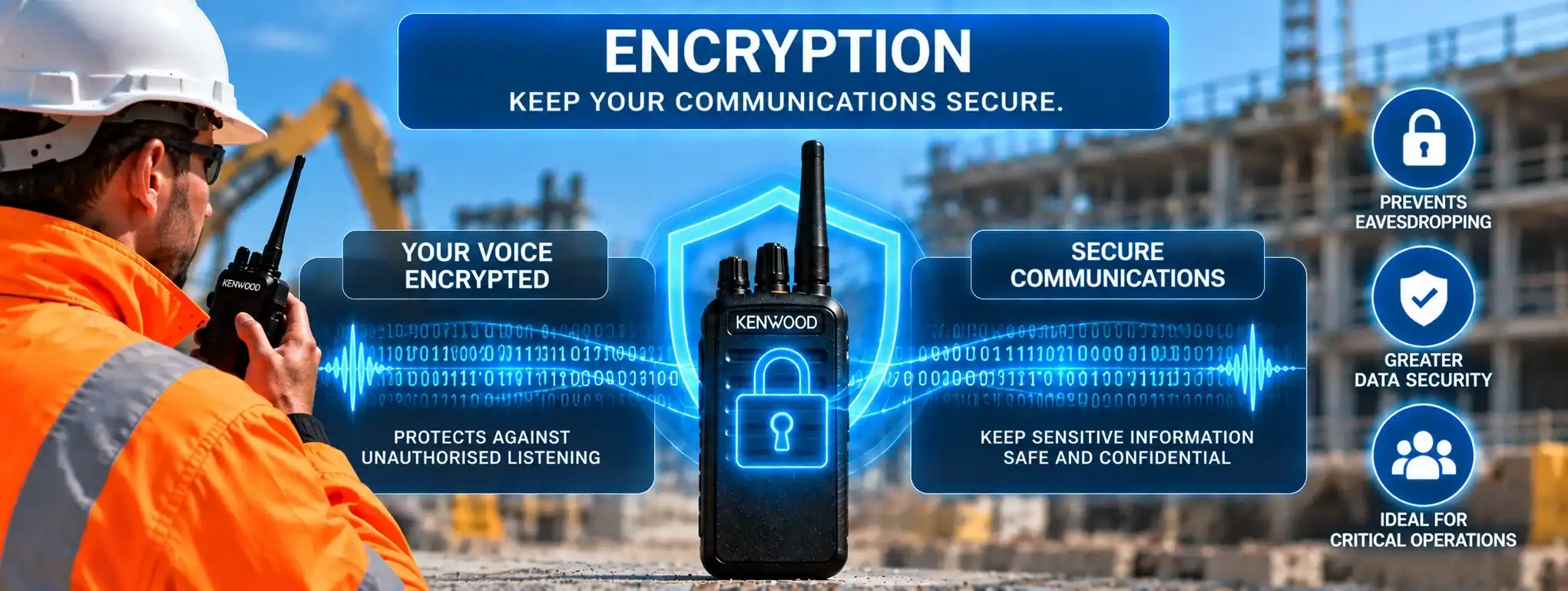
Encryption
Encryption is a security technology used in two-way radio systems to protect communications from unauthorised listening. It converts voice or data into a form that cannot be understood by someone who does not have the appropriate decryption capability or security key.
Encryption can be used to protect sensitive radio communications in environments such as security, public safety, transport, critical infrastructureRadio infrastructure is the equipment and supporting systems behind a professional two-way radio network, including repeaters, antennas, base stations, network connections, power systems and dispatch equipment. and commercial operations.
In an encrypted radio systemA Radio System is a complete communication solution comprising two-way radios and, where required, equipment such as repeaters, antennas, base stations, mobile radios and network infrastructure., the transmitting radio encrypts the voice or data before it is transmitted. The receiving radio uses the appropriate key or security information to decrypt the transmissionTransmission is the process of sending voice, data or signalling from a radio using a radio-frequency signal to another radio, repeater or communication system. and reproduce the original communication.
How does radio Encryption work?
A simplified encrypted communication process is:
Voice → Encryption → Radio transmission → Decryption → Voice
The transmitting radio applies an encryption algorithm to the digital voice or data.
The resulting transmission appears as unintelligible information to a receiverA Receiver is the part of a two-way radio that detects and processes incoming radio signals, converting them into audible voice or usable data for the user. that does not have the appropriate means of decrypting it.
A compatible receiving radio with the correct security configuration can decrypt the transmission and reproduce the original audio.
Encryption and digital radio
Encryption is most commonly associated with digital radio systems because digital voice can be processed using encryption algorithms before transmission.
Professional digital radio technologies, including DMR (Digital Mobile RadioA Mobile Radio is a two-way radio designed to be installed in a vehicle. It normally uses the vehicle's power supply and an external antenna to provide reliable communication while travelling or working in the field.), can support different levels and types of encryption depending on the equipment and system configuration.
Encryption is a security feature rather than a fundamental requirement of digital radio.
A digital radio can operate without encryption.
Encryption and DMR
DMR equipment can support encryption where the radio manufacturer and system configuration provide the appropriate functionality.
Different DMR manufacturers may offer different encryption options, key-management systems and security capabilities.
A radio must be correctly configured with compatible encryption settings for encrypted communications to work.
The exact capabilities vary between manufacturers and radio models.
AES Encryption
AES (Advanced Encryption Standard) is a widely used encryption standard that can be supported by professional digital radio systems.
AES uses a cryptographic key to encrypt and decrypt information.
In radio systems, AES can be used to protect digital voice and data communications from unauthorised interception.
The strength of an AES-based system depends not only on the algorithm but also on factors such as key management, implementation and configuration.
Encryption keys
An Encryption Key is the security information used by the radio to encrypt and decrypt communications.
The transmitting and receiving equipment must have compatible key information for encrypted communication to be understood.
Keys should be managed securely and should only be provided to authorised equipment and users.
Encryption key management
Effective encryption depends on proper key management.
Organisations using encrypted radio systems may need procedures covering:
- Creating keys
- Distributing keys
- Updating keys
- Replacing compromised keys
- Removing keys from lost radios
- Controlling access to keys
- Maintaining authorised radio lists
Poor key management can weaken an otherwise strong encryption system.
Encryption and radio programming
Encryption settings are normally included within the radio’s CodeplugA Codeplug is the configuration data programmed into a two-way radio that defines its channels, frequencies, talkgroups, radio ID and other operating features. or associated security configuration.
The radio may contain information defining which channels, talkgroups or communication functions use encryption.
Programming must be consistent across the radios that need to communicate.
If one radio is configured for encryption and another is not, they may be unable to communicate correctly on an encrypted channelA two-way radio channel is a programmed set of communication settings, typically including frequency and signalling, that allows compatible radios to communicate with one another..
Encrypted and unencrypted communications
A radio system can potentially contain both encrypted and unencrypted communication channels.
For example, an organisation might have:
- General Operations — unencrypted
- Security — encrypted
- Management — encrypted
Whether this arrangement is appropriate depends on the organisation’s communication and security requirements.
Encryption and talkgroups
Encryption can be applied to specific Talkgroups or communication channels.
This allows an organisation to protect sensitive communications without necessarily encrypting every radio communication on the entire system.
All radios that need to participate in an encrypted talkgroup must have the appropriate encryption configuration.
Encryption and individual calls
Depending on the radio system, encryption can also be used for Individual Calls between specific radios.
The receiving radio must support the relevant encryption method and possess the necessary key information.
The exact functionality depends on the radio technology and manufacturer.
Encryption and group calls
Encrypted Group Calls allow multiple authorised radios to communicate while protecting the voice traffic from unauthorised listeners.
Every participating radio needs compatible encryption settings.
This can be useful where a team needs to discuss sensitive operational information over a shared communication group.
Encryption and voice communications
In a digital radio system, encryption can be applied to the digital voice information before it is transmitted.
The radio receiver then decrypts the information before converting it back into audible speech.
The user normally does not need to perform any manual encryption or decryption.
When correctly configured, encryption operates automatically in the background.
Encryption and data
Encryption is not limited to voice.
Some digital radio systems can also use encryption to protect data communications.
Depending on the equipment, this can include information such as:
- Text messages
- Location information
- TelemetryTelemetry is the automatic collection and transmission of information from a remote device, vehicle, machine or radio to another location for monitoring, analysis or control.
- Status information
- Other digital data
The specific data that can be encrypted depends on the radio system.
Encryption and radio interception
Without appropriate encryption, digital radio transmissions may potentially be received by other compatible equipment within radio range.
Encryption is intended to prevent an unauthorised receiver from understanding the protected communication.
However, encryption should not be described as making a radio transmission invisible.
The radio signal still exists and can potentially be detected or recorded as a radio-frequency transmission.
Encryption protects the content rather than preventing the existence of the transmission.
Encryption and radio monitoring
Encryption can prevent ordinary radio-monitoring equipment from decoding protected communications.
A receiver may detect that a transmission is taking place but will not normally be able to reproduce the protected voice content without the appropriate cryptographic capability and keys.
This is particularly important for organisations handling sensitive operational information.
Encryption and security
Encryption can provide an additional layer of protection for radio communications.
It can be useful where radio users may discuss information such as:
- Security incidents
- Access arrangements
- Personnel movements
- Operational procedures
- Sensitive customer information
- Security responses
The level of protection required depends on the nature of the communication.
Encryption is not the same as privacy codes
Encryption should not be confused with CTCSS or DCS privacy codes.
CTCSS and DCS are primarily used to control which radios respond to a particular signal.
They do not provide cryptographic protection of the voice communication.
A radio using a CTCSS or DCS tone can still transmit voice that may be received by other equipment capable of monitoring the frequencyAn antenna transmits and receives radio-frequency signals, allowing a two-way radio to communicate. Antenna type, frequency, height and location can all affect radio performance and coverage..
Encryption, by contrast, is intended to protect the content of the communication.
Encryption and CTCSS
CTCSS is an analogue signalling system used to control access to a channel or prevent a radio from opening its speaker for transmissions without the correct tone.
It is sometimes incorrectly described as a privacy feature.
CTCSS does not encrypt the voice transmission.
Encrypted digital communication provides a fundamentally different type of security.
Encryption and DCS
DCS is another signalling method used in analogue radioAnalogue radio uses continuously varying radio signals to transmit voice communication. It remains widely used for reliable two-way communication across business, industry, events, security and other applications. systems.
Like CTCSS, it can help control which radios respond to transmissions but does not encrypt the voice itself.
A radio system should therefore not be described as secure simply because it uses CTCSS or DCS.
Encryption and scrambling
Scrambling is sometimes used as a general term for techniques that make voice communications difficult to understand.
However, scrambling and modern cryptographic encryption are not necessarily equivalent.
Some older analogue radio systems used voice-scrambling techniques that provided limited protection and could potentially be defeated with suitable equipment.
Modern encryption systems use established cryptographic algorithms and key management.
The precise level of security depends on the technology implemented.
Encryption and analogue radio
Some analogue radio systems have historically offered voice-scrambling or analogue encryption features.
These systems generally differ significantly from modern digital cryptographic encryption.
Where strong communication security is required, the capabilities of the specific radio system should be assessed rather than assuming that any feature described as scrambling provides equivalent protection to modern encryption.
Encryption and AES-256
Some professional radio systems support AES-256 encryption.
The “256” refers to the length of the cryptographic key used by AES.
AES-256 is a recognised strong encryption configuration when correctly implemented and securely managed.
However, the security of a complete radio system depends on more than the key length. Hardware implementation, key management, software, configuration and operational procedures are also important.
Encryption and key rotation
Some advanced systems support changing encryption keys periodically.
Regular key changes can reduce the potential impact if a key is compromised.
The appropriate key-management policy depends on the organisation, radio system and security requirements.
Encryption and lost radios
A lost or stolen radio containing encryption keys can present a security concern.
Professional radio systems may provide mechanisms for removing, changing or disabling security credentials.
Where supported, organisations should have procedures for dealing with lost or compromised radios.
The appropriate response depends on the security architecture of the radio system.
Encryption and radio hire
Encrypted radio systems can be used for temporary operations where sensitive communications need additional protection.
For example, a professional event or security operation may require encrypted communications between selected personnel.
The hire company needs to ensure that all participating radios have compatible encryption configuration and that the necessary security procedures are in place.
Encryption and radio compatibility
Two radios cannot necessarily communicate simply because they both advertise encryption.
They must support compatible:
- Encryption technology
- Encryption algorithm
- Key configuration
- Radio programming
- Communication mode
- NetworkA Network is a connected system of radios, equipment and infrastructure that allows users to communicate across a defined area. Radio networks can range from simple radio-to-radio systems to large multi-site networks. or repeaterA Repeater receives a two-way radio transmission and retransmits it, usually from an elevated location, to extend the coverage and reliability of a radio communication system. configuration
Encryption compatibility should therefore be confirmed when combining equipment from different manufacturers or suppliers.
Encryption and repeaters
Encrypted radio communications can normally pass through compatible digital radio infrastructure such as repeaters.
The repeater may relay the encrypted information without needing to decrypt the voice itself, depending on the system architecture.
The precise handling of encryption depends on the technology and network design.
End-to-end encryption
End-to-End EncryptionEnd-to-End Encryption protects radio communications between authorised endpoints, keeping voice or data encrypted through the network until it reaches the intended receiving device. (E2EE) means that communication is encrypted at the source and remains protected until it reaches the intended receiving endpoint.
The exact meaning and implementation of end-to-end encryption can vary between radio systems.
It is important to distinguish end-to-end encryption from systems where communication is decrypted at an intermediate network or infrastructure component.
Encryption and cloud radio systems
Modern Cloud ManagementCloud Management uses an online platform to remotely manage and monitor compatible two-way radios, users, devices and communication settings from a central location. and cloud-based radio systems can incorporate encryption and security controls.
The underlying radio communication may be protected using encryption while management, authentication and other system functions are handled through connected infrastructure.
The security architecture depends on the particular platform.
Encryption and compliance
Organisations may have legal, contractual or internal requirements concerning the protection of communications.
Encryption can form part of a wider information-security strategy.
However, using encryption does not by itself guarantee regulatory or security compliance.
Organisations should consider their complete system, data, access controls and operating procedures.
Encryption limitations
Encryption provides protection against unauthorised access to the content of communications, but it is not a complete security solution.
Potential risks can include:
- Compromised encryption keys
- Poor key management
- Lost radios
- Incorrect programming
- Unauthorised access to radio equipment
- Weak security procedures
- Vulnerabilities in equipment or software
The overall security of a radio system therefore depends on both technology and operational controls.
Encryption and radio system design
When designing an encrypted radio system, consideration should be given to:
- What communications require protection
- Which encryption standard is appropriate
- How keys will be managed
- Which radios need access
- How lost radios will be handled
- Whether repeaters and dispatch systems support encryption
- How the system will be maintained
- How encryption will be tested
Security requirements should be established before equipment is selected and programmed.
Encryption and DCS
DCS can provide professional digital radio systems with encryption where supported by the selected equipment.
Depending on the application, encrypted communications can be incorporated into handheld, mobile, base-station, repeater and dispatch systems.
The appropriate encryption technology and configuration depend on the sensitivity of the communications, equipment capabilities and operational requirements.
For demanding environments where reliable communications are essential, professional two way radio hire gives your team the equipment they need.