Telemetry
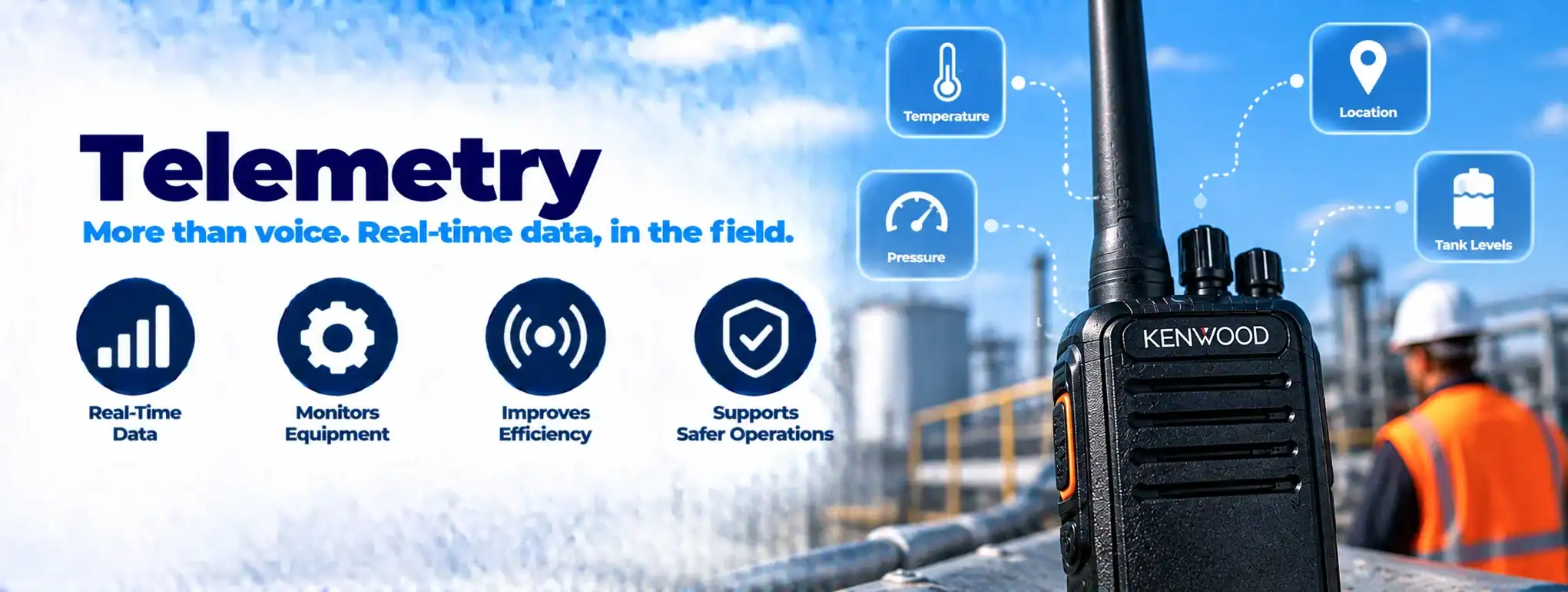
Telemetry is the automatic collection and transmissionTransmission is the process of sending voice, data or signalling from a radio using a radio-frequency signal to another radio, repeater or communication system. of information from a remote device, vehicle, machine or system to another location for monitoring, analysis or control.
In two-way radio systems, telemetry can allow radios or connected equipment to send information such as status, location, alarms or equipment data over a radio networkA Network is a connected system of radios, equipment and infrastructure that allows users to communicate across a defined area. Radio networks can range from simple radio-to-radio systems to large multi-site networks..
Telemetry is different from ordinary voice communication because the information is transmitted automatically or electronically rather than being spoken by the user.
What is telemetry?
Telemetry involves three basic stages:
Measure or detect → Transmit data → Receive and monitor
For example, a vehicle-mounted radio systemA Radio System is a complete communication solution comprising two-way radios and, where required, equipment such as repeaters, antennas, base stations, mobile radios and network infrastructure. could transmit the vehicle’s location to a control room.
A radio network can therefore carry both voice communications and data.
Telemetry and two-way radio
Professional two-way radio systems can support telemetry alongside voice communication.
Depending on the system, telemetry data can include:
- Equipment status
- Vehicle location
- Alarm conditions
- Sensor readings
- Battery status
- User status
- Machine information
- Operational data
The exact capabilities depend on the radio technology and system infrastructureRadio infrastructure is the equipment and supporting systems behind a professional two-way radio network, including repeaters, antennas, base stations, network connections, power systems and dispatch equipment..
Telemetry vs voice communication
Voice communication involves a user speaking into a radio.
Telemetry involves data being generated and transmitted automatically or electronically.
For example:
Voice: “Vehicle 12 has arrived.”
Telemetry: Vehicle 12 automatically reports its location and status.
Both can potentially use the same wider communications infrastructure.
Telemetry and data
Telemetry is a form of data communication.
Instead of transmitting a person’s voice, the radio system transmits information in a digital format.
The receiving system can then interpret and display the information.
Telemetry and digital radio
Telemetry is particularly suited to digital radio systems because digital networks can carry both voice and data.
Technologies such as DMR (Digital Mobile RadioA Mobile Radio is a two-way radio designed to be installed in a vehicle. It normally uses the vehicle's power supply and an external antenna to provide reliable communication while travelling or working in the field.) can support various data applications alongside voice communications, subject to the capabilities and configuration of the equipment.
Telemetry and DMR
DMR systems can support data services that can be used for telemetry applications.
Depending on the system, this can include information such as:
- GPS location
- Status messages
- Short data messages
- Alarm signals
- Device information
The available data capacity is limited compared with conventional broadbandBroadband is a high-speed data connection used by systems such as PoC radio to carry voice, video and other communications over mobile networks, Wi-Fi or IP networks. networks, so telemetry applications should be designed appropriately.
Telemetry and GPS
GPS (Global Positioning System)GPS is a satellite-based positioning system that allows compatible two-way radios to determine their location. GPS data can support tracking, dispatch, fleet management and Geo-Fencing. is a common source of telemetry information.
A radio with an integrated GPS receiverA Receiver is the part of a two-way radio that detects and processes incoming radio signals, converting them into audible voice or usable data for the user. can determine its location and transmit that information to a control or monitoring platform.
For example:
Radio → GPS position → Radio network → Control system
The control system can then display the user’s or vehicle’s location.
Telemetry and vehicle tracking
Vehicle-mounted radios can transmit location and status information to a central system.
This can support fleet-management applications such as:
- Vehicle location
- Journey monitoring
- Dispatch
- Route management
- Arrival notifications
- Vehicle status
Telemetry and workforce tracking
Portable radios with GPS can potentially provide location information for mobile workers.
This can help supervisors or control rooms understand where field personnel are operating, where supported by the system and appropriate policies.
Telemetry and dispatch
Telemetry can work alongside a Dispatch system.
A dispatcher may be able to view information such as:
- Radio location
- Radio status
- Vehicle location
- Emergency alerts
- Status messages
This provides information in addition to voice communication.
Telemetry and control rooms
A control room can receive telemetry from multiple radios or connected devices.
Information can be displayed on software dashboards, maps or management systems.
For example:
Radio 1 → Location
Radio 2 → Location
Vehicle 3 → Status
Vehicle 4 → Alarm
This can give the operator an overview of the operational system.
Telemetry and emergency alerts
Telemetry can be used to transmit automatic alerts.
For example, a compatible radio may send an emergency status when the user activates an emergency buttonAn Emergency Button is a dedicated two-way radio control that allows users to quickly send an emergency alert to a dispatcher, control room or authorised radio users..
Other safety functions, such as Man DownMan Down is a safety feature on some professional two-way radios that can detect a possible fall or unusual radio position and automatically raise an alert if the user does not respond. or Lone WorkerA Lone Worker is someone who works without direct supervision or immediate assistance nearby. Compatible two-way radios can provide safety features such as timed check-ins, emergency alerts and GPS location., can also generate data or signalling that is transmitted to a control system.
Telemetry and Man Down
A radio with a Man Down function can detect an unusual orientation or lack of movement, depending on the system.
If an alert condition is detected, the radio can send an automatic notification through the radio system.
This is an example of telemetry or automated signalling being used for worker safetyWorker Safety refers to measures used to protect employees from workplace risks. Two-way radios can support worker safety through instant communication, emergency alerts, Lone Worker and Man Down functions..
Telemetry and Lone Worker
A Lone Worker system can use telemetry or status signalling to monitor users working alone.
Depending on the system, the radio may transmit:
- Periodic status information
- Location
- Alarm conditions
- Emergency alerts
The receiving system can then alert a supervisor or control room.
Telemetry and alarms
Telemetry can transmit alarm information from connected equipment.
For example, a radio network could potentially carry an alert indicating that a monitored machine has entered a fault condition.
The receiving system can then display the alarm to an operator.
Telemetry and sensors
Telemetry systems can collect information from sensors.
Possible sensor information includes:
- Temperature
- Pressure
- Motion
- Door status
- Tank level
- Machine status
The radio network provides the communication path for the data.
Telemetry and industrial systems
Industrial environments can use telemetry to monitor remote equipment and operational conditions.
Radio-based telemetry can be useful where wired network connections are impractical or where equipment is mobile.
Telemetry and agriculture
Agricultural operations can use telemetry to monitor equipment and vehicles.
Potential applications include:
- Tractor location
- Machinery status
- Equipment monitoring
- Environmental sensors
- Remote alarms
Radio-based telemetry can be particularly useful across large sites where mobile equipment operates beyond the reach of conventional wired networks.
Telemetry and transport
Transport operations can use telemetry to provide information about vehicles and operational equipment.
Examples include:
- Vehicle location
- Fleet status
- Driver status
- Depot movements
- Arrival information
Telemetry can complement voice communication between drivers and control rooms.
Telemetry and security
Security operations can use telemetry alongside radio communications.
For example, a security organisation could use compatible radios to provide:
- Officer location
- Emergency alerts
- Radio status
- Patrol information
This can give supervisors additional operational information without relying entirely on voice reports.
Telemetry and events
Large events can use location and status telemetry to support operational management.
For example, compatible radios can potentially provide the location of security or event personnel to a control room.
This can help coordinate teams across large venues or event sites.
Telemetry and radio hire
Telemetry features can sometimes be included in professional Radio HireRadio Hire is the temporary rental of two-way radios and related communication equipment for events, projects and operational requirements, providing professional communication without purchasing the equipment. systems where the equipment and software support them.
Potential applications include:
- GPS tracking
- Emergency alerts
- Status reporting
- Vehicle tracking
- Worker location
Not all hired radios support telemetry, so the required functionality should be specified when planning the system.
Telemetry and PoC
Push-to-Talk over Cellular (PoC)Push-to-Talk over Cellular (PoC) provides radio-style push-to-talk communication over cellular or IP networks, allowing users to communicate across wide areas where suitable network connectivity is available. systems can provide extensive data capabilities because they operate over cellular networks.
Depending on the platform, telemetry-style information can include:
- GPS location
- Device status
- User status
- Alerts
- Application data
PoC systems can therefore combine PTT voice communication with data services.
Telemetry and SIM cards
PoC devices normally use a SIM CardA SIM Card (Subscriber Identity Module) identifies and authenticates a device or subscriber on a mobile network, providing cellular connectivity for systems such as Push-to-Talk over Cellular (PoC). or eSIM to connect to a mobile network.
The cellular connection provides the data path used to transmit information to the PoC platform.
Telemetry and hybrid communication
A Hybrid CommunicationHybrid Communication combines two or more communication technologies, such as two-way radio, DMR, cellular, Wi-Fi or IP networks, allowing different systems or users to communicate through a common platform. system can combine radio and cellular technologies.
For example:
DMR radio → Radio network
PoC device → Cellular network
Control platform → Combined operational view
This can allow voice and data from different communication technologies to be managed through a common platform where compatible systems are available.
Telemetry and GPS tracking
GPS tracking is one of the most common applications associated with radio telemetry.
A radio periodically determines its position and sends the coordinates to a monitoring system.
The monitoring software can then display the device on a map.
Telemetry intervals
Telemetry systems may transmit information continuously, periodically or when a specific event occurs.
For example:
Periodic: Send location every 30 seconds.
Event-based: Send an alert when an emergency button is pressed.
Status-based: Send information when the equipment changes state.
The appropriate method depends on the application and available network capacity.
Telemetry and network capacity
Telemetry consumes communication resources.
A system carrying large amounts of telemetry data may have less capacity available for other data or communications.
System design should therefore consider:
- Number of devices
- Data frequencyAn antenna transmits and receives radio-frequency signals, allowing a two-way radio to communicate. Antenna type, frequency, height and location can all affect radio performance and coverage.
- Message size
- CoverageRadio Coverage is the geographical area in which a two-way radio system can provide reliable communication. Coverage depends on the radios, antennas, frequency, terrain, buildings and system infrastructure.
- Available channels
- Network capacity
Telemetry and latency
LatencyLatency is the delay between a radio transmission being sent and the resulting voice or data being received. It can be introduced by digital processing, repeaters, IP networks, gateways and cloud systems. is the delay between information being generated and being received by the monitoring system.
Radio-based telemetry can have variable latency depending on the technology, network design and traffic levels.
For many monitoring applications, short delays are acceptable. Safety-critical applications may have more demanding requirements.
Telemetry and reliability
Telemetry is only useful when the communication path is reliable enough for the intended application.
Factors affecting reliability can include:
- Radio coverage
- InterferenceRadio interference occurs when unwanted radio-frequency signals or electrical noise disrupt two-way radio communications, causing distorted audio, broken transmissions, reduced coverage or loss of communication.
- Network availability
- Battery condition
- AntennaAn antenna transmits and receives radio-frequency signals, allowing a two-way radio to communicate. Antenna type, frequency, height and location can all affect radio performance and coverage. performance
- System capacity
A Site SurveyA Site Survey is an assessment of a location to determine whether a two-way radio system will provide the required coverage, reliability and performance. can help assess radio coverage before deploying a telemetry-based system.
Telemetry and encryption
Telemetry data may contain sensitive operational information.
Where supported, encryptionEncryption protects two-way radio communications by converting voice or data into a secure form that can only be understood by authorised radios with the correct encryption capability and keys. can help protect transmitted information from unauthorised access.
The appropriate security arrangements depend on the system and application.
Telemetry and interoperability
Different radio systems may implement telemetry in different ways.
Two radio systems operating on the same frequencyFrequency is the number of cycles a radio wave completes each second, measured in Hertz. In two-way radio, frequency determines where a transmission operates within the radio spectrum. are not necessarily able to exchange telemetry data.
Compatibility depends on the technology, protocols and system configuration.
Telemetry and interoperability gateways
A gateway can sometimes connect different communication systems.
For example, a gateway or software platform may combine information from radio and cellular devices.
The specific capabilities depend on the products and integration involved.
Telemetry and infrastructure
A telemetry system can involve more than the radio itself.
A complete system may include:
- Radio devices
- Repeaters
- Antennas
- Radio networks
- GPS receivers
- Servers
- Monitoring software
- Control-room consoles
- Cellular networks
The radio provides the communication link while the wider system processes and displays the information.
Telemetry and repeaters
A RepeaterA Repeater receives a two-way radio transmission and retransmits it, usually from an elevated location, to extend the coverage and reliability of a radio communication system. can provide the radio coverage required for telemetry communications.
If telemetry devices operate over a large geographical area, a repeater can extend the effective coverage of the radio network.
Telemetry and multi-site systems
Large organisations may use multiple radio sites.
Telemetry information can be transported between sites through network infrastructure, allowing information from geographically separated users or vehicles to reach a central monitoring system.
Telemetry and IP Site Connect
IP Site ConnectIP Site Connect links compatible DMR radio sites using an IP network, allowing selected radio communications to be shared between separate buildings, facilities or geographical locations. can link compatible DMR repeater sites over an IP network.
Where the system supports the relevant data functions, this can allow communications and associated information to move between connected sites.
Telemetry and radio programming
Telemetry functions may need to be configured within the radio programming and wider system.
Configuration can include:
- GPS reporting
- Reporting intervals
- Emergency signalling
- Status messages
- Radio IDs
- Data destinations
The available settings depend on the equipment and software.
Telemetry and battery life
Frequent telemetry transmissions can increase battery consumption on portable devices.
For battery-powered radios, the reporting frequency should therefore be balanced against the operational requirement.
Telemetry and mobile radios
Vehicle-mounted mobile radios can be well suited to telemetry applications because they can draw powerAn antenna transmits and receives radio-frequency signals, allowing a two-way radio to communicate. Antenna type, frequency, height and location can all affect radio performance and coverage. from the vehicle.
They may also use external antennas that provide improved RF performance compared with a handheld device.
Telemetry and portable radios
Portable radios can transmit telemetry such as GPS location and status information while being carried by users.
This can be useful for mobile workforces and security teams.
Telemetry and base stations
A Base StationA base station is a fixed two-way radio installed at a permanent location, allowing an operator to communicate with handheld or mobile radios across a site or operating area. can receive or transmit telemetry as part of a wider radio system.
The base station may connect the radio network to a control or monitoring system.
Telemetry and subscriber units
A Subscriber UnitA Subscriber Unit is a two-way radio device used by an individual or vehicle to access and communicate through a radio system. It can be a portable or mobile radio. can generate telemetry information and transmit it through the radio network.
For example, a portable DMR radio with GPS can operate as a subscriber unit while reporting its location.
Telemetry vs GPS
GPS and telemetry are not the same thing.
GPS determines a device’s geographical position.
Telemetry is the process of collecting and transmitting information.
GPS data can therefore be one type of telemetry.
Telemetry vs tracking
Tracking is an application that uses location information to monitor movement.
Telemetry is the broader process of transmitting information from a remote device.
A tracking system can therefore use telemetry to transmit GPS positions.
Telemetry limitations
Radio-based telemetry may have limitations compared with broadband data networks.
These can include:
- Limited data capacity
- Coverage limitations
- Battery consumption
- Latency
- Device compatibility
- Network capacity
The technology should therefore be selected according to the actual data requirements.
When is radio telemetry useful?
Radio telemetry can be useful where:
- Equipment is mobile.
- Users operate across large areas.
- Wired connectivity is impractical.
- Voice and data need to share infrastructure.
- Automatic alerts are required.
- Vehicle or workforce location is useful.
- Remote equipment needs monitoring.
Telemetry and DCS
DCS can provide professional two-way radio systems with data and telemetry capabilities where supported by the selected equipment and system architecture.
Telemetry can be incorporated alongside voice communications, GPS, emergency functions and dispatch to provide organisations with additional operational information.