
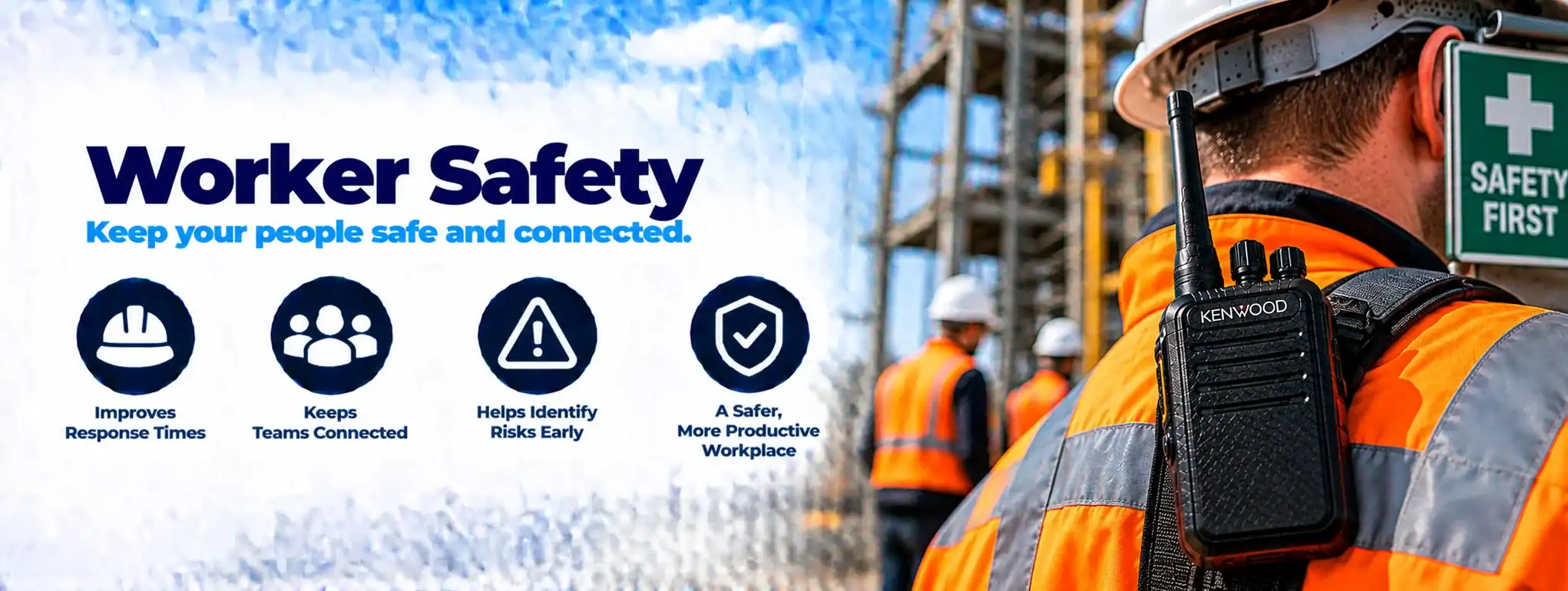
Worker Safety
Worker Safety refers to the measures, procedures and systems used to protect employees from hazards, injuries and other risks while carrying out their work. In professional two-way radio communications, radios can support worker safety by providing fast access to colleagues, supervisors, control rooms and emergency assistance.
Two-way radios do not replace formal workplace safety procedures, risk assessments or emergency arrangements. They provide a communication tool that can form part of a wider worker-safety system.
Worker safety and two-way radios
Two-way radios can help workers communicate quickly when assistance is needed.
A radio can provide:
- Instant push-to-talk communication
- Group communication
- Emergency alerts
- Lone WorkerA Lone Worker is someone who works without direct supervision or immediate assistance nearby. Compatible two-way radios can provide safety features such as timed check-ins, emergency alerts and GPS location. functions
- Man DownMan Down is a safety feature on some professional two-way radios that can detect a possible fall or unusual radio position and automatically raise an alert if the user does not respond. alerts
- Access to supervisors or control rooms
- Communication across large sites
The exact safety functions available depend on the radio equipment and system.
Worker safety communications
Clear communication is an important part of many workplace safety procedures.
Radio users can quickly report:
- Accidents
- Injuries
- Equipment problems
- Unsafe conditions
- Security incidents
- Fire or evacuation situations
- Requests for assistance
A well-designed radio systemA Radio System is a complete communication solution comprising two-way radios and, where required, equipment such as repeaters, antennas, base stations, mobile radios and network infrastructure. can help ensure that the appropriate people receive the information quickly.
Emergency radio communication
Professional two-way radios can provide dedicated emergency communication functions.
Depending on the system, an emergency buttonAn Emergency Button is a dedicated two-way radio control that allows users to quickly send an emergency alert to a dispatcher, control room or authorised radio users. can allow a worker to send an alert to:
- Other radio users
- Supervisors
- Security teams
- A control room
- Dispatch personnel
The precise operation depends on the radio and system configuration.
Emergency button
Many professional radios include a dedicated Emergency Button.
The button can be configured to initiate an emergency alert or priority transmissionTransmission is the process of sending voice, data or signalling from a radio using a radio-frequency signal to another radio, repeater or communication system..
This can provide a rapid way for a worker to request assistance without navigating menus or changing channels.
Worker safety and Lone Worker
Lone Worker functionality can provide additional protection for employees working alone or away from colleagues.
Depending on the system, a radio may:
- Prompt the worker for a response.
- Detect a failure to respond.
- Generate an alert.
- Send the alert to a supervisor or control room.
Lone Worker functionality should form part of a wider lone-worker procedure rather than being treated as a complete safety solution.
Worker safety and Man Down
Man Down is a radio feature designed to detect a configured condition such as an unusual radio orientation or lack of movement.
If the condition continues for a configured period, the radio can generate an alert where supported.
This can provide an additional means of raising an alarm if a worker is unable to operate the radio normally.
Worker safety and Push-to-Talk
The Push-to-Talk (PTT)Push-to-Talk (PTT) is the button or control used to activate a two-way radio's transmitter. Press it to speak and release it to listen. button provides immediate access to radio communication.
A worker can press PTT and speak to the relevant channelA two-way radio channel is a programmed set of communication settings, typically including frequency and signalling, that allows compatible radios to communicate with one another. or talk groupA Talk Group is a predefined group of users or radios within a two-way radio system that share a common communication group, allowing teams to communicate without involving other users. without dialling a telephone number.
This can be particularly useful for short operational messages.
Worker safety and Talk Groups
Talk Groups can organise radio users according to their responsibilities.
For example:
- Operations
- Security
- Maintenance
- Supervisors
- Emergency Response
This can help ensure that routine communications are separated from safety-critical communications.
Worker safety and Priority Call
A Priority CallPriority Call is a two-way radio feature that gives important or authorised communications higher priority than routine radio traffic, helping urgent messages access the system when channels are busy. can allow important communications to receive preferential treatment within supported radio systems.
The exact priority behaviour depends on the radio networkA Network is a connected system of radios, equipment and infrastructure that allows users to communicate across a defined area. Radio networks can range from simple radio-to-radio systems to large multi-site networks..
Priority functions should be configured according to the organisation’s communication procedures.
Worker safety and emergency priority
Some professional radio systems can prioritise emergency traffic over routine communications.
This can be particularly useful on busy radio networks where multiple teams are communicating simultaneously.
The available functionality depends on the radio technology and system architecture.
Worker safety and control rooms
A Control Room can provide a central point for receiving and coordinating safety-related radio communications.
For example:
Worker → Radio → Radio Network → Control Room
The control room can then coordinate an appropriate response according to the organisation’s procedures.
Worker safety and dispatch
A Dispatch system can allow authorised personnel to communicate with radio users and manage alerts.
Depending on the system, dispatch operators may be able to identify the radio that generated an emergency alert and communicate directly with the user.
Worker safety and GPS
Some professional digital radios include GPS.
Where supported, location information can help authorised personnel identify the approximate location of a radio user.
GPS performance can be reduced indoors, underground or in areas where satellite signals are obstructed.
Worker safety and indoor location
GPS is not always suitable for indoor worker-location requirements.
Some advanced systems can use other technologies, including Wi-FiWi-Fi is a wireless networking technology that connects compatible devices to a local or wider network. In radio systems, it can support programming, updates, data services and IP-based communications. or dedicated indoor-location infrastructureRadio infrastructure is the equipment and supporting systems behind a professional two-way radio network, including repeaters, antennas, base stations, network connections, power systems and dispatch equipment., to provide location information.
The accuracy depends on the technology and site configuration.
Worker safety and radio coverage
A safety-related radio system is only useful where adequate radio coverageRadio Coverage is the geographical area in which a two-way radio system can provide reliable communication. Coverage depends on the radios, antennas, frequency, terrain, buildings and system infrastructure. is available.
Coverage can be affected by:
- Building construction
- Distance
- Terrain
- Underground areas
- Metal structures
- Concrete
- Radio frequencyAn antenna transmits and receives radio-frequency signals, allowing a two-way radio to communicate. Antenna type, frequency, height and location can all affect radio performance and coverage.
- AntennaAn antenna transmits and receives radio-frequency signals, allowing a two-way radio to communicate. Antenna type, frequency, height and location can all affect radio performance and coverage. position
- InterferenceRadio interference occurs when unwanted radio-frequency signals or electrical noise disrupt two-way radio communications, causing distorted audio, broken transmissions, reduced coverage or loss of communication.
A Site SurveyA Site Survey is an assessment of a location to determine whether a two-way radio system will provide the required coverage, reliability and performance. can identify coverage requirements and potential dead spots.
Worker safety and repeaters
A RepeaterA Repeater receives a two-way radio transmission and retransmits it, usually from an elevated location, to extend the coverage and reliability of a radio communication system. can extend radio coverage across a large or difficult site.
This can be important where workers need to communicate across:
- Large warehouses
- Construction sites
- Industrial facilities
- Farms
- Hotels
- Multi-building sites
The repeater receives the radio transmission and retransmits it to extend the effective coverage area.
Worker safety and wide-area systems
Organisations operating across multiple sites can connect radio systems using network infrastructure such as a Wide Area Network (WAN)A Wide Area Network (WAN) connects networks across large geographical areas. In professional radio systems, WAN connectivity can link repeaters, radio sites and control rooms to provide wider-area communications..
This can allow selected safety communications and alerts to reach remote locations or central control rooms.
Worker safety and radio dead spots
A dead spotA Dead Spot is an area where two-way radio communication is weak, unreliable or unavailable. Dead spots can be caused by buildings, terrain, distance, interference or inadequate radio coverage. is an area where radio coverage is inadequate.
Safety-critical radio systems should identify and address coverage gaps wherever practical.
Possible solutions can include:
- Repeater installation
- Antenna changes
- Additional radio sites
- Network connectivity
- Alternative equipment
- System redesign
Worker safety in warehouses
Warehouses can contain hazards including moving vehicles, machinery, high-level storage and isolated work areas.
Radios can allow warehouse workers to communicate quickly with supervisors and colleagues.
Safety features such as Lone Worker and Man Down may be appropriate for particular roles.
Worker safety in construction
Construction sites can change continuously as buildingsAn antenna transmits and receives radio-frequency signals, allowing a two-way radio to communicate. Antenna type, frequency, height and location can all affect radio performance and coverage. and infrastructure develop.
Radio systems can support communication between:
- Site managers
- Supervisors
- Plant operators
- Ground workers
- Security
- Contractors
Because construction environments can be noisy, appropriate radios, microphones and Noise CancellationNoise Cancellation is technology used in two-way radios and communication equipment to reduce unwanted background noise and make speech easier to hear, particularly in noisy working environments. can improve communication.
Worker safety in manufacturing
Manufacturing environments may contain machinery, production lines and areas where mobile-phone use is unsuitable.
Professional radios can provide instant communication between operators, supervisors, maintenance teams and control rooms.
Where hazardous areas are present, appropriately certified equipment may be required.
Worker safety in agriculture
Agricultural workers can operate across large outdoor areas where mobile-phone coverage may be inconsistent.
Professional radio systems can provide communication between workers, vehicles, buildings and control points.
A suitable system may include portable radios, mobile radios and repeaters.
Worker safety in logistics
Logistics operations can involve warehouses, loading bays, vehicle yards and moving vehicles.
Radios can allow workers and supervisors to coordinate activities quickly and report safety concerns.
Worker safety in transport
Transport organisations can use radios to communicate between drivers, dispatchers, supervisors and operational teams.
Vehicle-mounted radios and portable radios can be combined where appropriate.
Worker safety in hospitality
Hotels, venues and large hospitality facilities can use radios to connect operational teams.
Safety-related communication can include:
- Security incidents
- Medical assistance
- Maintenance problems
- Evacuation
- Staff assistance
Worker safety for security personnel
Security personnel often need immediate communication with colleagues and control rooms.
Professional radios can provide dedicated security talk groups, emergency alerts and, where supported, location or Lone Worker functionality.
Worker safety in events
Large events can require coordinated communication between security, stewards, production staff, medical teams and event control.
Radio systems can provide separate talk groups while allowing authorised personnel to communicate across teams when required.
Worker safety and headsets
Headsets can allow workers to communicate while keeping their hands available for other tasks.
They can also improve the audibility of radio communications in some environments.
The appropriate headsetA radio headset combines a microphone and speaker or earpiece, allowing two-way radio users to communicate conveniently while keeping the radio away from their face or using hands-free operation. depends on the radio and working conditions.
Worker safety and Remote Speaker Microphones
A Remote Speaker Microphone (RSM)A Remote Speaker Microphone (RSM) is an external radio accessory combining a microphone, speaker and Push-to-Talk button, allowing users to operate a two-way radio without handling the radio itself. allows a user to operate the radio’s microphone and speaker without reaching for the radio itself.
This can make radio operation easier when the radio is attached to clothing or protective equipment.
Worker safety and hands-free communication
Voice Activation (VOX)Voice Activation (VOX) allows a two-way radio to transmit automatically when it detects speech, providing hands-free communication without pressing the Push-to-Talk (PTT) button. can provide hands-free radio transmission where supported.
However, VOX can be unsuitable in noisy environments because background sounds may activate the transmitter.
PTT may provide better control where precise transmission is important.
Worker safety and noise
High noise levels can make radio communication difficult.
Suitable equipment can include:
- Noise-cancelling microphones
- Headsets
- Hearing-protection headsets
- Remote speaker microphones
- Appropriate radio audio settings
The equipment should be selected for the actual working environment.
Worker safety and intrinsically safe radios
Where workers operate in potentially explosive or hazardous environments, specialist Intrinsically Safe Radios may be required.
These radios are designed and certified for specified hazardous environments.
The correct certification must match the particular workplace and hazard classification.
Worker safety and radio licensing
Radio licensing requirements depend on the radio service and frequencies being used.
In the UK, professional business radioBusiness Radio refers to professional two-way radio systems used by businesses and organisations for instant communication, often using licensed frequencies and equipment designed for commercial use. users may require an Ofcom Business Radio LicenceAn Ofcom Business Radio Licence authorises businesses and organisations in the UK to use specified radio frequencies for professional two-way radio communication, subject to the licence conditions..
Licence-free services such as PMR446 are also available for appropriate equipment and applications.
The radio system should be selected and operated in accordance with the applicable regulatory requirements.
Worker safety and radio reliability
Safety-related communications require reliable equipment.
Radio system design should consider:
- Coverage
- Battery life
- Equipment durability
- Network resilience
- Emergency functions
- User training
- Charging arrangements
- Maintenance
Worker safety and battery management
A radio with a depleted battery cannot provide communication when required.
Organisations using radios for operational or safety communications should have appropriate battery-management procedures.
These can include:
- Spare batteries
- Charging stations
- Multi-unit chargers
- Shift-based charging
- Battery testing
- Battery replacement
Worker safety and rugged radios
Rugged Radios can be appropriate for demanding working environments.
Depending on the model, they can provide protection against water, dust, impact and other environmental conditions.
The protection level should be appropriate for the workplace.
Worker safety and radio testing
Safety-related radio systems should be tested regularly to confirm that:
- Radios operate correctly.
- Batteries remain suitable.
- Coverage is adequate.
- Emergency functions work.
- Alerts reach the intended destination.
- Users understand operating procedures.
Testing requirements should be established by the organisation according to the risks and operational environment.
Worker safety and training
Radio users should understand how to operate the equipment and what to do during an emergency.
Training can cover:
- PTT operation
- Channel selection
- Talk groups
- Emergency buttons
- Lone Worker procedures
- Man Down
- Radio etiquette
- Battery charging
- Reporting equipment faults
Worker safety and radio procedures
A radio system should form part of a documented communication procedure.
Workers should know:
- Which channel to use.
- Who to contact.
- How to raise an emergency.
- What information to provide.
- What to do if the radio fails.
- What alternative communication method is available.
Worker safety and emergency procedures
Two-way radio should support, rather than replace, the organisation’s emergency procedures.
A complete workplace emergency plan may also include:
- Emergency services
- First aid
- Evacuation procedures
- Fire procedures
- Risk assessments
- Incident reporting
- Alternative communications
Worker safety and mobile phones
Mobile phones can provide an additional communication method, but they are not always ideal for operational radio communication.
Two-way radios provide instant group communication and can be designed to operate across dedicated coverage areas.
A robust workplace may use both technologies as complementary communication methods.
Worker safety and PoC
Push-to-Talk over Cellular (PoC)Push-to-Talk over Cellular (PoC) provides radio-style push-to-talk communication over cellular or IP networks, allowing users to communicate across wide areas where suitable network connectivity is available. can provide wide-area push-to-talk communication using cellular or Wi-Fi networks.
PoC can be useful for organisations that require communication across geographically separated sites.
Its reliability depends on the availability of the underlying network.
Worker safety and Wi-Fi
Wi-Fi can support some IP-based communication systems and radio-management functions.
However, Wi-Fi coverage should not automatically be assumed to provide suitable coverage for a safety-critical radio application.
The required technology should be assessed against the actual operating environment.
Worker safety and communication redundancy
Where communications are safety-critical, organisations may consider having alternative communication methods available.
Depending on the operation, these might include:
- Two-way radio
- Mobile phone
- Fixed telephone
- Public-address system
- Emergency alarmAn Emergency Alarm allows a two-way radio user to quickly alert a dispatcher, control room or other authorised users that assistance may be required.
- Face-to-face procedures
The appropriate arrangement depends on the workplace risk assessment.
Worker safety limitations
A two-way radio cannot prevent an accident or guarantee emergency assistance.
Its effectiveness depends on:
- Radio coverage
- Battery condition
- Equipment reliability
- Correct configuration
- User training
- Appropriate procedures
- Availability of the receiving team
Radio safety features should therefore be treated as one component of a wider worker-safety strategy.
Choosing radios for worker safety
When selecting a radio system where worker safety is an important consideration, assess:
- Coverage requirements.
- Number of workers.
- Lone-worker risks.
- Emergency requirements.
- Man Down requirements.
- Indoor and outdoor environments.
- Noise levels.
- Hazardous-area requirements.
- Battery requirements.
- Control-room requirements.
- Repeater requirements.
- Licensing.
- User training.
- System resilience.
Worker safety and DCS
DCS can supply professional two-way radio systems designed around workplace communication requirements.
Depending on the application, a system can include portable radios, repeaters, emergency functions, Lone Worker and Man Down features, accessories and control-room communications.
The appropriate radio system should always be selected around the organisation’s actual operational and safety requirements.