Talk Group
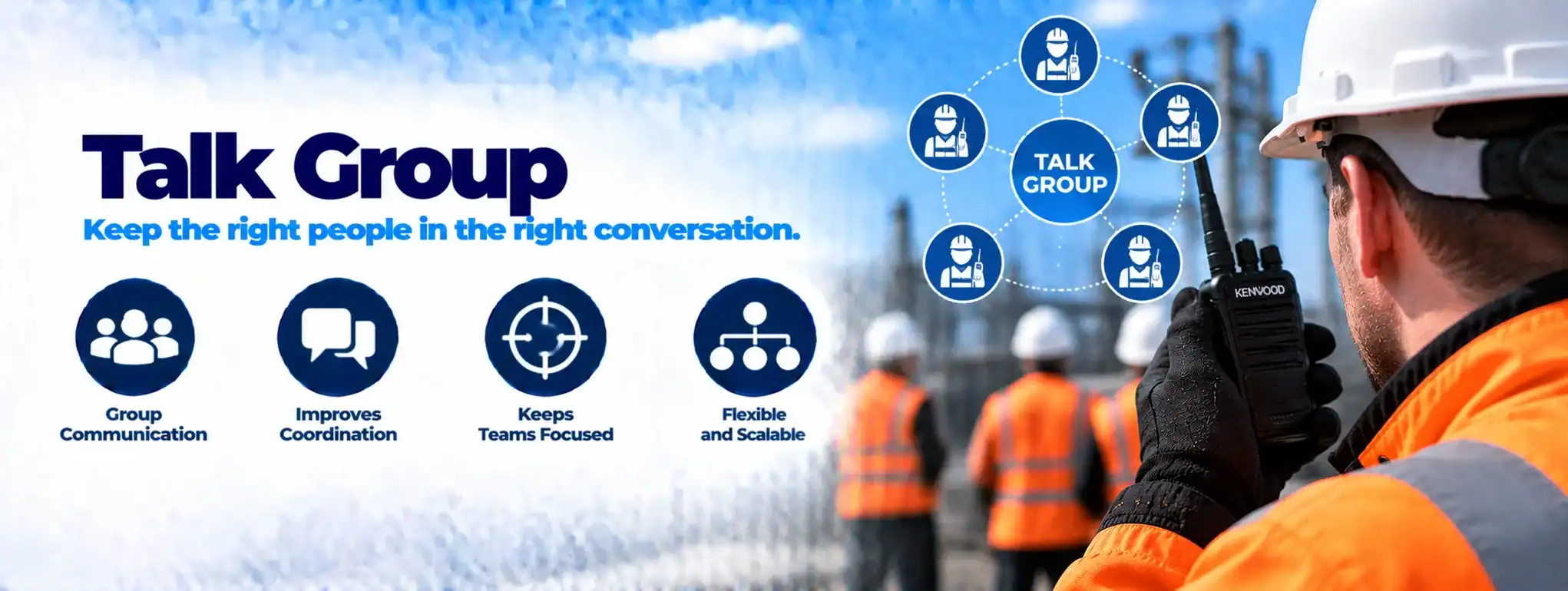
A Talk Group is a predefined group of users or radios within a two-way radio systemA Radio System is a complete communication solution comprising two-way radios and, where required, equipment such as repeaters, antennas, base stations, mobile radios and network infrastructure. that share a common communication channelA two-way radio channel is a programmed set of communication settings, typically including frequency and signalling, that allows compatible radios to communicate with one another. or virtual communication group. Talk groups allow different teams, departments or operational roles to communicate without every radio on the wider system hearing the conversation.
Talk groups are particularly common in DMR (Digital Mobile RadioA Mobile Radio is a two-way radio designed to be installed in a vehicle. It normally uses the vehicle's power supply and an external antenna to provide reliable communication while travelling or working in the field.) and other professional digital radio systems.
For example, a company could have separate talk groups for:
- Security
- Management
- Maintenance
- Operations
- Events
A user selects the appropriate talk group and presses Push-to-Talk (PTT)Push-to-Talk (PTT) is the button or control used to activate a two-way radio's transmitter. Press it to speak and release it to listen. to communicate with the members of that group.
How does a talk group work?
A talk group is essentially a defined communication group within the radio system.
For example:
Security RadioA Security Radio is a professional two-way radio used by security personnel to communicate quickly and reliably, with features such as group calling, emergency alerts, Lone Worker and Man Down. → Security Talk Group → Security Radios
A transmissionTransmission is the process of sending voice, data or signalling from a radio using a radio-frequency signal to another radio, repeater or communication system. to the Security talk group is delivered to radios configured to monitor that group, rather than automatically being heard by every user on the entire radio networkA Network is a connected system of radios, equipment and infrastructure that allows users to communicate across a defined area. Radio networks can range from simple radio-to-radio systems to large multi-site networks..
Talk group vs channel
A talk group and a radio channel are related but are not necessarily the same thing.
A Channel normally refers to a configured radio-frequency resource and its associated settings.
A Talk Group is a logical group of users within the radio system.
In a digital system, multiple talk groups can potentially share the same physical radio-frequency resources through technologies such as time slots.
Talk groups in DMR
Talk groups are a fundamental feature of many DMR systems.
DMR uses digital signalling to identify the intended communication group.
For example:
Talk Group 1 → Security
Talk Group 2 → Operations
Talk Group 3 → Management
The radios can be programmed with the relevant talk groups and users can select the group they need.
Talk group ID
Digital radio systems normally assign a numerical Talk Group ID (TGID) to each talk group.
For example:
TGID 101 → Security
TGID 102 → Maintenance
The actual numbering is determined by the radio system and its programming.
Talk group and group call
A Group Call is a communication addressed to a particular talk group.
When a user transmits to the group, compatible radios monitoring that talk group can receive the call.
Talk group and private call
A Private CallPrivate Call is a two-way radio feature that allows one radio user to communicate directly with another individual radio user rather than making the conversation part of a general group call. is directed towards an individual radio rather than an entire talk group.
For example:
Group Call → Security team
Private Call → Security supervisor
Both functions can exist within the same digital radio system.
Talk group and all call
Some radio systems support an All Call function.
This allows an authorised user to communicate with a wider group of radios, potentially all radios within the system.
The exact behaviour depends on the radio system and configuration.
Talk groups and radio IDs
Each radio in a digital system can have its own Radio ID.
The Talk Group ID identifies the communication group, while the Radio ID identifies an individual subscriber unitA Subscriber Unit is a two-way radio device used by an individual or vehicle to access and communicate through a radio system. It can be a portable or mobile radio..
For example:
Radio ID 125 → Individual radio
Talk Group ID 10 → Security team
Talk groups and subscriber units
A Subscriber Unit can be programmed to access one or more talk groups.
This allows the same radio to be used by a worker who needs to communicate with different teams.
For example, a supervisor’s radio could contain:
Channel 1 — Security
Channel 2 — Operations
Channel 3 — Management
Each channel can be associated with a different talk group.
Talk groups and scan lists
A radio can sometimes be configured to Scan multiple talk groups.
This allows a user to monitor communications from several groups without manually switching between them.
The radio’s programming determines how scanning operates.
Talk groups and priority
Some radio systems allow particular talk groups to have priority within a scan listA Scan List is a programmed collection of channels or talkgroups that a two-way radio monitors automatically when its scanning function is enabled. or communication system.
This can ensure that important communications are more likely to be heard.
Priority handling varies between radio technologies and manufacturers.
Talk groups and emergency calls
Professional digital radio systems can associate emergency functions with specific talk groups.
For example, an emergency transmission from a security officer could be directed to the security control group.
Some systems can also route emergency alerts to designated control-room or supervisory users.
Talk groups and control rooms
Control rooms can use talk groups to organise communications between different operational teams.
For example:
Control Room
↳ Security Talk Group
↳ Maintenance Talk Group
↳ Operations Talk Group
↳ Management Talk Group
This allows the control operator to communicate with the appropriate team without unnecessarily interrupting other users.
Talk groups and dispatch
A radio dispatch system can allow an operator to select different talk groups from a central console.
The dispatcher may be able to:
- Select a talk group
- Make a group call
- Make an individual call
- Monitor groups
- Send emergency alerts
- Manage radio users
The available features depend on the system.
Talk groups and repeaters
A RepeaterA Repeater receives a two-way radio transmission and retransmits it, usually from an elevated location, to extend the coverage and reliability of a radio communication system. can support multiple talk groups on compatible digital systems.
The repeater provides the RF coverageRadio Coverage is the geographical area in which a two-way radio system can provide reliable communication. Coverage depends on the radios, antennas, frequency, terrain, buildings and system infrastructure. while the digital system determines which radios receive a particular group communication.
This allows several operational teams to share radio infrastructureRadio infrastructure is the equipment and supporting systems behind a professional two-way radio network, including repeaters, antennas, base stations, network connections, power systems and dispatch equipment..
Talk groups and DMR time slots
DMR uses two time slots within a standard 12.5 kHz RF channel.
This can allow two separate conversations to use the same RF channel at different times.
Talk groups can therefore be associated with particular time slots in a DMR system.
For example:
Time Slot 1 → Security Talk Group
Time Slot 2 → Operations Talk Group
The exact configuration depends on the system design.
Talk groups and pseudo trunking
Pseudo TrunkingPseudo Trunking is a feature on some professional digital radio systems that allows multiple communication groups to share available radio resources more efficiently, without requiring a full trunked radio network. can allow compatible DMR systems to make more efficient use of available time slots.
When a user initiates a call, the system can use an available time slot rather than permanently assigning one to a particular group.
The implementation varies by manufacturer.
Talk groups and trunked radio
In a Trunked Radio system, talk groups can be dynamically assigned radio resources by the network.
Users select a talk group rather than manually selecting a specific frequencyAn antenna transmits and receives radio-frequency signals, allowing a two-way radio to communicate. Antenna type, frequency, height and location can all affect radio performance and coverage..
The network then manages the underlying radio resources.
Talk groups and conventional radio
Conventional analogue radioAnalogue radio uses continuously varying radio signals to transmit voice communication. It remains widely used for reliable two-way communication across business, industry, events, security and other applications. systems do not normally use talk groups in exactly the same way as digital trunked systems.
However, groups of users can be configured to share channels using signalling such as CTCSS or DCS.
The term “talk group” is therefore particularly associated with digital and trunked radio systems.
Talk groups and CTCSS
CTCSS can allow radios sharing a frequencyFrequency is the number of cycles a radio wave completes each second, measured in Hertz. In two-way radio, frequency determines where a transmission operates within the radio spectrum. to respond only to transmissions using the programmed tone.
This can provide a group-like communication arrangement.
However, CTCSS is technically a squelch-control system and is not equivalent to a digital talk group.
Talk groups and DCS
DCS provides a similar function using digital coded squelchAnalogue radio uses continuously varying radio signals to transmit voice communication. It remains widely used for reliable two-way communication across business, industry, events, security and other applications..
Compatible radios can be programmed with different codes to control which transmissions open the receiverA Receiver is the part of a two-way radio that detects and processes incoming radio signals, converting them into audible voice or usable data for the user..
Again, this should not be confused with a digital DMR talk group.
Talk groups and privacy
A talk group does not automatically make a conversation private.
Other users may be able to monitor the same communication if they have compatible equipment and are configured appropriately.
Talk groups provide communication organisation, not necessarily communication security.
Talk groups and encryption
Where confidentiality is required, compatible radio systems can use EncryptionEncryption protects two-way radio communications by converting voice or data into a secure form that can only be understood by authorised radios with the correct encryption capability and keys..
Encryption protects the content of communications, while talk groups determine which users are intended to participate.
These are separate functions.
Talk groups and interoperability
Talk groups can affect InteroperabilityInteroperability is the ability of different communication systems, devices or organisations to work together and exchange information. In two-way radio, it can connect different radio networks, technologies or users through compatible systems or gateways. between different radios and systems.
Radios need compatible technology, programming and system configuration to participate in the same talk group.
Two radios operating on the same frequency are not necessarily capable of communicating with one another.
Talk groups and roaming
In a multi-site radio network, talk groups can be carried across multiple radio sites.
A user can therefore potentially move between coverage areas while continuing to communicate with the same operational group.
This depends on the network’s RoamingRoaming allows a compatible two-way radio to move between different radio sites or coverage areas, automatically selecting an appropriate site as the user moves. and talk-group configuration.
Talk groups and IP Site Connect
IP Site ConnectIP Site Connect links compatible DMR radio sites using an IP network, allowing selected radio communications to be shared between separate buildings, facilities or geographical locations. can link compatible DMR repeaters over an IP network.
This can allow a talk group to be available across multiple geographically separated sites.
For example:
Site A → IP Network → Site B
A user at Site A can communicate with users at Site B through the connected system where the relevant talk group is configured.
Talk groups and wide-area radio
Talk groups are particularly useful for wide-area radio systems.
A large organisation can have users spread across multiple locations while maintaining defined communication groups.
For example:
North Site Security
South Site Security
National Operations
Each can have its own talk group.
Talk groups and hybrid communication
A Hybrid CommunicationHybrid Communication combines two or more communication technologies, such as two-way radio, DMR, cellular, Wi-Fi or IP networks, allowing different systems or users to communicate through a common platform. system can connect conventional radio users with other communication technologies.
Depending on the platform, talk groups may be linked to:
- DMR radios
- PoC devices
- Dispatch consoles
- Smartphones
- Other communication systems
The exact interoperability depends on the technology and gateway or platform used.
Talk groups and Push-to-Talk over Cellular
Push-to-Talk over Cellular (PoC)Push-to-Talk over Cellular (PoC) provides radio-style push-to-talk communication over cellular or IP networks, allowing users to communicate across wide areas where suitable network connectivity is available. systems commonly use group-based communication.
Users can be assigned to groups and communicate using PTT over a cellular data connection.
The terminology may differ between PoC platforms, but the underlying concept is similar.
Talk groups and SIM cards
A PoC device may use a SIM CardA SIM Card (Subscriber Identity Module) identifies and authenticates a device or subscriber on a mobile network, providing cellular connectivity for systems such as Push-to-Talk over Cellular (PoC). or eSIM to connect to the mobile network.
The SIM provides cellular connectivity, while the PoC platform manages the communication groups.
Talk groups and GPS
Talk groups can be combined with GPS (Global Positioning System)GPS is a satellite-based positioning system that allows compatible two-way radios to determine their location. GPS data can support tracking, dispatch, fleet management and Geo-Fencing. functionality.
For example, a control platform could display the locations of users belonging to a particular operational group.
Location tracking and talk-group membership are separate system functions.
Talk groups and geo-fencing
A radio system with location capabilities can potentially use Geo-FencingGeo-Fencing uses GPS and a virtual geographical boundary to identify when a radio user or tracked device enters or leaves a defined area, triggering alerts or other actions where supported. alongside talk groups.
For example, users entering a particular operational area could be assigned or presented with a relevant communication group, depending on system capabilities.
Talk groups and lone workers
Talk groups can be used to organise communications involving Lone Workers.
A lone-worker team could have a dedicated talk group monitored by supervisors or a control room.
Emergency functionality may also be configured to alert designated personnel.
Talk groups and security
Security organisations often use separate talk groups for different operational roles.
For example:
Security
Supervisors
Control
Emergency
This helps prevent routine communications from unnecessarily interrupting other users.
Talk groups and events
Large events often have multiple operational teams.
Talk groups can separate communications between:
- Security
- Event management
- Production
- Medical
- Stewards
- Venue operations
This allows each team to have its own operational communications while maintaining the ability to contact wider groups when required.
Talk groups and construction
A construction project may use separate talk groups for:
- Site management
- Ground workers
- Plant operators
- Security
- Contractors
Supervisors can be given access to multiple groups where required.
Talk groups and hospitality
Hotels, venues and large hospitality operations can use separate talk groups for:
- Front of house
- Security
- Maintenance
- Housekeeping
- Management
This keeps operational communications organised.
Talk groups and transport
Transport organisations can use talk groups for:
- Drivers
- Dispatch
- Depot operations
- Supervisors
- Maintenance
A dispatcher can communicate with a specific operational group without contacting every radio user.
Talk groups and agriculture
Large farms and estates can use talk groups to separate communications between:
- Farm management
- Field teams
- Machinery operators
- Maintenance
- Security
The number of groups required depends on the operation.
Talk groups and radio hire
Talk groups are particularly useful for Radio HireRadio Hire is the temporary rental of two-way radios and related communication equipment for events, projects and operational requirements, providing professional communication without purchasing the equipment. systems at large events, construction projects and temporary operations.
A hire company can pre-program radios with appropriate groups before deployment.
For example:
Channel 1 — Event Control
Channel 2 — Security
Channel 3 — Production
Channel 4 — Medical
This allows users to select the appropriate operational group.
Talk groups and temporary systems
A temporary radio system can be designed around the customer’s operational structure.
The hire provider can configure radios, repeaters and control-room equipment so that the required talk groups are available.
Talk groups and radio programming
Talk groups are normally configured through the radio’s programming software.
Programming can include:
- Talk Group ID
- Channel assignment
- Time slot
- Colour code
- Scan list
- Call permissions
- Emergency settings
- Priority settings
- Encryption settings
Talk group naming
Talk groups are usually given meaningful names so that users can identify them easily.
Examples include:
- Security
- Operations
- Management
- Maintenance
- Control
- Emergency
The names displayed on the radio do not necessarily represent the technical Talk Group ID.
Talk group capacity
The number of talk groups a system can support depends on the radio technology and system architecture.
Having many talk groups does not necessarily mean that many conversations can occur simultaneously.
The available RF channels, time slots and network capacity determine how much traffic the system can support.
Talk groups and system capacity
A talk group is a logical communication arrangement, not additional RF capacity.
For example, a DMR system may have many configured talk groups but only a limited number of simultaneous RF conversations.
System design must therefore consider expected traffic levels.
Talk group limitations
Talk groups do not:
- Increase radio range by themselves.
- Increase RF capacity by themselves.
- Eliminate interferenceRadio interference occurs when unwanted radio-frequency signals or electrical noise disrupt two-way radio communications, causing distorted audio, broken transmissions, reduced coverage or loss of communication..
- Guarantee privacy.
- Replace repeaters.
- Replace radio infrastructure.
- Automatically provide interoperability between different systems.
They are primarily a way of organising communications within a radio system.
Designing talk groups
When designing a talk-group structure, consider:
- Number of users.
- Operational teams.
- Geographic locations.
- Control-room requirements.
- Emergency communications.
- Required individual calling.
- Radio system capacity.
- Roaming requirements.
- Interoperability.
- Privacy and encryption requirements.
Too many groups can make radios complicated to operate, while too few groups can result in unnecessary radio traffic.
Talk groups and radio system design
A well-designed talk-group structure should reflect how an organisation actually communicates.
For example:
Control
↓
Operations
↓
Security
↓
Maintenance
Users can then be given access to the groups relevant to their role.
Talk groups and DCS
DCS can design and supply professional radio systems using appropriate talk-group structures for organisations that require separate operational communication groups.
For larger systems, talk groups can be combined with DMR repeaters, multi-site networking, dispatch and other radio infrastructure to provide structured communications across a site or wider area.