
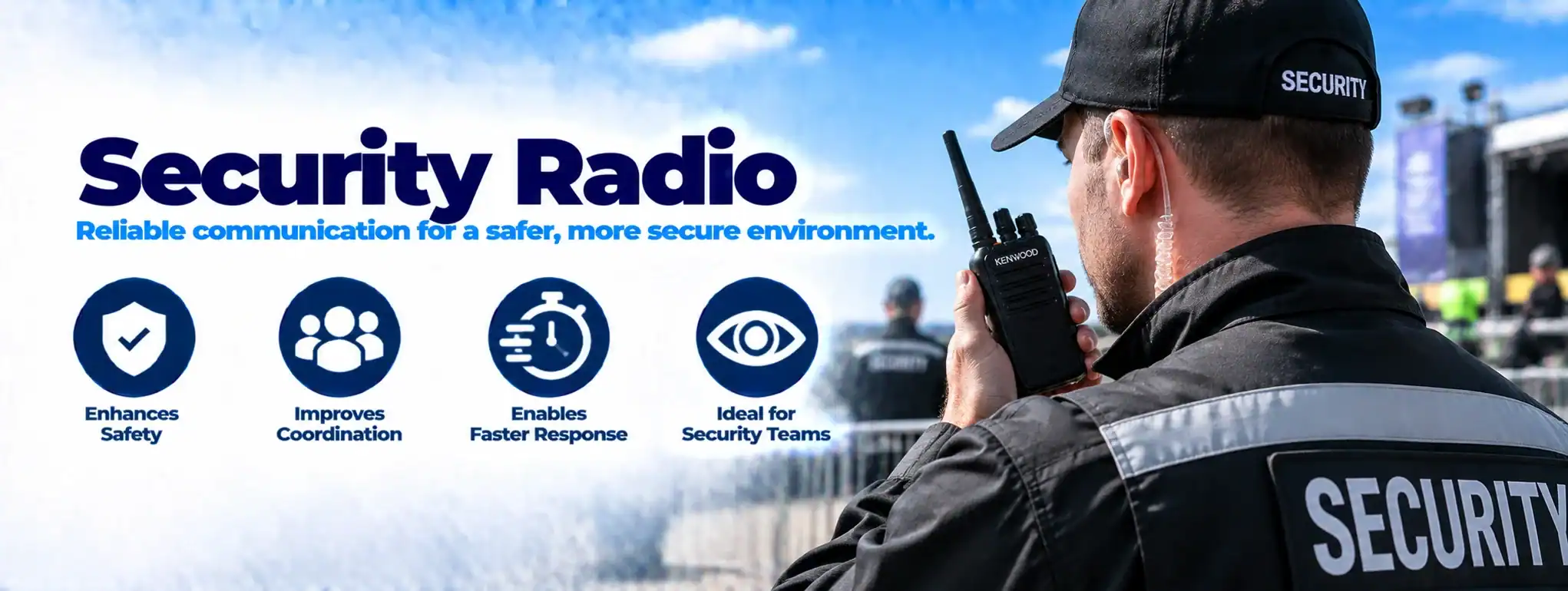
Security Radio
A Security Radio is a professional two-way radio used by security personnel to communicate quickly and reliably while protecting people, property and sites.
Security radios are commonly used by security guards, mobile patrols, event security teams, door supervisors, control-room operators and security managers.
Unlike consumer walkie-talkies, professional security radio systems can provide features designed for operational security, including Group Calling, Private CallPrivate Call is a two-way radio feature that allows one radio user to communicate directly with another individual radio user rather than making the conversation part of a general group call., Emergency CallAn Emergency Call is a priority two-way radio function that allows a user to quickly request assistance and, on supported systems, establish an urgent voice communication with a dispatcher or control room., Priority CallPriority Call is a two-way radio feature that gives important or authorised communications higher priority than routine radio traffic, helping urgent messages access the system when channels are busy., Lone WorkerA Lone Worker is someone who works without direct supervision or immediate assistance nearby. Compatible two-way radios can provide safety features such as timed check-ins, emergency alerts and GPS location., Man DownMan Down is a safety feature on some professional two-way radios that can detect a possible fall or unusual radio position and automatically raise an alert if the user does not respond., GPS location and, on compatible systems, encryptionEncryption protects two-way radio communications by converting voice or data into a secure form that can only be understood by authorised radios with the correct encryption capability and keys..
What is a security radio?
A security radio is normally a portable handheld radio configured for the requirements of a security operation.
A typical security radio systemA Radio System is a complete communication solution comprising two-way radios and, where required, equipment such as repeaters, antennas, base stations, mobile radios and network infrastructure. may include:
- Handheld two-way radios
- Repeaters
- Base or control-room radios
- Remote Speaker Microphones
- Earpieces or headsets
- Chargers and spare batteries
- Multiple communication groups
- Emergency functions
The system can be designed around the size and layout of the site being protected.
How are security radios used?
Security teams use radios to communicate information immediately without relying on mobile phones.
Typical communications include:
- Reporting incidents
- Requesting assistance
- Coordinating patrols
- Managing access control
- Reporting suspicious activity
- Directing security personnel
- Communicating with control rooms
- Coordinating emergency responses
Push-to-talk operation allows users to communicate quickly with other members of the team.
Security radio channels
Security operations can use separate channels or Talkgroups for different functions.
For example:
| Communication Group | Purpose |
|---|---|
| Security | General security communications |
| Control | Control-room communications |
| Management | Supervisors and managers |
| Emergency | Urgent incidents |
| Operations | Wider site coordination |
The exact configuration depends on the security operation.
Security radio and Push-to-Talk
Push-to-Talk (PTT)Push-to-Talk (PTT) is the button or control used to activate a two-way radio's transmitter. Press it to speak and release it to listen. allows a security officer to press a button and immediately transmit to the selected communication group.
This is particularly useful when personnel need to communicate while moving around a site or carrying out other tasks.
Security radio and group calling
Group Calling allows a security officer to communicate with multiple members of the security team simultaneously.
For example:
Officer → Security Group → All available security officers
This can be useful when coordinating responses to incidents or directing personnel across a site.
Security radio and private calling
Some professional digital radios support Private Call.
This allows one radio user to communicate directly with another without transmitting the conversation to the entire group.
Private calling can be useful for:
- Supervisor communications
- Control-room conversations
- Sensitive operational information
- Individual instructions
The exact functionality depends on the radio system.
Security radio and emergency call
Many professional security radios provide an Emergency Call function.
An emergency buttonAn Emergency Button is a dedicated two-way radio control that allows users to quickly send an emergency alert to a dispatcher, control room or authorised radio users. can allow a user to raise an alert when immediate assistance is required.
Depending on the system, an emergency transmissionTransmission is the process of sending voice, data or signalling from a radio using a radio-frequency signal to another radio, repeater or communication system. may be given priority over routine communications.
The exact behaviour depends on the radio system and programming.
Security radio and priority call
A Priority Call can allow important communications to receive preferential treatment over routine radio traffic.
This can be particularly useful in busy security operations where multiple teams are communicating simultaneously.
Security radio and Man Down
Some professional radios support Man Down functionality.
The radio can monitor factors such as movement or orientation and can initiate an alert if a configured condition suggests that the user may have fallen or become incapacitated.
Man Down should be treated as an additional safety feature rather than a substitute for security procedures.
Security radio and Lone Worker
Lone Worker functionality can provide additional protection for security personnel working alone.
Depending on the system, the radio may require the user to acknowledge periodic prompts.
If the user fails to respond, the system can initiate an alert according to its configuration.
Security radio and GPS
Professional security radios may include GPS (Global Positioning System)GPS is a satellite-based positioning system that allows compatible two-way radios to determine their location. GPS data can support tracking, dispatch, fleet management and Geo-Fencing..
This can allow authorised personnel or control-room systems to determine the approximate location of radios in the field.
GPS can support:
- Staff location
- Patrol monitoring
- Incident response
- Workforce coordination
The exact location accuracy and functionality depend on the equipment and environment.
Security radio and tracking
Radio systems with location functionality can allow a control room to monitor the position of authorised radios.
This can provide supervisors with greater awareness of where mobile security personnel are operating.
Location tracking should be implemented in accordance with applicable organisational and legal requirements.
Security radio and control rooms
A security control room can act as the central communication point for a radio system.
A control-room operator may communicate with:
- Security officers
- Supervisors
- Mobile patrols
- Management
- Emergency teams
A Base StationA base station is a fixed two-way radio installed at a permanent location, allowing an operator to communicate with handheld or mobile radios across a site or operating area. or dispatch console can be used for this purpose.
Security radio and dispatch
Professional radio systems can support Dispatch functions.
A dispatcher can coordinate multiple security teams and communicate with specific groups or individual users.
More advanced systems can integrate radio communications with incident-management or control-room software.
Security radio and incident management
Security teams can use radios as part of wider Incident ManagementIncident Management is the process of coordinating people, communications and resources during an incident. Two-way radios can provide rapid communication between teams, control rooms and responders. procedures.
A typical incident might involve:
Incident reported → Control notified → Security team dispatched → Response coordinated → Incident updated
Radio communication allows information to be shared quickly throughout the response.
Security radio and incident response
Fast communication can be particularly important during:
- Intruder incidents
- Medical emergencies
- Fire alarms
- Evacuations
- Suspicious activity
- Crowd disturbances
- Access-control incidents
- Equipment failures
The radio system should support the organisation’s established emergency procedures.
Security radio and encryption
Some professional digital radios support Encryption.
Encryption can help protect radio communications from unauthorised interception.
This can be particularly useful where security teams communicate operationally sensitive information.
The level and type of encryption available varies between radio systems.
Security radio and confidentiality
Security teams may communicate information about:
- Personnel
- Incidents
- Access arrangements
- Security procedures
- Vulnerabilities
- Customers
- Locations
Where confidentiality is important, the radio system should be designed with appropriate security controls.
Encryption is only one part of overall communications security.
Security radio and earpieces
Security personnel may use Earpieces where discreet communication is required.
An earpieceAn earpiece is a two-way radio audio accessory that lets users hear radio communications discreetly, often with a microphone and Push-to-Talk button for transmitting. can allow the user to hear radio traffic without broadcasting the conversation through the radio’s main speaker.
This can be useful in:
- Retail security
- Hotels
- Events
- Corporate buildingsAn antenna transmits and receives radio-frequency signals, allowing a two-way radio to communicate. Antenna type, frequency, height and location can all affect radio performance and coverage.
- Close-protection environments
Security radio and Remote Speaker Microphone
A Remote Speaker Microphone (RSM)A Remote Speaker Microphone (RSM) is an external radio accessory combining a microphone, speaker and Push-to-Talk button, allowing users to operate a two-way radio without handling the radio itself. allows the user to operate the radio through an accessory connected to the handheld.
The RSM can be positioned near the user’s shoulder, allowing the radio to remain secured on a belt or vest.
This makes PTT operation easier while wearing gloves or other equipment.
Security radio and covert communication
Where operational circumstances require discreet communication, compatible radios can be used with suitable earpieces or surveillance-style accessories.
The appropriate equipment depends on the security role and operating environment.
Security radio and noise cancellation
Security personnel may operate in noisy environments such as:
- Events
- Transport hubs
- Industrial sites
- Stadiums
- Construction sites
Radios with Noise CancellationNoise Cancellation is technology used in two-way radios and communication equipment to reduce unwanted background noise and make speech easier to hear, particularly in noisy working environments. can help improve transmitted speech clarity in environments with significant background noise.
Security radio and loud audio
High-output audio can help security personnel hear radio communications in noisy environments.
This can be particularly important for outdoor patrols and busy public venues.
Security radio and ruggedness
Security radios are often carried throughout long shifts and may be exposed to rain, drops and frequent handling.
A Rugged RadioA Rugged Radio is a two-way radio designed to withstand demanding working environments, with features such as impact resistance and protection against dust, water and other environmental conditions. with an appropriate IP Rating can provide additional protection in demanding environments.
The required level of protection depends on where the radio will be used.
Security radio and battery life
Security personnel may work long shifts, making battery capacity an important consideration.
Radio systems can be supplied with:
- Spare batteries
- Multi-unit chargers
- Vehicle chargers
- Desktop chargers
- Battery-management facilities
Battery requirements should be considered when planning a complete security radio system.
Security radio and radio hire
Radio HireRadio Hire is the temporary rental of two-way radios and related communication equipment for events, projects and operational requirements, providing professional communication without purchasing the equipment. is commonly used for temporary security operations.
Security radios can be hired for:
- Events
- Festivals
- Sporting events
- Exhibitions
- Construction projects
- Temporary sites
- Corporate events
- Security contracts
A hire system can be configured with the required channels, accessories and coverageRadio Coverage is the geographical area in which a two-way radio system can provide reliable communication. Coverage depends on the radios, antennas, frequency, terrain, buildings and system infrastructure. infrastructureRadio infrastructure is the equipment and supporting systems behind a professional two-way radio network, including repeaters, antennas, base stations, network connections, power systems and dispatch equipment..
Security radio hire for events
Large events often require temporary security teams.
A typical event-security radio system might include:
- Security handheld radios
- Supervisor radios
- Control-room radio
- Earpieces
- Spare batteries
- RepeaterA Repeater receives a two-way radio transmission and retransmits it, usually from an elevated location, to extend the coverage and reliability of a radio communication system. where required
Multiple communication groups can be configured for security, event control, medical teams and other operational functions.
Security radio and event security
Event security personnel may need to communicate across large or crowded venues.
A properly designed radio system can provide communication between:
- Gate security
- Internal security
- Supervisors
- Control
- Response teams
- Event management
Security radio and retail
Retail security teams can use radios to communicate discreetly between security officers and store management.
Applications can include:
- Shoplifting incidents
- Staff assistance
- Customer incidents
- Access control
- Opening and closing procedures
Security radio and hospitality
Hotels, resorts and venues can use security radios to coordinate security personnel with other departments.
Communication groups can be configured for:
- Security
- Management
- Maintenance
- Events
- Operations
Security radio and construction sites
Security teams at construction sites may use radios to coordinate patrols, access control and incident response.
Rugged equipment can be particularly appropriate where radios are exposed to dust, rain and physical impacts.
Security radio and warehouses
Warehouses and distribution centres can use security radios to coordinate guards, gatehouses and control rooms.
The radio system can also integrate with wider site operations where required.
Security radio and transport hubs
Airports, railway stations, ports and other transport environments can require extensive radio coverage and multiple communication groups.
Large sites may require repeaters or multi-site radio infrastructure.
Security radio and stadiums
Stadium security can use radios to coordinate personnel across:
- Entrances
- Stands
- Concourses
- Pitch areas
- Car parks
- Control rooms
Large stadiums can require carefully designed radio coverage because of reinforced structures, crowds and the size of the venue.
Security radio and body-worn equipment
Some security personnel carry radios alongside body-worn cameras and other equipment.
The radio and accessories should be positioned so that PTT operation remains practical without interfering with other equipment.
Security radio and intrinsically safe environments
A standard security radio should not be used in a potentially explosive atmosphere simply because it is rugged or waterproof.
Where security personnel operate in hazardous environments, an appropriately certified Intrinsically Safe RadioAn Intrinsically Safe Radio is a two-way radio designed and certified for use in specified hazardous areas where flammable gases, vapours or combustible dust could create a risk of explosion. may be required.
Security radio and radio licensing
Whether a security radio requires a licence depends on the radio service and frequencies being used.
Professional business-radio systems in the UK are regulated by OfcomOfcom (Office of Communications) is the UK's communications regulator. For two-way radio users, Ofcom manages and regulates access to radio spectrum and the use of radio frequencies in the UK..
Licence-free options such as PMR446 have specific technical restrictions and may not provide the coverage, capacity or features required for a professional security operation.
Security radio and PMR446
PMR446 can be suitable for some short-range licence-free communications.
However, larger security operations may require licensed professional radio systems where greater coverage, capacity, features or system control are required.
Security radio and repeater coverage
A Repeater can significantly extend radio coverage across a large security site.
This can be particularly useful in:
- Large buildings
- Stadiums
- Shopping centres
- Construction sites
- Industrial facilities
- Large outdoor events
Security radio and multi-site coverage
Large security operations may cover several buildings or geographically separated sites.
A multi-site radio system can connect these locations using appropriate radio infrastructure and networkA Network is a connected system of radios, equipment and infrastructure that allows users to communicate across a defined area. Radio networks can range from simple radio-to-radio systems to large multi-site networks. connectivity.
RoamingRoaming allows a compatible two-way radio to move between different radio sites or coverage areas, automatically selecting an appropriate site as the user moves. may allow compatible radios to move between coverage areas.
Security radio and radio system design
A professional security radio system should be designed around the operational requirements rather than simply the number of radios.
Important considerations include:
- Site size.
- Indoor and outdoor coverage.
- Number of users.
- Number of communication groups.
- Simultaneous conversations.
- Emergency requirements.
- Control-room requirements.
- Battery requirements.
- Accessories.
- Encryption.
- Radio licensing.
- Future expansion.
Security radio and site surveys
A Site SurveyA Site Survey is an assessment of a location to determine whether a two-way radio system will provide the required coverage, reliability and performance. can identify areas where radio coverage may be weak.
This is particularly important in buildings containing:
- Reinforced concrete
- Steel structures
- Basements
- Underground areas
- Multiple floors
The results can determine whether additional repeaters or other infrastructure are required.
Security radio and interference
Radio interferenceRadio interference occurs when unwanted radio-frequency signals or electrical noise disrupt two-way radio communications, causing distorted audio, broken transmissions, reduced coverage or loss of communication. can affect security communications.
Professional systems should be properly frequencyAn antenna transmits and receives radio-frequency signals, allowing a two-way radio to communicate. Antenna type, frequency, height and location can all affect radio performance and coverage. planned and tested to minimise interference.
Potential issues include:
- Co-channel interference
- Adjacent-channel interference
- RF congestion
- Poor antennaAn antenna transmits and receives radio-frequency signals, allowing a two-way radio to communicate. Antenna type, frequency, height and location can all affect radio performance and coverage. installation
Security radio and reliability
Security communications can be operationally critical.
System reliability can be improved through measures such as:
- Quality radio equipment
- Proper coverage planning
- Spare batteries
- Backup powerAn antenna transmits and receives radio-frequency signals, allowing a two-way radio to communicate. Antenna type, frequency, height and location can all affect radio performance and coverage.
- Redundant infrastructure
- Appropriate maintenance
The required level of resilience depends on the security operation.
Security radio and failover
Critical radio systems can incorporate FailoverFailover allows a two-way radio system to switch to backup equipment, infrastructure or communication routes when the primary system fails, helping maintain communications. arrangements such as backup power or redundant network connections.
This can help maintain communications if part of the supporting infrastructure fails.
Security radio maintenance
Professional security radios should be inspected and maintained regularly.
Checks can include:
- Battery condition
- Antenna condition
- PTT operation
- Audio quality
- ConnectorsAn antenna transmits and receives radio-frequency signals, allowing a two-way radio to communicate. Antenna type, frequency, height and location can all affect radio performance and coverage.
- Charging equipment
- Emergency functions
- Programming
Regular testing is particularly important for radios used in critical security roles.
Choosing a security radio
When selecting a security radio system, consider:
- Required coverage.
- Number of security personnel.
- Indoor and outdoor operation.
- Required communication groups.
- Emergency functions.
- Lone Worker requirements.
- Man Down requirements.
- GPS and tracking.
- Encryption.
- Ruggedness and IP rating.
- Battery life.
- Earpiece or RSM requirements.
- Radio licensing.
- Whether the system is permanent or temporary.
Security radio and DCS
DCS can supply and configure professional two-way radio systems for security operations, pubs and bar security teams including radios for security guards, mobile patrols, event security and control rooms.
Systems can be designed around the required coverage, communication groups, accessories and operational features, with repeater and multi-site solutions available where greater coverage is required.