
Priority Call
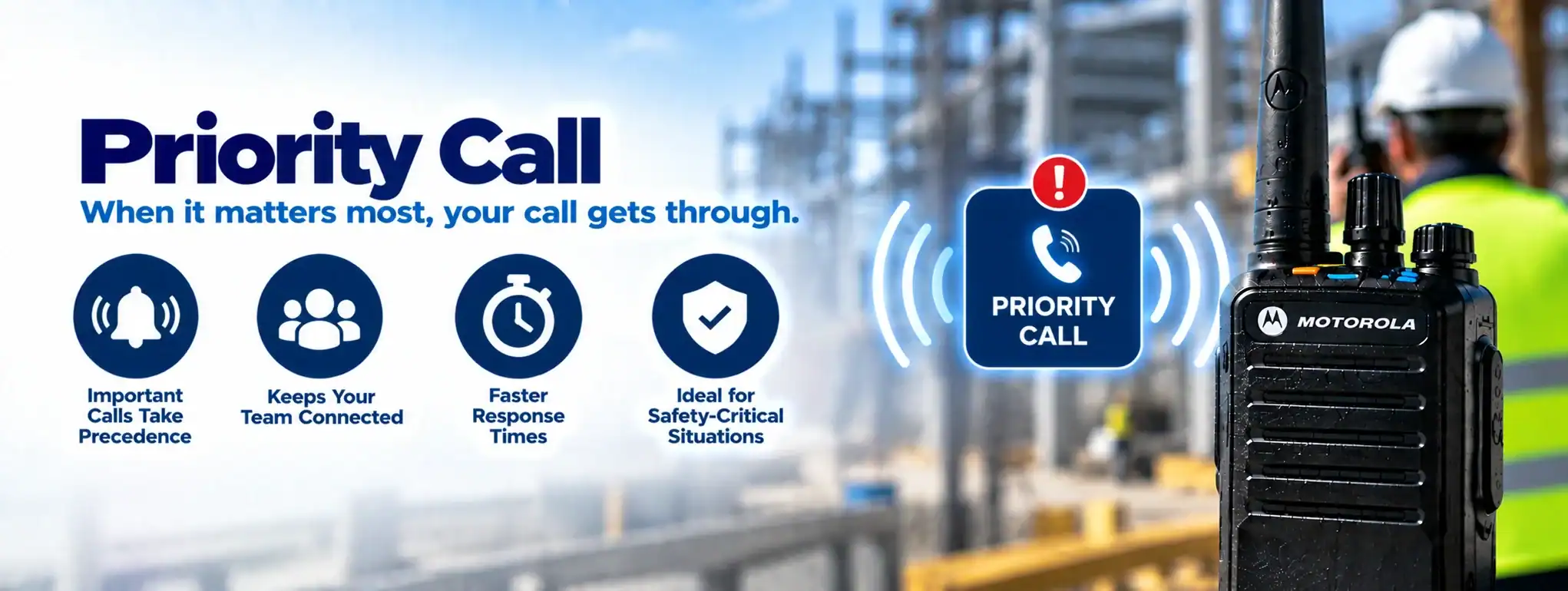
Priority Call is a two-way radio feature that gives an important or authorised communication a higher priority than routine radio traffic.
It is used on professional radio systems where certain users or types of communication may need to reach other users even when the radio channelA two-way radio channel is a programmed set of communication settings, typically including frequency and signalling, that allows compatible radios to communicate with one another. is busy.
Priority calling can be particularly useful for security, emergency response, transport, construction, utilities and other operations where urgent communications need to be heard quickly.
What is a priority call?
A priority call is a communication that is given preferential treatment by the radio systemA Radio System is a complete communication solution comprising two-way radios and, where required, equipment such as repeaters, antennas, base stations, mobile radios and network infrastructure..
Depending on the system, a priority call may:
- Take priority over routine traffic
- Interrupt lower-priority communications
- Gain access to a busy channel
- Alert selected users
- Give priority to a designated radio or dispatcher
The exact behaviour depends on the radio technology and system configuration.
Priority Call vs normal call
A normal radio call generally uses the channel according to the system’s standard access rules.
A priority call can be configured to receive higher priority.
For example:
Routine Call → Normal Channel Access
Priority Call → Higher Priority Channel Access
This can help ensure important communications are not delayed by routine traffic.
Priority Call and emergency calls
Priority Call and Emergency CallAn Emergency Call is a priority two-way radio function that allows a user to quickly request assistance and, on supported systems, establish an urgent voice communication with a dispatcher or control room. are related but are not necessarily the same feature.
An emergency call is specifically intended to communicate an emergency situation.
A priority call can be used more broadly whenever a communication needs preferential access.
For example, a transport control room may give priority to an operationally important communication without it necessarily being an emergency.
Priority Call and emergency alarms
An Emergency AlarmAn Emergency Alarm allows a two-way radio user to quickly alert a dispatcher, control room or other authorised users that assistance may be required. can notify a dispatcher or group that a radio user requires assistance.
A Priority Call can then be used to give the resulting communication higher priority.
The exact sequence depends on the radio system.
Priority Call and dispatch
Priority calling can be particularly useful in a Dispatch environment.
A dispatcher may need to communicate with a particular team while other radio users are already communicating.
Where supported, the system can give the dispatcher’s communication a higher priority.
For example:
Dispatcher → Priority Call → Response Team
Priority Call and group calling
A priority call can be directed towards a defined group of radio users.
For example:
Control Room → Security Supervisors
The system may give the call priority over routine group communications.
Priority Call and individual calling
Some radio systems allow priority to be assigned to communications involving specific individual radios.
For example, a supervisor’s radio may have higher calling priority than standard user radios.
The available options depend on the radio system.
Priority Call and radio channels
Priority functionality can operate at the channel or system level.
A radio system may assign different levels of priority to different users or communication types.
This can help manage access when several users attempt to communicate at the same time.
Priority Call and busy channels
One of the main purposes of priority calling is to provide access when a communication channel is already busy.
Depending on the system, a priority call may be allowed to interrupt or pre-empt lower-priority traffic.
This is sometimes referred to as Pre-emption.
Priority Call and pre-emption
Pre-emption allows a higher-priority communication to take precedence over an existing lower-priority communication.
For example:
Routine Communication → Priority Communication → Routine Communication Resumes
Not every radio system supports pre-emption, and the behaviour varies between technologies.
Priority Call and DMR
DMR (Digital Mobile RadioA Mobile Radio is a two-way radio designed to be installed in a vehicle. It normally uses the vehicle's power supply and an external antenna to provide reliable communication while travelling or working in the field.) systems can provide different levels of call and channel priority depending on the equipment and system architecture.
Some professional DMR systems support priority and pre-emption features through their networkA Network is a connected system of radios, equipment and infrastructure that allows users to communicate across a defined area. Radio networks can range from simple radio-to-radio systems to large multi-site networks. infrastructureRadio infrastructure is the equipment and supporting systems behind a professional two-way radio network, including repeaters, antennas, base stations, network connections, power systems and dispatch equipment..
The precise functionality depends on the manufacturer and system configuration.
Priority Call and MOTOTRBO™
Compatible MOTOTRBO™MOTOTRBO™ is Motorola Solutions' professional digital two-way radio platform, based on the DMR standard. It supports business communication ranging from simple radio systems to multi-site networks. systems can provide priority and emergency communication features through supported system configurations.
The available priority functionality depends on the radio model, system architecture and associated software.
Priority Call and trunked radio
Priority calling can be particularly useful in Trunked Radio systems.
A trunked system dynamically assigns available radio resources to users.
When resources are limited, priority levels can help determine which communications should receive access first.
Priority Call and conventional radio
Priority functions can also be available in conventional radio systems.
However, the exact behaviour may be more limited than in a sophisticated trunked or networked system.
Priority Call and radio fleet management
Large organisations may assign different communication priorities to different users.
For example:
- Emergency services or alarms – Highest priority
- Control room – High priority
- Supervisors – Medium priority
- General users – Standard priority
The actual priority structure depends on the system.
Priority Call and security
Security operations may use priority communications to ensure supervisors or control-room staff can communicate during busy periods.
For example, if several security officers are using the same channel, a control room may need a way to reach a specific team quickly.
Priority Call in transport
Transport control rooms may use priority communication to contact drivers or operational staff when an important instruction needs to be delivered.
Priority functions can help manage communications when many users share the same radio system.
Priority Call in construction
Construction sites can become busy radio environments, particularly during major operations.
A priority communication can help supervisors or site management communicate important instructions when routine radio traffic is taking place.
Priority Call at events
Large events can have many radio users communicating simultaneously.
Priority functions can help event control rooms communicate with selected teams when radio traffic is heavy.
For example:
Event Control → Security → Priority Communication
Priority Call and lone worker
A Lone WorkerA Lone Worker is someone who works without direct supervision or immediate assistance nearby. Compatible two-way radios can provide safety features such as timed check-ins, emergency alerts and GPS location. system may use priority communication when an alert is generated.
For example, if a lone worker activates an emergency function, the resulting communication can be handled with higher priority depending on the system.
Priority Call and Man Down
A Man DownMan Down is a safety feature on some professional two-way radios that can detect a possible fall or unusual radio position and automatically raise an alert if the user does not respond. alert can generate an emergency notification.
Where the radio system supports priority handling, the resulting alert or communication can be given a higher priority than routine traffic.
Priority Call and paging
PagingPaging is a communication method used to send a short alert or notification to an individual or group. In two-way radio systems, it can quickly notify users that their attention or response is required. can be used to alert users that a priority communication is waiting.
For example:
Priority Alert → Radio User Notified → Priority Call
The exact process depends on the radio system.
Priority Call and scan
Radios that use Scan may be configured to monitor multiple channels.
Priority channels can be configured so that the radio checks them more frequently or gives them preferential attention.
This can help ensure important communications are not missed.
Priority Call and priority scanning
Priority scanning is different from priority calling.
Priority Scan determines which channels a radio checks preferentially while scanning.
Priority Call determines which communication receives preferential treatment when accessing the radio system.
The two features can work together but perform different functions.
Priority Call and encryption
A priority call can be encrypted where the radio system supports encryptionEncryption protects two-way radio communications by converting voice or data into a secure form that can only be understood by authorised radios with the correct encryption capability and keys..
Priority determines how the communication is handled by the system, while Encryption protects the content of the communication.
These are separate functions.
Priority Call and radio coverage
Priority calling does not increase the physical coverageRadio Coverage is the geographical area in which a two-way radio system can provide reliable communication. Coverage depends on the radios, antennas, frequency, terrain, buildings and system infrastructure. of a radio system.
The radio still needs sufficient signal strength and network access to communicate.
If a user is outside the system’s coverage area, priority cannot compensate for the lack of connectivity.
Priority Call and repeaters
A RepeaterA Repeater receives a two-way radio transmission and retransmits it, usually from an elevated location, to extend the coverage and reliability of a radio communication system. can form part of the communication path for a priority call.
For example:
Priority Radio → Repeater → Priority User
The repeater and wider radio infrastructure must support the required priority functionality.
Priority Call and multi-site systems
In a multi-site radio network, priority communication may be distributed across connected sites.
For example:
Control Room → Network → Site A / Site B / Site C
The exact behaviour depends on the network architecture.
Priority Call and cloud systems
Modern radio systems may integrate communication management with Cloud ManagementCloud Management uses an online platform to remotely manage and monitor compatible two-way radios, users, devices and communication settings from a central location. platforms.
Where supported, priority settings can form part of the wider system configuration.
Priority Call and radio programming
Priority settings may be stored within a radio’s CodeplugA Codeplug is the configuration data programmed into a two-way radio that defines its channels, frequencies, talkgroups, radio ID and other operating features. or configured through the radio system’s infrastructure.
Administrators should ensure that priority settings are correctly configured and tested.
Priority Call and OTAP
Compatible systems may allow some priority-related configuration to be distributed using Over-the-Air Programming (OTAP)Over-the-Air Programming (OTAP) allows compatible two-way radios to be configured or updated remotely through a radio network, reducing the need to physically connect each radio to a programming computer..
This can make it easier to manage settings across a large radio fleet.
The specific settings that can be changed remotely depend on the manufacturer and management system.
Priority Call limitations
Priority calling does not guarantee that every communication will always be delivered immediately.
Performance can depend on:
- Radio coverage
- Network availability
- System capacity
- Radio configuration
- Priority levels
- Infrastructure
- Equipment compatibility
Priority should therefore be designed into the overall communication system.
Priority Call and system design
When designing a professional radio system, priority requirements should be considered alongside:
- Number of users.
- Coverage.
- Channels.
- Talkgroups.
- Repeater requirements.
- Dispatch requirements.
- Emergency functions.
- Network capacity.
- Encryption.
- Licensing.
Priority Call and DCS
DCS can advise on professional two-way radio systems where certain users or communications need preferential access to the radio network.
Priority calling can be particularly useful in busy operational environments where important communications need to be delivered without being lost among routine radio traffic.
The exact priority and pre-emption capabilities depend on the radio technology, equipment and system architecture.