Over-the-Air Programming (OTAP)
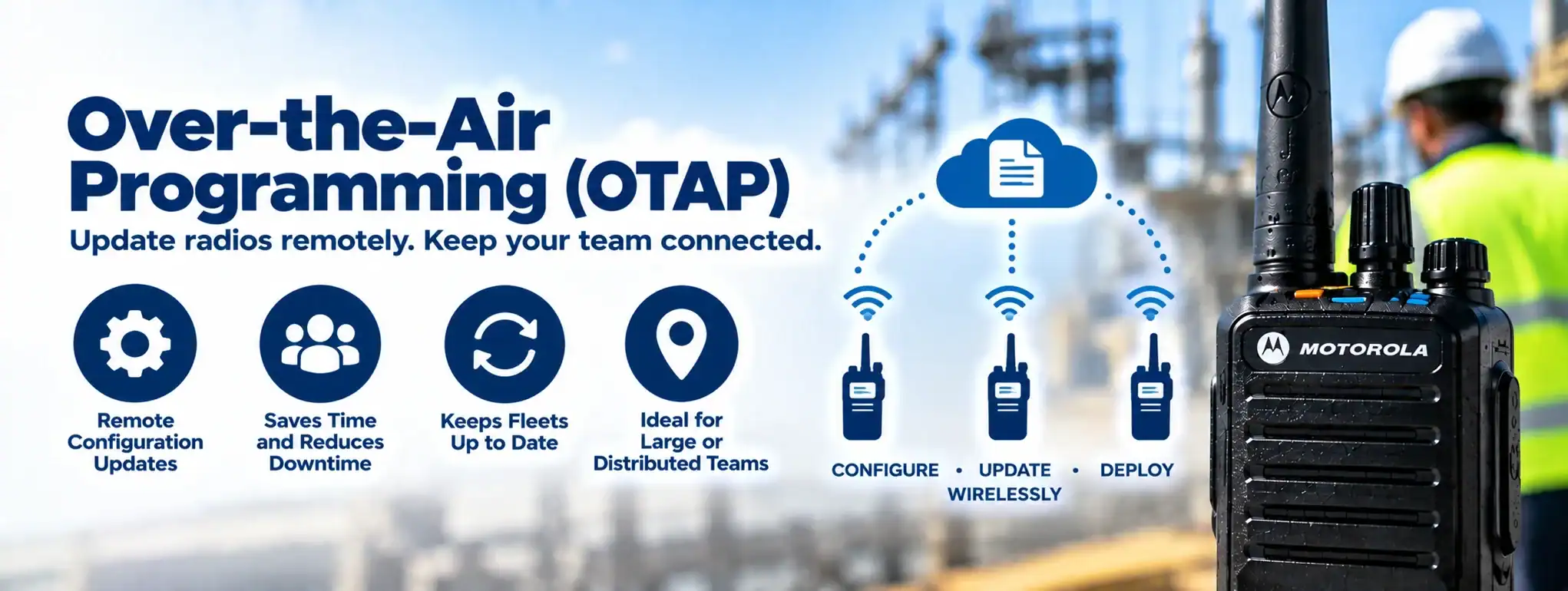
Over-the-Air Programming (OTAP) is a method of remotely updating and configuring compatible two-way radios without physically connecting each radio to a programming computer.
OTAP can allow radio administrators to change settings, update configurations or distribute software remotely. This can significantly reduce the time and effort required to manage a large fleet of radios, particularly where users are spread across multiple locations.
What is Over-the-Air Programming?
Traditionally, a two-way radio is programmed by connecting it directly to a computer using a programming cableA Programming Cable connects a two-way radio to a computer so compatible programming software can configure, update or service the radio's settings..
With OTAP, compatible radio settings can be transmitted to the radio through the communication networkA Network is a connected system of radios, equipment and infrastructure that allows users to communicate across a defined area. Radio networks can range from simple radio-to-radio systems to large multi-site networks..
A simplified process is:
Radio Management System → Radio Network → Radio
The radio receives the new configuration and applies the authorised changes.
OTAP and radio programming
Radio programming controls how a radio operates within a communication system.
A radio’s CodeplugA Codeplug is the configuration data programmed into a two-way radio that defines its channels, frequencies, talkgroups, radio ID and other operating features. can contain settings such as:
- Channels
- Frequencies
- Talkgroups
- Scan lists
- Radio identification
- PowerAn antenna transmits and receives radio-frequency signals, allowing a two-way radio to communicate. Antenna type, frequency, height and location can all affect radio performance and coverage. settings
- Emergency functions
- Other system parameters
OTAP can allow compatible codeplug settings to be updated remotely.
OTAP and codeplugs
The codeplug is an important part of radio configuration.
Instead of removing every radio from service and connecting each one to a programming computer, OTAP can allow a revised configuration to be distributed remotely.
For example:
New Configuration → OTAP → Multiple Radios
This can be particularly useful when a large number of radios require the same change.
OTAP and firmware updates
Some radio systems can use over-the-air methods to distribute FirmwareFirmware is the software built into a two-way radio that controls its underlying operation, features and hardware. Manufacturers may release updates to improve performance, fix faults or add functionality. updates.
Firmware is the software built into the radio that controls its operation.
Where supported, OTAP can reduce the need for radios to be physically returned to a service centre for certain updates.
The specific firmware-update capabilities depend on the radio model and management system.
OTAP and radio management
OTAP is normally associated with a wider Radio Management system.
An administrator may be able to remotely manage compatible radios, including:
- Configuration
- Software
- Radio settings
- Device information
- Updates
The exact capabilities depend on the manufacturer and radio-management platform.
OTAP and DMR
Compatible DMR (Digital Mobile RadioA Mobile Radio is a two-way radio designed to be installed in a vehicle. It normally uses the vehicle's power supply and an external antenna to provide reliable communication while travelling or working in the field.) systems can support over-the-air programming where the radio equipment and system infrastructureRadio infrastructure is the equipment and supporting systems behind a professional two-way radio network, including repeaters, antennas, base stations, network connections, power systems and dispatch equipment. provide the necessary functionality.
OTAP is not a feature of the DMR standard itself in the same way that basic digital voice communication is; implementation depends on the particular manufacturer and system.
OTAP and MOTOTRBO™
Compatible MOTOTRBO™MOTOTRBO™ is Motorola Solutions' professional digital two-way radio platform, based on the DMR standard. It supports business communication ranging from simple radio systems to multi-site networks. systems can provide over-the-air programming capabilities through supported radio-management solutions.
This can allow administrators to remotely manage configurations across a fleet of compatible radios.
The precise functionality depends on the MOTOTRBO™ radio model, system architecture and management software.
OTAP and multi-site radio networks
OTAP can be particularly useful for organisations operating radios across multiple sites.
For example:
Head Office → Radio Network → Site A / Site B / Site C
An administrator may be able to distribute a configuration to compatible radios without visiting each location.
OTAP and large radio fleets
The main benefit of OTAP becomes more significant as the number of radios increases.
For example, updating ten radios manually may be straightforward.
Updating several hundred radios across multiple locations can require considerable time and administration.
OTAP can allow compatible changes to be managed centrally.
OTAP and radio hire
OTAP can also be useful in professional Radio HireRadio Hire is the temporary rental of two-way radios and related communication equipment for events, projects and operational requirements, providing professional communication without purchasing the equipment. operations where a large number of radios need to be configured for different customers or events.
A supplier may be able to remotely change compatible radio configurations between deployments.
This can reduce the amount of physical handling required between hires.
OTAP and temporary events
Event radio systems can require changes to talkgroups, channels or other configuration settings.
Where the equipment supports OTAP, compatible changes can potentially be made remotely rather than collecting and reprogramming every radio.
This can be useful when radios are already distributed across a large event site.
OTAP and emergency functions
Compatible emergency features can be configured through radio programming.
Where supported, OTAP can allow administrators to update relevant settings remotely.
Because emergency functions are safety-critical, changes should be carefully tested before being deployed across an operational fleet.
OTAP and talkgroups
Talkgroup configuration can be managed remotely on compatible systems.
For example, an organisation could add or change a talkgroup used by a particular department.
The radio would receive the updated configuration through the supported OTAP system.
OTAP and channels
OTAP can allow compatible radios to receive changes to their channelA two-way radio channel is a programmed set of communication settings, typically including frequency and signalling, that allows compatible radios to communicate with one another. configuration.
This can be useful when:
- Frequencies change
- New channels are added
- Talkgroups are changed
- Scan lists are updated
- Radio systems are expanded
Any frequencyAn antenna transmits and receives radio-frequency signals, allowing a two-way radio to communicate. Antenna type, frequency, height and location can all affect radio performance and coverage. changes must remain within the conditions of the applicable radio licence.
OTAP and licensed radio
OTAP does not change the legal requirements governing radio operation.
If a radio is programmed with a new frequencyFrequency is the number of cycles a radio wave completes each second, measured in Hertz. In two-way radio, frequency determines where a transmission operates within the radio spectrum. or channel, that frequency must still be authorised for the system.
In the UK, professional licensed radioA Licensed Radio is a two-way radio operated under an appropriate radio licence. Licensed systems can provide greater control over frequencies, coverage and infrastructure than licence-free radio services such as PMR446. systems must operate within the conditions of the relevant Ofcom Business Radio LicenceAn Ofcom Business Radio Licence authorises businesses and organisations in the UK to use specified radio frequencies for professional two-way radio communication, subject to the licence conditions..
OTAP and encryption
Compatible systems can allow security-related configuration to be managed remotely.
However, encryptionEncryption protects two-way radio communications by converting voice or data into a secure form that can only be understood by authorised radios with the correct encryption capability and keys. settings and keys require careful administration.
Changes to encryption configuration should be performed using appropriate security procedures to avoid disrupting communications or compromising the security of the system.
OTAP and GPS
GPS configuration can be included among the settings managed on compatible radios.
For example, administrators may be able to configure location-reporting behaviour where the radio and management platform support it.
OTAP and fleet management
OTAP can complement Fleet ManagementFleet Management is the process of managing a two-way radio fleet, including equipment, users, programming, maintenance, firmware, security and radio system configuration. by allowing the radios used by vehicles and mobile workers to remain centrally managed.
A large fleet can therefore combine:
Radio Fleet + GPS + Fleet Management + OTAP
This can simplify the administration of geographically distributed equipment.
OTAP and cloud management
Some modern radio systems provide Cloud ManagementCloud Management uses an online platform to remotely manage and monitor compatible two-way radios, users, devices and communication settings from a central location. capabilities.
Where OTAP is supported, cloud-based management can provide a central location from which administrators can manage compatible radios.
A simplified arrangement is:
Administrator → Cloud Management → Radio Network → Radios
The exact architecture depends on the manufacturer’s system.
OTAP and dispatch
OTAP is primarily a configuration and management function rather than a dispatch feature.
However, both can form part of a wider managed radio systemA Radio System is a complete communication solution comprising two-way radios and, where required, equipment such as repeaters, antennas, base stations, mobile radios and network infrastructure..
For example:
Radio Management → OTAP
and
Dispatch → Radio Communication
can operate alongside each other within the same overall infrastructure.
OTAP and network connectivity
OTAP requires a suitable communication path between the management system and the radio.
Depending on the radio system, this may involve:
- Radio channels
- Repeaters
- IP networks
- Cellular networks
- Wi-FiWi-Fi is a wireless networking technology that connects compatible devices to a local or wider network. In radio systems, it can support programming, updates, data services and IP-based communications.
- Cloud services
The available method depends on the particular equipment.
OTAP and coverage
A radio generally needs suitable network connectivity to receive an over-the-air update.
If a radio is outside the required coverageRadio Coverage is the geographical area in which a two-way radio system can provide reliable communication. Coverage depends on the radios, antennas, frequency, terrain, buildings and system infrastructure. area, the update may not be delivered successfully.
For this reason, large organisations may need to consider network coverage when planning OTAP deployments.
OTAP and bandwidth
Over-the-air updates consume communication resources.
Small configuration changes may require relatively little data, while larger software or firmware updates can require substantially more.
The impact depends on the radio technology, network architecture and type of update.
OTAP and radio downtime
Some changes may require a radio to restart before they take effect.
Firmware updates can also temporarily take a radio out of service.
Administrators should therefore plan larger OTAP deployments around operational requirements.
OTAP and failed updates
A failed update can potentially leave a radio incorrectly configured or temporarily unavailable.
Professional radio-management systems may provide mechanisms for managing failed updates or retrying delivery.
Testing changes on a small number of radios before a wider deployment can reduce operational risk.
OTAP security
Because OTAP allows remote changes to radio equipment, security is an important consideration.
A properly managed system should control who can:
- Create configurations
- Approve changes
- Deploy updates
- Access radio-management systems
Authentication and appropriate access controls help reduce the risk of unauthorised configuration changes.
OTAP and configuration control
Centralised programming can improve configuration consistency.
For example, an organisation can maintain an approved configuration and distribute it to compatible radios.
This can reduce the risk of individual radios being programmed differently.
OTAP and troubleshooting
OTAP can make certain troubleshooting and configuration tasks easier.
If a known configuration problem affects multiple radios, a corrected configuration may be distributed remotely rather than requiring every radio to be physically collected.
However, hardware faults and some technical problems will still require physical inspection.
OTAP limitations
OTAP is not suitable for every radio or every type of update.
Limitations can include:
- Radio compatibility
- Network coverage
- Available bandwidth
- Update size
- System architecture
- Security requirements
- Battery condition
- Firmware compatibility
Some radios will still require physical programming.
OTAP vs cable programming
Traditional programming:
Computer → Programming Cable → Radio
OTAP:
Management System → Radio Network → Radio
Cable programming can provide direct control over an individual radio, while OTAP can provide greater convenience when managing large numbers of geographically distributed radios.
OTAP and radio system expansion
When an organisation adds new users or departments, compatible radios can potentially receive updated configurations remotely.
This can make it easier to expand an existing radio network without physically reprogramming every device.
OTAP for large organisations
OTAP is particularly valuable for organisations with:
- Large radio fleets
- Multiple locations
- Mobile workers
- Multiple radio sites
- Frequent configuration changes
- Centralised radio management
Examples include transport companies, utilities, security organisations and large industrial operations.
OTAP and DCS
DCS can advise on professional radio systems that support remote management and over-the-air programming where this is appropriate.
OTAP can reduce the need to physically collect radios when compatible configuration changes or updates are required.
The availability and functionality of OTAP depend on the radio model, network infrastructure and management platform.