
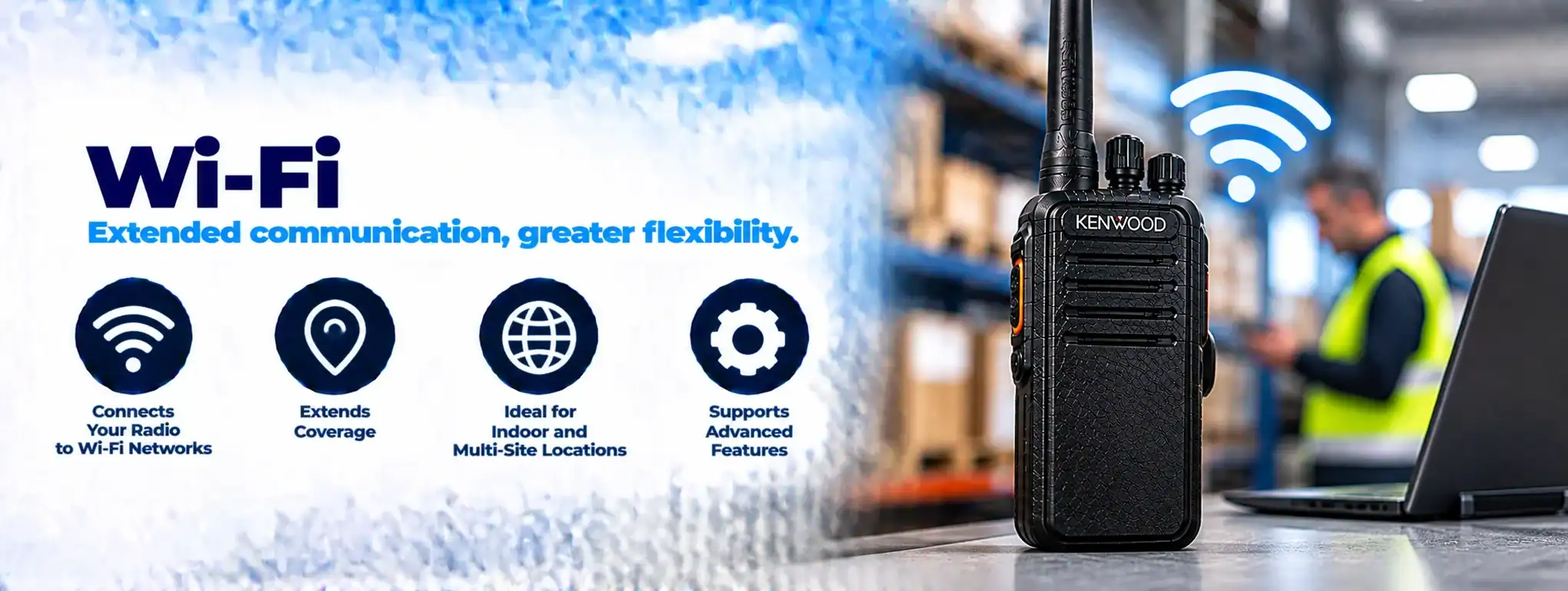
Wi-Fi
Wi-Fi is a wireless networking technology that allows compatible devices to connect to a local networkA Network is a connected system of radios, equipment and infrastructure that allows users to communicate across a defined area. Radio networks can range from simple radio-to-radio systems to large multi-site networks. and exchange data without a physical network cable. In professional two-way radio systems, Wi-Fi can be used for configuration, software updates, network connectivity, location services and Push-to-Talk over Cellular (PoC)Push-to-Talk over Cellular (PoC) provides radio-style push-to-talk communication over cellular or IP networks, allowing users to communicate across wide areas where suitable network connectivity is available. or other IP-based communication systems.
Wi-Fi is different from conventional radio communication. A Wi-Fi connection normally uses wireless access points connected to a network, whereas a traditional two-way radio communicates using radio frequencies directly between radios or through radio infrastructureRadio infrastructure is the equipment and supporting systems behind a professional two-way radio network, including repeaters, antennas, base stations, network connections, power systems and dispatch equipment. such as repeaters.
What is Wi-Fi?
Wi-Fi allows devices such as computers, smartphones, tablets and compatible radios to connect wirelessly to a network.
A typical Wi-Fi connection consists of:
Device → Wi-Fi Access Point → Network
The access point provides the wireless connection while the wider network provides access to other devices or services.
Wi-Fi and two-way radios
Some modern professional two-way radios include built-in Wi-Fi.
Depending on the radio model, Wi-Fi can be used for functions such as:
- Radio programming
- Software updates
- FirmwareFirmware is the software built into a two-way radio that controls its underlying operation, features and hardware. Manufacturers may release updates to improve performance, fix faults or add functionality. updates
- Configuration management
- Network connectivity
- Location services
- Data applications
Wi-Fi does not necessarily replace the radio’s normal RF communication.
Wi-Fi and radio communication
Wi-Fi and conventional two-way radio use different technologies.
A conventional radio systemA Radio System is a complete communication solution comprising two-way radios and, where required, equipment such as repeaters, antennas, base stations, mobile radios and network infrastructure. may operate using:
Portable RadioA Portable Radio is a battery-powered two-way radio designed to be carried and operated by an individual, providing mobile communication for professional and operational users. → RepeaterA Repeater receives a two-way radio transmission and retransmits it, usually from an elevated location, to extend the coverage and reliability of a radio communication system. → Radio
A Wi-Fi-connected device may operate using:
Device → Wi-Fi → Network → Application or Service
Some modern radio systems can combine both technologies.
Wi-Fi-enabled radios
Professional radios with Wi-Fi connectivity can connect to an organisation’s wireless network when appropriately configured.
This can provide additional functionality without requiring the radio to be physically connected to a computer.
The exact Wi-Fi functions depend on the manufacturer and radio model.
Wi-Fi and radio programming
Some professional radios support Over-the-Air Programming (OTAP)Over-the-Air Programming (OTAP) allows compatible two-way radios to be configured or updated remotely through a radio network, reducing the need to physically connect each radio to a programming computer. using Wi-Fi or other network connections.
This can allow authorised radio administrators to update configuration information without connecting each radio individually to a programming computer.
The available programming functions depend on the radio system.
Wi-Fi and firmware updates
Wi-Fi can allow compatible radios to receive firmware or software updates over a network.
This can make fleet maintenance easier, particularly where many radios are deployed across an organisation.
Updates should be managed carefully to avoid disrupting operational communications.
Wi-Fi and OTAP
Over-the-Air Programming (OTAP) allows compatible radio configurations to be updated remotely.
Wi-Fi can provide the network connection used to deliver these updates on supported equipment.
OTAP and Wi-Fi are not the same technology: Wi-Fi is the network connection, while OTAP is the radio-management function.
Wi-Fi and DMR
Professional DMR (Digital Mobile RadioA Mobile Radio is a two-way radio designed to be installed in a vehicle. It normally uses the vehicle's power supply and an external antenna to provide reliable communication while travelling or working in the field.) equipment may include Wi-Fi for supplementary functions.
The radio’s primary DMR voice communication normally continues to use the configured radio frequencies and DMR infrastructure.
Wi-Fi may provide additional connectivity for management, applications or updates.
Wi-Fi and PoC
Push-to-Talk over Cellular (PoC) systems can use Wi-Fi as an alternative to cellular connectivity.
For example:
Radio/device → Wi-Fi → Internet/IP network → PoC service
This can provide push-to-talk communication where a suitable Wi-Fi connection is available.
Wi-Fi and Push-to-Talk
Wi-Fi can carry IP-based push-to-talk traffic.
This differs from conventional push-to-talk radio, where the radio transmissionTransmission is the process of sending voice, data or signalling from a radio using a radio-frequency signal to another radio, repeater or communication system. takes place over a dedicated radio frequencyAn antenna transmits and receives radio-frequency signals, allowing a two-way radio to communicate. Antenna type, frequency, height and location can all affect radio performance and coverage..
The user experience can still be similar:
Press PTT → Speak → Release PTT
Wi-Fi and wide-area networks
Wi-Fi normally provides local wireless connectivity.
A Wide Area Network (WAN)A Wide Area Network (WAN) connects networks across large geographical areas. In professional radio systems, WAN connectivity can link repeaters, radio sites and control rooms to provide wider-area communications. can then connect that local network to remote locations.
For example:
Radio → Wi-Fi → Local Network → WAN → Remote Site
This can allow communications or data to travel between geographically separated locations.
Wi-Fi and LAN
Wi-Fi is commonly used to connect devices to a Local Area Network (LAN) without physical Ethernet cables.
For example, a warehouse might have Wi-Fi access points throughout the building, allowing compatible devices to connect to the company’s internal network.
Wi-Fi in warehouses
Wi-Fi is widely used in warehouse environments for devices such as:
- Computers
- Tablets
- Barcode scanners
- Handheld terminals
- Smartphones
- Industrial equipment
Some radio systems can also use Wi-Fi for supplementary connectivity.
Wi-Fi and two-way radio can therefore operate alongside each other within the same warehouse.
Wi-Fi and warehouse radios
A warehouse may use conventional UHF radio for operational voice communications while using Wi-Fi for data systems.
For example:
Two-way radio → Voice communication
Wi-Fi → Warehouse management data
This allows each technology to perform the task for which it is best suited.
Wi-Fi and warehouse management systems
A Warehouse Management System (WMS) can use Wi-Fi to connect handheld terminals, scanners and other devices to the company’s network.
Two-way radios can provide the voice communication between workers while the WMS manages inventory and operational data.
Wi-Fi in large buildings
Wi-Fi coverageRadio Coverage is the geographical area in which a two-way radio system can provide reliable communication. Coverage depends on the radios, antennas, frequency, terrain, buildings and system infrastructure. can be affected by building construction, walls, floors, metal structures and other obstacles.
Large buildingsAn antenna transmits and receives radio-frequency signals, allowing a two-way radio to communicate. Antenna type, frequency, height and location can all affect radio performance and coverage. may require multiple wireless access points to provide adequate Wi-Fi coverage.
Wi-Fi coverage should therefore not be assumed simply because a building has an internet connection.
Wi-Fi vs radio coverage
Wi-Fi coverage and two-way radio coverage are separate.
A Wi-Fi network uses wireless access points.
A radio network uses radio transmitters, receivers, antennas and potentially repeaters.
A building may have excellent Wi-Fi coverage but poor two-way radio coverage, or vice versa.
Wi-Fi and radio dead spots
Both Wi-Fi and radio systems can experience coverage gaps.
However, the causes and solutions can be different.
A radio Site SurveyA Site Survey is an assessment of a location to determine whether a two-way radio system will provide the required coverage, reliability and performance. can identify radio coverage problems, while a Wi-Fi survey can identify wireless-network coverage and interferenceRadio interference occurs when unwanted radio-frequency signals or electrical noise disrupt two-way radio communications, causing distorted audio, broken transmissions, reduced coverage or loss of communication. issues.
Wi-Fi interference
Wi-Fi operates within designated wireless-network frequencyFrequency is the number of cycles a radio wave completes each second, measured in Hertz. In two-way radio, frequency determines where a transmission operates within the radio spectrum. bands.
Other wireless devices and network equipment can potentially create interference or congestion.
Professional network design can help manage channelA two-way radio channel is a programmed set of communication settings, typically including frequency and signalling, that allows compatible radios to communicate with one another. allocation, access-point placement and network capacity.
Wi-Fi security
Wi-Fi networks should use appropriate security controls to prevent unauthorised access.
Depending on the network, these can include:
- Strong authentication
- EncryptionEncryption protects two-way radio communications by converting voice or data into a secure form that can only be understood by authorised radios with the correct encryption capability and keys.
- Access controls
- Network segmentation
- Secure passwords
- Enterprise Wi-Fi security
The appropriate security configuration depends on the organisation and network architecture.
Wi-Fi and encryption
Wi-Fi encryption protects data transmitted over the wireless network.
This is different from radio Encryption, which protects supported radio communications.
A system can use both forms of encryption where appropriate.
Wi-Fi and radio encryption
A professional digital radio can use radio encryption for voice communications while simultaneously using Wi-Fi for another function.
The two security mechanisms operate at different parts of the overall system.
Wi-Fi and GPS
Some professional radios use Wi-Fi alongside GPS and other positioning technologies.
Wi-Fi can potentially provide additional location information or network connectivity for location-based applications, depending on the equipment.
Wi-Fi and indoor location
GPS can be less effective indoors.
Some systems can use Wi-Fi or other technologies as part of indoor-location solutions.
The accuracy and functionality depend on the technology and infrastructure installed.
Wi-Fi and telemetry
Wi-Fi can transport TelemetryTelemetry is the automatic collection and transmission of information from a remote device, vehicle, machine or radio to another location for monitoring, analysis or control. data from compatible devices to a network or central application.
This can be useful where equipment needs to send status information or measurements over a local wireless network.
Wi-Fi and radio data
Modern digital radio systems can transmit data as well as voice.
Wi-Fi can provide an additional high-bandwidth network connection for applications that require more data than the radio channel is designed to carry.
Wi-Fi and remote management
Network-connected radios and infrastructure can potentially be managed remotely.
Wi-Fi can provide local network access for compatible equipment, reducing the need for physical connections during certain management tasks.
Wi-Fi and vehicle radios
Some vehicle-mounted communication equipment can use Wi-Fi for supplementary connectivity.
The exact application depends on the radio and system architecture.
Wi-Fi availability can also vary significantly between vehicles and locations.
Wi-Fi and radio hire
Temporary sites may use Wi-Fi alongside hired professional radios.
For example, an event could use:
Two-way radio → Staff voice communication
Wi-Fi → Internet and operational data
The two systems can operate independently or be integrated where compatible.
Wi-Fi at events
Events often use Wi-Fi for ticketing, payment systems, production equipment and internet access.
Two-way radios can provide instant operational communication between staff.
Where a suitable network is available, Wi-Fi can also support compatible IP-based communication systems.
Wi-Fi and event communications
A large event may combine several communication technologies:
- Professional two-way radio
- Wi-Fi
- Mobile networks
- Internet connectivity
- Control-room systems
- PoC
Each can provide different capabilities.
Wi-Fi and security systems
Security operations may use Wi-Fi for CCTV, access-control systems and other networked equipment.
Two-way radios can provide voice communication between security personnel.
Network integration can allow information from different systems to be brought together where appropriate.
Wi-Fi and control rooms
A control room can use Wi-Fi and wired networks to connect computers, dispatch applications and other equipment.
The radio system can then provide the voice communications layer.
Wi-Fi and dispatch
A Dispatch application can use an IP network to communicate with radio infrastructure.
Wi-Fi may provide the local wireless connection for compatible tablets, computers or radio devices.
Wi-Fi and roaming
Wi-Fi networks can be designed with multiple access points so compatible devices can move between coverage areas.
This is separate from radio RoamingRoaming allows a compatible two-way radio to move between different radio sites or coverage areas, automatically selecting an appropriate site as the user moves., although both technologies can use multiple coverage areas.
Wi-Fi and radio roaming
Some devices can use both Wi-Fi and cellular or radio networks.
The behaviour when moving between networks depends on the device and application.
A Wi-Fi network does not automatically provide roaming between radio sites.
Wi-Fi and latency
LatencyLatency is the delay between a radio transmission being sent and the resulting voice or data being received. It can be introduced by digital processing, repeaters, IP networks, gateways and cloud systems. is the time taken for data to travel through a network.
Low and predictable latency can be important for real-time applications such as voice communication.
Network congestion or poor Wi-Fi coverage can increase latency.
Wi-Fi and Quality of Service
Quality of Service (QoS)Quality of Service (QoS) is the management and prioritisation of network traffic to help important communications receive suitable bandwidth, latency and reliability, particularly on IP-based systems. can be used on some networks to prioritise important traffic.
This can be useful when voice, video and other data applications share the same network.
Wi-Fi bandwidth
Wi-Fi generally provides significantly more bandwidth than a conventional narrowbandNarrowband describes a radio communication system that uses a relatively small amount of frequency spectrum to transmit information. It is widely used in professional two-way radio to make efficient use of available radio channels. two-way radio channel.
This makes Wi-Fi suitable for applications such as:
- Internet access
- Video
- Large data transfers
- Cloud applications
- Software updates
Conventional radio remains highly effective for low-bandwidth, instant voice communications.
Wi-Fi vs two-way radio
Wi-Fi and two-way radio are not direct replacements for each other.
Two-way radio:
- Designed for operational voice communication
- Instant push-to-talk
- Can operate without public internet access
- Can use dedicated radio infrastructure
Wi-Fi:
- Designed primarily for wireless networking
- Provides higher data capacity
- Requires network infrastructure
- Commonly connects devices to local or wider networks
Modern communication systems can use both.
Wi-Fi and mobile networks
Wi-Fi can sometimes provide an alternative network connection to cellular data.
For PoC and other IP-based services, a device may use either:
Wi-Fi
or:
4G/5G cellular
depending on availability and configuration.
Wi-Fi and PoC radios
A PoC radio may use Wi-Fi when inside a suitable wireless network.
This can be particularly useful inside buildings where Wi-Fi coverage is strong but cellular coverage is limited.
Wi-Fi limitations
Wi-Fi has several limitations for professional communications.
These can include:
- Limited coverage from individual access points
- Dependence on network infrastructure
- Congestion
- Interference
- Network outages
- Security configuration requirements
- Building-related coverage problems
For critical voice communication, the appropriate network technology should be selected according to the operational requirements.
Wi-Fi and business radio systems
Wi-Fi can complement a professional business radioBusiness Radio refers to professional two-way radio systems used by businesses and organisations for instant communication, often using licensed frequencies and equipment designed for commercial use. system rather than replacing it.
For example:
Radio network → Operational voice
Wi-Fi network → Data and applications
WAN → Multi-site connectivity
This creates a broader communications infrastructure using different technologies for different purposes.
Choosing Wi-Fi for radio applications
When Wi-Fi is being considered as part of a communications system, important factors include:
- Coverage.
- Number of connected devices.
- Network capacity.
- Security.
- Latency.
- Reliability.
- Internet availability.
- Access-point placement.
- Roaming requirements.
- Integration with the radio system.
Wi-Fi and DCS
DCS can provide professional two-way radio systems that operate alongside Wi-Fi and other network technologies.
Where a radio system requires IP connectivity, Wi-Fi, LAN or WAN infrastructure can be incorporated where supported by the selected equipment and system architecture.