
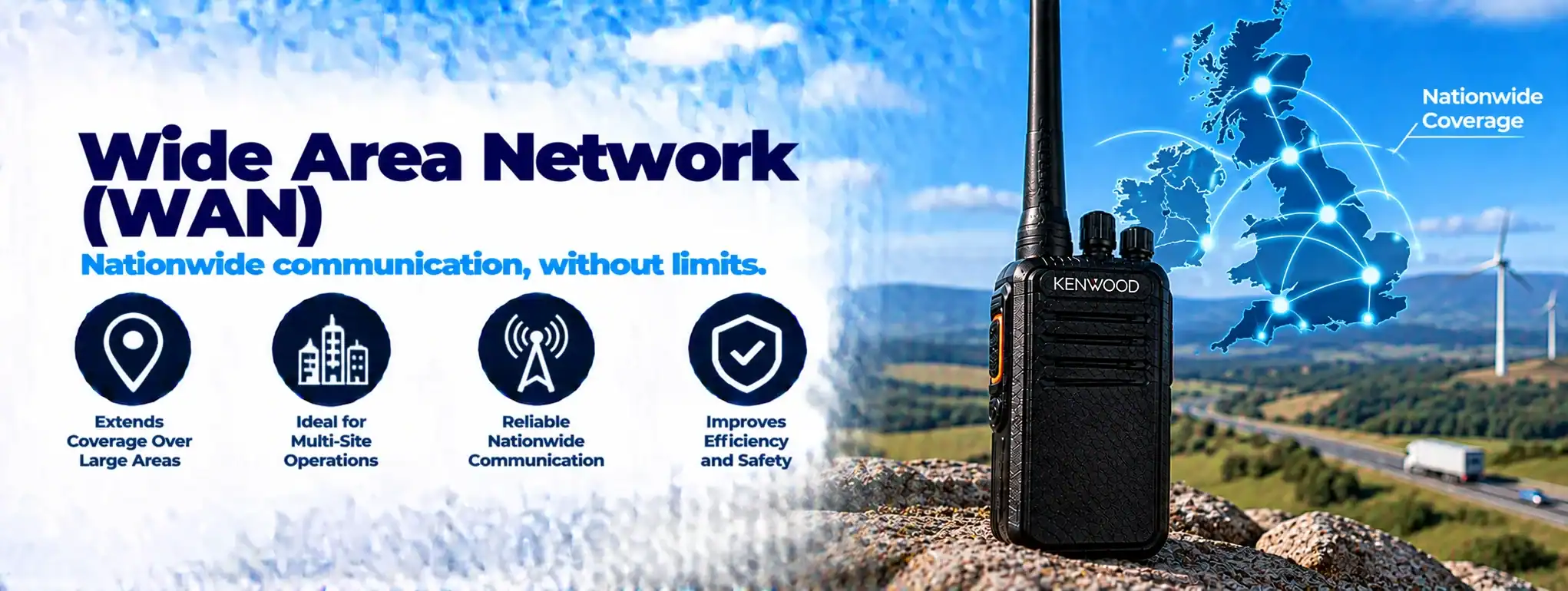
Wide Area Network (WAN)
A Wide Area NetworkA Network is a connected system of radios, equipment and infrastructure that allows users to communicate across a defined area. Radio networks can range from simple radio-to-radio systems to large multi-site networks. (WAN) is a communications network that connects computers, devices or smaller networks across a large geographical area. In professional two-way radio systems, a WAN can be used to connect radio sites, repeaters, control rooms and other system infrastructureRadio infrastructure is the equipment and supporting systems behind a professional two-way radio network, including repeaters, antennas, base stations, network connections, power systems and dispatch equipment. across different locations.
WAN connectivity allows a radio systemA Radio System is a complete communication solution comprising two-way radios and, where required, equipment such as repeaters, antennas, base stations, mobile radios and network infrastructure. to extend beyond the coverageRadio Coverage is the geographical area in which a two-way radio system can provide reliable communication. Coverage depends on the radios, antennas, frequency, terrain, buildings and system infrastructure. of a single site.
What is a WAN?
WAN stands for Wide Area Network.
Unlike a Local Area Network (LAN), which normally connects devices within a limited area such as a building, a WAN connects networks or locations over a wider geographical area.
A WAN can use technologies such as:
- Internet connections
- Private network connections
- Fibre
- Mobile data networks
- Microwave links
- Other telecommunications infrastructure
WAN and two-way radio
A WAN can form part of a modern professional Radio System.
For example, multiple radio sites can be connected over a WAN:
Radio Site A → WAN → Radio Site B
This allows communications to be passed between locations that are too far apart for conventional radio signals to reach directly.
WAN and radio repeaters
A WAN can connect Repeaters at different locations.
Instead of each repeaterA Repeater receives a two-way radio transmission and retransmits it, usually from an elevated location, to extend the coverage and reliability of a radio communication system. operating as an isolated system, network connectivity can allow selected radio traffic to be shared between sites.
This can create a wider-area radio network.
WAN and DMR
Professional Digital Mobile Radio (DMR)Digital Mobile Radio (DMR) is an ETSI digital radio standard for professional two-way communications, supporting voice, group calling, data and other features on compatible radio systems. systems can use IP networks and WAN connectivity to link radio sites.
Depending on the system architecture, this can support functions such as:
- Multi-site communication
- RoamingRoaming allows a compatible two-way radio to move between different radio sites or coverage areas, automatically selecting an appropriate site as the user moves.
- Talk groups
- Dispatch
- Remote monitoring
- System management
- Data services
The exact capabilities depend on the radio manufacturer and network architecture.
WAN and IP Site Connect
IP Site ConnectIP Site Connect links compatible DMR radio sites using an IP network, allowing selected radio communications to be shared between separate buildings, facilities or geographical locations. is a technology used by some DMR systems to connect radio sites over an IP network.
A WAN can provide the underlying network connection between those sites.
For example:
Site 1 → WAN → Site 2 → WAN → Site 3
Users can then communicate across multiple radio coverage areas where the system has been configured to allow it.
WAN and wide-area radio coverage
A WAN does not itself transmit radio signals.
Instead, it provides the network connection between radio infrastructure.
The radio coverage at each location is still provided by the radio equipment, antennas and repeaters.
The WAN effectively connects those individual coverage areas together.
WAN and roaming
WAN-connected radio systems can support Roaming, allowing compatible radios to move between connected coverage areas.
For example, a logistics company could operate radio sites at several distribution centres.
A compatible radio could move between those sites while remaining connected to the appropriate radio service.
WAN and multi-site radio systems
A WAN is particularly useful for organisations operating across multiple locations.
Examples include:
- Distribution centres
- Transport networks
- Utilities
- Large industrial organisations
- Multi-site businesses
- Regional security operations
- Large infrastructure projects
The WAN can connect the individual radio systems into a wider communications network.
WAN and control rooms
A WAN can connect remote radio sites to a central Control Room or dispatch operation.
This allows authorised personnel to communicate with users across multiple locations.
A typical arrangement could be:
Portable Radios → Local Repeater → WAN → Control Room
WAN and dispatch
A WAN can allow a Dispatch system to communicate with radios at remote sites.
A dispatcher may be able to communicate with individual users or talk groups across a connected radio network.
The exact functions depend on the dispatch platform and radio system.
WAN and talk groups
WAN-connected radio systems can allow selected Talk Groups to operate across multiple sites.
For example:
Operations Talk GroupA Talk Group is a predefined group of users or radios within a two-way radio system that share a common communication group, allowing teams to communicate without involving other users. → Site A + Site B + Site C
Other talk groups may remain local to a particular site.
This allows the radio network to be configured around the organisation’s operational requirements.
WAN and private calls
Depending on the radio system, WAN connectivity can support Private Calls between users at different connected sites.
The system must be configured to route the call between the relevant radio sites.
WAN and emergency communications
WAN-connected radio systems can allow emergency alerts to reach control rooms or other connected locations.
For example:
Emergency Alert → Local Radio Site → WAN → Control Room
The availability and behaviour of emergency functions depend on the radio system.
WAN and Lone Worker
A WAN can provide network connectivity for radio systems supporting Lone WorkerA Lone Worker is someone who works without direct supervision or immediate assistance nearby. Compatible two-way radios can provide safety features such as timed check-ins, emergency alerts and GPS location. functions.
Where supported, alerts generated by a radio can be passed through the network to a control room or other designated destination.
The WAN is the communications infrastructure; Lone Worker is the operational safety feature.
WAN and Man Down
Similarly, Man DownMan Down is a safety feature on some professional two-way radios that can detect a possible fall or unusual radio position and automatically raise an alert if the user does not respond. alerts can potentially be transported through a connected radio network.
A radio detects the configured condition and generates an alert, which the wider system can then deliver to the appropriate recipient where supported.
WAN and GPS
Some professional radio systems use WAN connectivity to transport GPS location information from radios to a central application or dispatch system.
This can allow authorised personnel to view the locations of radios operating at connected sites.
WAN and data
Modern digital radio systems can transmit more than voice.
Depending on the system, WAN connectivity can support the transport of:
- GPS information
- Text messages
- Status information
- TelemetryTelemetry is the automatic collection and transmission of information from a remote device, vehicle, machine or radio to another location for monitoring, analysis or control.
- Alarm information
- System management data
WAN and telemetry
Telemetry involves collecting and transmitting information from equipment or sensors.
A WAN can provide the network connection required to transport telemetry between remote radio sites and a central application.
WAN and radio system management
Network-connected radio infrastructure can sometimes be monitored and managed remotely.
This can reduce the need for engineers to be physically present at every radio site.
Available management functions depend on the radio system.
WAN and site connectivity
A WAN can connect radio systems located in different:
- BuildingsAn antenna transmits and receives radio-frequency signals, allowing a two-way radio to communicate. Antenna type, frequency, height and location can all affect radio performance and coverage.
- Towns
- Cities
- Industrial sites
- Warehouses
- Distribution centres
- Regional offices
This makes it possible to create a communications system covering a much larger geographical area than a single radio site.
WAN vs LAN
A LAN normally covers a relatively limited physical area.
A WAN connects networks over larger geographical distances.
For example:
LAN: Radio equipment and computers within one building.
WAN: Radio systems at several buildings or locations connected together.
A WAN may use LANs at each individual site as part of the overall network architecture.
WAN vs radio coverage
WAN coverage and radio coverage are different concepts.
Radio coverage determines where a radio can communicate with the local radio infrastructure.
WAN connectivity determines how those separate radio sites can communicate with one another.
A WAN cannot compensate for inadequate local radio coverage.
WAN and the internet
A WAN can use the public internet as its underlying transport network.
However, professional radio systems may use additional security, authentication and networking measures to protect communications.
A private WAN can also be used where an organisation requires greater control over its network infrastructure.
WAN reliability
Because a WAN can become an important part of a radio system, network reliability should be considered during system design.
Factors can include:
- Network availability
- Connection speed
- LatencyLatency is the delay between a radio transmission being sent and the resulting voice or data being received. It can be introduced by digital processing, repeaters, IP networks, gateways and cloud systems.
- Redundancy
- Backup connectivity
- Network security
- Quality of Service (QoS)Quality of Service (QoS) is the management and prioritisation of network traffic to help important communications receive suitable bandwidth, latency and reliability, particularly on IP-based systems.
WAN latency
Latency is the time taken for information to travel through a network.
Excessive latency can affect the performance of network-connected radio systems.
This is particularly important where voice traffic is being transported between geographically separated radio sites.
WAN and Quality of Service
Quality of Service (QoS) can be used to prioritise certain types of network traffic.
In a professional radio environment, appropriate network configuration can help ensure that voice and critical system traffic receive suitable network priority.
WAN redundancy
Critical radio systems may use redundant network connections.
For example, a site could have a primary WAN connection and a secondary connection that can be used if the primary connection fails.
The appropriate level of redundancy depends on the importance of the communications service.
WAN and radio system resilience
A professionally designed wide-area radio system should consider what happens if the WAN connection fails.
Depending on the system, local radio communications may continue even if communication with remote sites is temporarily unavailable.
System behaviour depends on the equipment and configuration.
WAN security
A WAN connecting professional radio infrastructure should be appropriately secured.
Security measures can include:
- Authentication
- EncryptionEncryption protects two-way radio communications by converting voice or data into a secure form that can only be understood by authorised radios with the correct encryption capability and keys.
- Firewalls
- Network segmentation
- Secure VPN connections
- Access controls
The appropriate measures depend on the network architecture.
WAN and encryption
WAN encryption and radio Encryption are separate concepts.
A WAN can protect network traffic travelling between radio sites, while radio encryption can protect the content of radio communications.
A complete system may use both where appropriate.
WAN and VPN
A Virtual Private Network (VPN) can provide a secure connection across an underlying network such as the internet.
VPN technology can be used in some radio-network architectures to connect geographically separated sites.
The specific requirements depend on the radio manufacturer’s system design.
WAN and mobile networks
A WAN connection can potentially use a mobile data network where fixed connectivity is unavailable.
This can be useful for temporary or remote radio sites, subject to network availability and system requirements.
WAN and temporary radio systems
Temporary radio systems can use network connectivity to connect sites where conventional fixed network infrastructure is unavailable.
This can be useful for:
- Large events
- Temporary construction projects
- Emergency operations
- Remote worksites
- Temporary logistics facilities
WAN and radio hire
For Radio HireRadio Hire is the temporary rental of two-way radios and related communication equipment for events, projects and operational requirements, providing professional communication without purchasing the equipment. projects covering multiple locations, network connectivity can allow compatible radio infrastructure to be linked where required.
The appropriate solution depends on the geographical coverage and operational requirements of the hire project.
WAN for warehouses
A logistics organisation with multiple warehouses can use WAN-connected radio systems to provide communications between separate facilities.
For example:
Warehouse A → WAN → Warehouse B → WAN → Warehouse C
Local radio coverage is provided at each warehouse, while the WAN connects the sites.
WAN for transport
Transport organisations can use wide-area communications to connect operational teams across multiple depots or locations.
A WAN-connected radio system can provide centralised communication where the system architecture supports it.
WAN for utilities
Utilities and infrastructure organisations often operate across large geographical areas.
WAN-connected radio systems can help connect geographically separated radio sites and operational teams.
WAN for security
Security organisations operating across multiple sites can use network-connected radio systems to provide communication between local teams and central control rooms.
Talk groups can be configured according to operational requirements.
WAN and PoC
Push-to-Talk over Cellular (PoC)Push-to-Talk over Cellular (PoC) provides radio-style push-to-talk communication over cellular or IP networks, allowing users to communicate across wide areas where suitable network connectivity is available. systems use IP connectivity, often through cellular or Wi-FiWi-Fi is a wireless networking technology that connects compatible devices to a local or wider network. In radio systems, it can support programming, updates, data services and IP-based communications. networks, to provide wide-area push-to-talk communication.
PoC is therefore inherently dependent on network connectivity.
Conventional professional radio systems can also use WAN infrastructure while retaining local radio communications.
WAN and PoC comparison
A conventional radio network may use:
Radio → Repeater → WAN → Repeater → Radio
A PoC system may use:
Radio/device → Cellular/Wi-Fi → IP Network → Cellular/Wi-Fi → Radio/device
Both approaches can provide wide-area communication, but they use different underlying technologies.
WAN and radio interoperability
A WAN can provide the network connection required to integrate different parts of a communications system.
However, simply connecting systems to the same WAN does not automatically make different radio technologies interoperable.
InteroperabilityInteroperability is the ability of different communication systems, devices or organisations to work together and exchange information. In two-way radio, it can connect different radio networks, technologies or users through compatible systems or gateways. depends on the equipment, software and system interfaces being used.
WAN and professional radio system design
When designing a WAN-connected radio system, engineers may consider:
- Number of radio sites.
- Geographical distance between sites.
- Required talk groups.
- Voice traffic.
- Data requirements.
- Network latency.
- Network availability.
- Redundancy.
- Security.
- Future expansion.
WAN limitations
A WAN introduces an additional dependency into a networked radio system.
Potential issues include:
- Network outages
- Latency
- Connection failures
- Bandwidth limitations
- Configuration problems
- Security risks
A well-designed system should account for these risks.
WAN and DCS
DCS can design and supply professional two-way radio systems that use network connectivity to link radio sites where wide-area communication is required.
The appropriate architecture depends on the number of sites, geographical coverage, radio technology, network availability and operational requirements.