
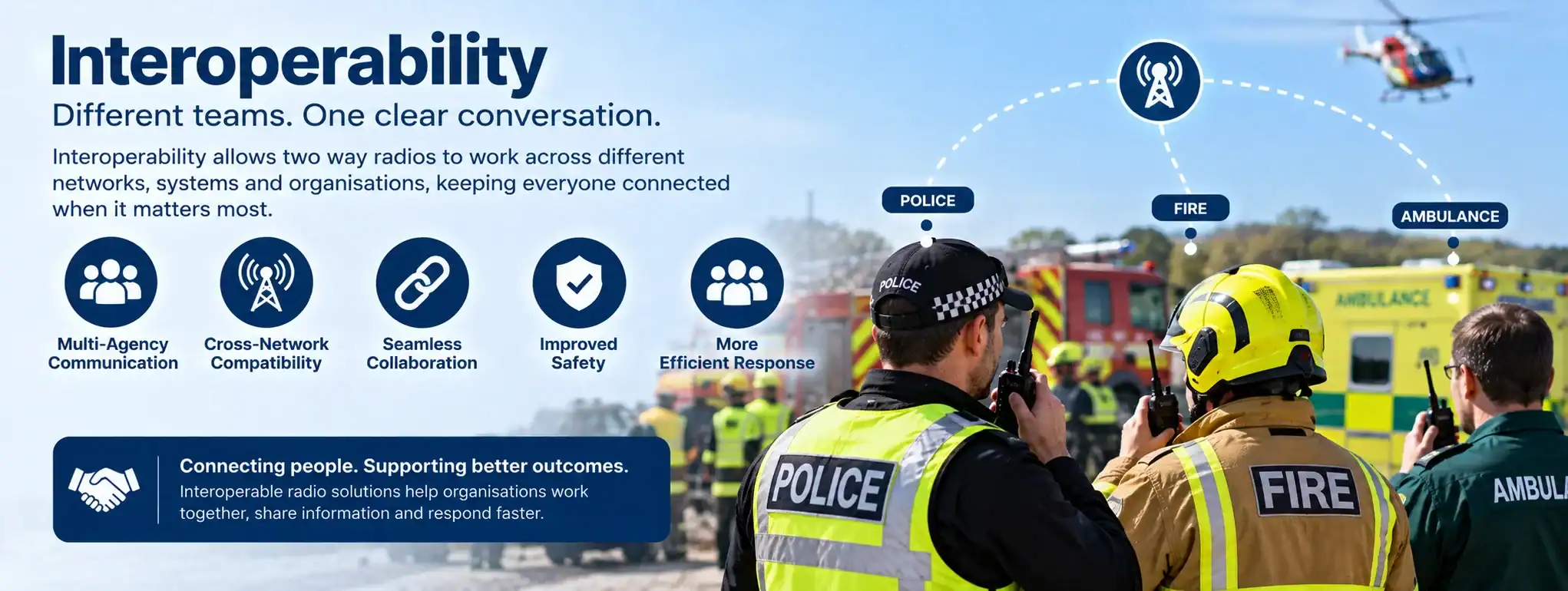
Interoperability
Interoperability is the ability of different communication systems, devices, technologies or organisations to communicate and work together effectively.
In two-way radio, interoperability allows users operating different radio systems or communication technologies to exchange information where the systems have been designed or connected to support it.
This can be particularly important when several teams, contractors or organisations need to communicate during the same operation or incident.
What does interoperability mean?
Interoperability means that different systems can work together rather than operating as completely separate communication networks.
For example:
Radio SystemA Radio System is a complete communication solution comprising two-way radios and, where required, equipment such as repeaters, antennas, base stations, mobile radios and network infrastructure. A → Gateway → Radio System B
Or:
Two-way radio → NetworkA Network is a connected system of radios, equipment and infrastructure that allows users to communicate across a defined area. Radio networks can range from simple radio-to-radio systems to large multi-site networks. → Dispatch platform → Mobile device
The exact method depends on the technologies involved.
Interoperability and two-way radios
Two-way radio systems are not automatically interoperable simply because they use the same type of radio.
Different manufacturers, frequencies, protocols, encryptionEncryption protects two-way radio communications by converting voice or data into a secure form that can only be understood by authorised radios with the correct encryption capability and keys. arrangements and system configurations can prevent direct communication.
Interoperability therefore needs to be considered when designing the communication system.
Radio interoperability
Radio interoperability can involve communication between:
- Different radio manufacturers
- Different radio systems
- Analogue and digital radios
- Different digital radio technologies
- Radio and cellular networks
- Radio and IP networks
- Radio and dispatch systems
- Different organisations
The method used to achieve interoperability depends on the systems involved.
Interoperability between analogue and digital radio
Analogue and digital radio systems use different methods of transmitting voice.
They cannot necessarily communicate directly with each other.
A suitable gateway or other interface may be required to connect the systems.
For example:
Analogue radioAnalogue radio uses continuously varying radio signals to transmit voice communication. It remains widely used for reliable two-way communication across business, industry, events, security and other applications. → Gateway → Digital radio
The gateway converts or passes the communication between the two systems according to its capabilities.
Interoperability and DMR
Digital Mobile Radio (DMR)Digital Mobile Radio (DMR) is an ETSI digital radio standard for professional two-way communications, supporting voice, group calling, data and other features on compatible radio systems. is a digital radio standard used by a range of manufacturers.
DMR provides a common technical framework, but this does not mean that every DMR radio or system will automatically provide identical functionality.
Features, system architecture, configuration and manufacturer-specific implementations can affect interoperability.
Interoperability and different manufacturers
Two radios from different manufacturers may operate on the same general radio standard but still have limitations when used together.
Basic voice communication may be possible in some configurations, while advanced features may not be supported.
Features that can be affected include:
- Group calling
- Emergency signalling
- GPS
- Encryption
- Data
- Remote control
- Dispatch
- TelemetryTelemetry is the automatic collection and transmission of information from a remote device, vehicle, machine or radio to another location for monitoring, analysis or control.
Compatibility should therefore be checked for the specific equipment and system.
Interoperability and frequencies
Two radios must use compatible frequencies and channelA two-way radio channel is a programmed set of communication settings, typically including frequency and signalling, that allows compatible radios to communicate with one another. configurations to communicate directly.
If two systems operate on different frequencies, they cannot normally communicate directly.
A gateway or other network connection may be used where communication between the systems is required.
Interoperability and licensing
FrequencyAn antenna transmits and receives radio-frequency signals, allowing a two-way radio to communicate. Antenna type, frequency, height and location can all affect radio performance and coverage. licensing can also affect interoperability.
Different organisations may have separate licensed frequencies or radio systems.
Connecting those systems may require technical planning and consideration of the applicable licensing arrangements.
Interoperability and gateways
A Gateway is one of the most common ways of connecting different communication systems.
A gateway provides an interface between otherwise separate systems.
For example:
Radio System A → Gateway → IP Network → Radio System B
Gateways can be hardware-based, software-based or incorporated into a wider communication platform.
Interoperability and IP networks
IP networking allows geographically separated communication systems to be connected.
For example:
Radio Site A → IP Network → Radio Site B
This can allow radio users at different locations to communicate through connected infrastructureRadio infrastructure is the equipment and supporting systems behind a professional two-way radio network, including repeaters, antennas, base stations, network connections, power systems and dispatch equipment..
IP networking can also connect radio systems to dispatch and cloud platforms.
Interoperability and Cloud Dispatch
Cloud DispatchCloud Dispatch is a cloud-based radio management and communication system that allows authorised dispatchers to communicate with, monitor and manage two-way radio users through an internet-connected platform. can provide an interface between radio users and other authorised communication users.
Depending on the platform, radio users may communicate with users operating:
- Desktop computers
- Smartphones
- Tablets
- Other radio systems
This can provide interoperability between traditional radio and network-based communications.
Interoperability and hybrid communication
Hybrid CommunicationHybrid Communication combines two or more communication technologies, such as two-way radio, DMR, cellular, Wi-Fi or IP networks, allowing different systems or users to communicate through a common platform. combines different communication technologies within the same operational environment.
For example:
DMR radio + cellular Push-to-Talk + Wi-FiWi-Fi is a wireless networking technology that connects compatible devices to a local or wider network. In radio systems, it can support programming, updates, data services and IP-based communications. + Cloud Dispatch
A hybrid system can allow users to communicate across different technologies where suitable interfaces are available.
Interoperability between radio and smartphones
A radio system can potentially be connected to smartphone-based communication through an appropriate network or application.
This can allow a smartphone user to communicate with radio users without carrying a traditional two-way radio.
The smartphone normally requires a suitable network connection.
Interoperability and Push-to-Talk
Push-to-Talk over Cellular (PoC)Push-to-Talk over Cellular (PoC) provides radio-style push-to-talk communication over cellular or IP networks, allowing users to communicate across wide areas where suitable network connectivity is available. uses cellular or other IP networks to provide push-to-talk communications.
A PoC system can potentially be connected to a professional radio network, allowing users on both systems to communicate.
This can be useful where some users require traditional radio equipment while others need communication over a wider geographical area.
Interoperability and dispatch
A dispatch platform can provide a central interface between different communication groups.
For example, a dispatcher may communicate with:
- Radio users
- Mobile users
- Fixed control stations
- Multiple radio sites
This can make it easier to coordinate different groups during normal operations or incidents.
Interoperability and control rooms
A control room can act as a central point for interoperable communications.
Operators may have access to multiple communication systems from the same location.
For example:
Radio → Control Room ← Telephone / IP / Mobile
This can help coordinate teams using different technologies.
Interoperability during incidents
Interoperability can become particularly important during an Incident ManagementIncident Management is the process of coordinating people, communications and resources during an incident. Two-way radios can provide rapid communication between teams, control rooms and responders. situation.
A major incident may involve:
- Security teams
- Site management
- Contractors
- Medical teams
- Emergency services
- Transport teams
- Event organisers
These groups may normally use separate communication systems.
An interoperable communication arrangement can provide a way for relevant teams to exchange information when required.
Interoperability and emergency services
Different emergency organisations may use separate radio networks and communication systems.
Communication between organisations may therefore require agreed procedures, compatible systems or appropriate interfaces.
Organisations should not assume that their commercial radio system can communicate directly with emergency-service radio networks.
Interoperability and events
Large events often involve multiple organisations.
For example:
Event organiser + security contractor + medical provider + production team + traffic management
Each organisation may arrive with its own communication equipment.
Interoperability planning can determine how these teams communicate with one another where required.
Interoperability and radio hire
Radio HireRadio Hire is the temporary rental of two-way radios and related communication equipment for events, projects and operational requirements, providing professional communication without purchasing the equipment. deployments can involve equipment from different organisations.
A temporary radio system may need to accommodate:
- Event staff
- Security companies
- Contractors
- Production crews
- Venue teams
A radio supplier can plan channels, talkgroups and interfaces to provide the required communication structure.
Where separate systems need to be connected, a suitable gateway or network solution may be required.
Interoperability and construction
Construction projects can involve multiple contractors and specialist teams.
For example:
- Main contractor
- Security
- Mechanical contractors
- Electrical contractors
- Plant operators
- Site management
Interoperability can allow selected teams to communicate without requiring every organisation to replace its existing radio equipment.
Interoperability and transport
Transport operations can involve communication between:
- Drivers
- Control rooms
- Depots
- Security
- Maintenance
- Emergency response teams
Interoperable systems can help coordinate these groups where their communication requirements overlap.
Interoperability and security
Security operations may involve several teams using different communication methods.
A central control or dispatch platform can provide a way of coordinating communications across these systems.
Access should be carefully controlled so that users only receive communications appropriate to their role.
Interoperability and encryption
Encryption can affect interoperability.
Two encrypted radio systems cannot simply communicate because they use the same frequencyFrequency is the number of cycles a radio wave completes each second, measured in Hertz. In two-way radio, frequency determines where a transmission operates within the radio spectrum..
They must also have compatible encryption arrangements and appropriate configuration.
Encryption keys and security policies can therefore become important considerations when connecting different systems.
Interoperability and End-to-End Encryption
End-to-End EncryptionEnd-to-End Encryption protects radio communications between authorised endpoints, keeping voice or data encrypted through the network until it reaches the intended receiving device. can make interoperability more complex because communications may need to remain protected across the complete communication path.
When a communication passes through a gateway or different network, the security architecture must be understood.
Interoperability should never be assumed to override the security requirements of either system.
Interoperability and emergency alerts
Emergency features may not be interoperable between different radio systems.
For example, an emergency buttonAn Emergency Button is a dedicated two-way radio control that allows users to quickly send an emergency alert to a dispatcher, control room or authorised radio users. activated on one manufacturer’s radio may not automatically generate the same emergency alert on another system.
Where emergency functionality is important, the complete system should be tested.
Interoperability and GPS
GPS data may also have compatibility limitations.
A radio system may provide location information to its own dispatch platform but not necessarily to another manufacturer’s system.
An appropriate interface or software integration may be required.
Interoperability and call recording
Call RecordingCall Recording is a two-way radio feature or system function that captures and stores radio communications for later playback, review, incident investigation or record keeping. can also be affected when connecting different systems.
If communications pass through several platforms, each platform may record different parts of the conversation.
Recording requirements should therefore be considered as part of the overall system design.
Interoperability and trunked radio
Trunked radio systems can use complex network infrastructure and signalling.
Connecting two trunked systems may require specialist interfaces rather than simply configuring both systems to use the same frequency.
The specific trunking technologies and system architecture need to be considered.
Interoperability and conventional radio
Conventional radio systems can sometimes be easier to connect because their communication structure is relatively simple.
However, compatibility still depends on factors such as:
- Frequency
- Channel spacing
- ModulationAnalogue radio uses continuously varying radio signals to transmit voice communication. It remains widely used for reliable two-way communication across business, industry, events, security and other applications.
- Signalling
- CTCSS/DCS
- Encryption
- Equipment configuration
Interoperability and PMR446
PMR446 radios can communicate with compatible PMR446 radios operating on the same channel and using compatible settings.
However, PMR446 should not be assumed to provide interoperability with professional licensed radioA Licensed Radio is a two-way radio operated under an appropriate radio licence. Licensed systems can provide greater control over frequencies, coverage and infrastructure than licence-free radio services such as PMR446. systems.
A gateway or other technical solution would be required to connect separate systems.
Interoperability and back-to-back repeaters
A Back-to-Back RepeaterA back-to-back repeater uses two connected radios to receive and retransmit communications, allowing different radio channels or systems to communicate with each other. arrangement can sometimes be used to connect different radio systems.
One repeaterA Repeater receives a two-way radio transmission and retransmits it, usually from an elevated location, to extend the coverage and reliability of a radio communication system. communicates with one radio system while another repeater communicates with a second system.
The audio or signalling is then passed between the systems through the appropriate interface.
Interoperability and coverage
Interoperability does not automatically solve coverageRadio Coverage is the geographical area in which a two-way radio system can provide reliable communication. Coverage depends on the radios, antennas, frequency, terrain, buildings and system infrastructure. problems.
Each connected communication system still needs suitable coverage for its own users.
For example:
Radio A has coverage → Radio B has poor coverage
Connecting the systems does not necessarily improve Radio B’s coverage.
Interoperability and failover
FailoverFailover allows a two-way radio system to switch to backup equipment, infrastructure or communication routes when the primary system fails, helping maintain communications. can be incorporated into an interoperable communication system.
For example, if one communication network becomes unavailable, users may be able to move to an alternative network or communication method.
The backup arrangement must be designed and tested in advance.
Interoperability and resilience
Interoperability can form part of a resilient communication strategy by providing more than one way for users to communicate.
For example:
Primary radio network → Secondary IP network → Mobile communication
However, adding systems also introduces additional technical dependencies.
Interoperability testing
Interoperability should be tested before a system is relied upon operationally.
Testing can include:
- Voice communication
- Group calls
- Individual calls
- Emergency alerts
- GPS
- Dispatch
- Encryption
- Call recording
- Network failure
- Coverage
- System recovery
Testing should reflect the situations in which the system will actually be used.
Interoperability planning
Good interoperability planning starts by identifying:
- Who needs to communicate?
- Which systems do they currently use?
- Which users need to communicate directly?
- What information needs to be shared?
- Which features are required?
- What security restrictions apply?
- What happens if a system fails?
This helps determine the appropriate technical solution.
Interoperability limitations
Interoperability does not mean that every feature of one communication system will be available on another.
Basic voice communication may be possible while advanced functions remain system-specific.
Potential limitations include:
- Encryption
- Emergency functions
- GPS
- Data
- Messaging
- Talkgroups
- Call recording
- User management
- Dispatch functions
These limitations should be identified before systems are connected.
Interoperability and system design
A professionally designed interoperable system should consider the complete communication path.
For example:
User → Radio → Radio Infrastructure → Gateway → IP Network → Second System → User
Every part of this chain can affect communication quality, reliability and security.
Interoperability and DCS
DCS can help organisations assess communication requirements where different radio systems or technologies need to work together.
Solutions can include compatible radio equipment, network-connected systems, gateways, dispatch platforms or hybrid communication arrangements, depending on the operational requirements.
The correct solution depends on the systems involved and the level of interoperability required.