
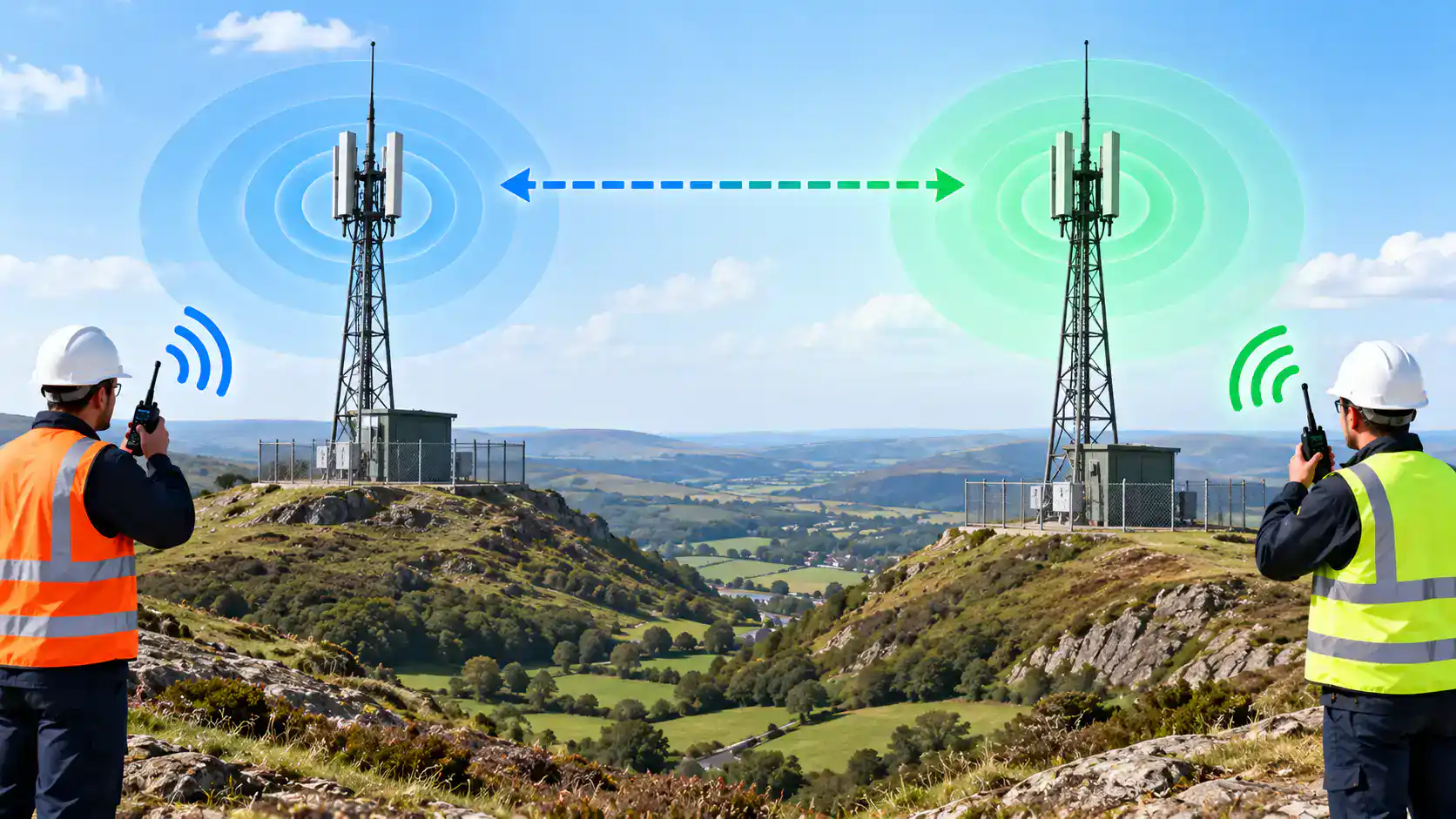
Back-to-Back Repeater
A back-to-back repeaterA Repeater receives a two-way radio transmission and retransmits it, usually from an elevated location, to extend the coverage and reliability of a radio communication system. is a two-way radio arrangement in which two radio units are connected together so that one radio receives a transmissionTransmission is the process of sending voice, data or signalling from a radio using a radio-frequency signal to another radio, repeater or communication system. and passes the audio to the second radio, which then retransmits it on a different frequencyAn antenna transmits and receives radio-frequency signals, allowing a two-way radio to communicate. Antenna type, frequency, height and location can all affect radio performance and coverage. or channelA two-way radio channel is a programmed set of communication settings, typically including frequency and signalling, that allows compatible radios to communicate with one another..
This arrangement can be used to link two otherwise separate radio systems or frequencyFrequency is the number of cycles a radio wave completes each second, measured in Hertz. In two-way radio, frequency determines where a transmission operates within the radio spectrum. ranges. It is sometimes used where users operating on different radio channels need to communicate with each other.
A back-to-back repeater is different from a conventional single-radio repeater. Instead of one repeater unit receiving and retransmitting a signal using its internal transmitter and receiverA Receiver is the part of a two-way radio that detects and processes incoming radio signals, converting them into audible voice or usable data for the user., a back-to-back arrangement uses two radios connected together to perform the receive-and-retransmit function.
How does a back-to-back repeater work?
A basic back-to-back repeater consists of two compatible radio units connected through an appropriate interface.
For example:
Radio A receives → audio/interface → Radio B transmits
If Radio A is listening on one channel and receives a transmission, the connected system can pass the audio to Radio B. Radio B then transmits that audio on its programmed channel.
The process can operate in the opposite direction as well, allowing communications to pass between the two radio systems.
This effectively creates a bridge between two radio channels or systems.
Why use a back-to-back repeater?
A back-to-back repeater can be useful when two groups of radio users need to communicate but are operating on different channels, frequencies or radio systems.
For example, an organisation may have one group using a particular radio systemA Radio System is a complete communication solution comprising two-way radios and, where required, equipment such as repeaters, antennas, base stations, mobile radios and network infrastructure. while another group uses a different system. A back-to-back arrangement can potentially provide a communication link between them without requiring every user to change radios.
It can also be used as part of a temporary communication system where a conventional repeater is not the most suitable solution.
Back-to-back repeater vs conventional repeater
A conventional repeater normally contains a receiver and transmitter designed to work together as a dedicated repeater system.
The repeater receives a transmission on one frequency and simultaneously retransmits it on another frequency, allowing two-way radios to communicate over a greater area.
A back-to-back repeater instead uses two separate radio units connected together. One radio acts as the receiving side and the other as the transmitting side.
This can provide additional flexibility because the two radios may be configured for different radio systems, channels or frequencies.
However, it also introduces additional equipment and configuration requirements.
Back-to-back repeater and radio systems
Back-to-back repeaters can be used to connect different parts of a communications system.
For example, they may provide a link between:
- Two different radio channels
- Two frequency bands, where the equipment supports them
- Two groups using different radio configurations
- Different radio technologies, subject to compatibility
- Temporary and permanent communication systems
The exact capabilities depend on the radios, interface equipment and system configuration.
Back-to-back repeater and radio coverage
A back-to-back repeater does not automatically provide greater coverageRadio Coverage is the geographical area in which a two-way radio system can provide reliable communication. Coverage depends on the radios, antennas, frequency, terrain, buildings and system infrastructure. simply because two radios are connected together.
The coverage of the resulting system still depends on the antennas, radio locations, transmitter powerAn antenna transmits and receives radio-frequency signals, allowing a two-way radio to communicate. Antenna type, frequency, height and location can all affect radio performance and coverage., frequencies, terrain, buildingsAn antenna transmits and receives radio-frequency signals, allowing a two-way radio to communicate. Antenna type, frequency, height and location can all affect radio performance and coverage. and other factors.
If the two radios are located at suitable positions, the arrangement can allow communications to pass between two areas that would otherwise use separate systems.
The positioning of the radios and antennas is therefore important.
Audio interface
The two radios in a back-to-back repeater need a suitable method of exchanging the required audio and control signals.
This may involve a dedicated interface or repeater controller that manages functions such as:
- Receive audio
- Transmit audio
- Push-to-talk activation
- SquelchAnalogue radio uses continuously varying radio signals to transmit voice communication. It remains widely used for reliable two-way communication across business, industry, events, security and other applications. or carrier detection
- Signalling
- Timing and control
The exact interface depends on the radio equipment and the intended application.
Simply connecting two radios together with an ordinary audio cable does not necessarily create a functioning repeater.
Back-to-back repeater limitations
There are several considerations when using a back-to-back arrangement.
Because two separate radios are involved, the system can require more equipment, configuration and maintenance than a purpose-built repeater.
There may also be a short delay between receiving and retransmitting a transmission. Audio quality can be affected by the radios and interface being used.
The system must also be configured carefully to prevent unwanted retransmission, feedback or continuous transmission.
Frequency planning and licensing requirements must be considered where applicable.
Back-to-back repeater for temporary radio hire
A back-to-back repeater can sometimes be useful for temporary communication requirements where different groups need to be linked.
For example, a large event or temporary operation may involve different radio channels or systems that need to exchange communications.
Whether a back-to-back repeater is appropriate depends on the radio equipment, frequencies, coverage requirements and the way the users need to communicate.
DCS can assess the communication requirements and recommend an appropriate repeater or radio-link arrangement where required.