
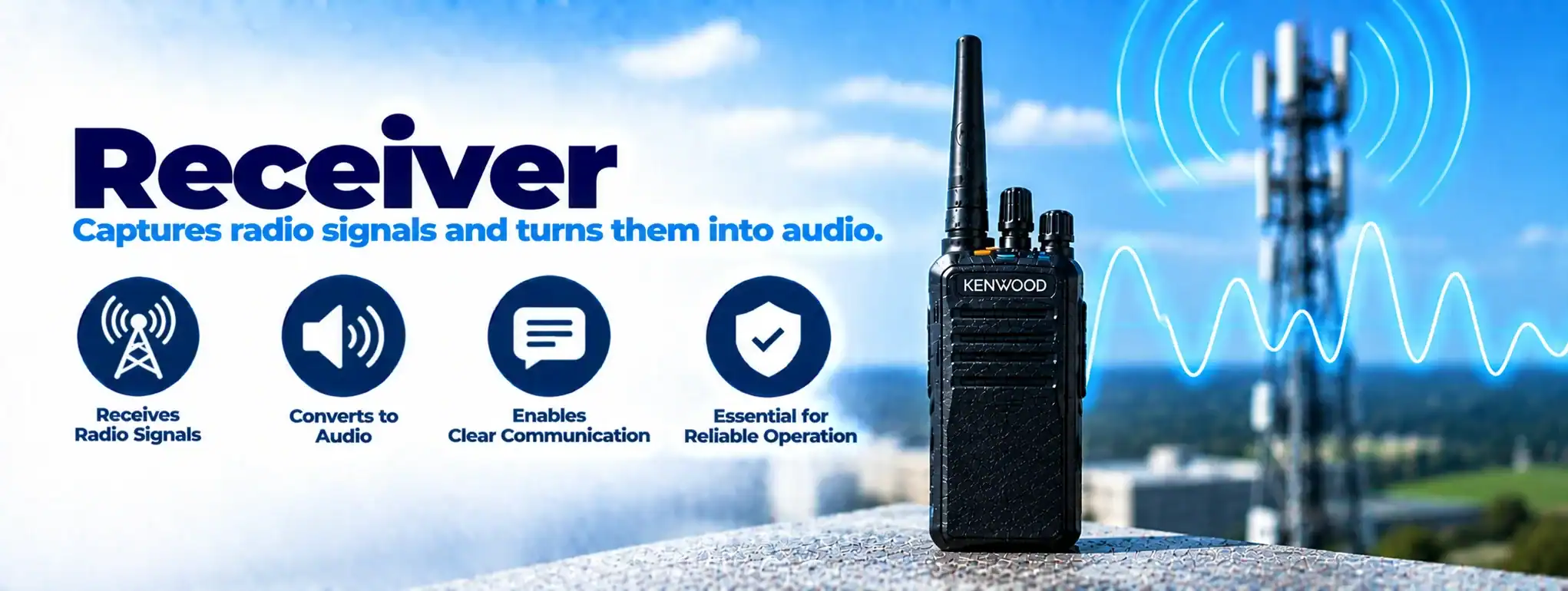
Receiver
A Receiver is the part of a two-way radio that detects and processes incoming radio signals so they can be converted into audible voice or usable data. It is one of the two primary functions of a radio transceiverA Transceiver combines a transmitter and receiver in one device, allowing a two-way radio to both send and receive radio signals., alongside the transmitter.
When another radio transmits, the receiving radio uses its antennaAn antenna transmits and receives radio-frequency signals, allowing a two-way radio to communicate. Antenna type, frequency, height and location can all affect radio performance and coverage. to pick up the radio-frequency signal, filters out unwanted signals and processes the required signal so the user can hear the communication.
A simplified process is:
Radio Signal → Antenna → Receiver → Audio Processing → Speaker
What does a radio receiver do?
The receiver is responsible for receiving incoming communications.
Its main functions include:
- Detecting radio-frequency signals
- Selecting the required frequencyAn antenna transmits and receives radio-frequency signals, allowing a two-way radio to communicate. Antenna type, frequency, height and location can all affect radio performance and coverage.
- Rejecting unwanted signals
- Demodulating the received signal
- Processing audio or digital information
- Sending the resulting audio to the speaker or headsetA radio headset combines a microphone and speaker or earpiece, allowing two-way radio users to communicate conveniently while keeping the radio away from their face or using hands-free operation.
Receiver vs transmitter
A two-way radio needs both receiving and transmitting capabilities.
Transmitter: Sends the radio signal.
Receiver: Receives the radio signal.
Together they form a Transceiver.
This allows a radio to both send and receive communications.
Receiver and antenna
The antenna receives electromagnetic Radio Frequency (RF)Radio Frequency (RF) refers to electromagnetic waves used to transmit voice and data wirelessly. Two-way radios use RF signals to communicate between radios, repeaters and other system infrastructure. energy and passes the resulting electrical signal to the receiver.
The antenna must be suitable for the frequencyFrequency is the number of cycles a radio wave completes each second, measured in Hertz. In two-way radio, frequency determines where a transmission operates within the radio spectrum. range being used.
A poor antenna, damaged connection or unsuitable installation can reduce receiver performance even when the radio itself is functioning correctly.
Receiver sensitivity
Receiver Sensitivity describes how effectively a receiver can detect weak radio signals.
A receiver with good sensitivity can detect weaker signals under suitable conditions.
However, sensitivity alone does not determine overall radio performance.
Other factors include:
- Antenna performance
- InterferenceRadio interference occurs when unwanted radio-frequency signals or electrical noise disrupt two-way radio communications, causing distorted audio, broken transmissions, reduced coverage or loss of communication.
- Selectivity
- Signal-to-noise ratio
- Radio-frequency environment
- Terrain
- BuildingsAn antenna transmits and receives radio-frequency signals, allowing a two-way radio to communicate. Antenna type, frequency, height and location can all affect radio performance and coverage.
Receiver selectivity
Selectivity is the receiver’s ability to distinguish the wanted signal from signals on nearby frequencies.
Good selectivity is particularly important in areas where many radio systems operate close together.
For example:
Wanted Signal → 165.000 MHz
Unwanted Signal → 165.0125 MHz
A well-designed receiver should be able to receive the wanted signal while rejecting the unwanted one.
Receiver and interference
Interference can make it difficult for a receiver to decode or reproduce a communication correctly.
Interference may come from:
- Other radio transmitters
- Adjacent channels
- Electrical equipment
- Industrial machinery
- Poor frequency planning
- Other wireless systems
A highly sensitive receiver can still perform poorly if significant interference is present.
Receiver and signal strength
The strength of a received signal is an important factor in communication quality.
Signal strength can be affected by:
- Distance
- Transmitter powerAn antenna transmits and receives radio-frequency signals, allowing a two-way radio to communicate. Antenna type, frequency, height and location can all affect radio performance and coverage.
- Antenna height
- Antenna efficiency
- Terrain
- Buildings
- Frequency
- RepeaterA Repeater receives a two-way radio transmission and retransmits it, usually from an elevated location, to extend the coverage and reliability of a radio communication system. infrastructureRadio infrastructure is the equipment and supporting systems behind a professional two-way radio network, including repeaters, antennas, base stations, network connections, power systems and dispatch equipment.
A weak signal does not necessarily mean that the receiver is faulty.
Receiver and squelch
SquelchAnalogue radio uses continuously varying radio signals to transmit voice communication. It remains widely used for reliable two-way communication across business, industry, events, security and other applications. is a receiver function that prevents the radio’s speaker from producing unwanted background noise when no suitable signal is being received.
When the received signal reaches the configured squelch threshold, the receiver opens and allows the communication to be heard.
This helps prevent continuous background noise when the channelA two-way radio channel is a programmed set of communication settings, typically including frequency and signalling, that allows compatible radios to communicate with one another. is quiet.
Receiver and analogue radio
In an analogue radioAnalogue radio uses continuously varying radio signals to transmit voice communication. It remains widely used for reliable two-way communication across business, industry, events, security and other applications., the receiver demodulates the incoming signal and converts it into audio.
The audio is then amplified and sent to the speaker or connected accessory.
Receiver and digital radio
A digital radio receiver processes digitally encoded information rather than simply reproducing an analogue voice signal.
In a Digital Mobile Radio (DMR)Digital Mobile Radio (DMR) is an ETSI digital radio standard for professional two-way communications, supporting voice, group calling, data and other features on compatible radio systems. system, the receiver processes the digital signal and reconstructs the transmitted voice or data.
Receiver and DMR
DMR receivers can process digital radio signals using the parameters configured for the radio systemA Radio System is a complete communication solution comprising two-way radios and, where required, equipment such as repeaters, antennas, base stations, mobile radios and network infrastructure..
These can include:
- Frequency
- Time slot
- Colour code
- Talkgroup
- Radio ID
If the radio is incorrectly programmed, it may not decode the intended communication even if a signal is present.
Receiver and frequency
The receiver must be tuned or configured for the appropriate Receive Frequency.
If the radio is set to the wrong frequency, it will normally be unable to receive the intended transmissionTransmission is the process of sending voice, data or signalling from a radio using a radio-frequency signal to another radio, repeater or communication system..
Receiver and channel
When a user selects a channel, the radio’s receiver is configured according to the parameters assigned to that channel.
The channel may contain:
- Receive frequency
- Transmit frequency
- CTCSS or signalling information
- Talkgroup
- Time slot
- Other system parameters
The user therefore normally selects a channel rather than manually tuning the receiver.
Receiver and repeater systems
In a repeater system, the receiving radio normally listens on the repeater’s output frequency.
The repeater receives transmissions from radios on its input frequency and retransmits them on its output frequency.
The receiving radio then detects the retransmitted signal.
Receiver and duplex communication
A radio system using separate transmit and receive frequencies can use a Duplexduplex, duplex radio, duplex communication, duplex frequencies, duplex operation, duplex spacing, frequency offset, repeater duplex, duplex repeater, full duplex, half duplex, radio repeater arrangement.
The radio receiver listens on one frequency while the transmitter uses another.
The exact operating arrangement depends on the radio system.
Receiver and half-duplex
Most handheld professional two-way radios operate using Half-DuplexHalf-Duplex allows two-way communication in both directions, but users normally take turns transmitting. It is the standard operating method for most Push-to-Talk professional two-way radio systems. communication.
The radio normally either transmits or receives at a given time.
When another user is speaking, the receiver is active.
When the user presses PTT, the transmitter becomes active.
Receiver and full duplex
In Full DuplexFull Duplex allows two-way radio users to transmit and receive simultaneously, providing a continuous, telephone-style conversation rather than requiring users to take turns using Push-to-Talk. communication, transmitting and receiving can occur simultaneously.
This is more typical of telephone-style communication than conventional handheld two-way radio operation.
The receiver remains active while the transmitter is operating, subject to the design of the system.
Receiver and audio
Once the receiver has processed the incoming signal, the resulting audio is sent to:
- Internal speaker
- Remote speaker microphoneA Speaker Microphone is a two-way radio accessory combining a microphone, loudspeaker and usually a Push-to-Talk button, allowing convenient radio operation without handling the radio itself.
- EarpieceAn earpiece is a two-way radio audio accessory that lets users hear radio communications discreetly, often with a microphone and Push-to-Talk button for transmitting.
- Headset
- Other audio accessoryAn audio accessory is an external device such as a speaker microphone, earpiece or headset that connects to a two-way radio to improve or adapt how users send and receive audio.
Audio quality can depend on both the receiver and the surrounding radio environment.
Receiver and noise cancellation
Some modern radios incorporate Noise CancellationNoise Cancellation is technology used in two-way radios and communication equipment to reduce unwanted background noise and make speech easier to hear, particularly in noisy working environments. or other audio-processing technologies.
These can help improve speech intelligibility in noisy environments.
Noise cancellation generally operates after the radio has received the signal and should not be confused with RF filtering or interference rejection.
Receiver and speaker
The receiver’s processed audio is normally sent to the radio’s speaker.
Professional radios may use high-output speakers designed to remain audible in noisy working environments.
Receiver and earpieces
An Earpiece can be connected to the radio so that received communication can be heard privately.
This can be useful for:
- Security
- Events
- Hospitality
- Front-of-house staff
- Production teams
Receiver and headsets
A Headset can provide both an earpiece and microphone.
This can allow users to receive communications without relying on the radio’s internal speaker.
Receiver and Bluetooth
Some professional radios support Bluetooth audio accessories.
A compatible Bluetooth earpiece or headset can receive the radio’s audio without a physical cable.
Receiver and emergency calls
The receiver can receive an Emergency CallAn Emergency Call is a priority two-way radio function that allows a user to quickly request assistance and, on supported systems, establish an urgent voice communication with a dispatcher or control room. or emergency alert from another radio where the system supports the relevant functionality.
Depending on the system, emergency traffic may be indicated through:
- Audible tones
- Display messages
- Priority indications
- Dedicated alerts
Receiver and priority calls
A Priority CallPriority Call is a two-way radio feature that gives important or authorised communications higher priority than routine radio traffic, helping urgent messages access the system when channels are busy. can be given preferential treatment by compatible radio systems.
The receiver may indicate that the incoming communication has priority.
The exact behaviour depends on the radio system and programming.
Receiver and private calls
A digital radio receiver can be configured to decode an individual Private CallPrivate Call is a two-way radio feature that allows one radio user to communicate directly with another individual radio user rather than making the conversation part of a general group call. intended for that radio.
The system may use radio IDs to determine which device should receive the communication.
Receiver and group calls
In a digital radio system, the receiver can monitor a configured Talkgroup.
When a compatible user transmits on that group, authorised radios can receive the communication.
Receiver and encryption
When EncryptionEncryption protects two-way radio communications by converting voice or data into a secure form that can only be understood by authorised radios with the correct encryption capability and keys. is used, the receiver must have the appropriate security configuration to decode the protected communication.
A radio may detect the presence of a transmission but be unable to produce intelligible audio if it does not have the correct encryption configuration.
Receiver and GPS
A radio containing GPS has a separate GPS receiver for obtaining positioning information from satellite signals.
This should not be confused with the radio’s primary communication receiver.
The two receivers perform different functions.
Receiver and radio coverage
The receiver plays an important role in determining how effectively a radio can operate at the edge of coverageRadio Coverage is the geographical area in which a two-way radio system can provide reliable communication. Coverage depends on the radios, antennas, frequency, terrain, buildings and system infrastructure..
However, radio coverage is a system-level characteristic.
It depends on:
- Transmitter power
- Receiver sensitivity
- Antenna
- Frequency
- Repeater location
- Terrain
- Buildings
- Interference
Receiver and dead spots
A Dead SpotA Dead Spot is an area where two-way radio communication is weak, unreliable or unavailable. Dead spots can be caused by buildings, terrain, distance, interference or inadequate radio coverage. can occur when the received signal becomes too weak or is affected by interference.
Improving receiver sensitivity may help in some circumstancesAn antenna transmits and receives radio-frequency signals, allowing a two-way radio to communicate. Antenna type, frequency, height and location can all affect radio performance and coverage., but it cannot eliminate all dead spots.
Coverage problems may require changes to the antenna system, repeater infrastructure or radio system design.
Receiver and repeater coverage
A repeater can provide a stronger and more strategically located signal than a handheld radio transmitting directly to another handheld.
This can significantly improve the signal available to receivers across a coverage area.
Receiver and RF filtering
Receivers use filtering to select the desired portion of the radio-frequency spectrumSpectrum is the range of radio frequencies used for wireless communication. Two-way radios operate within specific parts of the radio spectrum, subject to frequency allocation and licensing requirements. and reject unwanted signals.
Filtering can improve performance in environments with strong nearby transmitters.
Receiver and automatic gain control
Receivers can use Automatic Gain Control (AGC) to adjust signal levels within the receiver circuitry.
This helps maintain suitable signal levels as received signal strength changes.
Receiver and digital signal processing
Modern digital radios can use Digital Signal Processing (DSP) to process received signals.
DSP can perform functions such as:
- Filtering
- Demodulation
- Audio processing
- Noise reduction
- Error correction
The exact functions vary between radio technologies.
Receiver and error correction
Digital radio systems can use error-correction techniques to reconstruct information affected by transmission errors.
This can help maintain intelligible communication under less-than-perfect signal conditions.
However, there are limits to how much information can be recovered when the received signal becomes too poor.
Receiver and radio frequency
The receiver is designed to operate within a particular RF range.
A professional radio may support specific frequency bands such as VHF or UHF depending on its design.
A radio designed for one band cannot necessarily be converted to operate on another simply through programming.
Receiver and VHF
VHF (Very High Frequency)VHF (Very High Frequency) is the 30 MHz to 300 MHz radio-frequency range. VHF two-way radios are widely used for professional communications across outdoor, rural and open areas. radios can have useful propagation characteristics for outdoor and open-area applications.
The actual coverage depends on the frequency, antenna, terrain and system design.
Receiver and UHF
UHF (Ultra High Frequency)UHF (Ultra High Frequency) is the 300 MHz to 3 GHz radio-frequency range. UHF two-way radios are widely used for professional communications, particularly in buildings and urban environments. radios are often used in buildings and urban environments.
They can provide useful performance in many indoor applications, although building construction and other factors can significantly affect coverage.
Receiver and radio system design
Receiver performance should be considered as part of the complete radio system.
System designers should assess:
- Receiver sensitivity.
- Selectivity.
- Antenna performance.
- Transmitter power.
- Frequency.
- Interference.
- Coverage.
- Repeater requirements.
- Operating environment.
- Required communication reliability.
Receiver testing
Professional radio receivers can be tested to verify that they are operating within their specified performance.
Testing can include:
- Sensitivity
- Frequency accuracy
- Selectivity
- Audio output
- Signal reception
- Interference rejection
Specialist test equipment may be required for detailed measurements.
Receiver faults
Possible receiver problems include:
- No received audio
- Weak reception
- Intermittent reception
- Distorted audio
- Excessive noise
- Poor sensitivity
- Incorrect programming
The fault may originate from the radio, antenna, programming, repeater or wider system.
Receiver troubleshooting
When a radio appears unable to receive communications, basic checks can include:
- Confirm the radio is switched on.
- Check the selected channel.
- Check the volume.
- Check the squelch setting.
- Confirm the antenna is correctly fitted.
- Test with another known-working radio.
- Check whether other users can communicate.
- Determine whether the problem occurs everywhere or only in a particular location.
This can help establish whether the problem is with the individual receiver or the wider radio system.
Receiver and radio hire
In Radio HireRadio Hire is the temporary rental of two-way radios and related communication equipment for events, projects and operational requirements, providing professional communication without purchasing the equipment., receiver performance is important because hired radios must provide reliable communication across the intended operating area.
If users experience poor reception, the cause should be investigated rather than assuming that the radio itself is defective.
Coverage, antenna systems, repeaters and interference should all be considered.
Receiver and professional radio systems
Professional radio receivers are designed to operate within defined technical specifications.
When selecting equipment, receiver sensitivity and selectivity can be particularly important in areas where users require reliable communication or where multiple radio systems operate close together.
Receiver and DCS
DCS can help select and configure professional two-way radio equipment according to the required coverage, environment and communication needs.
Where reliable reception is critical, receiver performance should be considered alongside the antenna system, radio frequency, repeater infrastructure and overall system design.