
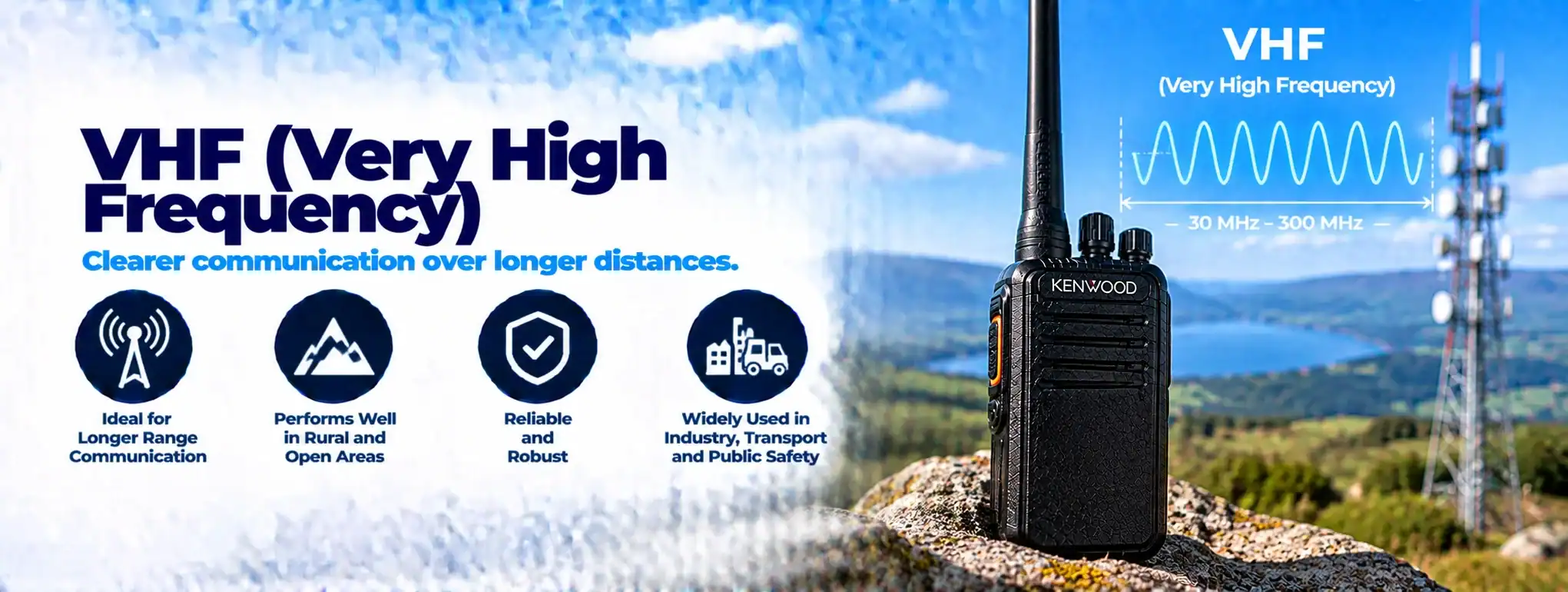
VHF (Very High Frequency)
VHF (Very High FrequencyAn antenna transmits and receives radio-frequency signals, allowing a two-way radio to communicate. Antenna type, frequency, height and location can all affect radio performance and coverage.) is a range of radio frequencies from 30 MHz to 300 MHz. VHF two-way radios are widely used for professional communications, particularly in outdoor, rural and open-area environments where good coverageRadio Coverage is the geographical area in which a two-way radio system can provide reliable communication. Coverage depends on the radios, antennas, frequency, terrain, buildings and system infrastructure. over relatively large distances is required.
VHF is commonly used by sectors including agriculture, construction, utilities, transport, marine operations, events and outdoor services.
What does VHF mean?
VHF stands for Very High FrequencyFrequency is the number of cycles a radio wave completes each second, measured in Hertz. In two-way radio, frequency determines where a transmission operates within the radio spectrum..
The VHF frequency range extends from:
30 MHz → 300 MHz
Professional two-way radio normally uses only a small portion of this wider frequency range.
Business-radio systems in the UK commonly operate in VHF bands around 150–170 MHz, subject to the applicable licensing and frequency allocation.
VHF vs UHF
VHF and UHF (Ultra High Frequency)UHF (Ultra High Frequency) is the 300 MHz to 3 GHz radio-frequency range. UHF two-way radios are widely used for professional communications, particularly in buildings and urban environments. are both widely used for two-way radio, but their propagation characteristics differ.
| Feature | VHF | UHF |
|---|---|---|
| Frequency range | 30–300 MHz | 300 MHz–3 GHz |
| Typical professional use | Outdoor, rural and open areas | BuildingsAn antenna transmits and receives radio-frequency signals, allowing a two-way radio to communicate. Antenna type, frequency, height and location can all affect radio performance and coverage., urban areas and general business use |
| Wavelength | Longer | Shorter |
| AntennaAn antenna transmits and receives radio-frequency signals, allowing a two-way radio to communicate. Antenna type, frequency, height and location can all affect radio performance and coverage. size | Generally larger | Generally smaller |
| Building penetration | Generally less effective than UHF | Generally better in many buildings |
Neither band is universally better. The appropriate choice depends on the operating environment, coverage requirements and system design.
VHF two-way radio
A VHF two-way radio uses frequencies within the VHF range to transmit and receive communications.
Professional VHF radios are available as:
- Handheld portable radios
- Vehicle-mounted mobile radios
- Base stations
- Repeaters
- Digital radios
- Analogue radios
VHF portable radios
Handheld Portable Radios are available in VHF versions for professional users.
Because VHF wavelengths are longer than UHF wavelengths, VHF portable radios normally use somewhat longer antennas.
VHF mobile radios
Vehicle-mounted Mobile Radios can operate on VHF frequencies.
An external vehicle antenna can provide good RF performance and is particularly useful for users operating across large outdoor areas.
VHF base stations
A VHF Base StationA base station is a fixed two-way radio installed at a permanent location, allowing an operator to communicate with handheld or mobile radios across a site or operating area. can provide communications from a fixed location.
Installing the antenna at an elevated position can improve coverage, particularly in open or rural environments.
VHF repeaters
A RepeaterA Repeater receives a two-way radio transmission and retransmits it, usually from an elevated location, to extend the coverage and reliability of a radio communication system. can extend the effective coverage of a VHF radio systemA Radio System is a complete communication solution comprising two-way radios and, where required, equipment such as repeaters, antennas, base stations, mobile radios and network infrastructure..
The repeater receives a transmissionTransmission is the process of sending voice, data or signalling from a radio using a radio-frequency signal to another radio, repeater or communication system. from one radio and retransmits it so that other radios can receive it.
For example:
Radio A → VHF Repeater → Radio B
A repeater can be particularly useful where terrain or distance prevents reliable direct radio-to-radio communication.
VHF and outdoor environments
VHF is often well suited to outdoor environments.
It can be used across:
- Farms
- Construction sites
- Rural estates
- Utilities networks
- Transport routes
- Outdoor events
- Industrial sites
- Large open areas
VHF and rural areas
VHF is commonly considered for rural communications because its propagation characteristics can provide useful coverage across open terrain.
However, terrain remains a major factor.
Hills, valleys, woodland and other obstructions can create areas of reduced signal strength.
VHF and open areas
VHF can provide effective coverage across open areas when suitable frequencies, antennas and powerAn antenna transmits and receives radio-frequency signals, allowing a two-way radio to communicate. Antenna type, frequency, height and location can all affect radio performance and coverage. levels are used.
A well-positioned repeater can extend coverage considerably beyond direct radio-to-radio operation.
VHF and buildings
VHF can operate inside buildings, but UHF will often have advantages where communications need to pass through multiple walls, floors or other dense structures.
The actual result depends on building construction and the radio system.
Reinforced concrete, steel structures, underground areas and other materials can affect both VHF and UHF signals.
VHF and urban environments
VHF can be used in urban environments, but UHF is often preferred where a large proportion of communications take place inside buildings.
VHF performance in an urban environment depends heavily on building layout, antenna position and system design.
VHF and range
VHF does not have a fixed or guaranteed range.
A VHF radio can communicate over a relatively short distance in a built-up environment or over considerably greater distances in favourable outdoor conditions.
Range depends on:
- Transmitter power
- Antenna
- Antenna height
- Terrain
- Frequency
- ReceiverA Receiver is the part of a two-way radio that detects and processes incoming radio signals, converting them into audible voice or usable data for the user. sensitivity
- InterferenceRadio interference occurs when unwanted radio-frequency signals or electrical noise disrupt two-way radio communications, causing distorted audio, broken transmissions, reduced coverage or loss of communication.
- Buildings
- Repeater infrastructureRadio infrastructure is the equipment and supporting systems behind a professional two-way radio network, including repeaters, antennas, base stations, network connections, power systems and dispatch equipment.
VHF and line of sight
Radio communications are affected by the physical path between transmitting and receiving antennas.
VHF signals can interact with terrain and obstacles in ways that differ from UHF.
A suitable antenna height and repeater location can significantly improve coverage.
VHF and wavelength
VHF signals have longer wavelengths than UHF signals.
For example, a 150 MHz signal has a wavelength of approximately 2 metres.
This is one reason VHF antennas are generally longer than antennas used for UHF radios.
VHF antenna size
Because VHF frequencies have longer wavelengths, VHF antennas are generally physically larger than equivalent UHF antennas.
The antenna must still be matched to the operating frequency for effective performance.
VHF antenna performance
The antenna is a critical part of any VHF radio system.
Performance can be affected by:
- Antenna type
- Antenna height
- Ground plane
- Cable losses
- Installation
- Frequency
- Antenna condition
For fixed installations, professional antenna design and installation can have a significant effect on coverage.
VHF and radio frequency
VHF is a classification of Radio Frequency (RF)Radio Frequency (RF) refers to electromagnetic waves used to transmit voice and data wirelessly. Two-way radios use RF signals to communicate between radios, repeaters and other system infrastructure..
It is not a particular radio technology.
Both analogue and digital radio systems can operate using VHF frequencies.
VHF analogue radio
Analogue two-way radios can operate on VHF frequencies.
Analogue VHF systems remain widely used for straightforward professional voice communications.
VHF digital radio
Digital radio technologies such as DMR (Digital Mobile RadioA Mobile Radio is a two-way radio designed to be installed in a vehicle. It normally uses the vehicle's power supply and an external antenna to provide reliable communication while travelling or working in the field.) can also operate on VHF frequencies.
A VHF DMR system combines VHF propagation characteristics with digital features such as:
- Talk groups
- Private calls
- GPS
- Data
- Emergency signalling
- EncryptionEncryption protects two-way radio communications by converting voice or data into a secure form that can only be understood by authorised radios with the correct encryption capability and keys., where supported
- TDMA
VHF and DMR
DMR is a digital radio technology rather than a frequency band.
Therefore:
VHF = frequency range
DMR = radio technology
A professional radio can therefore be a VHF DMR radio.
VHF and TDMA
DMR VHF radios can use Time Division Multiple Access (TDMA)Time Division Multiple Access (TDMA) is a technology that divides a radio channel into time slots, allowing multiple users or conversations to share the same frequency. DMR uses two time slots within a 12.5 kHz channel..
DMR uses two time slots within a 12.5 kHz channelA two-way radio channel is a programmed set of communication settings, typically including frequency and signalling, that allows compatible radios to communicate with one another..
This allows two logical communication paths to share the same RF channel, subject to the system configuration.
VHF and narrowband
Professional VHF systems can use NarrowbandNarrowband describes a radio communication system that uses a relatively small amount of frequency spectrum to transmit information. It is widely used in professional two-way radio to make efficient use of available radio channels. channel arrangements.
Narrowband radio allows efficient use of available spectrumSpectrum is the range of radio frequencies used for wireless communication. Two-way radios operate within specific parts of the radio spectrum, subject to frequency allocation and licensing requirements. by operating within relatively narrow channels.
The exact channel spacing depends on the radio service and regulatory requirements.
VHF and spectrum
VHF is part of the electromagnetic spectrum.
The wider VHF range is used by many different radio services, including professional communications and specialised services.
Individual frequencies are allocated to specific applications.
VHF and Ofcom
In the UK, OfcomOfcom (Office of Communications) is the UK's communications regulator. For two-way radio users, Ofcom manages and regulates access to radio spectrum and the use of radio frequencies in the UK. regulates the use of radio spectrum.
Professional business-radio users must operate within the relevant frequency and licensing arrangements.
The fact that a radio is VHF does not determine whether it is licence-free.
VHF business radio
Businesses can use licensed VHF frequencies for professional two-way radio communications.
An Ofcom Business Radio LicenceAn Ofcom Business Radio Licence authorises businesses and organisations in the UK to use specified radio frequencies for professional two-way radio communication, subject to the licence conditions. can provide authorised access to suitable business-radio frequencies, subject to its conditions.
VHF licence-free radio
Not all VHF radio is licensed, but licence-free radioA Licence-Free Radio is a two-way radio that can be used without an individual radio licence when it complies with the applicable licence-exempt rules. In the UK, PMR446 is the main licence-free radio service. services are subject to specific technical requirements.
Users must not assume that any VHF frequency can be used without authorisation.
VHF licensed radio
Licensed VHF radio can provide access to frequencies appropriate for professional applications.
Depending on the licence and system, professional VHF systems can use:
- Multiple channels
- Repeaters
- External antennas
- Digital technologies
- Higher-power equipment where permitted
- Multi-site infrastructure
VHF and power output
Power OutputPower Output is the amount of radio-frequency energy produced by a two-way radio's transmitter, normally measured in watts. It is one factor affecting coverage, alongside frequency, antenna, terrain and other conditions. is one factor affecting VHF radio performance.
Higher transmitter power can increase signal strength in some situations, but it does not automatically result in proportionally greater range.
Antenna height, terrain and receiver sensitivity can be equally important.
VHF and interference
VHF systems can be affected by Interference from other radio transmissions and sources of RF energy.
Professional frequency planning helps reduce the risk of interference.
Licensed frequencies are coordinated according to the relevant regulatory arrangements.
VHF and receiver sensitivity
Receiver sensitivity is important when determining how effectively a VHF radio can receive weak signals.
A good receiver can detect lower-level signals while maintaining appropriate performance in the presence of unwanted signals.
VHF and RSSI
RSSI (Received Signal Strength Indicator)RSSI (Received Signal Strength Indicator) is a measurement of the strength of a radio signal received by a two-way radio or other wireless device, commonly used to assess coverage and diagnose reception problems. can provide an indication of received VHF signal strength.
RSSI can be useful when investigating coverage and identifying weak-signal areas.
However, signal strength alone does not determine communication quality.
VHF and site surveys
A Site SurveyA Site Survey is an assessment of a location to determine whether a two-way radio system will provide the required coverage, reliability and performance. can assess VHF coverage across an operating area.
A survey can identify:
- Coverage gaps
- Weak-signal areas
- Suitable repeater locations
- Antenna positions
- Potential interference
- Terrain-related problems
VHF and repeaters
A VHF repeater can extend coverage by receiving and retransmitting radio signals.
A repeater is normally positioned where its antenna can provide a useful coverage area.
Elevated locations can be particularly valuable in rural environments.
VHF multi-site systems
Organisations with large coverage requirements can deploy multiple VHF radio sites.
These sites can be connected using appropriate networkA Network is a connected system of radios, equipment and infrastructure that allows users to communicate across a defined area. Radio networks can range from simple radio-to-radio systems to large multi-site networks. infrastructure to provide wider-area communications.
VHF and IP Site Connect
Compatible DMR repeaters can use IP Site ConnectIP Site Connect links compatible DMR radio sites using an IP network, allowing selected radio communications to be shared between separate buildings, facilities or geographical locations. to connect radio sites over an IP network.
This can allow selected communications to be shared between geographically separated VHF radio sites.
VHF and roaming
A multi-site VHF system can support RoamingRoaming allows a compatible two-way radio to move between different radio sites or coverage areas, automatically selecting an appropriate site as the user moves. where the radio technology and system are configured for it.
A compatible radio can move between coverage areas while maintaining access to the required communication services.
VHF and trunked radio
VHF frequencies can be used for Trunked Radio Systems where the chosen radio technology and spectrum arrangements support trunking.
Trunking allows available radio resources to be dynamically shared between users.
VHF and DMR Tier III
DMR Tier III provides standardised trunked DMR operation.
Where appropriate, a VHF DMR Tier III system can combine VHF frequencies with digital trunked operation.
VHF and talk groups
Digital VHF radio systems can use multiple Talk Groups.
For example:
- Operations
- Maintenance
- Security
- Management
- Emergency
The radio system manages the communications according to its configuration.
VHF and agriculture
VHF is commonly considered for agricultural communications because farms and rural estates can cover large outdoor areas.
Radios can be used between:
- Farm workers
- Tractors
- Vehicles
- Buildings
- Field teams
- Supervisors
A repeater may be appropriate for larger properties or areas with difficult terrain.
VHF and construction
VHF radios can be used on large construction projects, particularly where significant outdoor coverage is required.
However, steel structures and buildings can create challenging RF environments, so a site assessment may be appropriate.
VHF and utilities
Utility workers can operate across large geographical areas, making VHF a potential choice for field communications.
Applications can include:
- Water
- Electricity
- Gas
- Telecommunications
- Infrastructure maintenance
VHF and transport
VHF can be used for communications across transport routes, depots and other outdoor operating environments.
Vehicle-mounted radios with external antennas can be particularly useful for mobile workers.
VHF and marine radio
VHF is extensively used for Marine RadioA Marine Radio is a two-way radio designed for communication between vessels, shore stations and marine operations. Marine VHF radios are widely used for operational and safety communication on the water. communications.
Marine VHF operates within internationally recognised marine-radio frequency allocations and is used for ship-to-ship, ship-to-shore and safety communications.
Marine VHF is a specialist radio service and should not be confused with general business-radio VHF systems.
VHF and events
VHF radios can be suitable for outdoor events where teams need to communicate across relatively open areas.
For large events, a professional system may include:
- Portable radios
- Repeaters
- Base stations
- Talk groups
- Headsets
- Remote speaker microphones
The appropriate frequency band depends on the event environment and required coverage.
VHF and security
Security teams can use VHF radios for outdoor patrols and large open sites.
Where security operations take place predominantly inside buildings, UHF may offer advantages.
VHF and industrial environments
VHF can be used at industrial sites, particularly where communications extend across outdoor areas.
Large metal structures and enclosed areas can still affect coverage, so system design should be based on the actual site.
VHF and radio hire
Professional Radio HireRadio Hire is the temporary rental of two-way radios and related communication equipment for events, projects and operational requirements, providing professional communication without purchasing the equipment. providers can supply VHF radios for temporary operations.
VHF hire systems can be useful for:
- Agriculture
- Outdoor events
- Construction
- Utilities
- Transport
- Large rural sites
- Temporary operations
The equipment can be programmed for the required licensed frequencies and communication groups.
VHF and rugged radios
Professional VHF Rugged Radios are available for demanding working environments.
Depending on the model, features can include:
- Dust protection
- Water resistance
- Impact resistance
- High-capacity batteries
- Emergency functions
- IP-rated construction
VHF and intrinsically safe radios
Specialist Intrinsically Safe Radios are available in VHF versions for certain hazardous environments.
The radio must have the appropriate certification for the specific hazardous area in which it will be used.
VHF and battery life
VHF portable radios use rechargeable batteries.
Battery operating time depends on:
- Battery capacity
- Transmit power
- Transmit duty cycle
- Receive time
- Standby time
- Radio features
VHF itself does not determine battery life.
VHF and coverage planning
The decision between VHF and UHF should be based on the environment and operational requirements.
Important considerations include:
- Site size.
- Indoor and outdoor coverage.
- Terrain.
- Building construction.
- Required range.
- Number of users.
- Antenna locations.
- Repeater requirements.
- Frequency availability.
- Interference.
- Required system capacity.
VHF limitations
VHF is not automatically the best choice for every application.
Its performance can be affected by:
- Terrain
- Buildings
- Distance
- Interference
- Antenna position
- Power output
- Frequency selection
- System design
UHF may be preferable where communications take place mainly inside buildings or dense urban environments.
Does VHF travel further than UHF?
There is no universal rule that VHF always travels further than UHF.
VHF can have propagation advantages in some open and rural environments, while UHF can provide advantages in many buildings and urban environments.
The actual coverage of either system depends on the radio equipment, antennas, terrain, buildings, frequency, power and system infrastructure.
VHF and wavelength
VHF has longer wavelengths than UHF.
This affects antenna size and how radio signals interact with the surrounding environment.
For professional radio applications, the wavelength is one of several factors considered when selecting a frequency band.
VHF and line-of-sight coverage
VHF communications can be strongly affected by terrain and antenna height.
A hill or other obstruction can block or reduce coverage, while an elevated repeater antenna can provide much wider coverage.
VHF and system design
A professional VHF radio system should be designed around the actual operating environment.
A typical system might include:
VHF Portable Radios → VHF Repeater → Network → Control/Dispatch
The architecture depends on the required coverage, number of users and operational needs.
VHF and DCS
DCS can supply professional VHF two-way radio systems for organisations requiring reliable communications across rural areas, outdoor sites and large operational areas.
Depending on the application, a DCS VHF system can include portable radios, mobile radios, repeaters, base stations and associated accessories and infrastructure.