
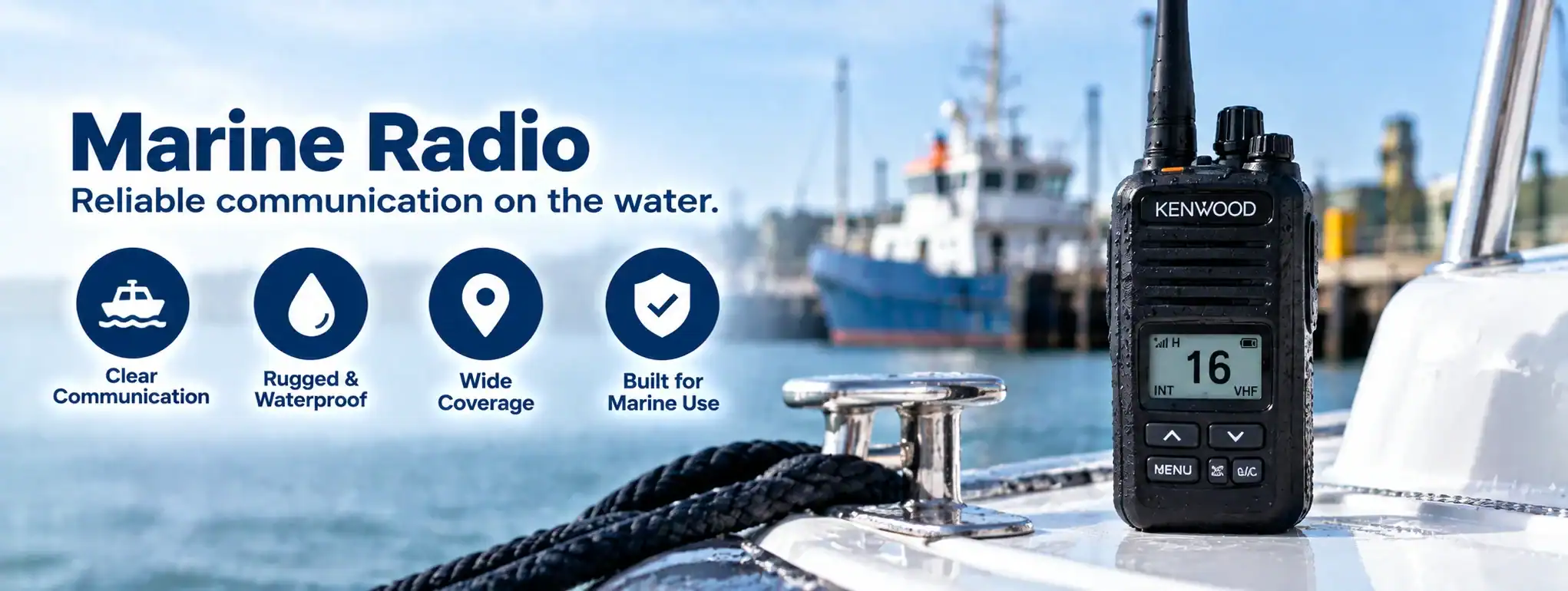
Marine Radio
A Marine Radio is a two-way radio designed for communication between vessels, shore stations and other marine users.
Marine radios are built for use in environments where water, weather, salt spray and long periods of outdoor operation can place greater demands on equipment than typical land-based radios.
They are commonly used by commercial vessels, leisure boaters, ports, marinas, harbour authorities, offshore operators and marine service teams.
What is a marine radio?
A marine radio provides voice communication over designated marine radio frequencies.
Depending on the equipment and service, a marine radio can be used for:
- Vessel-to-vessel communication
- Vessel-to-shore communication
- Port and harbour operations
- Marina communication
- Safety communications
- Operational coordination
- Contact with marine authorities
- Emergency communication
Marine radios are available in both handheld and fixed-mount configurations.
Marine VHF radio
The most common type of marine radio used for short-range maritime voice communication is VHF marine radio.
Marine VHF operates on internationally recognised marine channels and is widely used for communication between vessels and shore stations.
The equipment and channels available depend on the applicable regulations and the type of marine service.
Marine VHF channels
Marine VHF radios provide designated channels for different types of communication.
Some channels are used for:
- Ship-to-ship communication
- Ship-to-shore communication
- Port operations
- Safety communication
- Calling
- Emergency and distress communication
Users should follow the applicable marine radio regulations and channel-use requirements.
Marine radio licensing
Marine radio operation is subject to specific regulatory requirements.
In the UK, marine radio users may require the appropriate licence and operator qualification depending on the type of equipment and service being used.
The requirements can differ between leisure, commercial and other marine operations.
Marine radio range
Marine VHF radio can provide useful communication over water because there are generally fewer physical obstacles than on land.
However, range is affected by:
- AntennaAn antenna transmits and receives radio-frequency signals, allowing a two-way radio to communicate. Antenna type, frequency, height and location can all affect radio performance and coverage. height
- Transmitter powerAn antenna transmits and receives radio-frequency signals, allowing a two-way radio to communicate. Antenna type, frequency, height and location can all affect radio performance and coverage.
- Vessel height
- Shore station location
- Weather and atmospheric conditions
- Obstructions
- Antenna installation
A fixed VHF radio with a properly installed external antenna can normally provide greater coverageRadio Coverage is the geographical area in which a two-way radio system can provide reliable communication. Coverage depends on the radios, antennas, frequency, terrain, buildings and system infrastructure. than a handheld marine radio.
Marine handheld radio
A Handheld Radio provides portable marine communication.
It can be carried around a vessel or used as a backup to a fixed radio.
Handheld marine radios are particularly useful for:
- Small boats
- Dinghies
- Crew communication
- Marina operations
- Port operations
- Emergency backup
- Maintenance teams
Fixed marine radio
A fixed marine radio is permanently installed on a vessel or at a shore facility.
It normally uses an external antenna and can provide greater range than a handheld radio.
Fixed marine radios are commonly installed on:
- Commercial vessels
- Fishing vessels
- Workboats
- Ferries
- Offshore vessels
- Harbour craft
Marine radio antenna
The antenna is an important part of a marine radio systemA Radio System is a complete communication solution comprising two-way radios and, where required, equipment such as repeaters, antennas, base stations, mobile radios and network infrastructure..
VHF radio communication generally benefits from antenna height because radio signals travel primarily by line of sight.
A correctly installed antenna can therefore have a significant effect on communication range.
Marine radio and line of sight
Marine VHF communication is largely dependent on line-of-sight propagation.
A vessel positioned behind a large obstruction may experience reduced communication even if another vessel is relatively close.
Increasing antenna height can sometimes improve the effective communication range.
Marine radio and coverage
Marine radio coverage depends on both the radio equipment and the surrounding environment.
A shore-based marine radio system can potentially cover a wide area when its antenna is positioned at a suitable height.
Coverage should be considered when planning communication for ports, harbours and coastal operations.
Marine radio and waterproofing
Marine radios are designed for environments where exposure to water is possible.
Many handheld marine radios have an appropriate IP Rating for resistance to water and dust.
The exact protection level varies between models.
A radio’s IP rating should be checked against the conditions in which it will be used.
Marine radio and floating radios
Some handheld marine radios are designed to float if dropped into water.
This can be particularly useful for marine operations because retrieving a radio that has fallen overboard may otherwise be difficult.
Floating capability is a feature of particular radio models and should not be assumed for every marine radio.
Marine radio and salt water
Salt water can be particularly harsh on electronic equipment and connectorsAn antenna transmits and receives radio-frequency signals, allowing a two-way radio to communicate. Antenna type, frequency, height and location can all affect radio performance and coverage..
Marine radios are designed with marine environments in mind, but equipment should still be maintained and cleaned according to the manufacturer’s recommendations.
Marine radio battery
Handheld marine radios use rechargeable batteries to provide portable operation.
Battery capacity should be considered when radios are used for long periods away from charging facilities.
For extended marine operations, spare batteries or suitable charging arrangements may be required.
Marine radio charging
Marine radios can be charged using compatible charging equipment.
Depending on the radio, this may include:
- Desktop chargers
- Charging docks
- USB charging
- Vehicle charging
- Vessel-based charging systems
Only suitable charging equipment should be used.
Marine radio and emergency communication
Marine radio plays an important role in maritime safety communication.
A compatible radio can allow a vessel to communicate with other vessels, shore stations or marine emergency services.
Emergency procedures and channelA two-way radio channel is a programmed set of communication settings, typically including frequency and signalling, that allows compatible radios to communicate with one another. use should follow the applicable maritime regulations.
Marine radio distress call
Marine VHF systems support recognised distress and safety communications.
A distress call is used when a vessel or person is in serious and immediate danger.
Users should understand the correct procedures before relying on marine radio for emergency communication.
Marine radio and DSC
Digital Selective CallingSelective Calling allows a two-way radio system to direct a transmission to a specific radio or group of radios rather than all users on the channel. (DSC) is a digital signalling system used with compatible marine radio equipment.
DSC can allow a radio to transmit digital calls and alerts rather than relying solely on voice communication.
Depending on the equipment and configuration, DSC can support:
- Distress alerts
- Individual calls
- Group calls
- Selective calling
- Position information
Marine radio and MMSI
An MMSI (Maritime Mobile Service Identity) is a unique identification number used by marine communication systems such as DSC.
A compatible marine radio can use the vessel’s MMSI to identify digital calls and alerts.
The MMSI is programmed into the relevant equipment according to the applicable requirements.
Marine radio and GPS
Many modern marine radios include GPS or can obtain position information from a connected GPS receiverA Receiver is the part of a two-way radio that detects and processes incoming radio signals, converting them into audible voice or usable data for the user..
Position information can be used by compatible DSC functions and other marine communication systems.
This can be particularly important for emergency and distress communication.
Marine radio and AIS
Automatic Identification System (AIS) is a separate maritime communication and identification technology.
AIS can transmit information such as:
- Vessel identity
- Position
- Course
- Speed
- Vessel information
Some marine radios incorporate AIS functionality or can be integrated with other onboard equipment.
AIS and VHF voice communication are related technologies but serve different purposes.
Marine radio and dual watch
Some marine radios provide Dual Watch functionality.
This allows the radio to monitor more than one channel or priority communication channel according to the radio’s configuration.
The exact functionality varies between radio models.
Marine radio and scanning
Marine radios may provide channel scanning functions.
Scanning allows the radio to monitor selected channels for activity.
The available scanning modes depend on the equipment.
Marine radio and squelch
SquelchAnalogue radio uses continuously varying radio signals to transmit voice communication. It remains widely used for reliable two-way communication across business, industry, events, security and other applications. controls when the radio’s speaker opens in response to a received signal.
Correct squelch settings can reduce unwanted background noise while still allowing relevant transmissions to be heard.
Marine radio and simplex communication
Many marine VHF channels use SimplexSimplex is a method of two-way radio communication where radios transmit and receive on the same frequency, communicating directly without a repeater. communication.
With simplex operation, users transmit and receive on the same channel, normally taking turns to speak.
This is the traditional operating method for many vessel-to-vessel communications.
Marine radio and duplex communication
Some marine channels use Duplexduplex, duplex radio, duplex communication, duplex frequencies, duplex operation, duplex spacing, frequency offset, repeater duplex, duplex repeater, full duplex, half duplex, radio repeater operation.
In a duplex arrangement, transmissionTransmission is the process of sending voice, data or signalling from a radio using a radio-frequency signal to another radio, repeater or communication system. and reception use different frequencies.
This can allow communication between a vessel and a shore station or other compatible service.
The radio automatically handles the relevant transmit and receive frequencies for the selected channel.
Marine radio and full duplex
Marine radio communication is not normally equivalent to a telephone conversation.
Most voice communication is conducted using push-to-talk operation.
Where a marine communication service supports duplex operation, the exact communication method depends on the channel and service.
Marine radio and repeater systems
Marine communication systems can use shore-based infrastructureRadio infrastructure is the equipment and supporting systems behind a professional two-way radio network, including repeaters, antennas, base stations, network connections, power systems and dispatch equipment. to extend or manage communications.
However, marine radio channels and infrastructure are subject to specific regulatory arrangements.
A marine radio should not be connected to or modified for repeaterA Repeater receives a two-way radio transmission and retransmits it, usually from an elevated location, to extend the coverage and reliability of a radio communication system. operation unless the equipment and service are specifically designed and authorised for it.
Marine radio and port operations
Ports can use marine radio systems to coordinate:
- Vessel movements
- Berthing
- Tug operations
- Pilotage
- Maintenance
- Security
- Cargo operations
Marine VHF provides an important communication link between vessels and shore-based operational teams.
Marine radio and marina operations
Marinas can use marine radio for communication between staff, boats and operational teams.
Typical uses include:
- Berthing assistance
- Maintenance
- Security
- Boat movements
- Customer assistance
- Emergency communication
Marine radio and harbour authorities
Harbour authorities can use marine radio to communicate with vessels operating within their jurisdiction.
This can support vessel movements, safety information and operational coordination.
Marine radio and commercial vessels
Commercial vessels may use marine radio as part of their wider onboard communication systems.
The exact equipment and regulatory requirements depend on the vessel, operation and applicable maritime regulations.
Marine radio and offshore operations
Offshore operations can involve significant distances, harsh weather and challenging working environments.
Marine radio can be used alongside other communication technologies to support vessel and crew coordination.
Depending on the operation, communications may also incorporate satellite, cellular, digital radio or other systems.
Marine radio and fishing
Fishing vessels commonly use marine VHF for communication with other vessels, harbour facilities and relevant shore services.
The equipment used depends on the vessel and operational requirements.
Marine radio and leisure boating
Leisure boaters may use handheld or fixed marine VHF radios for communication with other vessels and relevant marine services.
Users should understand the applicable licensing and operator requirements before operating marine radio equipment.
Marine radio and radio hire
Marine radios can sometimes be supplied as part of Radio HireRadio Hire is the temporary rental of two-way radios and related communication equipment for events, projects and operational requirements, providing professional communication without purchasing the equipment. arrangements for temporary marine operations.
Potential applications include:
- Marine events
- Harbour projects
- Temporary workboats
- Offshore projects
- Port operations
- Water-based events
The equipment selected should be suitable for the marine environment and the communication requirements.
Marine radio and event operations
Water-based events can require communication between safety teams, event management and vessels.
Marine radios can provide direct communication between operational teams where suitable marine channels and licensing arrangements are in place.
Marine radio and emergency teams
Marine safety teams may use handheld marine radios to maintain communication while operating on or near the water.
Where emergency communication is involved, the radio system should form part of a wider emergency plan.
Marine radio accessories
Marine radio accessories can include:
- Remote speaker microphones
- Earpieces
- Headsets
- Spare batteries
- Charging docks
- Carrying cases
- External antennas
- Antenna mounts
Accessories should be compatible with the particular radio.
Marine radio and speaker microphones
A Speaker MicrophoneA Speaker Microphone is a two-way radio accessory combining a microphone, loudspeaker and usually a Push-to-Talk button, allowing convenient radio operation without handling the radio itself. can allow a user to operate a handheld radio without removing it from a belt or lifejacket-mounted position.
This can be useful when working around water or when the radio needs to remain readily accessible.
Marine radio and intrinsically safe operation
Some marine environments may also involve hazardous areas, such as fuel-handling facilities or certain offshore installations.
Where an Intrinsically Safe RadioAn Intrinsically Safe Radio is a two-way radio designed and certified for use in specified hazardous areas where flammable gases, vapours or combustible dust could create a risk of explosion. is required, the radio must have the appropriate certification for the hazardous environment.
A standard marine radio should not be assumed to be intrinsically safe.
Marine radio and encryption
Marine radio communications are generally subject to specific channel and service arrangements.
Where communication security is required for a particular professional operation, the appropriate authorised communication technology should be selected.
EncryptionEncryption protects two-way radio communications by converting voice or data into a secure form that can only be understood by authorised radios with the correct encryption capability and keys. should not be added to or used on marine channels in a way that conflicts with applicable regulations.
Marine radio and interference
Marine VHF channels are shared communication resources.
InterferenceRadio interference occurs when unwanted radio-frequency signals or electrical noise disrupt two-way radio communications, causing distorted audio, broken transmissions, reduced coverage or loss of communication. can result from:
- Other vessels
- Shore stations
- Electrical equipment
- Poor antenna installations
- Incorrect equipment configuration
- Atmospheric conditions
Users should follow the applicable channel-use procedures.
Marine radio maintenance
Marine radios should be inspected and maintained regularly.
Maintenance can include checking:
- Battery condition
- Antenna connections
- Radio housing
- Controls
- Display
- Charging equipment
- Speaker and microphone
- Waterproof seals
Equipment exposed to salt water should receive appropriate care.
Marine radio and battery management
Battery condition is particularly important for handheld marine radios used for safety communication.
Operators should ensure that batteries are charged and ready for use and that suitable charging or replacement arrangements are available for extended operations.
Marine radio limitations
Marine radio has limitations that should be considered when designing a communication system.
These can include:
- VHF range is largely line of sight
- Handheld radios generally have less range than fixed installations
- Coverage can be affected by antenna height
- Channels are shared
- Equipment must comply with applicable regulations
- Battery-powered radios depend on available charge
Marine radio should therefore be selected according to the actual operating environment.
Marine radio system design
A professional marine communication system may combine:
Handheld VHF Radios + Fixed VHF Radio + External Antenna + GPS + DSC
Larger operations may also integrate marine radio with:
- Control rooms
- AIS
- Telephone systems
- Dispatch platforms
- Satellite communications
- Other radio networks
The appropriate configuration depends on the vessel or marine operation.
Choosing a marine radio
When selecting a marine radio, consider:
- Handheld or fixed installation.
- Required coverage.
- Marine VHF channel requirements.
- Waterproofing and IP rating.
- Battery capacity.
- Floating capability.
- GPS requirements.
- DSC requirements.
- MMSI requirements.
- Antenna installation.
- Emergency communication requirements.
- Environmental conditions.
- Licensing and operator requirements.
- Required accessories.
Marine Radio and DCS
DCS can provide communication equipment and radio hire solutions for marine and water-based operations where suitable equipment is required.
The correct marine communication solution depends on the vessel or site, operating environment, required coverage and applicable marine radio regulations.