
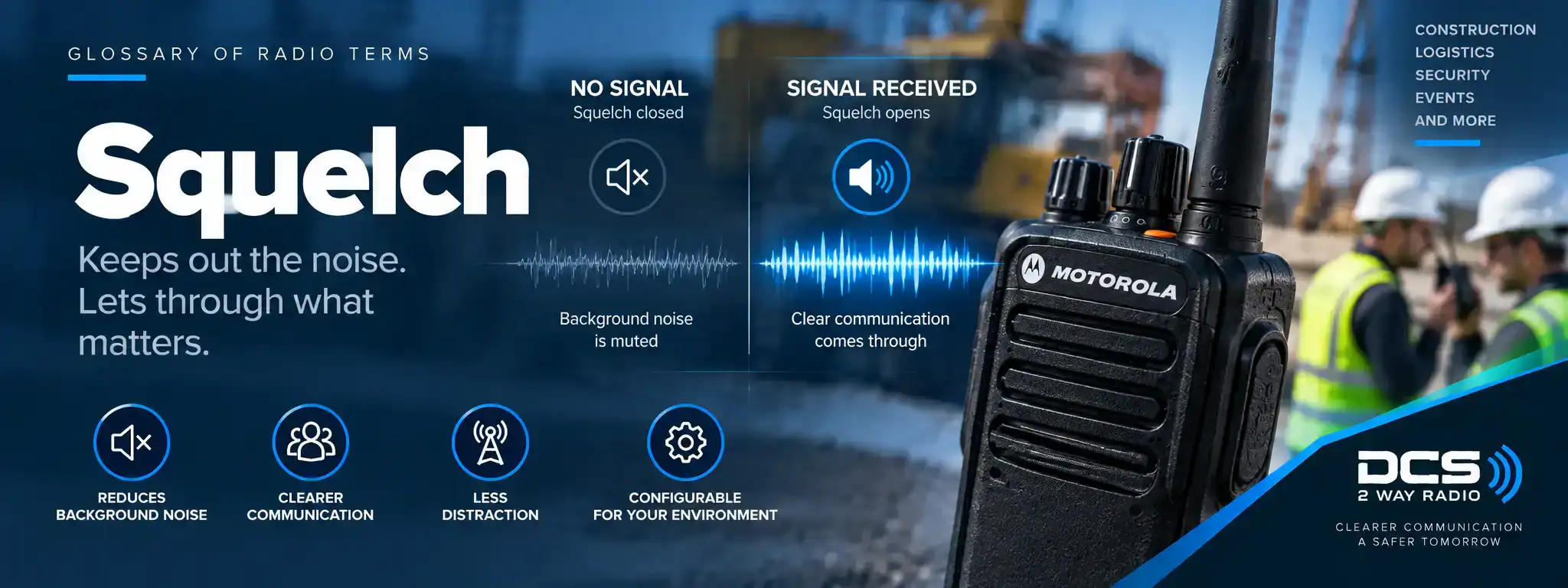
Squelch
Squelch is a function in a two-way radio that automatically mutes the speaker when no suitable radio signal is being received. It prevents the constant background hiss and noise that would otherwise be heard when a radio is monitoring an unused or weak channelA two-way radio channel is a programmed set of communication settings, typically including frequency and signalling, that allows compatible radios to communicate with one another..
Squelch helps make two-way radio communication more comfortable and easier to understand by allowing the radio to open its speaker when a signal reaches the required threshold.
What is squelch on a two-way radio?
Squelch is a receiverA Receiver is the part of a two-way radio that detects and processes incoming radio signals, converting them into audible voice or usable data for the user. function that controls when the radio's speaker is muted or opened.
Without squelch, an analogue radioAnalogue radio uses continuously varying radio signals to transmit voice communication. It remains widely used for reliable two-way communication across business, industry, events, security and other applications. monitoring an unused channel can produce continuous background noise. The squelch circuit suppresses this noise until the radio detects a signal that meets the required conditions.
When a suitable transmissionTransmission is the process of sending voice, data or signalling from a radio using a radio-frequency signal to another radio, repeater or communication system. is detected, the radio opens the audio path so the user can hear the communication.
Why is squelch used?
Squelch is used primarily to prevent unwanted background noise from coming through the radio's speaker.
This is particularly useful when a radio is being used for long periods. Without squelch, users would have to listen continuously to the hiss and static present on an open radio channel.
A correctly configured squelch setting allows users to monitor a channel without being distracted by constant background noise.
How does squelch work?
A basic form of squelch monitors the strength of the incoming radio signal.
When the received signal reaches the required threshold, the radio opens the speaker. When the signal falls below the threshold, the radio mutes the audio again.
The exact operation depends on the radio and the type of squelch being used.
Squelch level
Many professional two-way radios provide different squelch settings.
A normal squelch setting allows the radio to open when a suitable signal is detected. A tight squelch setting applies a higher threshold, which can help filter out weaker unwanted signals and background noise.
However, setting squelch too tightly can have a disadvantage: weaker legitimate transmissions may also be prevented from opening the radio's speaker. Motorola documentation specifically notes that tight squelch can filter unwanted calls and background noise but may also filter calls from remote locations.
Normal squelch vs tight squelch
The appropriate setting depends on the radio environment.
Normal squelch is generally suitable where the radio needs to receive weaker signals and normal background noise is acceptable.
Tight squelch can be useful where there is significant background noise or unwanted weak signals, but it may reduce the ability to hear distant transmissions.
For professional radio systems, squelch should therefore be configured as part of the overall radio setup rather than simply set as high as possible.
Carrier squelch
Carrier squelch is a basic form of squelch that opens the radio when it detects a radio-frequency carrier above a specified threshold.
It does not require a particular tone or coded signal before opening the receiver.
Motorola documentation describes carrier squelch as allowing the radio to unmute when the detected carrier energy exceeds the designated threshold.
CTCSS and squelch
Squelch can also work with signalling systems such as CTCSS (Continuous Tone-Coded Squelch System).
With CTCSS, a sub-audible tone is used to control whether the receiving radio opens its speaker. This can help prevent users from hearing transmissions that are not intended for their radio group.
CTCSS does not make the radio frequencyAn antenna transmits and receives radio-frequency signals, allowing a two-way radio to communicate. Antenna type, frequency, height and location can all affect radio performance and coverage. private or encrypted. Other users operating on the same frequencyFrequency is the number of cycles a radio wave completes each second, measured in Hertz. In two-way radio, frequency determines where a transmission operates within the radio spectrum. may still be able to receive the transmission if their equipment is configured appropriately.
DCS and squelch
DCS (Digital-Coded Squelch) uses a digital code rather than an analogue CTCSS tone.
The receiving radio checks for the appropriate code before opening the speaker. This can provide another way of organising users on a shared frequency and reducing unwanted audio.
DCS is sometimes referred to by different manufacturer-specific names, including Digital Private Line (DPL) in Motorola equipment.
These systems should not be confused with encryptionEncryption protects two-way radio communications by converting voice or data into a secure form that can only be understood by authorised radios with the correct encryption capability and keys. because coded squelch does not prevent another suitably equipped radio from receiving the underlying transmission.
Squelch and radio interference
Squelch can help reduce the amount of unwanted noise heard by radio users, but it does not eliminate radio interferenceRadio interference occurs when unwanted radio-frequency signals or electrical noise disrupt two-way radio communications, causing distorted audio, broken transmissions, reduced coverage or loss of communication. itself.
Interference can be caused by other transmitters, electrical equipment, poor installation, weak signals and other sources of radio-frequency activity.
Increasing the squelch level may prevent some weak unwanted signals from being heard, but it does not remove the underlying interference.
Where persistent interference affects a professional radio systemA Radio System is a complete communication solution comprising two-way radios and, where required, equipment such as repeaters, antennas, base stations, mobile radios and network infrastructure., the cause should be investigated rather than relying solely on a tighter squelch setting.
Squelch and digital radios
Squelch is also used in digital radio systems, although the way the receiver determines whether audio should be passed to the speaker can differ from a basic analogue carrier-squelch system.
Digital radios can use additional information such as networkA Network is a connected system of radios, equipment and infrastructure that allows users to communicate across a defined area. Radio networks can range from simple radio-to-radio systems to large multi-site networks. access codes, talk groups or other signalling to determine which transmissions should be presented to the user.
Motorola documentation, for example, describes different conventional digital squelch options including Digital Carrier-Operated Squelch and configurations involving network access codes and talk groups.
Squelch and radio coverage
Squelch settings can affect how users perceive the coverageRadio Coverage is the geographical area in which a two-way radio system can provide reliable communication. Coverage depends on the radios, antennas, frequency, terrain, buildings and system infrastructure. of a radio system.
If squelch is configured too tightly, a weak but usable signal may not open the receiver. A user could therefore believe that another radio is out of range when the actual issue is the receiver threshold.
This is one reason why radio coverage problems should be investigated as part of the complete system rather than assuming that changing the squelch setting will solve them.
Squelch on radio hire equipment
Professional radio hireRadio Hire is the temporary rental of two-way radios and related communication equipment for events, projects and operational requirements, providing professional communication without purchasing the equipment. equipment is normally configured according to the intended application and operating environment.
For a temporary event, construction project, warehouse operation or other site, radios may need to be configured so that users can communicate effectively without excessive background noise.
The appropriate configuration depends on the radio model, frequency, coverage requirements and wider radio system.
Squelch and DCS 2 Way Radio
At DCS 2 Way Radio, radio equipment and systems can be configured around the operational requirements of the customer.
Squelch is one of the many radio settings that can affect the user experience and performance of a two-way radio system. Correct configuration can help users hear the communications they need while reducing unwanted background noise.
For larger or more demanding radio networks, factors such as frequency, coverage, antennas, repeaters, signalling and radio programming all need to be considered together.
Related radio terms
- CTCSS (Continuous Tone-Coded Squelch System)
- DCS (Digital-Coded Squelch)
- Radio Frequency (RF)Radio Frequency (RF) refers to electromagnetic waves used to transmit voice and data wirelessly. Two-way radios use RF signals to communicate between radios, repeaters and other system infrastructure.
- Interference
- Receiver
- Channel
- Busy Channel Lockout (BCL)Busy Channel Lockout (BCL) is a two-way radio feature that prevents transmission when the selected channel is already being used, helping avoid users talking over one another.
- Digital Mobile Radio (DMR)Digital Mobile Radio (DMR) is an ETSI digital radio standard for professional two-way communications, supporting voice, group calling, data and other features on compatible radio systems.
- RepeaterA Repeater receives a two-way radio transmission and retransmits it, usually from an elevated location, to extend the coverage and reliability of a radio communication system.
- Coverage
- Radio Programming
- Two Way Radio
- Radio Hire