
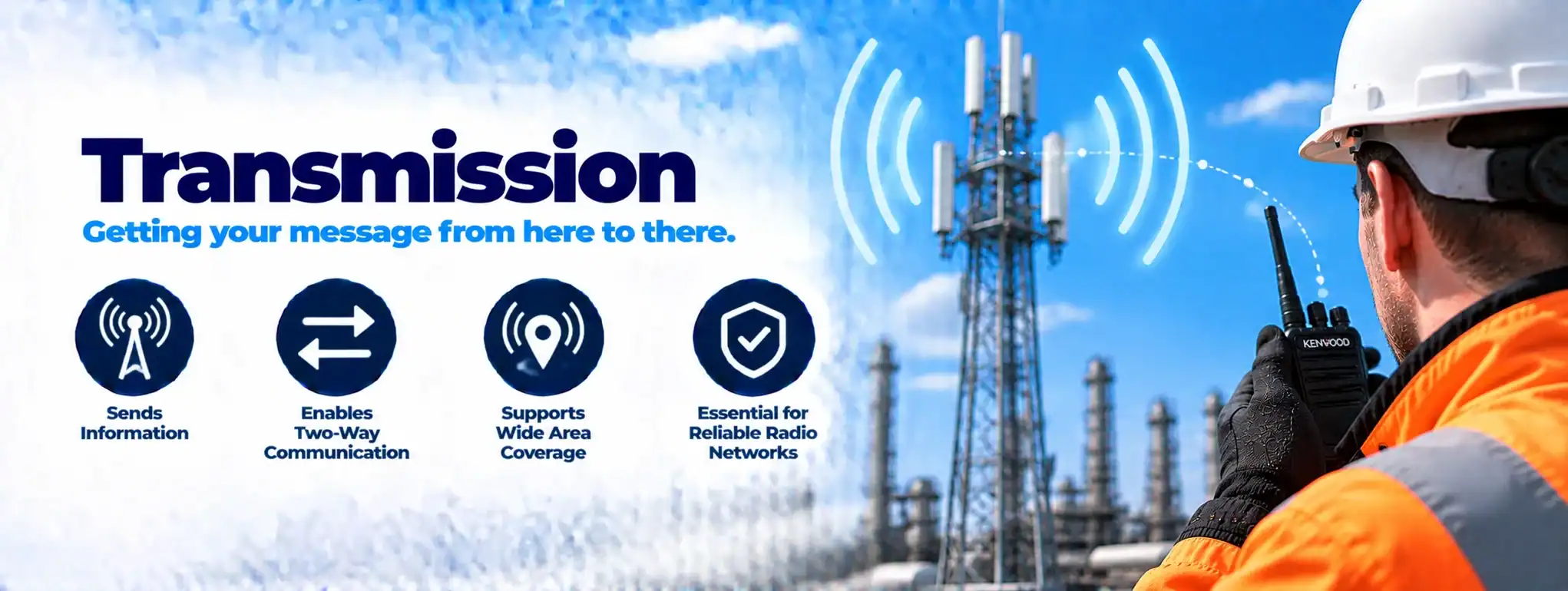
Transmission
Transmission is the process of sending information from one radio device to another using a radio-frequency signal. In two-way radio, a transmission normally carries voice, data or signalling from a transmitting radio to another radio, repeaterA Repeater receives a two-way radio transmission and retransmits it, usually from an elevated location, to extend the coverage and reliability of a radio communication system. or radio systemA Radio System is a complete communication solution comprising two-way radios and, where required, equipment such as repeaters, antennas, base stations, mobile radios and network infrastructure..
When a user presses the Push-to-Talk (PTT)Push-to-Talk (PTT) is the button or control used to activate a two-way radio's transmitter. Press it to speak and release it to listen. button and speaks, the radio creates a transmission that is sent through its antennaAn antenna transmits and receives radio-frequency signals, allowing a two-way radio to communicate. Antenna type, frequency, height and location can all affect radio performance and coverage..
What is a radio transmission?
A radio transmission begins when information is converted into a signal suitable for transmission over the air.
In a typical two-way radio:
Voice → Microphone → Radio processing → Transmitter → Antenna → Radio signal
The receiving radio then converts the signal back into usable audio or data.
Transmission vs communication
A transmission is the act of sending the signal.
Communication is the wider exchange of information between users.
For example, when two workers talk using radios, each person makes a transmission when they press PTT.
Transmission and reception
Two-way radio relies on both transmission and reception.
Transmission: Sends the signal.
Reception: Receives and processes the signal.
A radio capable of both functions is a TransceiverA Transceiver combines a transmitter and receiver in one device, allowing a two-way radio to both send and receive radio signals..
How a transmission works
When a user presses PTT:
- The radio activates its transmitter.
- The microphone captures the user’s voice.
- The audio is processed.
- The information is modulated onto an RF carrier.
- The transmitter amplifies the signal.
- The antenna radiates the RF signal.
The receiving radio then detects and processes the transmission.
Voice transmission
Voice is the most common type of two-way radio transmission.
In an analogue radioAnalogue radio uses continuously varying radio signals to transmit voice communication. It remains widely used for reliable two-way communication across business, industry, events, security and other applications., the voice is transmitted using an analogue modulationAnalogue radio uses continuously varying radio signals to transmit voice communication. It remains widely used for reliable two-way communication across business, industry, events, security and other applications. method.
In a digital radio, the voice is converted into digital information before being transmitted.
Digital transmission
Digital radio systems convert voice or other information into digital data before transmission.
Technologies such as Digital Mobile Radio (DMR)Digital Mobile Radio (DMR) is an ETSI digital radio standard for professional two-way communications, supporting voice, group calling, data and other features on compatible radio systems. use digital transmission to provide voice and data services.
Digital systems can also provide features such as:
- Group calls
- Private calls
- Radio identification
- Text messaging
- GPS
- Emergency signalling
- EncryptionEncryption protects two-way radio communications by converting voice or data into a secure form that can only be understood by authorised radios with the correct encryption capability and keys., where supported
Analogue transmission
Analogue radios transmit continuously varying signals representing the information being communicated.
Analogue professional radio remains in use for many applications, although digital systems provide additional features and can make more efficient use of spectrumSpectrum is the range of radio frequencies used for wireless communication. Two-way radios operate within specific parts of the radio spectrum, subject to frequency allocation and licensing requirements..
Transmission and radio frequency
A transmission is sent using a Radio Frequency (RF)Radio Frequency (RF) refers to electromagnetic waves used to transmit voice and data wirelessly. Two-way radios use RF signals to communicate between radios, repeaters and other system infrastructure..
The frequencyAn antenna transmits and receives radio-frequency signals, allowing a two-way radio to communicate. Antenna type, frequency, height and location can all affect radio performance and coverage. determines where in the radio spectrum the transmission operates.
Professional radio systems may operate in different frequencyFrequency is the number of cycles a radio wave completes each second, measured in Hertz. In two-way radio, frequency determines where a transmission operates within the radio spectrum. bands, including VHF and UHF.
Transmission frequency
A radio transmitter must operate on an authorised frequency or channelA two-way radio channel is a programmed set of communication settings, typically including frequency and signalling, that allows compatible radios to communicate with one another..
In the UK, frequency use is regulated by OfcomOfcom (Office of Communications) is the UK's communications regulator. For two-way radio users, Ofcom manages and regulates access to radio spectrum and the use of radio frequencies in the UK..
Licensed radioA Licensed Radio is a two-way radio operated under an appropriate radio licence. Licensed systems can provide greater control over frequencies, coverage and infrastructure than licence-free radio services such as PMR446. systems must comply with the conditions of the applicable licence.
Transmission power
Power OutputPower Output is the amount of radio-frequency energy produced by a two-way radio's transmitter, normally measured in watts. It is one factor affecting coverage, alongside frequency, antenna, terrain and other conditions. describes the RF powerAn antenna transmits and receives radio-frequency signals, allowing a two-way radio to communicate. Antenna type, frequency, height and location can all affect radio performance and coverage. produced by the transmitter.
Power is normally measured in watts.
Higher transmission power can potentially improve coverageRadio Coverage is the geographical area in which a two-way radio system can provide reliable communication. Coverage depends on the radios, antennas, frequency, terrain, buildings and system infrastructure., but it does not automatically result in greater range.
Coverage also depends on:
- Antenna
- Frequency
- Antenna height
- Terrain
- BuildingsAn antenna transmits and receives radio-frequency signals, allowing a two-way radio to communicate. Antenna type, frequency, height and location can all affect radio performance and coverage.
- ReceiverA Receiver is the part of a two-way radio that detects and processes incoming radio signals, converting them into audible voice or usable data for the user. sensitivity
- InterferenceRadio interference occurs when unwanted radio-frequency signals or electrical noise disrupt two-way radio communications, causing distorted audio, broken transmissions, reduced coverage or loss of communication.
Transmission range
The distance a transmission can travel depends on the radio system and environment.
Factors include:
- Transmitter power
- Antenna performance
- Frequency
- Terrain
- Buildings
- Vegetation
- Atmospheric conditions
- Receiver sensitivity
- Interference
A Repeater can extend effective communication coverage by receiving and retransmitting signals.
Direct transmission
In SimplexSimplex is a method of two-way radio communication where radios transmit and receive on the same frequency, communicating directly without a repeater. operation, one radio transmits directly to another.
For example:
Radio A → Radio B
The receiving radio must normally be within suitable coverage of the transmitting radio.
Repeater transmission
In a repeater-based system:
Radio A → Repeater → Radio B
The repeater receives the original transmission and retransmits it.
This can significantly extend the usable coverage of the radio system.
Transmission and repeaters
A repeater normally receives on one frequency and retransmits on another.
This frequency separation allows the repeater to transmit and receive simultaneously while providing service to radio users.
Transmission and base stations
A Base StationA base station is a fixed two-way radio installed at a permanent location, allowing an operator to communicate with handheld or mobile radios across a site or operating area. can transmit and receive radio communications from a fixed location.
It may provide communications for users within its coverage area or form part of a wider radio networkA Network is a connected system of radios, equipment and infrastructure that allows users to communicate across a defined area. Radio networks can range from simple radio-to-radio systems to large multi-site networks..
Transmission and mobile radios
A vehicle-mounted Mobile RadioA Mobile Radio is a two-way radio designed to be installed in a vehicle. It normally uses the vehicle's power supply and an external antenna to provide reliable communication while travelling or working in the field. can transmit using an external vehicle antenna.
The larger antenna and vehicle power supply can provide advantages over some handheld installations.
Transmission and portable radios
A handheld Portable RadioA Portable Radio is a battery-powered two-way radio designed to be carried and operated by an individual, providing mobile communication for professional and operational users. contains a compact transmitter and antenna system.
Its transmission performance is affected by how the radio is carried and by the surrounding environment.
For example, the user’s body can affect antenna performance, particularly at some frequencies.
Transmission and TDMA
Time Division Multiple Access (TDMA)Time Division Multiple Access (TDMA) is a technology that divides a radio channel into time slots, allowing multiple users or conversations to share the same frequency. DMR uses two time slots within a 12.5 kHz channel. divides access to a radio channel into time slots.
DMR uses two time slots within a 12.5 kHz channel.
The transmitter operates within the appropriate time slot rather than continuously occupying the entire channel.
Transmission and DMR
A DMR transmission contains digitally encoded information and uses the DMR air interface.
Depending on the system, the transmission can carry:
- Voice
- Data
- Signalling
- GPS information
- Status information
Transmission and talk groups
In a digital radio system, a transmission can be directed towards a Talk GroupA Talk Group is a predefined group of users or radios within a two-way radio system that share a common communication group, allowing teams to communicate without involving other users..
For example:
User → Security Talk Group
Compatible radios monitoring that group can receive the transmission.
Transmission and private calls
A digital radio can also transmit to a specific radio using a Private CallPrivate Call is a two-way radio feature that allows one radio user to communicate directly with another individual radio user rather than making the conversation part of a general group call..
The system uses the destination radio’s individual identifier to direct the communication.
Transmission and all calls
Some radio systems support All Call transmissions.
An authorised radio or dispatcher can transmit to a broad group of users where the system configuration permits it.
Transmission and emergency calls
Professional radios may support emergency transmissions.
An emergency buttonAn Emergency Button is a dedicated two-way radio control that allows users to quickly send an emergency alert to a dispatcher, control room or authorised radio users. or automatic safety function can initiate a transmission or alert.
The emergency communication may be given priority depending on the radio system.
Transmission and Man Down
A radio supporting Man DownMan Down is a safety feature on some professional two-way radios that can detect a possible fall or unusual radio position and automatically raise an alert if the user does not respond. can automatically generate an alert when specified conditions are detected.
The resulting signalling or data transmission can notify a supervisor or control room.
Transmission and Lone Worker
A Lone WorkerA Lone Worker is someone who works without direct supervision or immediate assistance nearby. Compatible two-way radios can provide safety features such as timed check-ins, emergency alerts and GPS location. system can use transmissions to communicate status or emergency alerts from a worker’s radio.
The system may transmit an alarm if the worker fails to respond to a required check-in or activates an emergency function.
Transmission and telemetry
TelemetryTelemetry is the automatic collection and transmission of information from a remote device, vehicle, machine or radio to another location for monitoring, analysis or control. involves transmitting information from a remote device or system.
A radio transmission can therefore contain telemetry data such as:
- GPS position
- Equipment status
- Sensor information
- Alarm conditions
Transmission and GPS
A radio with GPS can determine its location and transmit that information to a monitoring or dispatch system.
This allows compatible systems to provide location tracking.
Transmission and data
Radio transmissions are not limited to voice.
Digital radio systems can transmit data such as:
- Short messages
- GPS coordinates
- Status information
- Telemetry
- Control information
The amount of data that can be transmitted depends on the radio technology and available capacity.
Transmission and encryption
Digital radio transmissions can be Encrypted where the equipment and system support it.
Encryption protects the content of the transmission from unauthorised users with incompatible or unauthorised equipment.
Encryption does not increase radio range.
Transmission and interference
A transmission can be affected by Interference from other radio signals or sources of RF energy.
Interference can result in:
- Reduced audio quality
- Dropped communications
- Data errors
- Reduced usable coverage
Frequency planning and appropriate system design can help minimise interference.
Transmission and receiver sensitivity
The receiving radio must be able to detect and correctly process the transmitted signal.
Receiver sensitivity is therefore an important factor in determining whether a transmission can be successfully received.
Transmission and signal strength
The strength of a transmission at the receiving location depends on factors such as:
- Transmitter power
- Distance
- Antenna gain
- Antenna height
- Frequency
- Terrain
- Obstacles
RSSI (Received Signal Strength Indicator)RSSI (Received Signal Strength Indicator) is a measurement of the strength of a radio signal received by a two-way radio or other wireless device, commonly used to assess coverage and diagnose reception problems. can be used by compatible equipment to indicate received signal strength.
Transmission and signal-to-noise ratio
The quality of a received transmission depends not only on signal strength but also on the level of background noise and interference.
A strong signal can still produce poor communications if significant interference is present.
Transmission and modulation
Modulation is the process of encoding information onto a radio-frequency carrier.
Different radio technologies use different modulation methods.
The modulation method must be compatible between the transmitting and receiving equipment.
Transmission and bandwidth
Every radio transmission occupies a defined amount of radio spectrum.
The occupied bandwidth depends on the technology and modulation method.
Efficient use of bandwidth allows more communication channels to fit within the available spectrum.
Transmission and narrowband radio
NarrowbandNarrowband describes a radio communication system that uses a relatively small amount of frequency spectrum to transmit information. It is widely used in professional two-way radio to make efficient use of available radio channels. radio systems use relatively narrow channels to make efficient use of available spectrum.
Professional two-way radio systems commonly use narrowband channel arrangements.
Transmission and spectrum
The radio spectrum is a finite resource shared by many services.
Efficient transmission technologies allow more users and services to operate within the available spectrum.
Transmission and licensing
Radio transmissions must comply with the regulatory requirements applicable to the frequency and service being used.
In the UK, Ofcom regulates the use of radio spectrum.
Some services are licence-free under specific conditions, while professional business radioBusiness Radio refers to professional two-way radio systems used by businesses and organisations for instant communication, often using licensed frequencies and equipment designed for commercial use. systems commonly use licensed frequencies.
Licence-free transmissions
PMR446 is a licence-free short-range radio service in the UK and Europe, subject to its technical conditions.
Licence-free operation does not mean that the equipment can transmit on any frequency or at any power level.
Licensed transmissions
Professional business-radio systems can operate under an Ofcom Business Radio LicenceAn Ofcom Business Radio Licence authorises businesses and organisations in the UK to use specified radio frequencies for professional two-way radio communication, subject to the licence conditions..
The licence specifies the conditions under which the radio system can operate.
Transmission and radio hire
Professional Radio HireRadio Hire is the temporary rental of two-way radios and related communication equipment for events, projects and operational requirements, providing professional communication without purchasing the equipment. systems may use licensed radio frequencies and pre-programmed equipment.
The hire provider can configure the radios and associated infrastructureRadio infrastructure is the equipment and supporting systems behind a professional two-way radio network, including repeaters, antennas, base stations, network connections, power systems and dispatch equipment. for the required operation.
Transmission and system capacity
Every radio system has finite capacity.
Factors affecting capacity include:
- Number of RF channels
- TDMA time slots
- Number of repeaters
- Talk groups
- Traffic levels
- Network architecture
More radios do not automatically mean more simultaneous communication capacity.
Transmission and latency
LatencyLatency is the delay between a radio transmission being sent and the resulting voice or data being received. It can be introduced by digital processing, repeaters, IP networks, gateways and cloud systems. is the delay between a transmission being generated and being received.
Simplex radio can have very low communication latency, while networked systems may introduce additional delays depending on their architecture.
Transmission and roaming
In a multi-site radio system, RoamingRoaming allows a compatible two-way radio to move between different radio sites or coverage areas, automatically selecting an appropriate site as the user moves. can allow a radio to move between coverage areas.
The system can then establish communications through another radio site.
Transmission and IP Site Connect
IP Site ConnectIP Site Connect links compatible DMR radio sites using an IP network, allowing selected radio communications to be shared between separate buildings, facilities or geographical locations. can link compatible DMR repeater sites using an IP network.
This allows selected communications to be transmitted between geographically separated radio sites.
Transmission and hybrid communication
A Hybrid CommunicationHybrid Communication combines two or more communication technologies, such as two-way radio, DMR, cellular, Wi-Fi or IP networks, allowing different systems or users to communicate through a common platform. system can combine radio transmissions with cellular or IP-based communication.
For example:
Two-way radio → Radio network
PoC device → Cellular network
A common platform can potentially connect users across both systems.
Transmission and PoC
Push-to-Talk over Cellular (PoC)Push-to-Talk over Cellular (PoC) provides radio-style push-to-talk communication over cellular or IP networks, allowing users to communicate across wide areas where suitable network connectivity is available. transmits voice and data using cellular networks rather than a conventional dedicated radio-frequency network.
The transmission is carried over the cellular data connection to the PoC platform.
Transmission and antenna
The antenna is critical to transmission performance.
A poorly positioned, damaged or unsuitable antenna can significantly reduce the effective performance of a radio transmitter.
For fixed radio systems, antenna height and installation are particularly important.
Transmission and site surveys
A Site SurveyA Site Survey is an assessment of a location to determine whether a two-way radio system will provide the required coverage, reliability and performance. can assess how radio transmissions are expected to perform across a particular location.
It can identify:
- Coverage areas
- Weak signal locations
- Potential interference
- Suitable antenna positions
- Repeater requirements
Transmission and buildings
Buildings can absorb, reflect or obstruct radio signals.
Materials such as reinforced concrete and metal can significantly affect indoor transmission.
The impact varies according to frequency and building construction.
Transmission and terrain
Hills, valleys and other geographical features can affect radio transmissions.
Higher antenna locations can sometimes improve coverage by providing better line-of-sight.
Transmission and line of sight
Many radio systems perform best when a clear radio path exists between the transmitting and receiving antennas.
However, radio signals can travel around or through obstacles to varying degrees depending on frequency and environmental conditions.
Transmission and battery life
Transmitting normally consumes more battery power than leaving a portable radio in standby.
Frequent or long transmissions can therefore reduce battery operating time.
Transmission duty cycle
Duty Cycle describes the proportion of time a transmitter is actively transmitting.
A radio used continuously for long conversations has a higher transmit duty cycle than one used occasionally.
Duty cycle is an important consideration when assessing battery life and equipment operating conditions.
Transmission and heat
The transmitter generates heat during operation.
High transmit power and prolonged transmission can increase the thermal load on the radio.
Professional radios are designed within specified operating limits.
Transmission and radio programming
The transmission characteristics of a radio are determined partly by its programming.
Settings can include:
- Frequency
- Channel
- Power level
- Talk group
- Signalling
- Encryption
- Time slot
- Radio ID
Incorrect programming can prevent radios from communicating correctly.
Transmission and interoperability
Two radios cannot necessarily communicate simply because they are both two-way radios.
They need compatible:
- Frequency
- Channel settings
- Radio technology
- Modulation
- Signalling
- Talk groups
- Encryption, where applicable
Transmission and radio standards
Professional radio systems are designed around standards and specifications that define how transmissions are created, formatted and received.
Examples include DMR and other professional mobile-radio technologies.
Transmission and security
Radio transmissions can potentially be intercepted if appropriate security measures are not used.
Where sensitive communications are involved, organisations should consider suitable security features and system configuration.
Transmission and professional radio systems
A professional radio transmission is only one part of the overall communication system.
A complete system may include:
Subscriber Units + Antennas + Repeaters + Network Infrastructure + Control/Dispatch
Each component contributes to successful communication.
Transmission limitations
Radio transmission does not guarantee communication.
Performance can be affected by:
- Distance
- Terrain
- Buildings
- Interference
- Frequency
- Antenna performance
- Power output
- Receiver sensitivity
- Network availability
- System capacity
This is why professional radio systems should be designed around the actual operating environment.
Why transmission matters
Transmission is the fundamental process that allows information to travel between radios and radio infrastructure.
Understanding transmission helps explain how factors such as frequency, power, antennas, bandwidth, TDMA, repeaters and interference affect the performance of a two-way radio system.
Transmission and DCS
DCS can design and supply professional two-way radio systems engineered around the required coverage, user numbers and operating environment.
Whether using portable radios, mobile radios, repeaters or wider radio networks, appropriate transmission planning is essential to achieving reliable communications.