Modulation
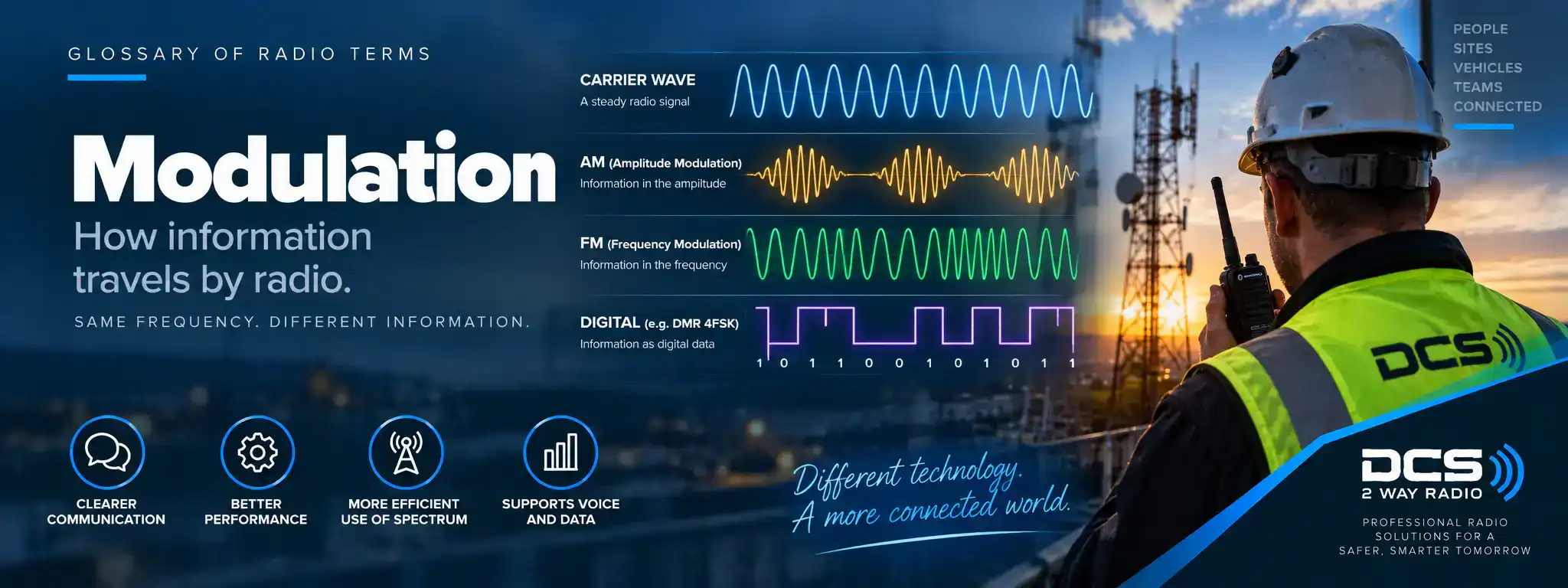
Modulation is the process of changing a radio-frequency carrier signal so that it can carry information such as voice, data or other signals. It is a fundamental part of radio communication and is used by both analogue and digital two-way radio systems.
Different types of modulation are used to transmit information efficiently and reliably. Traditional analogue two-way radios commonly use
FM (FrequencyAn antenna transmits and receives radio-frequency signals, allowing a two-way radio to communicate. Antenna type, frequency, height and location can all affect radio performance and coverage. Modulation), while modern digital radio systems use more advanced digital modulation techniques to carry voice and data.
What is modulation?
A radio transmitter generates a
carrier wave at a particular radio
frequencyFrequency is the number of cycles a radio wave completes each second, measured in Hertz. In two-way radio, frequency determines where a transmission operates within the radio spectrum.. On its own, the carrier does not contain the voice or data that needs to be communicated.
Modulation changes a characteristic of that carrier in a controlled way so that information can be transmitted.
The receiving radio then detects these changes and uses them to recover the original information.
In simple terms, modulation is how information is placed onto a radio signal so that it can travel from one radio to another.
Why is modulation used?
Without modulation, radio systems would not be able to efficiently transmit voice and data over radio frequencies.
Modulation allows information to be carried by a radio-frequency signal and transmitted through the air.
The type of modulation used can affect factors such as:
- Signal bandwidth
- Audio quality
- Data capacity
- ReceiverA Receiver is the part of a two-way radio that detects and processes incoming radio signals, converting them into audible voice or usable data for the user. performance
- Resistance to interferenceRadio interference occurs when unwanted radio-frequency signals or electrical noise disrupt two-way radio communications, causing distorted audio, broken transmissions, reduced coverage or loss of communication.
- SpectrumSpectrum is the range of radio frequencies used for wireless communication. Two-way radios operate within specific parts of the radio spectrum, subject to frequency allocation and licensing requirements. efficiency
- Overall radio systemA Radio System is a complete communication solution comprising two-way radios and, where required, equipment such as repeaters, antennas, base stations, mobile radios and network infrastructure. performance
The appropriate modulation method depends on the technology and application.
Analogue radio modulation
Traditional analogue two-way radio systems commonly use
frequency modulation (FM).
With FM, the frequency of the carrier signal varies according to the audio signal being transmitted. The amplitude of the carrier remains substantially constant while its frequency changes.
FM became widely used for professional two-way radio because it can provide good voice quality and is relatively resistant to certain types of amplitude noise.
Frequency Modulation (FM)
Frequency Modulation, or FM, is an analogue modulation method in which the frequency of a carrier changes in response to the information being transmitted.
FM is widely associated with analogue
business radioBusiness Radio refers to professional two-way radio systems used by businesses and organisations for instant communication, often using licensed frequencies and equipment designed for commercial use. and has been used for decades in professional two-way radio systems.
The amount by which the carrier frequency changes is known as
frequency deviationAnalogue radio uses continuously varying radio signals to transmit voice communication. It remains widely used for reliable two-way communication across business, industry, events, security and other applications..
Digital radio modulation
Digital two-way radio systems convert voice and other information into digital data before
transmissionTransmission is the process of sending voice, data or signalling from a radio using a radio-frequency signal to another radio, repeater or communication system..
Digital radio technologies can use different modulation techniques to transmit this information efficiently.
For example,
DMR (Digital Mobile RadioA Mobile Radio is a two-way radio designed to be installed in a vehicle. It normally uses the vehicle's power supply and an external antenna to provide reliable communication while travelling or working in the field.) uses
4FSK (Four-Level Frequency Shift Keying) as its modulation scheme.
Digital modulation allows radio systems to transmit digital information rather than directly varying the carrier according to an analogue audio waveform.
Modulation and DMR
DMR is an important digital radio technology used in professional two-way radio systems.
DMR uses 4FSK modulation and
TDMA (Time Division Multiple Access) to provide efficient use of radio spectrum.
In a DMR system, the transmitter converts the information into digital symbols which are represented using different frequency shifts. The receiver interprets these signals and reconstructs the transmitted information.
This is one of the technical foundations behind modern professional digital radio.
Modulation and radio bandwidth
The modulation method used by a radio system influences how much radio spectrum is required to transmit information.
Efficient use of bandwidth is particularly important because radio spectrum is a limited resource.
Modern digital radio technologies have been developed partly to make more efficient use of available spectrum while providing additional communication capabilities.
The relationship between modulation,
channelA two-way radio channel is a programmed set of communication settings, typically including frequency and signalling, that allows compatible radios to communicate with one another. bandwidth and data rate is an important part of radio system engineering.
Modulation and frequency deviation
In frequency modulation,
frequency deviation describes how far the carrier frequency moves above or below its centre frequency as information is transmitted.
The amount of deviation is an important characteristic of an FM radio system.
Incorrect frequency deviation can affect radio performance and can potentially cause problems with channel spacing or compatibility between equipment.
Radio equipment therefore needs to be configured correctly for the relevant frequency and radio standard.
Modulation and radio interference
Modulation can influence how a radio signal behaves in the presence of interference and noise.
Different modulation techniques have different characteristics when dealing with unwanted signals.
However, modulation itself does not eliminate interference. Radio-frequency interference can come from other transmitters, electrical equipment, poor installation, nearby radio systems and other sources.
Good radio system design considers modulation alongside frequency planning,
antennaAn antenna transmits and receives radio-frequency signals, allowing a two-way radio to communicate. Antenna type, frequency, height and location can all affect radio performance and coverage. selection, receiver performance and other factors.
Modulation and signal quality
The quality of a received radio signal depends on many factors, including the strength of the signal, interference, the radio equipment, antennas and the environment.
The modulation technique is also important because the receiver needs to correctly interpret the transmitted signal.
In analogue FM systems, increasing noise can gradually affect audio quality. Digital systems can behave differently, with audio often remaining usable until the received signal falls below the level required for reliable decoding.
Modulation and digital voice
Digital radio systems encode voice into digital information before transmission.
The voice information is processed and converted into a stream of digital data. That information is then transmitted using the radio system's digital modulation method.
The receiving radio reverses this process, decoding the digital information and converting it back into audible speech.
This process allows digital radio systems to support voice alongside other digital features and services.
Common types of modulation
There are many different modulation techniques used throughout radio communications.
Examples include:
- AM (Amplitude Modulation)
- FM (Frequency Modulation)
- PM (Phase Modulation)
- FSK (Frequency Shift Keying)
- PSK (Phase Shift Keying)
- QAM (Quadrature Amplitude Modulation)
- 4FSK (Four-Level Frequency Shift Keying)
Not all of these are used in conventional professional two-way radio systems. The modulation method depends on the radio technology and standard being used.
Modulation and two-way radio compatibility
Two radios need to use compatible technology and configuration to communicate correctly.
This includes factors such as frequency, channel configuration, signalling and, where applicable, the digital radio standard and modulation method.
Simply programming two radios to the same frequency does not necessarily make them compatible if they use different radio technologies or configurations.
This is one reason professional radio systems need to be correctly planned and programmed.
Modulation and radio receivers
A radio receiver needs to be capable of detecting and interpreting the modulation used by the transmitter.
The receiver extracts the information from the incoming radio-frequency signal and converts it into usable audio or data.
Receiver performance, sensitivity and selectivity can therefore have a significant effect on how effectively a radio system operates.
Modulation and radio system design
Modulation is one part of the wider technical design of a radio communication system.
When designing a professional two-way radio
networkA Network is a connected system of radios, equipment and infrastructure that allows users to communicate across a defined area. Radio networks can range from simple radio-to-radio systems to large multi-site networks., other factors may include:
- Radio frequency
- Channel bandwidth
- Antenna type
- Transmitter powerAn antenna transmits and receives radio-frequency signals, allowing a two-way radio to communicate. Antenna type, frequency, height and location can all affect radio performance and coverage.
- Receiver sensitivity
- CoverageRadio Coverage is the geographical area in which a two-way radio system can provide reliable communication. Coverage depends on the radios, antennas, frequency, terrain, buildings and system infrastructure. requirements
- Interference
- RepeaterA Repeater receives a two-way radio transmission and retransmits it, usually from an elevated location, to extend the coverage and reliability of a radio communication system. locations
- Digital or analogue technology
- Licensing requirements
These factors need to work together to provide the required level of communication across the site or operational area.
Modulation and radio hire
For organisations using
two-way radio hireRadio Hire is the temporary rental of two-way radios and related communication equipment for events, projects and operational requirements, providing professional communication without purchasing the equipment., the radio equipment supplied will normally be configured for the intended application.
The radios need to be compatible with one another and correctly configured for the relevant radio system.
For temporary events, construction projects, logistics operations and other short-term requirements, professional radio hire can provide equipment that is already prepared for the required communication system.
Modulation and DCS 2 Way Radio
At DCS 2 Way Radio, understanding the technical characteristics of radio equipment is an important part of providing suitable communication solutions.
Modulation is one of the fundamental technologies behind radio communication, whether the system uses traditional analogue FM or modern digital radio such as DMR.
For organisations requiring reliable communication, the choice of radio technology, frequencies, antennas, repeaters and other
infrastructureRadio infrastructure is the equipment and supporting systems behind a professional two-way radio network, including repeaters, antennas, base stations, network connections, power systems and dispatch equipment. should be based on the operational requirements of the site.
Related radio terms
- Frequency
- Radio Frequency (RF)Radio Frequency (RF) refers to electromagnetic waves used to transmit voice and data wirelessly. Two-way radios use RF signals to communicate between radios, repeaters and other system infrastructure.
- Frequency Deviation
- Digital Mobile Radio (DMR)Digital Mobile Radio (DMR) is an ETSI digital radio standard for professional two-way communications, supporting voice, group calling, data and other features on compatible radio systems.
- Analogue RadioAnalogue radio uses continuously varying radio signals to transmit voice communication. It remains widely used for reliable two-way communication across business, industry, events, security and other applications.
- Digital Radio
- FM (Frequency Modulation)
- AM (Amplitude Modulation)
- 4FSK (Four-Level Frequency Shift Keying)
- TDMA (Time Division Multiple Access)
- Bandwidth
- Receiver
- Interference
- Antenna
- Repeater
- Coverage
- Radio System
- Radio Hire