
Business Radio
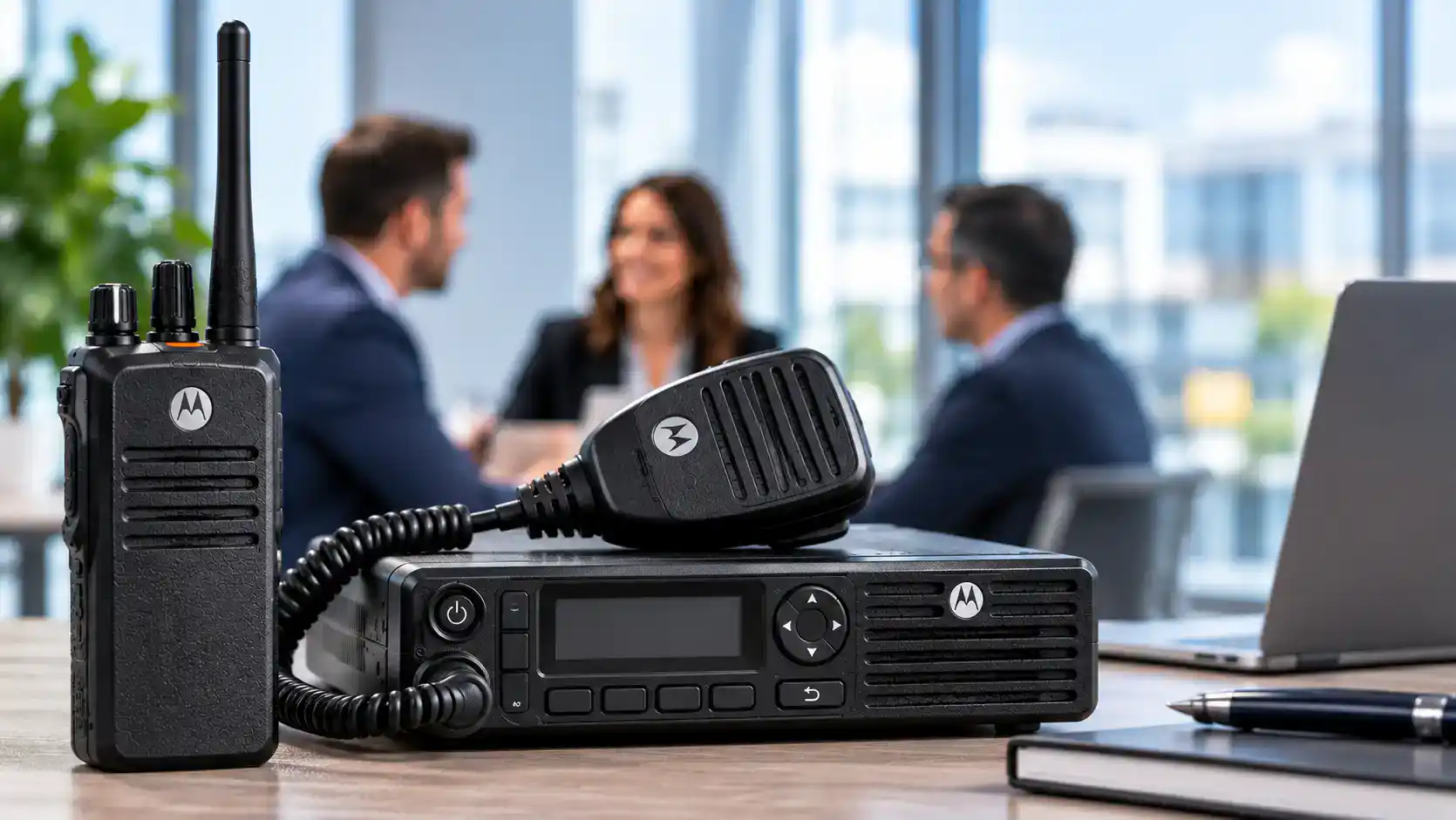
Business Radio is a term used to describe two-way radio systems designed for professional and commercial use by organisations, businesses and other users. Business radios provide instant voice communication between workers, teams and control points without relying on mobile phones.
In the UK, the term can also refer specifically to radio services operating under OfcomOfcom (Office of Communications) is the UK's communications regulator. For two-way radio users, Ofcom manages and regulates access to radio spectrum and the use of radio frequencies in the UK. business radio licensing arrangements. Business Radio can therefore cover a wide range of professional radio equipment and systems, from a small group of handheld radios operating on a single site to sophisticated digital systems using repeaters, multiple sites and networked communications.
Business Radio is used across industries including construction, security, hospitality, manufacturing, transport, logistics, events, agriculture, facilities management and retail.
How does Business Radio work?
A Business Radio systemA Radio System is a complete communication solution comprising two-way radios and, where required, equipment such as repeaters, antennas, base stations, mobile radios and network infrastructure. uses radio frequencies allocated for professional communications.
Users communicate by pressing a Push-to-Talk (PTT)Push-to-Talk (PTT) is the button or control used to activate a two-way radio's transmitter. Press it to speak and release it to listen. button on their radio. The radio transmits the user’s voice as a radio signal, which is received by other radios operating on the same compatible channelA two-way radio channel is a programmed set of communication settings, typically including frequency and signalling, that allows compatible radios to communicate with one another. or through associated infrastructureRadio infrastructure is the equipment and supporting systems behind a professional two-way radio network, including repeaters, antennas, base stations, network connections, power systems and dispatch equipment. such as a repeaterA Repeater receives a two-way radio transmission and retransmits it, usually from an elevated location, to extend the coverage and reliability of a radio communication system..
A basic system can therefore operate as:
Radio user → radio signal → other radio users
For larger areas, a repeater can receive the transmissionTransmission is the process of sending voice, data or signalling from a radio using a radio-frequency signal to another radio, repeater or communication system. and retransmit it, extending the effective coverageRadio Coverage is the geographical area in which a two-way radio system can provide reliable communication. Coverage depends on the radios, antennas, frequency, terrain, buildings and system infrastructure. of the system.
Business Radio in the UK
In the UK, Business Radio is regulated by Ofcom, which manages the use of radio spectrumSpectrum is the range of radio frequencies used for wireless communication. Two-way radios operate within specific parts of the radio spectrum, subject to frequency allocation and licensing requirements. and licensing arrangements.
Businesses may need an appropriate radio licence depending on the frequencies, equipment and service being used.
Professional Business Radio systems can operate under different licensing arrangements, including licences designed for use over a specific site or area.
The exact licence required depends on factors such as the frequencyAn antenna transmits and receives radio-frequency signals, allowing a two-way radio to communicate. Antenna type, frequency, height and location can all affect radio performance and coverage., geographical area, radio system and intended use.
Business Radio licences
A business using professional two-way radios may require a licence from Ofcom unless the equipment operates under an exemption such as PMR446.
Business Radio licences can provide access to specific frequencies and operating conditions suitable for professional communications.
Examples of Business Radio licensing arrangements include:
- Simple UK Light — suitable for certain low-power radio systems operating over a limited area.
- Simple Site Light — intended for specific site-based operations.
- Technically Assigned — allows frequencies to be assigned according to the technical requirements and location of the radio system.
- Area Defined — provides access to frequencies over a defined geographical area.
The appropriate licence depends on the system and how it will be used.
Business Radio vs PMR446
Business Radio should not be confused with PMR446.
PMR446 is a licence-exempt form of short-range radio communication operating within the designated PMR446 frequencyFrequency is the number of cycles a radio wave completes each second, measured in Hertz. In two-way radio, frequency determines where a transmission operates within the radio spectrum. range, subject to the applicable technical restrictions.
Business Radio systems can operate at higher powerAn antenna transmits and receives radio-frequency signals, allowing a two-way radio to communicate. Antenna type, frequency, height and location can all affect radio performance and coverage. and may provide greater coverage, additional frequencies and more sophisticated infrastructure.
For professional applications where reliable coverage across a defined site or wider area is important, a licensed Business Radio system may provide capabilities that a basic PMR446 radio cannot.
Business Radio and digital radio
Business Radio systems can use both analogue and digital radio technologies.
Traditional analogue systems can provide straightforward voice communication and remain suitable for many applications.
Digital technologies such as DMR can provide additional functionality, potentially including:
- Improved spectrum efficiency
- Group calling
- Individual calling
- Text messaging
- Radio identification
- Emergency functions
- Data services
- Enhanced system management
The features available depend on the radio equipment and system configuration.
Business Radio repeaters
A repeater can be used to extend the coverage of a Business Radio system.
The repeater receives a transmission from a radio and retransmits it from a suitable location, often using a different transmit and receive frequency.
This can significantly improve coverage across large sites, buildingsAn antenna transmits and receives radio-frequency signals, allowing a two-way radio to communicate. Antenna type, frequency, height and location can all affect radio performance and coverage. or geographical areas.
For example:
Handheld radio → repeater → handheld radio
A repeater may be particularly useful where buildings, terrain or distance make direct radio-to-radio communication unreliable.
Business Radio for different industries
Business Radio is used across a wide range of professional environments.
Construction
Construction teams can use radios to coordinate workers, plant operators, site managers and contractors where instant communication is required.
Security
Security teams use Business Radio to coordinate patrols, respond to incidents and communicate with control rooms or other members of the security team.
Events
Event organisers, security teams, stewards and production crews can use radios to coordinate activities across a venue.
Hospitality
Hotels, restaurants and large venues can use radios for communication between reception, housekeeping, maintenance, security and management teams.
Manufacturing
Factories can use Business Radio to coordinate production, engineering, maintenance, logistics and safety teams.
Transport and logistics
Radio communication can help drivers, warehouse teams, dispatchers and operational staff coordinate movements and respond quickly to changing situations.
Agriculture
Farms and estates can use Business Radio to communicate across large areas where mobile-phone coverage may be inconsistent.
Business Radio range
The range of a Business Radio system depends on several factors.
These can include:
- Transmitter power
- Operating frequency
- AntennaAn antenna transmits and receives radio-frequency signals, allowing a two-way radio to communicate. Antenna type, frequency, height and location can all affect radio performance and coverage. type
- Antenna height
- Terrain
- Buildings and other obstructions
- InterferenceRadio interference occurs when unwanted radio-frequency signals or electrical noise disrupt two-way radio communications, causing distorted audio, broken transmissions, reduced coverage or loss of communication.
- Radio sensitivity
- Whether a repeater is being used
There is therefore no single range that applies to all Business Radio systems.
A professionally designed licensed system can often provide considerably more reliable coverage than a basic handheld radio operating without infrastructure.
Business Radio and mobile phones
Business Radio and mobile phones provide different types of communication.
Two-way radio offers instant push-to-talk communication, allowing users to communicate with a group without making individual telephone calls.
Radios can also be easier to use when workers need to communicate repeatedly throughout a shift.
Business Radio does not depend on the public mobile-phone networkA Network is a connected system of radios, equipment and infrastructure that allows users to communicate across a defined area. Radio networks can range from simple radio-to-radio systems to large multi-site networks. when operating as a conventional radio system, which can be an important advantage for some businesses.
However, mobile phones provide capabilities such as internet access, private calls and applications that traditional radios may not provide.
For some organisations, the most effective communication solution combines both technologies.
Business Radio and emergency communication
Professional Business Radio systems can provide features designed to support emergency communication.
Depending on the equipment and system, these may include:
- Emergency buttons
- Priority calls
- Lone-worker functions
- Man-down alerts
- Worker identification
- Control-room or dispatch functions
These features vary between radio systems and should be selected according to the operational requirements.
Business Radio accessories
Business Radio systems can use a wide range of accessories to improve usability.
Common accessories include:
- Remote speaker microphones
- Earpieces
- Headsets
- Batteries
- Chargers
- Belt clips
- Vehicle mounting equipment
- External antennas
- Carrying cases
Specialist accessories can also be available for noisy environments, discreet communications and hazardous areas.
Business Radio and ATEX
Where radios are required in potentially explosive environments, specialist ATEX-certified Business Radio equipment may be required.
Standard Business Radio equipment should not be used in a hazardous area unless it has the appropriate certification for that environment.
The required equipment depends on the hazardous-area classification and the substances that may be present.
Business Radio hire
Business Radio is commonly hired for temporary operations where organisations need professional communication without purchasing and maintaining their own equipment.
Typical hire applications include:
- Events
- Construction projects
- Festivals
- Security operations
- Temporary industrial work
- Hospitality operations
- Agricultural activities
- Film and television production
A hire company can supply radios, accessories, repeaters and other infrastructure according to the requirements of the site.
Choosing a Business Radio system
The appropriate Business Radio system depends on the organisation’s communication requirements.
Important considerations include:
- Number of users
- Coverage area
- Indoor and outdoor environments
- Required range
- Number of communication groups
- Analogue or digital operation
- Whether a repeater is required
- Required licence
- Required accessories
- Emergency features
- Whether hazardous-area certification is required
- Whether the system is permanent or temporary
A properly designed system should provide the coverage and functionality users actually need rather than simply selecting radios based on advertised range.
Business Radio and DCS
DCS supplies and hires professional two-way radio equipment for businesses and organisations across a range of industries.
Business Radio systems can range from straightforward handheld radio solutions to larger systems incorporating repeaters, base stations, vehicle radios and other communications infrastructure.
DCS can advise on the appropriate radio equipment, accessories, coverage requirements and licensing considerations for a particular application.
If you’re planning a temporary operation or large event, radio hire for businesses provides a practical alternative to purchasing equipment.