Spectrum
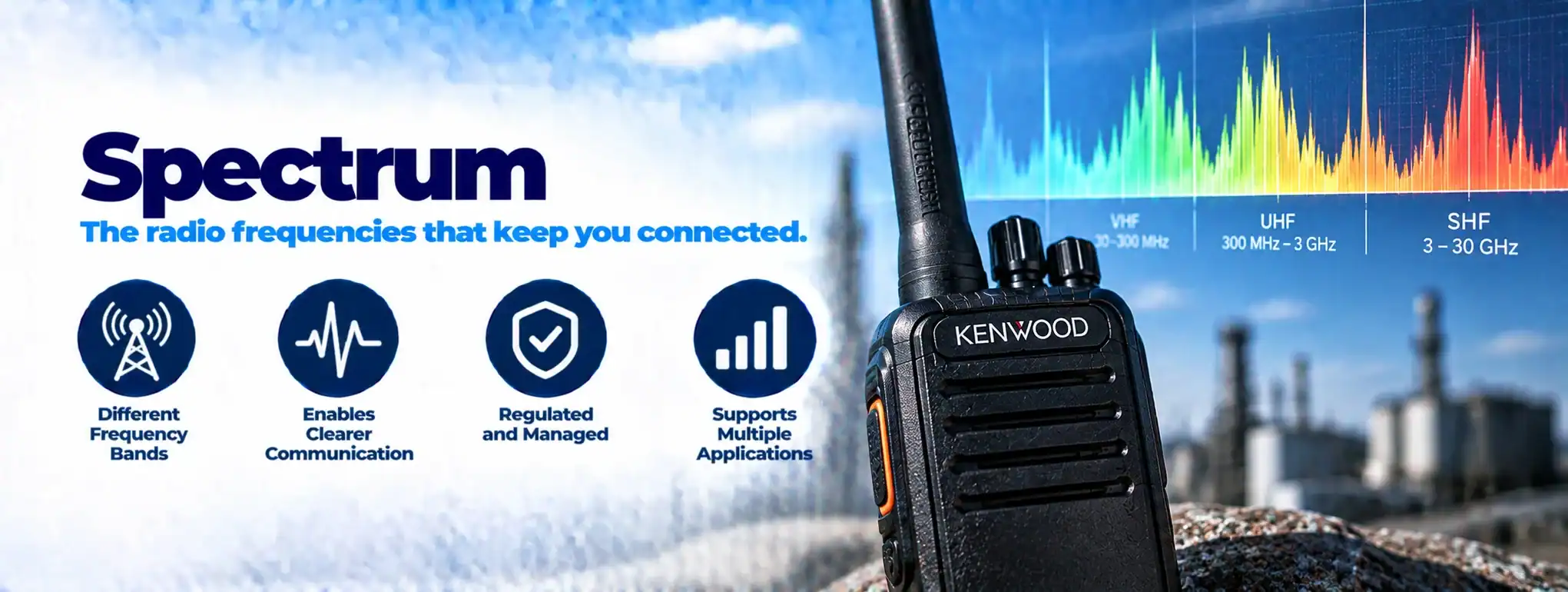
Spectrum refers to the range of radio frequencies used to transmit and receive radio signals. The Radio Spectrum is a finite resource used by many different wireless technologies, including two-way radios, mobile networks, television, satellite communications, Wi-FiWi-Fi is a wireless networking technology that connects compatible devices to a local or wider network. In radio systems, it can support programming, updates, data services and IP-based communications. and emergency services.
In two-way radio, the spectrum determines which frequencies a radio systemA Radio System is a complete communication solution comprising two-way radios and, where required, equipment such as repeaters, antennas, base stations, mobile radios and network infrastructure. can use to communicate.
What is the radio spectrum?
The radio spectrum is part of the electromagnetic spectrum consisting of radio-frequency electromagnetic waves.
It is divided into ranges of frequencies, measured in Hertz (Hz).
Common units include:
- kHz — kilohertz
- MHz — megahertz
- GHz — gigahertz
For example, a professional two-way radio may operate on a frequencyAn antenna transmits and receives radio-frequency signals, allowing a two-way radio to communicate. Antenna type, frequency, height and location can all affect radio performance and coverage. in the VHF or UHF range.
Frequency and spectrum
A FrequencyFrequency is the number of cycles a radio wave completes each second, measured in Hertz. In two-way radio, frequency determines where a transmission operates within the radio spectrum. describes the number of cycles of a radio wave per second.
The spectrum contains many different frequencies.
For example:
VHF → 30 MHz to 300 MHz
UHF → 300 MHz to 3 GHz
These are broad frequency ranges containing many individual frequencies that can potentially be used for different radio services.
VHF spectrum
VHF (Very High Frequency)VHF (Very High Frequency) is the 30 MHz to 300 MHz radio-frequency range. VHF two-way radios are widely used for professional communications across outdoor, rural and open areas. occupies the range from 30 MHz to 300 MHz.
Professional two-way radio systems commonly operate in parts of the VHF spectrum.
VHF can be particularly useful for outdoor communications because its propagation characteristics can work well across open areas.
UHF spectrum
UHF (Ultra High Frequency)UHF (Ultra High Frequency) is the 300 MHz to 3 GHz radio-frequency range. UHF two-way radios are widely used for professional communications, particularly in buildings and urban environments. occupies the range from 300 MHz to 3 GHz.
Professional two-way radio systems commonly operate in parts of the UHF spectrum.
UHF is widely used for applications including:
- Security
- Events
- Construction
- Hospitality
- Warehousing
- Industrial operations
UHF can also be useful for communications inside buildingsAn antenna transmits and receives radio-frequency signals, allowing a two-way radio to communicate. Antenna type, frequency, height and location can all affect radio performance and coverage., although building construction and other environmental factors can significantly affect coverageRadio Coverage is the geographical area in which a two-way radio system can provide reliable communication. Coverage depends on the radios, antennas, frequency, terrain, buildings and system infrastructure..
Spectrum allocation
The radio spectrum is divided between different services and users.
Different parts of the spectrum can be allocated for:
- Business radioBusiness Radio refers to professional two-way radio systems used by businesses and organisations for instant communication, often using licensed frequencies and equipment designed for commercial use.
- Emergency services
- Aviation
- Maritime communications
- Broadcasting
- Mobile networks
- Satellite communications
- Amateur radio
- Licence-free services
This allocation helps prevent incompatible services from using the same frequencies without appropriate coordination.
Spectrum management
Spectrum management is the process of planning and controlling the use of radio frequencies.
In the UK, OfcomOfcom (Office of Communications) is the UK's communications regulator. For two-way radio users, Ofcom manages and regulates access to radio spectrum and the use of radio frequencies in the UK. is responsible for managing the radio spectrum.
This includes making spectrum available for different uses and establishing rules governing its use.
Ofcom and spectrum
Ofcom manages the UK’s radio spectrum and sets the regulatory framework for many radio services.
For professional two-way radio users, this means that frequencies cannot simply be selected arbitrarily.
The appropriate frequency and licence arrangement depends on the radio service being used.
Spectrum licensing
Some parts of the radio spectrum require users to obtain a licence before transmitting.
Professional business-radio users may require an Ofcom Business Radio LicenceAn Ofcom Business Radio Licence authorises businesses and organisations in the UK to use specified radio frequencies for professional two-way radio communication, subject to the licence conditions. depending on the frequencies and service being used.
Licensing helps manage spectrum use and reduces the potential for harmful interferenceRadio interference occurs when unwanted radio-frequency signals or electrical noise disrupt two-way radio communications, causing distorted audio, broken transmissions, reduced coverage or loss of communication. between users.
Licence-free spectrum
Some parts of the spectrum are available for licence-free use under defined technical conditions.
PMR446 is an example relevant to two-way radio.
Licence-free operation does not mean unrestricted operation. Equipment and users must comply with the conditions applying to the relevant service.
Spectrum and PMR446
PMR446 occupies a designated portion of the UHF spectrum for licence-free short-range radio communications.
PMR446 equipment has specific technical limitations, including restrictions on transmitter powerAn antenna transmits and receives radio-frequency signals, allowing a two-way radio to communicate. Antenna type, frequency, height and location can all affect radio performance and coverage. and antennaAn antenna transmits and receives radio-frequency signals, allowing a two-way radio to communicate. Antenna type, frequency, height and location can all affect radio performance and coverage. arrangements.
This makes PMR446 different from licensed professional business-radio services.
Spectrum and business radio
Business-radio users can operate within spectrum allocated for professional land-mobile radio services.
Licensed systems can provide greater flexibility than licence-free services, including access to appropriately coordinated frequencies and higher-power equipment where permitted by the licence.
Spectrum and radio channels
A ChannelA two-way radio channel is a programmed set of communication settings, typically including frequency and signalling, that allows compatible radios to communicate with one another. is a configured frequency or frequency arrangement used by a radio system.
A radio may have many channels programmed into it.
For example:
Channel 1 → Frequency A
Channel 2 → Frequency B
The available channels depend on the radio service and programming.
Spectrum and bandwidth
Bandwidth describes the amount of spectrum occupied by a radio signal.
A radio transmissionTransmission is the process of sending voice, data or signalling from a radio using a radio-frequency signal to another radio, repeater or communication system. does not normally occupy only one infinitely narrow frequency.
The signal occupies a range of frequencies around its centre frequency.
Efficient use of bandwidth allows more users and services to share the available spectrum.
Narrowband spectrum
NarrowbandNarrowband describes a radio communication system that uses a relatively small amount of frequency spectrum to transmit information. It is widely used in professional two-way radio to make efficient use of available radio channels. radio systems use relatively small channel bandwidths.
Narrowbanding has been introduced in various radio services to improve spectrum efficiency and allow more users to share available frequencies.
Spectrum efficiency
Spectrum efficiency refers to how effectively available frequency resources are used to carry communications.
Digital technologies can provide ways of making more efficient use of spectrum.
For example, DMR can divide a 12.5 kHz channel into two logical time slots using TDMA technology, allowing two conversations to share the same RF channel under appropriate conditions.
Spectrum and DMR
Digital Mobile Radio (DMR)Digital Mobile Radio (DMR) is an ETSI digital radio standard for professional two-way communications, supporting voice, group calling, data and other features on compatible radio systems. operates within designated radio-frequency spectrum.
DMR systems can use technologies such as TDMA (Time Division Multiple Access) to make efficient use of available channel bandwidth.
The actual frequencies available depend on the applicable radio service and licensing arrangements.
Spectrum and analogue radio
Analogue two-way radios also occupy a portion of the radio spectrum when transmitting.
The signal’s bandwidth and characteristics depend on the modulationAnalogue radio uses continuously varying radio signals to transmit voice communication. It remains widely used for reliable two-way communication across business, industry, events, security and other applications. and configuration being used.
Spectrum and digital radio
Digital radio converts voice or other information into digital data before transmitting it over radio frequencies.
The digital information still occupies radio-frequency spectrum.
Digital technology therefore does not eliminate the need for spectrum management.
Spectrum and radio frequency
Radio Frequency (RF)Radio Frequency (RF) refers to electromagnetic waves used to transmit voice and data wirelessly. Two-way radios use RF signals to communicate between radios, repeaters and other system infrastructure. refers to electromagnetic frequencies used for radio communication.
The radio spectrum contains the full range of RF frequencies available for different applications.
A two-way radio operates within a defined part of this spectrum.
Spectrum and interference
Different radio systems operating too close together in frequency can potentially interfere with each other.
Interference can result from:
- Another transmitter
- Poor frequency coordination
- Excessive signal strength
- Faulty equipment
- Harmonics
- Intermodulation
- Overlapping or incompatible transmissions
Spectrum planning helps reduce these problems.
Spectrum planning
Spectrum planning involves selecting frequencies that are appropriate for the intended system and location.
For professional radio systems, planning can consider:
- Frequency availability
- Existing users
- Required coverage
- Transmitter power
- Channel bandwidth
- Antenna characteristics
- Geographic location
- RepeaterA Repeater receives a two-way radio transmission and retransmits it, usually from an elevated location, to extend the coverage and reliability of a radio communication system. operation
- Licensing requirements
Spectrum coordination
Spectrum coordination helps ensure that different radio users can operate without causing unacceptable interference to one another.
This can be particularly important in areas with many radio users.
Large events, industrial sites and densely populated areas may require careful frequency planning.
Spectrum and repeaters
A Repeater normally receives on one frequency and retransmits on another.
The two frequencies form a paired arrangement, allowing radios to communicate through the repeater without interfering with the repeater’s own transmission.
The frequencies used must be appropriately coordinated.
Spectrum and simplex
A SimplexSimplex is a method of two-way radio communication where radios transmit and receive on the same frequency, communicating directly without a repeater. radio system normally uses the same frequency for transmission and reception.
Spectrum planning is still important because other users may operate on or near the same frequency.
Spectrum and duplex
A Duplexduplex, duplex radio, duplex communication, duplex frequencies, duplex operation, duplex spacing, frequency offset, repeater duplex, duplex repeater, full duplex, half duplex, radio repeater radio system uses separate frequencies for transmitting and receiving.
This allows simultaneous transmission and reception within systems designed for full-duplex operation, or supports repeater input/output arrangements in professional land-mobile radio.
Spectrum and repeater offsets
A repeater often uses a defined frequency separation between its input and output frequencies.
This is known as the Repeater Offset.
The appropriate offset depends on the radio band and system configuration.
Spectrum and antenna
An antenna is designed to operate efficiently over a particular frequency range.
Using an antenna outside its intended frequency range can reduce performance and potentially cause problems for the transmitter.
Antenna selection is therefore an important part of radio system design.
Spectrum and propagation
Different frequencies propagate differently.
Factors such as wavelength, terrain, atmospheric conditions and building materials can affect how radio signals travel.
This is one reason why a Site SurveyA Site Survey is an assessment of a location to determine whether a two-way radio system will provide the required coverage, reliability and performance. can be important when designing a professional radio system.
Spectrum and wavelength
Frequency and wavelength are related.
As frequency increases, wavelength decreases.
VHF signals generally have longer wavelengths than UHF signals.
This contributes to differences in how the bands interact with obstacles and propagate through different environments.
Spectrum and radio range
Spectrum selection can influence radio propagation, but frequency alone does not determine range.
Actual coverage also depends on:
- Transmitter power
- Antenna
- Antenna height
- ReceiverA Receiver is the part of a two-way radio that detects and processes incoming radio signals, converting them into audible voice or usable data for the user. sensitivity
- Terrain
- Buildings
- Interference
- System architecture
Spectrum and power output
Power OutputPower Output is the amount of radio-frequency energy produced by a two-way radio's transmitter, normally measured in watts. It is one factor affecting coverage, alongside frequency, antenna, terrain and other conditions. is another factor affecting radio coverage.
Increasing transmitter power can improve signal strength in some circumstancesAn antenna transmits and receives radio-frequency signals, allowing a two-way radio to communicate. Antenna type, frequency, height and location can all affect radio performance and coverage., but it does not automatically solve coverage problems.
The maximum permitted power depends on the radio service and applicable licence conditions.
Spectrum and receiver sensitivity
A receiver must be able to detect and decode the desired signal.
A receiver with good sensitivity can potentially operate with weaker signals, although overall communication quality also depends on interference and other factors.
Spectrum and noise
Radio systems operate alongside naturally occurring and man-made RF noise.
Noise can reduce the effective quality of communications.
The amount of noise varies by frequency, location and environment.
Spectrum and interference testing
A spectrum analyser can be used by radio engineers to examine RF activity within a frequency range.
This can help identify:
- Existing transmissions
- Interference
- Unexpected signals
- Harmonics
- Other RF activity
Such testing can form part of a professional site survey.
Spectrum analyser
A Spectrum Analyser is test equipment that displays RF energy across a range of frequencies.
It can help engineers understand what is happening within the radio environment.
Spectrum analysers are useful for system installation, fault finding and interference investigation.
Spectrum and RF monitoring
RF monitoring can be used to observe activity within a defined portion of the spectrum.
This can help identify changes in the RF environment that may affect radio system performance.
Spectrum and security
Spectrum itself does not provide communication security.
A radio transmission can potentially be detected by other equipment within range.
Security features such as authentication and encryptionEncryption protects two-way radio communications by converting voice or data into a secure form that can only be understood by authorised radios with the correct encryption capability and keys. must be provided by the radio system where required.
Spectrum and encryption
Encryption protects the content of a radio communication.
It does not prevent the transmission from occupying spectrum or necessarily prevent the RF signal from being detected.
Spectrum and interoperability
Different radio systems may operate within the same broad frequency band while using different technologies.
Operating in the same band does not necessarily mean that radios are interoperable.
InteroperabilityInteroperability is the ability of different communication systems, devices or organisations to work together and exchange information. In two-way radio, it can connect different radio networks, technologies or users through compatible systems or gateways. depends on compatible frequencies, channel configurations, protocols and system technologies.
Spectrum and hybrid communication
Hybrid CommunicationHybrid Communication combines two or more communication technologies, such as two-way radio, DMR, cellular, Wi-Fi or IP networks, allowing different systems or users to communicate through a common platform. systems can combine conventional radio-frequency communications with cellular, Wi-Fi or other networkA Network is a connected system of radios, equipment and infrastructure that allows users to communicate across a defined area. Radio networks can range from simple radio-to-radio systems to large multi-site networks. technologies.
Each technology uses its own communication infrastructureRadio infrastructure is the equipment and supporting systems behind a professional two-way radio network, including repeaters, antennas, base stations, network connections, power systems and dispatch equipment. and frequency resources.
Spectrum and PoC
Push-to-Talk over Cellular (PoC)Push-to-Talk over Cellular (PoC) provides radio-style push-to-talk communication over cellular or IP networks, allowing users to communicate across wide areas where suitable network connectivity is available. systems use mobile networks rather than conventional dedicated business-radio frequencies for the communication path.
The mobile network operator manages the cellular spectrum used by the service.
Spectrum and SIM cards
A PoC device using a SIM CardA SIM Card (Subscriber Identity Module) identifies and authenticates a device or subscriber on a mobile network, providing cellular connectivity for systems such as Push-to-Talk over Cellular (PoC). accesses cellular spectrum through a mobile network.
The SIM provides subscriber authentication and network access; it does not itself allocate radio spectrum.
Spectrum and radio hire
Professional Radio HireRadio Hire is the temporary rental of two-way radios and related communication equipment for events, projects and operational requirements, providing professional communication without purchasing the equipment. systems may use either licensed radioA Licensed Radio is a two-way radio operated under an appropriate radio licence. Licensed systems can provide greater control over frequencies, coverage and infrastructure than licence-free radio services such as PMR446. spectrum or licence-free services, depending on the equipment and application.
A hire company can select and program suitable equipment according to the customer’s requirements.
Spectrum and temporary events
Large temporary events can involve many radio users operating in the same geographical area.
Careful frequency planning can help prevent interference between:
- Security
- Event management
- Production
- Medical teams
- Contractors
- Venue staff
Spectrum and radio system design
Spectrum considerations should form part of the overall radio system design.
A typical process is:
Requirements → Frequency planning → Licensing → Equipment selection → Site survey → Installation → Testing
Spectrum and site surveys
A Site Survey can assess the RF environment at the location where a radio system will operate.
This can identify potential interference and help determine whether the proposed frequencies are suitable.
Spectrum and radio licensing in the UK
For UK professional radio users, spectrum use should comply with the applicable Ofcom regulations and licence conditions.
The correct licensing route depends on the service, frequencies, equipment and operating requirements.
Spectrum limitations
Radio spectrum is finite and must be shared between many services.
This means that:
- Frequencies cannot be used without regard to other users.
- Interference must be managed.
- Some frequencies require licences.
- Equipment must comply with applicable technical requirements.
- Frequency availability varies by location and service.
Why spectrum matters to two-way radio
Spectrum is fundamental to two-way radio because every conventional radio transmission requires a portion of RF spectrum.
The choice and management of frequencies can affect:
- Coverage
- Interference
- Capacity
- Equipment selection
- Licensing
- System design
- Reliability
Understanding spectrum is therefore an important part of designing and operating a professional radio communication system.
Spectrum and DCS
DCS can advise on suitable two-way radio systems and frequency requirements for professional applications.
Where licensed radio is appropriate, frequency planning, licensing, equipment selection and coverage requirements can be considered together to develop a reliable communication system.