
Hybrid Communication
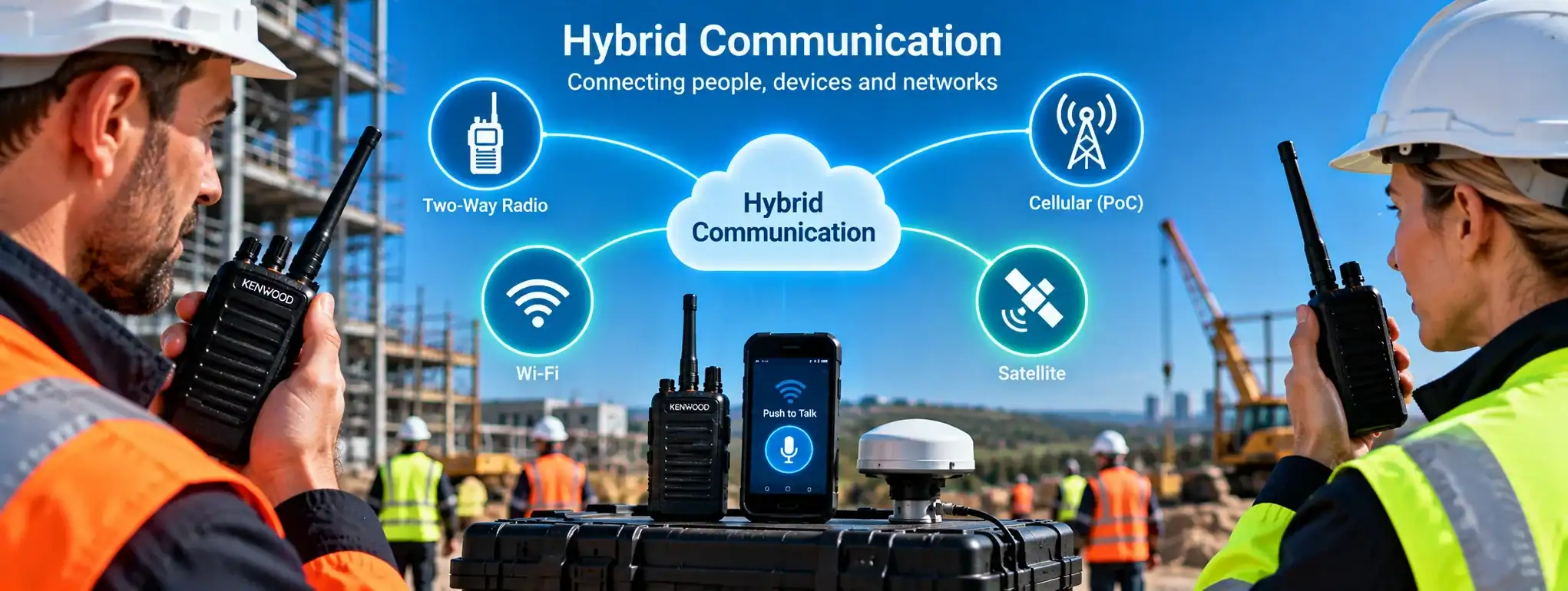
Hybrid Communication is a communication system that combines two or more different communication technologies, networks or radio systems so that users can communicate through a common system.
In professional two-way radio, Hybrid Communication can combine conventional radio with technologies such as DMR, analogue radioAnalogue radio uses continuously varying radio signals to transmit voice communication. It remains widely used for reliable two-way communication across business, industry, events, security and other applications., PoC (Push-to-Talk over Cellular), Wi-FiWi-Fi is a wireless networking technology that connects compatible devices to a local or wider network. In radio systems, it can support programming, updates, data services and IP-based communications., mobile networks or IP-based communication.
The purpose is to allow different types of communication equipment or networks to work together where a single technology may not provide the required coverageRadio Coverage is the geographical area in which a two-way radio system can provide reliable communication. Coverage depends on the radios, antennas, frequency, terrain, buildings and system infrastructure., flexibility or functionality.
How does Hybrid Communication work?
A Hybrid Communication system connects different communication technologies through suitable infrastructureRadio infrastructure is the equipment and supporting systems behind a professional two-way radio network, including repeaters, antennas, base stations, network connections, power systems and dispatch equipment..
For example:
Two-way radio → Radio networkA Network is a connected system of radios, equipment and infrastructure that allows users to communicate across a defined area. Radio networks can range from simple radio-to-radio systems to large multi-site networks. → IP gateway → Mobile network → PoC device
This can allow a user with a conventional radio to communicate with another user operating a different type of device.
The exact architecture depends on the technologies being integrated.
Why use Hybrid Communication?
Different communication technologies have different strengths and limitations.
A professional radio systemA Radio System is a complete communication solution comprising two-way radios and, where required, equipment such as repeaters, antennas, base stations, mobile radios and network infrastructure. may provide reliable Push-to-Talk communication and excellent local coverage, while a cellular or IP-based system may provide connectivity across a much wider geographical area.
A hybrid system can combine these capabilities.
Potential benefits include:
- Wider communication coverage
- Integration of different radio technologies
- Communication between different types of users
- Improved flexibility
- Centralised communication
- Multi-site communication
- Integration with dispatch systems
- Use of existing communication infrastructure
Hybrid Communication and two-way radio
Two-way radio remains a core component of many Hybrid Communication systems.
For example, a business may use professional DMR radios for staff working on a site while using network-connected devices for personnel working away from the site.
A suitable gateway or communication platform can connect the two groups.
Hybrid Communication and DMR
Digital Mobile Radio (DMR)Digital Mobile Radio (DMR) is an ETSI digital radio standard for professional two-way communications, supporting voice, group calling, data and other features on compatible radio systems. can form part of a Hybrid Communication system.
A DMR network may be connected to an IP-based platform, dispatch system or other communication network.
This can allow DMR users to communicate with users on another supported platform without replacing all of the existing radios.
Hybrid Communication and analogue radio
Analogue two-way radios can also form part of a hybrid system where suitable gateway equipment is available.
For example, an existing analogue radio channelA two-way radio channel is a programmed set of communication settings, typically including frequency and signalling, that allows compatible radios to communicate with one another. could potentially be connected to an IP communication platform.
This can allow an organisation to extend or modernise its communications without necessarily replacing every radio immediately.
Hybrid Communication and PoC
Push-to-Talk over Cellular (PoC)Push-to-Talk over Cellular (PoC) provides radio-style push-to-talk communication over cellular or IP networks, allowing users to communicate across wide areas where suitable network connectivity is available. uses mobile networks and data connections to provide Push-to-Talk communication.
PoC devices can potentially be integrated with professional radio systems through suitable platforms or gateways.
This allows users operating on cellular networks to communicate with conventional radio users where the system supports interoperabilityInteroperability is the ability of different communication systems, devices or organisations to work together and exchange information. In two-way radio, it can connect different radio networks, technologies or users through compatible systems or gateways..
Hybrid Communication and cellular networks
Mobile networks can provide wide geographical coverage beyond the range of a local radio system.
A hybrid system can therefore use radio where local RF coverage is required and cellular connectivity where users are operating outside that coverage.
This can be particularly useful for organisations with mobile or geographically dispersed personnel.
Hybrid Communication and Wi-Fi
Wi-Fi can also form part of a hybrid communication system.
Depending on the equipment, Wi-Fi may provide network connectivity for radio gateways, communication devices or Push-to-Talk applications.
Wi-Fi is particularly useful where reliable local network coverage is available, such as within buildingsAn antenna transmits and receives radio-frequency signals, allowing a two-way radio to communicate. Antenna type, frequency, height and location can all affect radio performance and coverage., warehouses or offices.
Hybrid Communication and IP networks
IP (Internet Protocol) networks provide a common method of connecting different communication systems.
A hybrid radio system may use an IP network to carry voice, data, GPS information or signalling between different locations and technologies.
This can allow geographically separated radio systems to operate as part of a wider communication network.
Hybrid Communication and gateways
A Gateway is often a key component of Hybrid Communication.
It provides an interface between different systems and converts or routes communications between them.
For example:
DMR radio → Gateway → IP network → PoC platform
The gateway allows the different technologies to communicate according to the rules and protocols supported by the system.
Hybrid Communication and interoperability
Interoperability means the ability of different communication systems, devices or organisations to work together.
Hybrid Communication is often used to achieve interoperability.
For example, a security team using DMR radios could potentially communicate with an operations team using a network-based Push-to-Talk service.
The systems must be designed and configured to support the required interoperability.
Hybrid Communication and talkgroups
Digital hybrid systems can use Talkgroups to organise users.
For example, a company could create a single operational talkgroup containing:
- DMR radio users
- PoC users
- Dispatch operators
- Other compatible network-connected devices
Users can then communicate through a common group even though they are using different types of equipment.
Hybrid Communication and Push-to-Talk
Push-to-Talk provides a consistent operating method across many hybrid systems.
A radio user can press the PTT button on a two-way radio, while a network-connected user can use the PTT control on their device.
The communication platform handles the connection between the different networks.
Hybrid Communication and dispatch
Hybrid systems can be integrated with Dispatch platforms.
A dispatcher may be able to communicate with users across multiple technologies from a central console.
For example, the dispatcher could potentially communicate with:
- DMR radios
- Analogue radios
- PoC devices
- Mobile users
- Fixed stations
This provides a central point for operational communications.
Hybrid Communication and Cloud Dispatch
A Cloud DispatchCloud Dispatch is a cloud-based radio management and communication system that allows authorised dispatchers to communicate with, monitor and manage two-way radio users through an internet-connected platform. platform can provide a central communication environment for users operating across different networks.
Depending on the system, the platform may allow a dispatcher to communicate with radio and network-connected users from a browser or dedicated application.
This can reduce the need to operate separate communication systems independently.
Hybrid Communication and Cloud Management
Cloud ManagementCloud Management uses an online platform to remotely manage and monitor compatible two-way radios, users, devices and communication settings from a central location. can allow administrators to configure and manage parts of a hybrid communication system remotely.
Depending on the platform, this may include:
- User management
- Group management
- Device configuration
- Location information
- System monitoring
- Dispatch configuration
The available functions vary between systems.
Hybrid Communication and GPS
Hybrid systems can transport GPS location information from compatible devices.
For example:
GPS radio → Radio network → IP gateway → Cloud platform
A central operator may then be able to see the location of users across different communication networks.
Hybrid Communication and fleet management
Hybrid Communication can be useful for organisations managing vehicles and mobile personnel.
A fleet may contain vehicles using radio equipment while drivers or managers elsewhere use mobile or network-connected devices.
A hybrid system can bring these users into a common communication environment.
Hybrid Communication and Geo-Fencing
Where GPS information is available, a hybrid platform can potentially support Geo-FencingGeo-Fencing uses GPS and a virtual geographical boundary to identify when a radio user or tracked device enters or leaves a defined area, triggering alerts or other actions where supported..
For example, an organisation could define a geographical area and receive an alert when a compatible user or vehicle enters or leaves that area.
The exact functionality depends on the communication platform.
Hybrid Communication and emergency communications
Hybrid systems can provide additional options for emergency communications.
For example, an emergency alert originating from a radio could potentially be delivered to a central dispatch platform and other authorised users.
However, emergency functionality must be specifically designed and tested across the connected systems.
Connecting two systems does not automatically mean that every emergency function will work across both.
Hybrid Communication and Emergency Calls
Emergency calls can behave differently depending on the radio or communication technology involved.
A DMR emergency function, for example, may use digital signalling that is not directly supported by another network.
A properly designed hybrid system may translate or pass relevant emergency information through a gateway, but this must be supported by the equipment and software.
Hybrid Communication and encryption
Different communication technologies can use different forms of EncryptionEncryption protects two-way radio communications by converting voice or data into a secure form that can only be understood by authorised radios with the correct encryption capability and keys..
A hybrid system therefore needs to consider how security is maintained when communications pass between systems.
Encryption used on one radio network does not necessarily remain end-to-end across another network.
For sensitive communications, the complete communication path should be assessed rather than assuming that encryption on one section protects the entire connection.
Hybrid Communication and End-to-End Encryption
End-to-End EncryptionEnd-to-End Encryption protects radio communications between authorised endpoints, keeping voice or data encrypted through the network until it reaches the intended receiving device. (E2EE) protects communications between the intended endpoints.
In a hybrid communication system, achieving genuine end-to-end encryption across different technologies can be more complex.
A gateway may need to process or convert communication between systems, which can affect how encryption is applied.
The security architecture should therefore be assessed for the complete system.
Hybrid Communication and coverage
One of the main reasons for using Hybrid Communication is to overcome coverage limitations.
For example:
Local radio coverage → DMR
Remote users → Cellular network
Buildings → Wi-Fi
These different networks can potentially work together to provide a broader communication service.
Hybrid Communication and dead spots
A hybrid system can provide alternative communication paths where a particular network has a Dead SpotA Dead Spot is an area where two-way radio communication is weak, unreliable or unavailable. Dead spots can be caused by buildings, terrain, distance, interference or inadequate radio coverage..
For example, if radio coverage is unavailable in a particular area but cellular coverage is available, a network-connected device may still be able to communicate.
However, hybrid communication does not automatically eliminate coverage problems. Each network still has its own coverage limitations.
Hybrid Communication and repeaters
A RepeaterA Repeater receives a two-way radio transmission and retransmits it, usually from an elevated location, to extend the coverage and reliability of a radio communication system. can be used to extend the RF coverage of the radio component of a hybrid system.
The repeater may then connect to a network or gateway that links the radio system to another communication technology.
This can create a multi-layer communication architecture.
Hybrid Communication and hotspots
A network-connected HotspotA radio Hotspot connects compatible two-way radio equipment to another communication network, such as an IP or internet-based network, allowing radio users to communicate beyond their normal local coverage. can provide an interface between certain radio systems and IP-based networks.
Where supported, this can form part of a hybrid communication arrangement.
The exact capabilities depend on the radio technology, hotspot and network service.
Hybrid Communication and failover
Hybrid systems can provide opportunities for FailoverFailover allows a two-way radio system to switch to backup equipment, infrastructure or communication routes when the primary system fails, helping maintain communications..
For example, an organisation could potentially use a radio network as the primary communication method and a cellular-based service as an alternative path.
However, genuine failover requires the backup system to be available and sufficiently independent of the primary system.
Hybrid Communication and resilience
A hybrid architecture can improve resilience by avoiding complete dependence on one communication technology.
For example, a system could combine:
- RF radio
- Cellular networks
- Wi-Fi
- IP infrastructure
- Cloud services
If one component becomes unavailable, another may still provide communication.
The degree of resilience depends on the actual system architecture.
Hybrid Communication and business radio
Business radioBusiness Radio refers to professional two-way radio systems used by businesses and organisations for instant communication, often using licensed frequencies and equipment designed for commercial use. users can benefit from hybrid systems when their operations extend beyond the practical coverage of a conventional radio network.
For example, a company may use professional radios at a fixed site while providing network-connected communication to managers or mobile personnel.
Hybrid Communication and events
Large events can benefit from hybrid communications where multiple teams have different communication requirements.
For example:
- Security → DMR radio
- Event control → Dispatch system
- Remote management → Mobile network
- Contractors → Compatible network devices
A hybrid system can potentially connect these groups into a common operational communication structure.
Hybrid Communication and security
Security organisations may use hybrid communication where teams work across multiple locations.
Local security personnel can use professional radios while supervisors or control personnel access the same communication environment through a network-connected platform.
This can provide greater flexibility than relying on a single communication technology.
Hybrid Communication and construction
Construction companies operating across large projects may use hybrid communications to connect workers on site with managers, contractors or personnel working elsewhere.
Professional radio can provide local site communication while cellular or IP-based services can connect remote personnel.
Hybrid Communication and transport
Transport organisations can combine radio, cellular and IP-based communication to connect drivers, depots and control centres.
This can be particularly useful where vehicles travel outside the coverage of a particular local radio system.
Hybrid Communication and agriculture
Large farms and rural operations can use different communication technologies across wide areas.
A radio system may provide local communication while cellular or network-based services provide connectivity between remote locations.
The appropriate combination depends on local coverage and operational requirements.
Hybrid Communication and radio hire
Hybrid Communication can be particularly useful for temporary operations where users may need to communicate across different locations or with people using different devices.
A temporary radio system can potentially be connected to an existing communication platform or network where suitable equipment and services are available.
This can be useful for larger events, multi-site operations and complex temporary deployments.
Hybrid Communication and legacy systems
Organisations may have existing radio equipment that they do not want to replace immediately.
A hybrid architecture can sometimes allow legacy and newer communication technologies to operate together.
This can provide a gradual migration path rather than requiring an immediate replacement of the entire radio fleet.
Compatibility and gateway requirements must be assessed before attempting to integrate older equipment.
Hybrid Communication and analogue-to-digital migration
Hybrid systems can support organisations moving from analogue to digital radio.
For example, an organisation could operate analogue and DMR equipment during a transition period while gradually replacing older radios.
A suitable communication gateway may allow certain users to communicate across the different systems.
The exact functionality depends on the equipment and system design.
Hybrid Communication limitations
Hybrid Communication can provide significant flexibility, but it also introduces additional complexity.
Potential limitations include:
- More complicated system architecture
- Compatibility requirements
- Additional equipment
- Network dependencies
- Configuration requirements
- Different security models
- Potential latencyLatency is the delay between a radio transmission being sent and the resulting voice or data being received. It can be introduced by digital processing, repeaters, IP networks, gateways and cloud systems.
- Additional maintenance
- Dependence on third-party networks
A hybrid system should therefore be designed around the actual operational requirements.
Hybrid Communication and latency
Communications that pass through IP or cellular networks may experience more delay than direct radio communication.
The amount of latency depends on the networks and systems involved.
For normal Push-to-Talk communication, small delays may be acceptable, but excessive latency can affect the natural flow of radio conversations.
Hybrid Communication and network availability
A hybrid system can only use a network-connected communication path when the relevant network is available.
Cellular coverage, Wi-Fi, internet connectivity and cloud services can all affect the performance of a network-connected system.
This is why critical systems should consider resilience and alternative communication methods.
Hybrid Communication and licensing
The licensing requirements for a hybrid system depend on the technologies being used.
For example, a professional two-way radio component may require an appropriate radio licence, while cellular and internet connectivity operate under different arrangements.
Connecting systems together does not remove the licensing requirements applicable to the individual technologies.
Hybrid Communication and cybersecurity
Connecting radio systems to IP networks and cloud services introduces additional cybersecurity considerations.
These can include:
- User authentication
- Access control
- Network security
- Device security
- Software updates
- Encryption
- Cloud security
- Gateway security
The more communication technologies that are connected together, the more important system-wide security becomes.
Hybrid Communication vs conventional radio
A conventional radio system generally relies primarily on radio-frequency communication between compatible radios, either directly or through repeaters.
A Hybrid Communication system combines radio with other technologies.
For example:
Conventional radio:
Radio → Repeater → Radio
Hybrid communication:
Radio → Repeater → IP Network → Cloud Platform → Network Device
Hybrid Communication vs PoC
PoC is one specific communication technology based primarily on cellular or IP networks.
Hybrid Communication is a broader concept.
A hybrid system may include PoC as one component alongside DMR, analogue radio, Wi-Fi or other technologies.
Hybrid Communication and system design
When designing a Hybrid Communication system, organisations should consider:
- Existing radio equipment
- Required coverage
- Number of users
- Radio technology
- Cellular coverage
- Wi-Fi availability
- IP connectivity
- Talkgroups
- Dispatch requirements
- GPS and location services
- Emergency communications
- Encryption
- Cybersecurity
- Failover
- Licensing
- Future expansion
The aim is to create a communication system in which the different technologies complement one another rather than simply adding unnecessary complexity.
Hybrid Communication and DCS
DCS can design and supply professional communication systems that combine different radio and network technologies where appropriate.
Hybrid Communication can be particularly useful where an organisation needs the reliability and Push-to-Talk operation of professional radio while also requiring wider-area connectivity, network integration, GPS, dispatch or communication between different types of users.
The most suitable solution depends on the operational environment, required coverage, existing equipment and communication objectives.
Need to equip your team quickly? Hire radios from DCS and keep everyone connected wherever the work takes place.