Cloud Dispatch
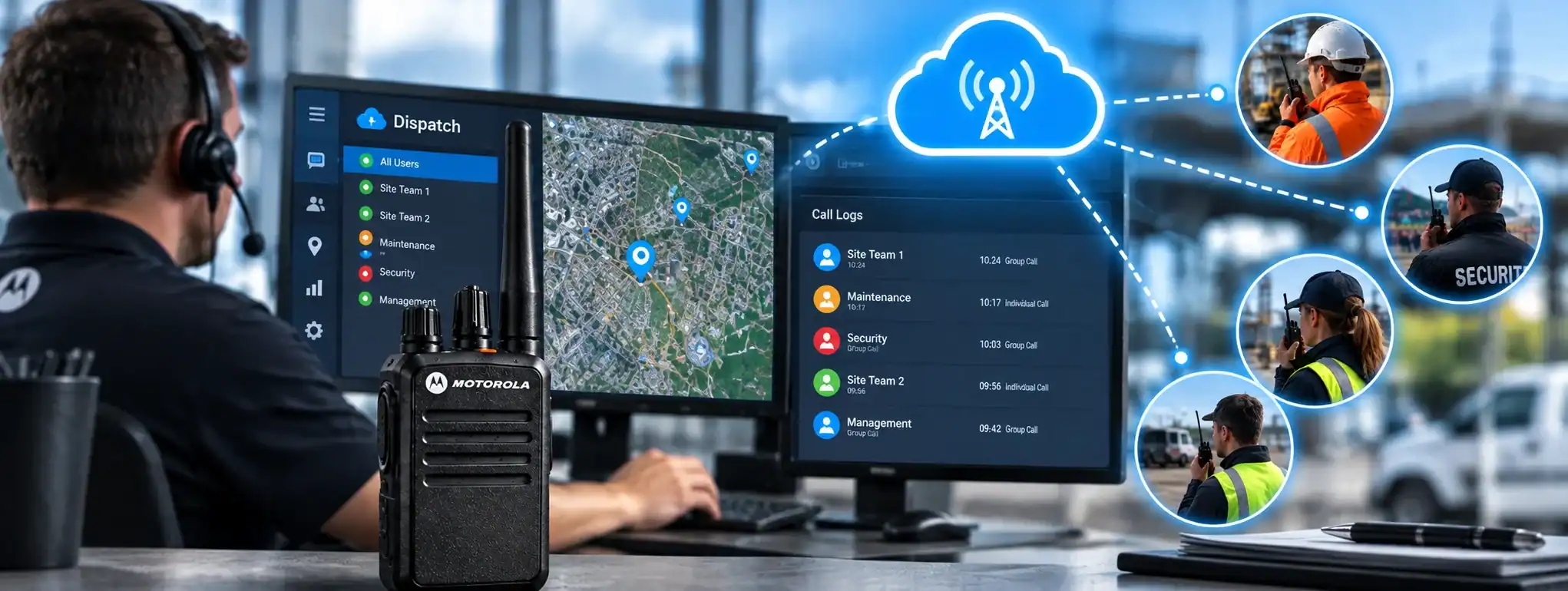
Cloud Dispatch is a radio dispatch system that uses cloud-based software and internet connectivity to manage and communicate with two-way radio users. Instead of relying entirely on a locally installed dispatch computer or server, the dispatch application and associated services are hosted in the cloud and accessed through an internet-connected computer, tablet or other compatible device.
Cloud Dispatch can provide a central point from which authorised users can communicate with, monitor and manage radio users across a professional communication system.
It is particularly useful for organisations with mobile teams, multiple sites or users who need to be managed from different locations.
How does Cloud Dispatch work?
A Cloud Dispatch system connects radio communications to a cloud-based dispatch platform.
A simplified arrangement is:
Radio users → radio networkA Network is a connected system of radios, equipment and infrastructure that allows users to communicate across a defined area. Radio networks can range from simple radio-to-radio systems to large multi-site networks. → internet → cloud dispatch platform → dispatcher
The dispatcher accesses the system through an authorised computer or other compatible device.
Depending on the system, the dispatcher may be able to make group calls, individual calls, monitor communication groups, send messages and access other radio-management functions.
The exact capabilities depend on the radio technology, network infrastructureRadio infrastructure is the equipment and supporting systems behind a professional two-way radio network, including repeaters, antennas, base stations, network connections, power systems and dispatch equipment. and cloud dispatch platform being used.
Cloud Dispatch vs traditional dispatch
Traditional radio dispatch systems may use a dedicated computer, server or console installed at a particular location.
Cloud Dispatch moves much of the dispatch functionality into a cloud-hosted environment.
This can provide greater flexibility because the dispatcher does not necessarily need to be physically located at the same site as the radio infrastructure.
For example, a company could manage communications for field teams from a central office while the radio users operate across multiple locations.
Cloud Dispatch and two-way radios
Cloud Dispatch can work with compatible professional two-way radio systems.
Depending on the platform, radio users may continue using conventional handheld or mobile radios while dispatchers use a computer-based interface.
This can provide a familiar radio experience for field workers while giving the control room additional management and communication capabilities.
The radio systemA Radio System is a complete communication solution comprising two-way radios and, where required, equipment such as repeaters, antennas, base stations, mobile radios and network infrastructure. must support the appropriate network or dispatch integration for this to work.
Cloud Dispatch and DMR
Cloud Dispatch can be integrated with compatible DMR (Digital Mobile RadioA Mobile Radio is a two-way radio designed to be installed in a vehicle. It normally uses the vehicle's power supply and an external antenna to provide reliable communication while travelling or working in the field.) systems.
A DMR system can provide individual radio identification, group communications and other digital information that can be used by a dispatch platform.
Depending on the implementation, a dispatcher may be able to select individual radios or talkgroups from a computer interface and communicate with them without physically operating a handheld radio.
The precise functionality varies between manufacturers and systems.
Cloud Dispatch and PoC
Cloud Dispatch is closely associated with Push-to-Talk over Cellular (PoC)Push-to-Talk over Cellular (PoC) provides radio-style push-to-talk communication over cellular or IP networks, allowing users to communicate across wide areas where suitable network connectivity is available. and other broadbandBroadband is a high-speed data connection used by systems such as PoC radio to carry voice, video and other communications over mobile networks, Wi-Fi or IP networks. communication systems.
PoC systems use mobile networks or Wi-FiWi-Fi is a wireless networking technology that connects compatible devices to a local or wider network. In radio systems, it can support programming, updates, data services and IP-based communications. rather than relying exclusively on traditional radio frequencies.
A cloud-based platform can manage users, groups and communications across these networks.
Some professional communication systems can also combine radio and broadband users, allowing different types of devices to participate in the same communication groups where supported.
Cloud Dispatch and control rooms
Cloud Dispatch can provide a central communication interface for a control room.
A dispatcher may be able to:
- Monitor communication groups
- Make individual calls
- Make group calls
- Receive incoming calls
- Send messages
- View radio or user status
- Manage communication groups
- Handle emergency communications
- Review communication activity
The exact functions depend on the platform and radio system.
Cloud Dispatch and multiple sites
One of the advantages of cloud-based dispatch is the ability to manage communications across geographically separated locations.
For example, an organisation operating several sites could use a central dispatch platform to communicate with teams at each location.
Where the underlying radio system supports network connectivity, users at different sites may be able to communicate through the same dispatch environment.
This can be particularly useful for organisations with regional or national operations.
Cloud Dispatch and remote working
Because the dispatch platform is cloud-based, authorised dispatchers may be able to access it from different locations, subject to the system’s security and connectivity requirements.
This can provide greater flexibility than a dispatch console that is permanently tied to one physical control room.
For example, an organisation may be able to maintain communications from a main control room while also providing authorised access to another operational location.
Reliable internet connectivity remains important because the dispatch interface depends on access to the cloud service.
Cloud Dispatch and internet connectivity
Cloud Dispatch relies on network connectivity between the dispatcher, cloud platform and radio communication system.
This may involve:
- Wired internet
- Wi-Fi
- Mobile broadband
- Private networks
- Other managed network connections
If connectivity is interrupted, some cloud-based dispatch functions may become unavailable or degraded.
Professional systems can incorporate suitable network resilience and backup arrangements where continuous communications are important.
Cloud Dispatch and radio coverage
Cloud Dispatch does not automatically increase the coverageRadio Coverage is the geographical area in which a two-way radio system can provide reliable communication. Coverage depends on the radios, antennas, frequency, terrain, buildings and system infrastructure. of a conventional radio system.
The coverage available to radio users still depends on the underlying radio infrastructure, which may include handheld radios, mobile radios, repeaters and networked radio sites.
However, cloud connectivity can allow communications to be managed across a much wider geographical area where the radio system is appropriately networked.
Cloud Dispatch and repeaters
Cloud Dispatch can be integrated with radio systems using repeaters and networked radio infrastructure.
A repeaterA Repeater receives a two-way radio transmission and retransmits it, usually from an elevated location, to extend the coverage and reliability of a radio communication system. extends the coverage of a radio system by receiving and retransmitting communications.
A network connection can then link radio infrastructure to a cloud dispatch platform, allowing authorised dispatchers to communicate with users through the wider system.
The exact architecture varies according to the radio technology and equipment.
Cloud Dispatch and GPS location
Some cloud dispatch platforms support GPS location or other location-management features.
Where compatible radios or communication devices include location capabilities, authorised users may be able to view the approximate position of devices through the dispatch interface.
This can help organisations coordinate mobile teams and understand where field resources are located.
Location functionality depends on the radio equipment, network and dispatch software.
Cloud Dispatch and messaging
Some Cloud Dispatch systems support text or data messaging in addition to voice communications.
Depending on the platform, dispatchers may be able to send messages to individual users or groups.
This can be useful when information needs to be communicated without opening a voice conversation.
Examples could include:
- Instructions
- Job information
- Location details
- Status requests
- Operational updates
Cloud Dispatch and emergency communications
Professional dispatch platforms can provide dedicated emergency communication functions.
An emergency transmissionTransmission is the process of sending voice, data or signalling from a radio using a radio-frequency signal to another radio, repeater or communication system. may be presented to the dispatcher with a visual or audible indication so that it receives immediate attention.
Depending on the system, the dispatcher may also be able to identify the radio or user generating the emergency alert and communicate directly with them.
Emergency functionality varies considerably between radio systems and should be designed around the organisation’s operational requirements.
Cloud Dispatch and call recording
Some Cloud Dispatch platforms can incorporate Call RecordingCall Recording is a two-way radio feature or system function that captures and stores radio communications for later playback, review, incident investigation or record keeping..
This can allow radio communications handled through the dispatch system to be recorded and stored for later review.
Depending on the system, recordings may include information such as:
- Date and time
- Radio or user identification
- Talkgroup
- ChannelA two-way radio channel is a programmed set of communication settings, typically including frequency and signalling, that allows compatible radios to communicate with one another.
- Dispatcher
- Recorded audio
Call recording is particularly useful in control-room, security and incident-management environments where communications may need to be reviewed afterwards.
Cloud Dispatch and user management
A cloud-based platform can provide centralised management of users and communication groups.
Administrators may be able to manage:
- User accounts
- Radio identities
- Communication groups
- Permissions
- Devices
- Dispatcher access
- System settings
Centralised management can make it easier to administer large numbers of users, particularly where an organisation operates across multiple sites.
The available administrative functions depend on the platform.
Cloud Dispatch security
Because Cloud Dispatch uses internet and cloud infrastructure, security is an important consideration.
Professional systems may use measures such as:
- User authentication
- Access controls
- Encrypted connections
- Role-based permissions
- Secure cloud infrastructure
- Activity logging
The specific security measures depend on the service provider and system design.
Organisations should ensure that access to the dispatch platform is restricted to authorised personnel.
Cloud Dispatch resilience
For organisations that rely on radio communications for critical operations, system resilience is important.
A Cloud Dispatch system may depend on several components, including:
Radio → radio infrastructure → network connection → cloud service → dispatcher
A failure at any point can affect the overall communication path.
Professional deployments may therefore use resilient network connections, backup infrastructure or alternative communication methods where required.
Cloud Dispatch for businesses
Cloud Dispatch can be useful for businesses that need to manage mobile or geographically distributed teams.
Potential applications include:
- Security
- Transport
- Logistics
- Facilities management
- Construction
- Utilities
- Events
- Hospitality
- Manufacturing
The main benefit is the ability to combine radio communications with centralised, software-based management.
Cloud Dispatch and radio hire
Cloud-based dispatch can also form part of a temporary communication system.
For example, a large event could use professional radios for security and operations teams while providing a control room with a cloud-based dispatch interface.
This can give event organisers a central point for managing communications without requiring every dispatcher to use a handheld radio.
The availability of Cloud Dispatch as part of a hire system depends on the radio equipment and dispatch platform being used.
Cloud Dispatch vs a radio app
A Cloud Dispatch platform is not necessarily the same as a smartphone push-to-talk application.
A radio app may allow an individual user to communicate using a smartphone.
Cloud Dispatch is primarily concerned with centralised communication management and dispatch, although some platforms can also support smartphones, tablets and other broadband devices.
Some systems can combine both approaches so that radios, smartphones and other compatible devices operate within the same communication environment.
Cloud Dispatch and DCS
DCS can provide professional communication solutions that incorporate dispatch functionality where required.
Cloud-based dispatch can be particularly useful for organisations that need centralised management of radio users, multiple communication groups, geographically separated sites or mobile teams.
The appropriate solution depends on the radio technology, coverage requirements, number of users and level of dispatch functionality required.