
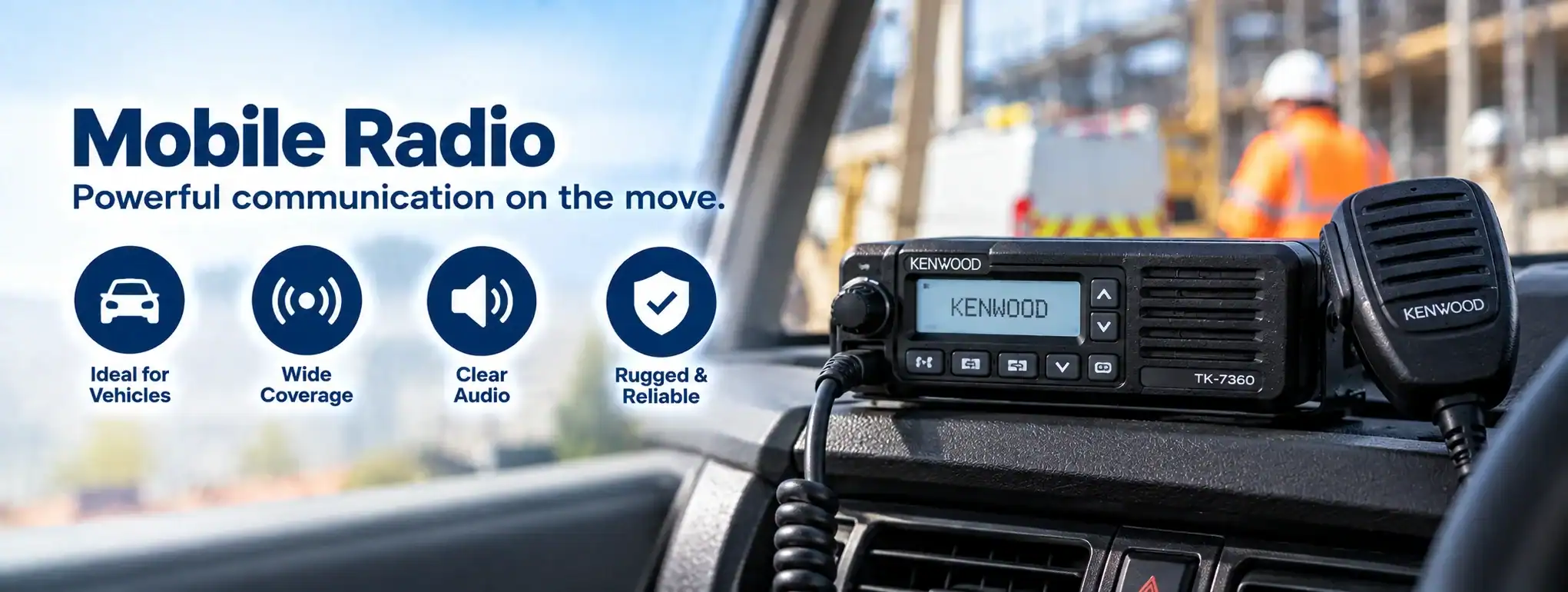
Mobile Radio
A Mobile Radio is a two-way radio designed to be installed in and operated from a vehicle. Unlike a handheld radio, a mobile radio is normally powered by the vehicle’s electrical system and uses an external antennaAn antenna transmits and receives radio-frequency signals, allowing a two-way radio to communicate. Antenna type, frequency, height and location can all affect radio performance and coverage. to provide reliable communication while travelling or working in the field.
Mobile radios are widely used by businesses and organisations that need communication between drivers, vehicles, control rooms and other radio users.
What is a mobile radio?
A mobile radio is a fixed radio unit installed in a vehicle.
It typically consists of:
- Radio transceiverA Transceiver combines a transmitter and receiver in one device, allowing a two-way radio to both send and receive radio signals.
- Control head or front panel
- Microphone
- External antenna
- Vehicle powerAn antenna transmits and receives radio-frequency signals, allowing a two-way radio to communicate. Antenna type, frequency, height and location can all affect radio performance and coverage. connection
- Mounting equipment
The radio can communicate with other handheld, mobile or base-station radios operating on the same compatible radio systemA Radio System is a complete communication solution comprising two-way radios and, where required, equipment such as repeaters, antennas, base stations, mobile radios and network infrastructure..
Mobile radio vs handheld radio
The main difference is how the radio is used.
Mobile radio:
- Installed in a vehicle
- Usually powered by the vehicle
- Uses an external antenna
- Designed for vehicle-based communication
- Can provide greater effective range than a handheld radio in some situations
Handheld radio:
- Portable
- Battery powered
- Uses an integrated antenna
- Designed to be carried by the user
Both can form part of the same professional radio system.
Mobile radio antenna
The external antenna is an important part of a mobile radio installation.
A vehicle-mounted antenna can provide advantages over the small antenna used by a handheld radio.
Performance depends on:
- Antenna type
- Antenna position
- Vehicle design
- Radio frequencyAn antenna transmits and receives radio-frequency signals, allowing a two-way radio to communicate. Antenna type, frequency, height and location can all affect radio performance and coverage.
- Installation quality
- Surrounding environment
The antenna should be installed correctly for the radio system being used.
Mobile radio range
A mobile radio can provide useful communication over a larger area than a handheld radio in some applications.
The actual range depends on:
- Transmitter power
- Antenna position
- Antenna efficiency
- Terrain
- BuildingsAn antenna transmits and receives radio-frequency signals, allowing a two-way radio to communicate. Antenna type, frequency, height and location can all affect radio performance and coverage.
- Radio frequencyFrequency is the number of cycles a radio wave completes each second, measured in Hertz. In two-way radio, frequency determines where a transmission operates within the radio spectrum.
- RepeaterA Repeater receives a two-way radio transmission and retransmits it, usually from an elevated location, to extend the coverage and reliability of a radio communication system. coverageRadio Coverage is the geographical area in which a two-way radio system can provide reliable communication. Coverage depends on the radios, antennas, frequency, terrain, buildings and system infrastructure.
- NetworkA Network is a connected system of radios, equipment and infrastructure that allows users to communicate across a defined area. Radio networks can range from simple radio-to-radio systems to large multi-site networks. infrastructureRadio infrastructure is the equipment and supporting systems behind a professional two-way radio network, including repeaters, antennas, base stations, network connections, power systems and dispatch equipment.
A mobile radio should not be selected based solely on a manufacturer’s quoted range.
Mobile radio power
Mobile radios are normally connected to the vehicle’s electrical system rather than relying on a rechargeable handheld battery.
This allows the radio to operate for extended periods without requiring a separate battery change.
The vehicle’s electrical system and the radio installation must be suitable for the equipment.
Mobile radio installation
A professional mobile radio installation can include:
Radio → Microphone → Vehicle Wiring → External Antenna
The radio is normally mounted in a suitable position where the driver can operate it safely.
The installation should avoid interfering with vehicle controls, airbags or other safety equipment.
Mobile radio microphone
A mobile radio normally uses a wired microphone connected to the radio or control head.
The microphone allows the driver or operator to use Push-to-Talk (PTT)Push-to-Talk (PTT) is the button or control used to activate a two-way radio's transmitter. Press it to speak and release it to listen. communication while remaining in the vehicle.
Some systems may also support remote or wireless accessories.
Mobile radio Push-to-Talk
The microphone normally incorporates a Push-to-Talk button.
The user presses PTT to transmit and releases it to receive.
This provides immediate voice communication without requiring a telephone-style connection.
Mobile radio and hands-free operation
Some mobile radio systems can support Hands-Free OperationHands-Free Operation allows two-way radio users to communicate without holding the radio or continuously pressing its PTT button, using features such as VOX, headsets or remote PTT controls. or external control arrangements.
This can be useful where drivers need to communicate while keeping their hands focused on driving.
Radio operation in vehicles should always comply with applicable road-safety requirements and the organisation’s operating procedures.
Mobile radio and vehicle communication
Mobile radios are particularly useful when vehicles form part of an operational team.
For example:
Vehicle → Radio Network → Control Room
This can allow drivers to communicate directly with dispatchers or other members of the organisation.
Mobile radio and handheld radios
Mobile and handheld radios can operate together when they are part of the same compatible radio system.
For example:
Vehicle Mobile Radio ↔ Repeater ↔ Handheld Radios
This can allow vehicle-based workers and personnel on foot to communicate as part of one operational network.
Mobile radio and base stations
A mobile radio can sometimes provide similar functionality to a fixed radio unit when installed in a control room or other permanent location, depending on the equipment.
A dedicated Base StationA base station is a fixed two-way radio installed at a permanent location, allowing an operator to communicate with handheld or mobile radios across a site or operating area. installation may be preferable where continuous fixed-site operation is required.
Mobile radio and repeaters
A Repeater can extend the communication range of mobile radios.
For example:
Mobile Radio → Repeater → Handheld Radio
This can provide coverage across larger areas than direct vehicle-to-radio communication.
Mobile radio and licensed radio
Mobile radios are commonly used as part of professional Licensed RadioA Licensed Radio is a two-way radio operated under an appropriate radio licence. Licensed systems can provide greater control over frequencies, coverage and infrastructure than licence-free radio services such as PMR446. systems.
A licensed system can provide:
- Greater coverage
- Controlled frequency use
- Repeaters
- Group communication
- Emergency functions
- GPS
- Dispatch
- Multi-site communication
The radio must operate within the conditions of the applicable licence.
Mobile radio and licence-free radio
Mobile radio equipment should not be confused with licence-free PMR446 equipment.
PMR446 is subject to specific equipment and technical restrictions.
A vehicle-mounted professional radio operating on licensed frequencies will normally require the appropriate radio authorisation.
Mobile radio and DMR
DMR (Digital Mobile Radio) mobile radios can provide professional digital communication from vehicles.
Depending on the equipment, features can include:
- Group calls
- Individual calls
- Emergency alerts
- GPS
- Data communication
- EncryptionEncryption protects two-way radio communications by converting voice or data into a secure form that can only be understood by authorised radios with the correct encryption capability and keys.
- Text messaging
The available functions depend on the radio and system configuration.
Mobile radio and analogue radio
Mobile radios are available for analogue radioAnalogue radio uses continuously varying radio signals to transmit voice communication. It remains widely used for reliable two-way communication across business, industry, events, security and other applications. systems as well as digital systems.
Analogue mobile radio can provide straightforward voice communication where advanced digital features are not required.
Mobile radio and digital radio
Digital mobile radios convert voice into digital information before transmissionTransmission is the process of sending voice, data or signalling from a radio using a radio-frequency signal to another radio, repeater or communication system..
This can allow additional functionality such as emergency signalling, GPS and data services.
The exact features depend on the digital radio technology being used.
Mobile radio and GPS
A compatible mobile radio can incorporate GPS (Global Positioning System)GPS is a satellite-based positioning system that allows compatible two-way radios to determine their location. GPS data can support tracking, dispatch, fleet management and Geo-Fencing..
GPS information can potentially be transmitted to a dispatch or fleet-management platform.
This can allow an organisation to monitor the approximate location of vehicles equipped with mobile radios.
Mobile radio and fleet management
Mobile radios can form part of a Fleet ManagementFleet Management is the process of managing a two-way radio fleet, including equipment, users, programming, maintenance, firmware, security and radio system configuration. system.
For example:
Vehicle → GPS → Radio Network → Fleet Management Platform
This can provide operational information about vehicle locations and communication.
The exact capabilities depend on the radio and software platform.
Mobile radio and job tracking
A mobile radio can be integrated with Job TrackingJob Tracking is the process of monitoring the progress, status and, where supported, location of a job or field worker from assignment through to completion, often using GPS, radio and dispatch systems. systems where supported.
This can help organisations coordinate vehicles and mobile workers with assigned tasks.
For example:
Job Assigned → Vehicle Dispatched → Radio Communication → Job Completed
Mobile radio and dispatch
A Dispatch system can allow a control room to communicate with vehicle-mounted radios.
A dispatcher may be able to:
- Call individual vehicles
- Contact groups
- View vehicle locations
- Send instructions
- Receive emergency alerts
- Coordinate field teams
Mobile radio and Cloud Dispatch
Some modern radio systems can connect mobile radios to Cloud DispatchCloud Dispatch is a cloud-based radio management and communication system that allows authorised dispatchers to communicate with, monitor and manage two-way radio users through an internet-connected platform. platforms.
This can provide remote access to communications and location information where the appropriate network infrastructure is available.
Performance can depend on the underlying cellular or IP connection.
Mobile radio and emergency functions
Professional mobile radios can provide emergency communication features.
Depending on the radio system, these may include:
- Emergency ButtonAn Emergency Button is a dedicated two-way radio control that allows users to quickly send an emergency alert to a dispatcher, control room or authorised radio users.
- Emergency AlarmAn Emergency Alarm allows a two-way radio user to quickly alert a dispatcher, control room or other authorised users that assistance may be required.
- Emergency CallAn Emergency Call is a priority two-way radio function that allows a user to quickly request assistance and, on supported systems, establish an urgent voice communication with a dispatcher or control room.
- Priority communications
- GPS location
- Lone WorkerA Lone Worker is someone who works without direct supervision or immediate assistance nearby. Compatible two-way radios can provide safety features such as timed check-ins, emergency alerts and GPS location. functions where supported
The exact features vary between radio models.
Mobile radio and Lone Worker
A vehicle operator working alone may use a radio system that includes Lone Worker functionality.
This can provide timed prompts or other monitoring features where supported.
Mobile radio safety features should form part of a wider lone-worker procedure.
Mobile radio and Man Down
Man DownMan Down is a safety feature on some professional two-way radios that can detect a possible fall or unusual radio position and automatically raise an alert if the user does not respond. is primarily associated with handheld radios where the radio’s orientation can be monitored.
Some vehicle-based radio systems may support other forms of emergency or operator-status monitoring, but Man Down should not be assumed to be available on every mobile radio.
Mobile radio and emergency button
A dedicated Emergency Button can provide a quick method of raising an alert.
Depending on the system, the emergency alert can be sent to:
- Control room
- Dispatcher
- Supervisor
- Radio group
The radio must have suitable network coverage for the alert to be transmitted.
Mobile radio and encryption
Professional digital mobile radios may support Encryption.
Encryption can help protect radio communications from unauthorised listening.
The available security features depend on the radio and communication system.
Mobile radio and call recording
Where connected to a compatible dispatch system, mobile radio communications may be recorded using Call RecordingCall Recording is a two-way radio feature or system function that captures and stores radio communications for later playback, review, incident investigation or record keeping..
This can provide a record of operational communications.
Recording capability depends on the radio infrastructure and software.
Mobile radio and channel scan
A mobile radio may support Channel ScanChannel Scan is a two-way radio feature that automatically monitors multiple programmed channels for activity, allowing users to hear communications without manually switching between channels., allowing it to monitor selected channels for activity.
This can be useful where vehicle operators need to monitor more than one operational group.
The available scanning functions depend on the radio.
Mobile radio and group calls
Mobile radios can participate in Call Groups or talkgroups.
This allows a vehicle operator to communicate with a defined team without contacting each person individually.
Mobile radio and individual calls
Compatible digital radio systems can allow an operator to make an individual call to another radio.
This can be useful when a dispatcher needs to communicate privately with a particular vehicle or driver.
Mobile radio and interoperability
Mobile radios can form part of an InteroperabilityInteroperability is the ability of different communication systems, devices or organisations to work together and exchange information. In two-way radio, it can connect different radio networks, technologies or users through compatible systems or gateways. solution where different communication technologies need to work together.
For example:
Mobile Radio → Gateway → Cellular / PoC → Other User
The required equipment depends on the systems being connected.
Mobile radio and hybrid communication
Hybrid CommunicationHybrid Communication combines two or more communication technologies, such as two-way radio, DMR, cellular, Wi-Fi or IP networks, allowing different systems or users to communicate through a common platform. can combine vehicle-mounted radio with cellular or other communication technologies.
This can provide additional communication options for vehicles operating across different areas.
Mobile radio and PoC
Push-to-Talk over Cellular (PoC)Push-to-Talk over Cellular (PoC) provides radio-style push-to-talk communication over cellular or IP networks, allowing users to communicate across wide areas where suitable network connectivity is available. can provide vehicle-based communication using cellular networks rather than traditional RF radio networks.
Some systems can integrate PoC users with professional radio users through suitable gateways or platforms.
Mobile radio and vehicle types
Mobile radios can be installed in many types of vehicles, including:
- Cars
- Vans
- Trucks
- Buses
- Coaches
- Utility vehicles
- Agricultural vehicles
- Emergency support vehicles
- Construction vehicles
- Plant and machinery
The installation requirements vary according to the vehicle.
Mobile radio for transport
Transport companies can use mobile radios to connect drivers with:
- Control rooms
- Depots
- Supervisors
- Other drivers
- Maintenance teams
This can provide immediate communication without relying solely on mobile phones.
Mobile radio for logistics
Logistics operations can use mobile radios to coordinate vehicles and warehouse teams.
A system can combine:
Vehicle Radios + Handheld Radios + Dispatch + GPS
This can provide communication across the operational network.
Mobile radio for construction
Construction vehicles and plant can use mobile radios to communicate with site teams.
This can be particularly useful on large sites where vehicles move across areas covered by a radio repeater.
Mobile radio for agriculture
Agricultural vehicles such as tractors and utility vehicles can be fitted with mobile radios.
This can allow communication between:
- Tractors
- Farm vehicles
- Base stations
- Handheld radios
- Other members of the farm team
Where farms cover large areas, a repeater can help improve coverage.
Mobile radio for utilities
Utility companies can use mobile radios in service vehicles to maintain communication with control rooms and field teams.
GPS and fleet-management integration can provide additional operational information.
Mobile radio for security
Security patrol vehicles can use mobile radios to communicate with security teams and control rooms.
A professional radio system can provide group communication, emergency functions and vehicle location where supported.
Mobile radio for events
Mobile radios can be used in event vehicles such as:
- Security vehicles
- Production vehicles
- Site vehicles
- Transport vehicles
- Medical support vehicles
They can operate alongside handheld radios used by staff on foot.
Mobile radio and radio hire
Mobile radios can be supplied as part of Radio HireRadio Hire is the temporary rental of two-way radios and related communication equipment for events, projects and operational requirements, providing professional communication without purchasing the equipment. arrangements for temporary projects and events.
Vehicle-mounted radios can be particularly useful where teams need communication while travelling around a large operational area.
The hire system can potentially include:
Mobile Radios + Handheld Radios + Repeater + Base Station
Mobile radio accessories
Common mobile radio accessories include:
- Microphones
- External speakers
- Antennas
- Antenna mounts
- Remote control heads
- Vehicle mounting brackets
- Power cables
- External GPS antennas
Accessories should be selected for the particular radio and vehicle.
Mobile radio maintenance
Mobile radios should be inspected and maintained as part of normal fleet equipment management.
Checks can include:
- Radio operation
- Microphone
- Antenna
- Mounting
- Power connection
- Cabling
- Controls
- Speaker
- Vehicle installation
The antenna and wiring should be checked particularly carefully because they are exposed to vehicle movement and environmental conditions.
Mobile radio and vehicle safety
Radio equipment should be installed so that it does not interfere with:
- Vehicle controls
- Driver visibility
- Airbags
- Safety systems
- Other electronic equipment
The installation should be carried out appropriately for the vehicle.
Mobile radio and battery
Unlike a handheld radio, a vehicle mobile radio normally receives its power from the vehicle.
This means the radio does not require the same type of rechargeable battery management as a portable handheld.
However, the vehicle’s electrical system must be capable of supporting the installation.
Mobile radio limitations
Mobile radios have some limitations.
These can include:
- Dependence on vehicle power
- Fixed installation
- Antenna installation requirements
- Limited portability
- Potential coverage dead spots
- Requirement for appropriate licensing where applicable
- Installation and maintenance requirements
The benefits of a mobile radio need to be considered against the operational requirements of the vehicle.
Choosing a mobile radio
When selecting a mobile radio, consider:
- Analogue or digital operation.
- Licensed or licence-free requirements.
- Required coverage.
- Frequency band.
- Transmit power.
- Antenna requirements.
- Vehicle type.
- GPS requirements.
- Emergency functions.
- Dispatch requirements.
- Encryption requirements.
- Group calling.
- Fleet-management integration.
- Required accessories.
- Future system expansion.
Mobile Radio and DCS
DCS can provide vehicle-mounted two-way radio solutions for businesses and organisations requiring reliable communication between vehicles, control rooms and field teams.
Mobile radios can be supplied as part of wider systems incorporating handheld radios, repeaters, base stations, GPS and dispatch where required.
The appropriate solution depends on the vehicle, operating environment, required coverage and communication requirements.