
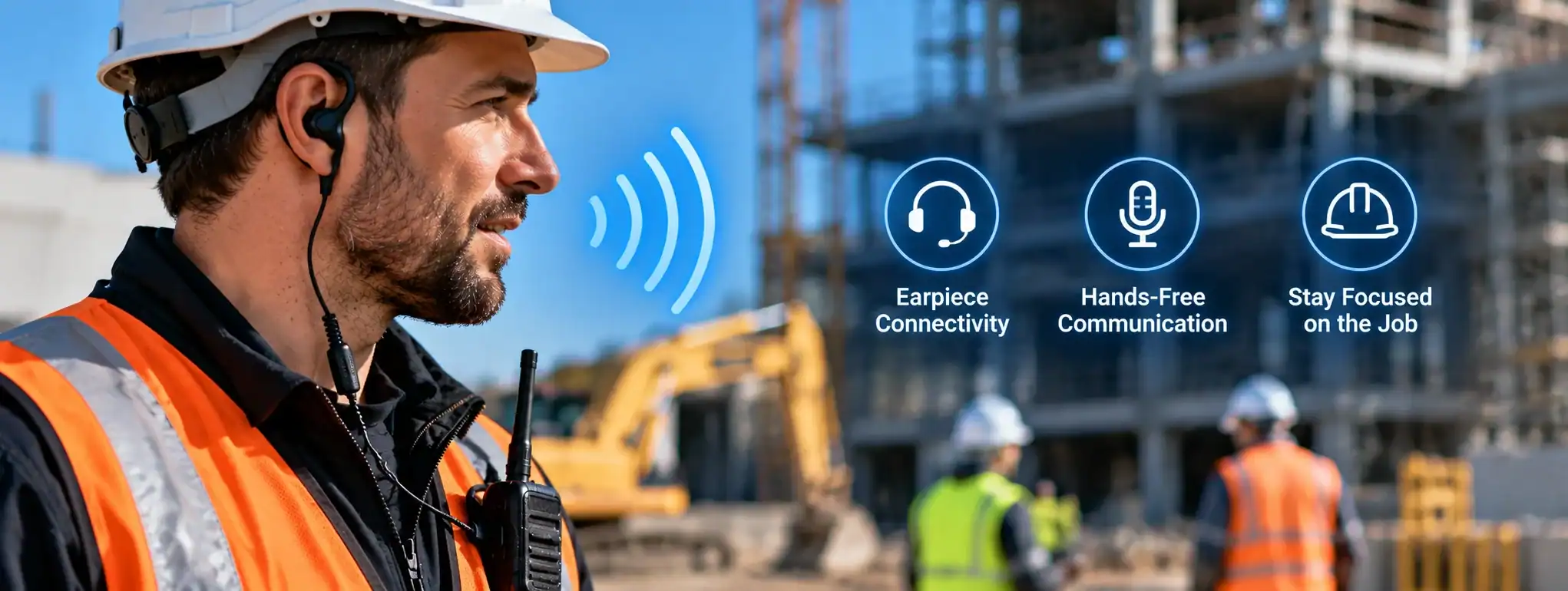
Hands-Free Operation
Hands-Free Operation is a feature that allows a two-way radio to be used without the user having to hold the radio or continuously press its Push-to-Talk (PTT)Push-to-Talk (PTT) is the button or control used to activate a two-way radio's transmitter. Press it to speak and release it to listen. button.
Depending on the radio and accessories being used, Hands-Free Operation can allow a user to transmit using a voice-activated function, a remote PTT button or another control method.
Hands-Free communication can be particularly useful when users need to keep both hands available for their primary task. Common applications include security, construction, manufacturing, hospitality, transport, warehousing and event operations.
How does Hands-Free Operation work?
Hands-Free Operation can be achieved in several different ways.
A radio may use Voice-Operated TransmissionTransmission is the process of sending voice, data or signalling from a radio using a radio-frequency signal to another radio, repeater or communication system. (VOX), where the radio detects the user’s voice and automatically begins transmitting.
Alternatively, a user may use a remote PTT control, such as a button mounted on clothing, a headsetA radio headset combines a microphone and speaker or earpiece, allowing two-way radio users to communicate conveniently while keeping the radio away from their face or using hands-free operation. or a vehicle control.
The exact method depends on the radio and accessory configuration.
Hands-Free Operation and VOX
VOX (Voice-Operated Transmission) is one of the most common ways to provide Hands-Free Operation.
With VOX enabled, the radio detects speech through its microphone and automatically switches into transmit mode.
The user does not need to press the radio’s PTT button.
When the user stops speaking, the radio returns to receive mode after the configured VOX delay.
Hands-Free Operation and PTT
Hands-Free Operation does not necessarily mean that the radio operates without any form of PTT.
A remote PTT button can allow the user to keep the radio and their hands in a convenient position while still controlling when the radio transmits.
For example, a security officer wearing an earpieceAn earpiece is a two-way radio audio accessory that lets users hear radio communications discreetly, often with a microphone and Push-to-Talk button for transmitting. can use a small remote PTT button attached to their clothing.
This provides hands-free use of the radio itself while retaining deliberate control over transmissions.
Hands-Free Operation and remote PTT
A Remote PTT is an external Push-to-Talk control connected to the radio or an audio accessoryAn audio accessory is an external device such as a speaker microphone, earpiece or headset that connects to a two-way radio to improve or adapt how users send and receive audio..
It can be positioned where it is easier for the user to operate.
Examples include:
- Shoulder-mounted PTT
- Lapel-mounted PTT
- Cable-mounted PTT
- Finger PTT
- Steering-wheel PTT
- Vehicle-mounted PTT
Remote PTT can be preferable to VOX where accidental transmissions need to be avoided.
Hands-Free Operation and headsets
A compatible Headset can provide Hands-Free Operation by placing the microphone close to the user’s mouth and the speaker or earpiece close to their ear.
A headset can be combined with either VOX or a remote PTT control.
This allows the user to communicate without repeatedly reaching for the radio.
Hands-Free Operation and earpieces
An Earpiece allows the user to hear radio communications without holding the radio close to their head.
When combined with a remote PTT or VOX, it can provide a convenient hands-free communication arrangement.
This is particularly useful for users who need to remain mobile while communicating.
Hands-Free Operation and Bluetooth
Some professional radios support Bluetooth®Bluetooth® is a short-range wireless technology used with compatible two-way radios to connect accessories such as headsets, earpieces and microphones without a physical cable. audio accessories.
A compatible Bluetooth headset can provide wireless audio and, where supported, remote control of radio communications.
Bluetooth functionality varies between radio manufacturers and models, so compatibility should be confirmed before selecting an accessory.
Hands-Free Operation and audio accessories
Hands-Free Operation can be provided using a range of Audio Accessories.
These can include:
- Earpieces
- Headsets
- Speaker microphones
- Remote PTTs
- Bluetooth headsets
- Throat microphones
- Heavy-duty headsets
The appropriate accessory depends on the user’s environment and communication requirements.
Hands-Free Operation and VOX sensitivity
VOX systems normally include sensitivity settings.
The sensitivity determines how easily the radio responds to sound.
If the sensitivity is too high, background noise may cause the radio to transmit unintentionally.
If it is too low, the radio may fail to detect quieter speech.
Correct configuration is therefore important for reliable Hands-Free Operation.
Hands-Free Operation and background noise
Background noise can affect VOX performance.
Examples include:
- Machinery
- Traffic
- Crowds
- Wind
- Engines
- Construction equipment
- Music
In noisy environments, a remote PTT may provide more reliable control than voice activation.
Noise suppression and microphone design can also affect performance.
Hands-Free Operation and audio gain
Audio GainAudio gain controls the level of an audio signal within a two-way radio system. Correct gain helps provide clear speech while avoiding excessive background noise, clipping or distortion. controls the level of an audio signal within the radio or accessory.
Correct gain levels can help ensure that speech is picked up clearly by the microphone without excessive distortion or unwanted noise.
Audio gain and VOX sensitivity are related to the overall audio performance of a hands-free system but perform different functions.
Hands-Free Operation and digital noise suppression
Digital Noise SuppressionDigital Noise Suppression uses digital audio processing in a two-way radio to reduce unwanted background noise and improve speech clarity, particularly in noisy working environments. can help reduce unwanted background noise picked up by a radio microphone.
This can improve speech intelligibility when Hands-Free Operation is used in noisy environments.
However, noise suppression cannot eliminate all background noise and should not be considered a replacement for a suitable headset or microphone.
Hands-Free Operation in noisy environments
For users working around loud machinery or vehicles, a specialist headset may provide better results than standard VOX.
Heavy-duty headsets can provide hearing protection, clear audio and controlled transmission.
The appropriate equipment depends on the noise level and working environment.
Hands-Free Operation in security
Security personnel often need to communicate while keeping their hands available.
A typical arrangement may consist of:
Two-way radio + earpiece + remote PTT
The radio can remain secured on the user’s belt or vest while the earpiece and PTT remain accessible.
For covert or discreet communications, specialist earpieces can be used where appropriate.
Hands-Free Operation in events
Event staff may need to communicate while managing crowds, checking tickets, moving equipment or carrying out other tasks.
Hands-Free Operation can make radio communication more convenient in these circumstances.
Headsets and remote PTT accessories can be particularly useful for staff working in busy environments.
Hands-Free Operation in construction
Construction workers frequently need both hands for tools, equipment or other tasks.
A hands-free radio arrangement can allow workers to communicate without stopping their work to pick up the radio.
Heavy-duty headsets and remote PTT controls can be useful in noisy construction environments.
Hands-Free Operation in transport
Drivers can benefit from hands-free radio accessories because they may need to keep their hands focused on vehicle controls.
Vehicle-mounted radios can also incorporate external microphones or PTT controls designed for the vehicle environment.
Any use while driving should comply with applicable road-safety requirements and the operator’s procedures.
Hands-Free Operation in warehouses
Warehouse staff may need to communicate while moving stock, operating equipment or handling packages.
A headset, earpiece or remote PTT can allow convenient radio communication without repeatedly handling a handheld radio.
Hands-Free Operation in manufacturing
Manufacturing environments can be noisy and may require workers to operate machinery or handle materials.
Specialist headsets and remote controls can allow radio users to communicate while keeping their hands available for their primary duties.
Hands-Free Operation and radio placement
A hands-free arrangement allows the radio to remain attached to a belt, harness, vest or other suitable location.
This can reduce the need for the user to repeatedly remove the radio from its carrying position.
The radio still needs to remain within suitable operating range of the accessory.
Hands-Free Operation and body-worn equipment
Hands-Free Operation can be integrated with other Body-Worn equipment.
For example, a security officer may wearAn antenna transmits and receives radio-frequency signals, allowing a two-way radio to communicate. Antenna type, frequency, height and location can all affect radio performance and coverage.:
- Radio
- Earpiece
- Remote PTT
- Body-worn cameraA body-worn camera is a compact camera worn on clothing or equipment to record video and audio, commonly used for security, evidence gathering and incident recording
The equipment should be selected and positioned so that the devices do not interfere with each other.
Hands-Free Operation and Body-Worn Cameras
Some users operate both a two-way radio and a Body-Worn Camera.
Where the equipment is designed to work together, the radio’s hands-free accessories can allow the user to communicate without removing the camera or radio from its normal position.
Compatibility between specific devices should always be confirmed.
Hands-Free Operation and emergency communications
Emergency communication remains available when using suitable hands-free accessories, but the emergency method depends on the radio.
For example, a radio may have a dedicated Emergency ButtonAn Emergency Button is a dedicated two-way radio control that allows users to quickly send an emergency alert to a dispatcher, control room or authorised radio users. that must still be physically activated.
VOX should not normally be relied upon as the sole method of initiating an emergency transmission.
Hands-Free Operation and emergency buttons
A radio’s Emergency Button is normally designed to provide a deliberate way of initiating an emergency function.
Although the radio may otherwise be configured for Hands-Free Operation, the emergency control may still require physical activation.
The exact behaviour depends on the equipment.
Hands-Free Operation and encryption
Hands-Free Operation can be used with encrypted radio communications where the radio supports both functions.
Hands-Free Operation controls how the radio is operated, while EncryptionEncryption protects two-way radio communications by converting voice or data into a secure form that can only be understood by authorised radios with the correct encryption capability and keys. protects the content of the communication.
They are separate features.
Hands-Free Operation and analogue radio
Hands-Free Operation can be available on both analogue and digital radios where the equipment supports VOX or compatible accessories.
The communication technology itself does not automatically determine whether Hands-Free Operation is available.
Hands-Free Operation and DMR
Professional DMR (Digital Mobile RadioA Mobile Radio is a two-way radio designed to be installed in a vehicle. It normally uses the vehicle's power supply and an external antenna to provide reliable communication while travelling or working in the field.) equipment can support Hands-Free Operation through VOX, compatible audio accessories or remote PTT controls where the specific radio provides these features.
The exact functionality varies between manufacturers and models.
Hands-Free Operation and radio hire
Hands-Free Operation can be included in temporary Event Radio HireEvent Radio Hire provides temporary professional two-way radios and communication equipment for events, helping organisers, security, production and other teams stay connected. systems where suitable radios and accessories are supplied.
For example, event staff may use earpieces and remote PTTs to communicate while keeping their hands available.
Accessory selection is particularly important for large events because the equipment needs to be suitable for the working environment.
Hands-Free Operation limitations
Hands-Free Operation is not suitable for every situation.
VOX can be affected by:
- Background noise
- Wind
- Machinery
- Crowds
- Nearby conversations
- Microphone position
- Incorrect sensitivity settings
A remote PTT or dedicated headset may therefore be more appropriate for demanding environments.
VOX vs remote PTT
The two main approaches can be summarised as:
VOX
- No button required to transmit
- Convenient
- Useful when both hands are occupied
- Can be triggered by unwanted noise
Remote PTT
- User deliberately controls transmission
- Less likely to transmit accidentally
- Requires access to a button
- Useful in noisy environments
The best option depends on the user’s working conditions.
Hands-Free Operation and battery life
Using additional wireless or electronic accessories can affect battery consumption.
VOX itself may also result in more frequent transmissions if the radio responds to background sounds.
Battery requirements should therefore be considered when designing a hands-free radio systemA Radio System is a complete communication solution comprising two-way radios and, where required, equipment such as repeaters, antennas, base stations, mobile radios and network infrastructure. for long shifts.
Hands-Free Operation and radio licensing
Hands-Free Operation does not change the radio’s licensing requirements.
The radio must still operate under the appropriate licence or licence-exempt arrangement for the frequencies and service being used.
Hands-Free Operation and system design
When specifying Hands-Free Operation, organisations should consider:
- Working environment
- Noise levels
- VOX requirements
- Remote PTT requirements
- Headset type
- Earpiece type
- Bluetooth compatibility
- Battery requirements
- Radio placement
- Emergency functions
- User comfort
- Durability
The accessory should be selected around the user’s actual working conditions rather than simply choosing the smallest or most convenient option.
Hands-Free Operation and DCS
DCS can supply professional two-way radios and compatible audio accessories for users who need Hands-Free Operation.
Depending on the application, this may include earpieces, headsets, remote PTT controls and other specialist accessories.
The correct solution depends on the radio model, working environment and communication requirements.