
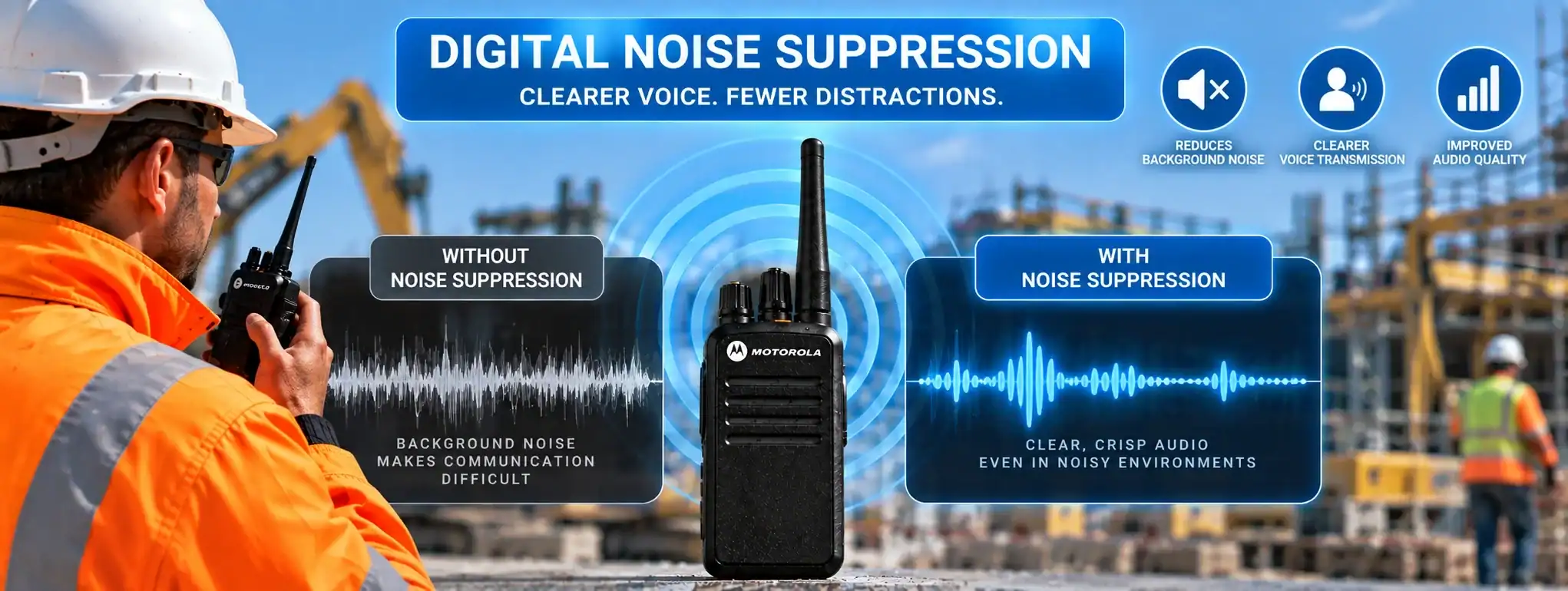
Digital Noise Suppression
Digital Noise Suppression is a feature used in two-way radios to reduce unwanted background noise and improve the clarity of received or transmitted audio. It uses digital signal processing to identify and reduce unwanted sounds, helping users understand speech more clearly in noisy working environments.
Digital Noise Suppression can be particularly useful where radios are used around machinery, vehicles, construction equipment, crowds, generators or other sources of continuous background noise.
The exact technology and terminology used varies between radio manufacturers and models.
How does Digital Noise Suppression work?
Digital Noise Suppression uses Digital Signal Processing (DSP) to analyse an audio signal and distinguish speech from unwanted background sounds.
A simplified process is:
Radio microphone → digital audio processing → noise reduction → transmitted audio
On the receiving radio, similar processing may also be used to improve the intelligibility of incoming speech.
The algorithms used vary between manufacturers and may be designed to recognise particular characteristics of human speech and environmental noise.
Digital Noise Suppression and two-way radios
Professional two-way radios are often used in environments where background noise can make voice communications difficult.
Digital Noise Suppression can help reduce the effect of unwanted sounds so that the user’s voice is easier to hear.
It can be particularly valuable in environments such as:
- Construction sites
- Factories
- Warehouses
- Airports
- Transport operations
- Events
- Security operations
- Manufacturing facilities
- Agriculture
- Utilities
Digital Noise Suppression vs analogue noise reduction
Traditional analogue radios can use techniques such as squelchAnalogue radio uses continuously varying radio signals to transmit voice communication. It remains widely used for reliable two-way communication across business, industry, events, security and other applications. to prevent the user from hearing background hiss when no transmissionTransmission is the process of sending voice, data or signalling from a radio using a radio-frequency signal to another radio, repeater or communication system. is present.
Squelch and Digital Noise Suppression perform different functions.
Squelch primarily controls whether the radio’s speaker opens when a signal is detected.
Digital Noise Suppression processes the audio itself to reduce unwanted background sounds.
A radio can therefore use both technologies at the same time.
Digital Noise Suppression and Digital Signal Processing
Digital Noise Suppression relies on Digital Signal Processing (DSP).
DSP allows the radio to analyse and modify audio electronically.
The processor can identify characteristics of the audio signal and apply algorithms designed to reduce unwanted noise while retaining speech.
Modern professional radios can perform this processing rapidly enough that the user experiences it as part of normal voice communication.
Digital Noise Suppression and microphone audio
Noise suppression can be particularly important at the transmitting end of a radio communication.
The microphone picks up both the user’s voice and surrounding sounds.
For example:
User’s voice + machinery noise + vehicle noise + wind
Digital audio processing can reduce some of the unwanted background sounds before the voice is transmitted.
This can make the resulting transmission easier for other radio users to understand.
Digital Noise Suppression and receiving audio
Some radios also apply digital audio processing to received communications.
The radio can process the incoming audio before it reaches the speaker, helping improve speech intelligibility in noisy environments.
The exact implementation varies between radio models.
Some systems may provide separate transmit and receive noise-reduction functions, while others apply processing automatically.
Digital Noise Suppression in noisy environments
Noise suppression is particularly useful where users cannot control the surrounding noise.
For example, a construction worker may need to communicate while operating close to:
- Excavators
- Cranes
- Compressors
- Generators
- PowerAn antenna transmits and receives radio-frequency signals, allowing a two-way radio to communicate. Antenna type, frequency, height and location can all affect radio performance and coverage. tools
- Heavy vehicles
Similarly, warehouse and manufacturing workers may operate close to machinery that produces continuous background noise.
Reducing unwanted noise can make radio conversations easier to understand without requiring users to move to a quieter location.
Digital Noise Suppression and wind noise
Wind can create significant unwanted noise when using a radio outdoors or around moving vehicles.
Depending on the radio and its microphone design, digital audio processing can help reduce some wind-related noise.
However, noise suppression cannot necessarily remove all wind noise, particularly where the microphone is exposed to strong or rapidly changing airflow.
Microphone design, positioning and suitable audio accessories remain important.
Digital Noise Suppression and audio accessories
The effectiveness of noise suppression can depend on the microphone and audio accessoryAn audio accessory is an external device such as a speaker microphone, earpiece or headset that connects to a two-way radio to improve or adapt how users send and receive audio. being used.
Accessories such as:
- Remote speaker microphones
- Headsets
- Earpieces
- Noise-cancelling microphones
- Heavy-duty speaker microphones
can be selected for different working environments.
A suitable microphone can help prevent unwanted environmental noise from reaching the radio’s audio-processing system in the first place.
Digital Noise Suppression and speaker audio
Noise suppression should not be confused with simply increasing the radio’s speaker volume.
Increasing volume makes both speech and background noise louder.
Digital Noise Suppression attempts to reduce unwanted audio while maintaining speech intelligibility.
This can provide a more useful improvement than simply turning up the volume, particularly where background noise is significant.
Digital Noise Suppression and DMR
Digital Noise Suppression is commonly found on modern DMR (Digital Mobile RadioA Mobile Radio is a two-way radio designed to be installed in a vehicle. It normally uses the vehicle's power supply and an external antenna to provide reliable communication while travelling or working in the field.) equipment, although the precise implementation differs between manufacturers.
Because DMR already processes voice digitally, manufacturers can incorporate sophisticated digital audio processing into compatible radios.
This can help improve speech clarity in challenging environments.
Noise suppression is not, however, a defining requirement of the DMR standard itself. It is a feature that may be implemented by individual radio manufacturers.
Digital Noise Suppression and analogue radio
Digital Noise Suppression can also be incorporated into radios that support analogue communications.
The radio can digitally process the microphone audio even when the actual radio transmission is analogue.
This means that digital audio processing is not limited to digital radio transmission.
The availability and effectiveness of the feature depend on the specific radio model.
Digital Noise Suppression and voice clarity
The primary purpose of Digital Noise Suppression is to improve speech intelligibility.
Speech intelligibility describes how easily a listener can understand spoken words.
Reducing persistent background noise can make important instructions easier to understand, particularly when users are communicating in demanding environments.
This can be especially valuable when radio communications need to be short and immediately understood.
Digital Noise Suppression and full-duplex communication
Noise suppression can be useful in both conventional push-to-talk radio communications and systems that support more continuous or telephone-style communication.
The underlying audio-processing technology can be applied regardless of whether the communication is simplexSimplex is a method of two-way radio communication where radios transmit and receive on the same frequency, communicating directly without a repeater., duplexduplex, duplex radio, duplex communication, duplex frequencies, duplex operation, duplex spacing, frequency offset, repeater duplex, duplex repeater, full duplex, half duplex, radio repeater or part of a wider networkA Network is a connected system of radios, equipment and infrastructure that allows users to communicate across a defined area. Radio networks can range from simple radio-to-radio systems to large multi-site networks..
The exact implementation depends on the radio systemA Radio System is a complete communication solution comprising two-way radios and, where required, equipment such as repeaters, antennas, base stations, mobile radios and network infrastructure..
Digital Noise Suppression limitations
Noise suppression is not capable of removing every type of unwanted sound.
Very loud, sudden or complex sounds can be difficult to distinguish from speech.
For example, if machinery is operating at a similar frequencyAn antenna transmits and receives radio-frequency signals, allowing a two-way radio to communicate. Antenna type, frequency, height and location can all affect radio performance and coverage. range to the user’s voice, aggressive noise reduction may have difficulty separating the two.
In some circumstancesAn antenna transmits and receives radio-frequency signals, allowing a two-way radio to communicate. Antenna type, frequency, height and location can all affect radio performance and coverage., excessive audio processing can also affect the natural quality of speech.
The performance therefore depends on the radio’s processing technology and the environment in which it is used.
Digital Noise Suppression vs noise-cancelling headphones
Digital Noise Suppression within a two-way radio is different from active noise cancellationNoise Cancellation is technology used in two-way radios and communication equipment to reduce unwanted background noise and make speech easier to hear, particularly in noisy working environments. (ANC) used in some headphones.
Radio noise suppression generally focuses on improving the speech signal being transmitted or received.
Active noise cancellation uses microphones and generated sound to reduce the noise heard by the wearer.
Some professional radio headsets can incorporate their own noise-reduction or noise-cancellation technology in addition to the radio’s built-in audio processing.
Digital Noise Suppression and radio hire
Digital Noise Suppression can be particularly useful when hiring radios for noisy environments.
Construction projects, festivals, motorsport events, industrial sites and large logistics operations can all involve significant background noise.
When selecting hire radios, the working environment should be considered alongside radio coverageRadio Coverage is the geographical area in which a two-way radio system can provide reliable communication. Coverage depends on the radios, antennas, frequency, terrain, buildings and system infrastructure., battery capacity and required accessories.
In particularly noisy environments, a suitable headsetA radio headset combines a microphone and speaker or earpiece, allowing two-way radio users to communicate conveniently while keeping the radio away from their face or using hands-free operation. or remote speaker microphoneA Speaker Microphone is a two-way radio accessory combining a microphone, loudspeaker and usually a Push-to-Talk button, allowing convenient radio operation without handling the radio itself. may provide additional benefit.
Digital Noise Suppression and safety
Clear radio communications can be important where workers rely on radios for operational or safety-related instructions.
Noise suppression can help improve speech intelligibility, but it should not be treated as a replacement for proper system design, suitable audio accessories or appropriate working procedures.
For critical communications, the complete radio system should be tested in the environment where it will actually be used.
Digital Noise Suppression and radio testing
The effectiveness of noise suppression should ideally be assessed in the actual operating environment.
Testing can involve checking communication while radios are used around representative levels of:
- Machinery
- Traffic
- Wind
- Crowds
- Vehicles
- Industrial equipment
This helps determine whether the radio and selected audio accessories provide sufficient speech intelligibility for the application.
Digital Noise Suppression and DCS
DCS can recommend professional two-way radios with audio features designed for demanding working environments.
Where users operate around significant background noise, radio selection can take account of Digital Noise Suppression alongside microphone design, speaker performance, audio accessories and overall radio-system requirements.