
Audio Accessory
An audio accessory is an external device connected to a two-way radio to provide or improve the way a user sends or receives audio. Audio accessories can make radios easier to use, particularly in noisy, busy or specialist working environments.
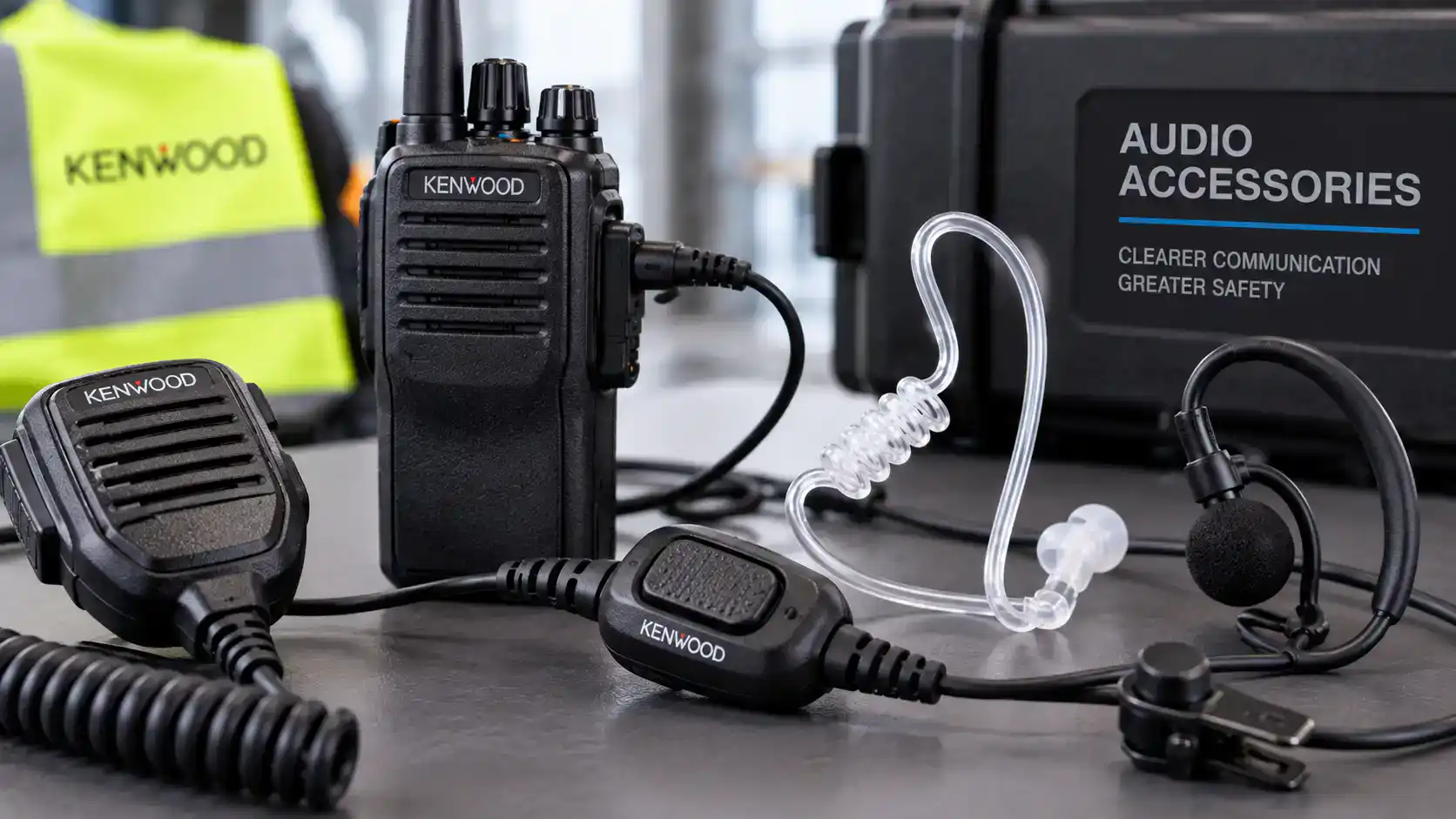
Common two-way radio audio accessories include remote speaker microphones, earpieces, headsets, surveillance kits and hands-free communication accessories.
An audio accessory normally connects to the radio through its accessory connectorAn accessory connector is the socket on a two-way radio used to connect external accessories such as speaker microphones, headsets, earpieces and programming equipment.. The type of connector and the electrical configuration vary between radio manufacturers and models, so an accessory must be compatible with the specific radio being used.
Why use an audio accessory?
A radio’s built-in microphone and speaker are suitable for many everyday applications. However, there are situations where an external audio accessory can make communication more practical.
For example, a worker may need to keep the radio attached to their belt while operating equipment. A remote speaker microphoneA Speaker Microphone is a two-way radio accessory combining a microphone, loudspeaker and usually a Push-to-Talk button, allowing convenient radio operation without handling the radio itself. allows them to transmit and listen without having to reach for the radio.
In a noisy environment, a suitable earpieceAn earpiece is a two-way radio audio accessory that lets users hear radio communications discreetly, often with a microphone and Push-to-Talk button for transmitting. or headsetA radio headset combines a microphone and speaker or earpiece, allowing two-way radio users to communicate conveniently while keeping the radio away from their face or using hands-free operation. can make incoming communications easier to hear. For users who require discreet communications, a suitable surveillance-style accessory can allow audio to be heard without using the radio’s main speaker.
Types of two-way radio audio accessories
There are several types of audio accessory available for professional two-way radios.
Remote speaker microphone
A remote speaker microphone (RSM)A Remote Speaker Microphone (RSM) is an external radio accessory combining a microphone, speaker and Push-to-Talk button, allowing users to operate a two-way radio without handling the radio itself. connects to the radio and provides a microphone, speaker and usually a push-to-talk button in a compact unit.
The radio can remain attached to a belt, harness or other position while the user operates the RSM closer to their mouth.
Remote speaker microphones are widely used in security, events, construction, hospitality, transport and other professional applications.
Earpiece
An earpiece allows the user to hear radio communications directly through an earpiece rather than the radio’s main speaker.
Earpieces are useful where communications need to be heard clearly without producing as much audible sound for people nearby.
Headset
A radio headset combines one or more speakers with a microphone and may incorporate a push-to-talk control.
Headsets can be particularly useful in noisy environments or where users need to keep both hands available for their work.
Specialist headsets may provide hearing protection as well as radio communication, depending on the equipment and application.
Surveillance and discreet audio accessories
Surveillance-style accessories are designed for situations where users need to communicate discreetly.
These systems can use a small earpiece and microphone, sometimes combined with a separate push-to-talk control.
They are commonly associated with security and close-protection applications, although their suitability depends on the specific working environment and radio systemA Radio System is a complete communication solution comprising two-way radios and, where required, equipment such as repeaters, antennas, base stations, mobile radios and network infrastructure..
Hands-free accessories
Some radio systems support accessories that allow users to communicate without repeatedly pressing a conventional push-to-talk button.
Depending on the radio and accessory, this can include voice-activated operation or other hands-free configurations.
Hands-free operationHands-Free Operation allows two-way radio users to communicate without holding the radio or continuously pressing its PTT button, using features such as VOX, headsets or remote PTT controls. should be selected carefully because the surrounding environment can affect how reliably voice activation works.
Audio accessory compatibility
Not every audio accessory is compatible with every two-way radio.
Manufacturers use different accessory connectorsAn antenna transmits and receives radio-frequency signals, allowing a two-way radio to communicate. Antenna type, frequency, height and location can all affect radio performance and coverage., wiring arrangements and electronic interfaces. Even radios made by the same manufacturer may use different connectors or accessory systems across different product ranges.
Compatibility can also depend on the radio’s programming and the functions supported by the accessory.
For this reason, the exact radio model should be checked before selecting an audio accessory.
Audio accessories and ATEX radios
Special consideration is required when audio accessories are being used with ATEX-certified radios.
An accessory suitable for an ordinary version of a radio may not be approved for the ATEX version.
In hazardous environments, only accessories that are specifically approved for the relevant radio and certification should be used. Using an unsuitable accessory could compromise the equipment’s certification and potentially introduce an ignition risk.
Audio accessories in noisy environments
Background noise can make radio communication difficult even when the radio signal itself is strong.
Factories, construction sites, airports, events and industrial locations can all produce high noise levels.
The right audio accessory can improve usability by placing the speaker closer to the user’s ear or providing a microphone and headset designed for the working environment.
However, an audio accessory does not increase the radio’s transmissionTransmission is the process of sending voice, data or signalling from a radio using a radio-frequency signal to another radio, repeater or communication system. range. It improves the way audio is captured or presented to the user.
Audio accessories and push-to-talk
Many radio audio accessories include a push-to-talk (PTT)Push-to-Talk (PTT) is the button or control used to activate a two-way radio's transmitter. Press it to speak and release it to listen. button.
The PTT allows the user to switch the radio from receiving to transmitting without handling the main radio unit.
The button may be located on a remote speaker microphone, headset control, surveillance accessory or another suitable position.
The exact operation depends on the radio and accessory combination.
Choosing an audio accessory
The right accessory depends on how and where the radio will be used.
Important considerations include:
- Radio make and model
- Accessory connector type
- Working environment
- Background noise levels
- Whether discreet communication is required
- Whether the user needs hands-free operation
- Whether hearing protection is required
- Whether the radio is ATEX-certified
- Whether the user needs a remote push-to-talk button
- Comfort and length of time the accessory will be worn
For temporary radio hireRadio Hire is the temporary rental of two-way radios and related communication equipment for events, projects and operational requirements, providing professional communication without purchasing the equipment., it is particularly important that accessories are selected to match the radios supplied for the hire period.
Maintaining audio accessories
Audio accessories are often exposed to more physical wearAn antenna transmits and receives radio-frequency signals, allowing a two-way radio to communicate. Antenna type, frequency, height and location can all affect radio performance and coverage. than the radio itself, particularly in demanding working environments.
Microphone cables, connectors, earpieces, PTT buttons and headset components should be checked regularly for damage or excessive wear.
Accessories used by multiple people, such as hired equipment, should also be cleaned and maintained appropriately between users.
Audio accessories and two-way radio hire
The correct audio accessory can make a significant difference to the practicality of hired two-way radios.
For example, event staff may require remote speaker microphones, security personnel may need discreet earpieces, while workers in noisy environments may benefit from suitable headsets.
DCS can advise on compatible audio accessories when supplying or hiring two-way radios, based on the radio model and the environment in which it will be used.
If you need radios for a short-term requirement, business radio hire can provide the equipment you need without a long-term investment.