
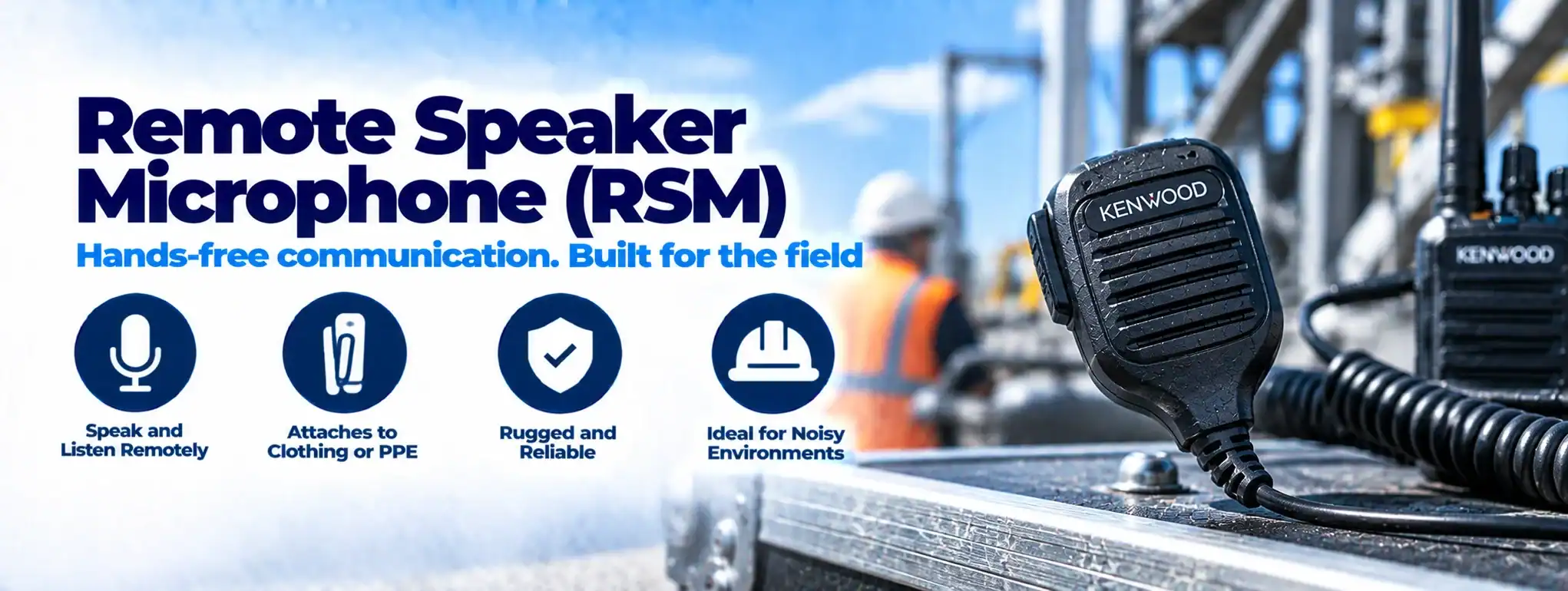
Remote Speaker Microphone (RSM)
A Remote Speaker MicrophoneA Speaker Microphone is a two-way radio accessory combining a microphone, loudspeaker and usually a Push-to-Talk button, allowing convenient radio operation without handling the radio itself. (RSM) is an external microphone and speaker accessory that connects to a two-way radio, allowing the user to transmit and receive communications without needing to operate the radio’s built-in microphone and speaker directly.
An RSM normally clips to clothing or equipment and places the microphone, speaker and Push-to-Talk (PTT)Push-to-Talk (PTT) is the button or control used to activate a two-way radio's transmitter. Press it to speak and release it to listen. control within easy reach.
RSMs are widely used in professional two-way radio applications, particularly by security, construction, event, transport, hospitality and emergency-response teams.
What is a Remote Speaker Microphone?
A Remote Speaker Microphone combines several radio controls into a compact accessory.
A typical RSM includes:
- Microphone
- Speaker
- Push-to-Talk button
- Radio connection
- Clothing or equipment clip
Some models can also provide additional controls or connections for an earpieceAn earpiece is a two-way radio audio accessory that lets users hear radio communications discreetly, often with a microphone and Push-to-Talk button for transmitting..
The radio can remain attached to a belt, harness or other equipment while the user operates the RSM.
How does an RSM work?
The RSM connects to the radio using a compatible connector or, on some systems, wirelessly.
The user presses the PTT button on the RSM to transmit.
Press PTT → Speak into RSM → Radio transmits
When another user transmits, the incoming communication is reproduced through the RSM’s speaker.
Radio receives → RSM speaker → User hears communication
Why use a Remote Speaker Microphone?
An RSM makes a radio easier to operate when the radio itself is not conveniently positioned.
It can allow users to:
- Keep the radio attached to a belt
- Operate PTT without reaching for the radio
- Hear communications more clearly
- Speak closer to the microphone
- Keep the radio controls accessible
- Use the radio while wearing protective or specialist clothing
RSM and Push-to-Talk
The Push-to-Talk (PTT) button is one of the most important features of an RSM.
The user presses the button to begin transmitting and releases it to return to receive mode.
The PTT is normally positioned so it can be operated quickly with one hand.
RSM and microphone
The microphone is positioned close to the user’s mouth when the RSM is clipped to clothing.
This can make communication easier than speaking towards a radio attached further away on a belt or harness.
The microphone may incorporate noise-reduction technology on some professional models.
RSM and speaker
The built-in speaker allows the user to hear incoming radio traffic without holding the radio next to their head.
Professional RSMs can have speakers designed to provide clear audio in noisy working environments.
RSM and earpieces
Some RSMs include a socket for an Earpiece.
This allows the user to hear communications privately while continuing to use the RSM’s PTT button.
For example:
RSM PTT → User speaks
RSM earpiece → User hears
This arrangement is particularly useful for security personnel and front-of-house staff.
RSM and headsets
An RSM can sometimes be used with a compatible HeadsetA radio headset combines a microphone and speaker or earpiece, allowing two-way radio users to communicate conveniently while keeping the radio away from their face or using hands-free operation..
The RSM provides the PTT interface while the headset provides the audio and microphone functions.
Compatibility depends on the radio and accessory.
RSM and hands-free operation
An RSM can make radio operation more convenient, but a standard RSM is not itself a completely hands-free system.
The user normally still needs to press the PTT button to transmit.
True hands-free operationHands-Free Operation allows two-way radio users to communicate without holding the radio or continuously pressing its PTT button, using features such as VOX, headsets or remote PTT controls. requires compatible equipment and a suitable voice-activated or other hands-free system.
RSM and radio placement
One of the main advantages of an RSM is that the radio does not have to be positioned close to the user’s mouth.
For example:
Radio → Belt
RSM → Shoulder
The user can then operate the radio from the shoulder-mounted accessory.
RSM clothing clip
Most professional RSMs include a clip for attaching the accessory to clothing, a harness or other equipment.
Common mounting positions include:
- Shoulder
- Chest
- Lapel
- Vest
- Harness
The best position depends on the user’s work and equipment.
RSM and security
RSMs are commonly used by security personnel because they allow quick access to the PTT button.
A security officer can keep the radio secured on a belt while operating the RSM from the shoulder.
An earpiece can also be connected where discreet communications are required.
RSM and events
Event staff can use RSMs to communicate while moving around a venue.
They can be useful for:
- Security
- Stewards
- Event management
- Production
- Venue operations
The RSM keeps the communication control accessible without requiring the user to remove the radio from its carrying position.
RSM and construction
Construction workers may use RSMs when working around machinery or wearing protective equipment.
The accessory can be positioned where the PTT button remains accessible while the radio is securely mounted elsewhere.
RSM and hospitality
RSMs can be useful in hotels, venues and hospitality environments where staff need quick access to radio communications without constantly handling the radio.
An earpiece can provide more discreet communication where appropriate.
RSM and transport
Drivers and transport personnel can use compatible RSMs to access radio communication while keeping the radio securely mounted.
Vehicle-specific accessories may be more appropriate where the radio is permanently installed in a vehicle.
RSM and noisy environments
A remote speaker can be positioned closer to the user’s head than a radio mounted at the waist.
This can improve audibility in some noisy environments.
However, the effectiveness depends on the speaker output, surrounding noise and the user’s position.
RSM and noise cancellation
Some RSMs incorporate microphone technology designed to reduce the effect of background noise.
This can improve the clarity of the user’s transmitted speech in noisy environments.
Noise cancellationNoise Cancellation is technology used in two-way radios and communication equipment to reduce unwanted background noise and make speech easier to hear, particularly in noisy working environments. capabilities vary between manufacturers and models.
RSM and waterproofing
Professional RSMs are available with different levels of environmental protection.
Where an RSM will be used outdoors or in wet conditions, its Ingress Protection (IP) RatingAn Ingress Protection (IP) Rating indicates how well electrical equipment, including two-way radios, is protected against dust, solid objects and water. Higher ratings provide greater protection. should be considered.
The RSM should be suitable for the environment in which it will be used.
RSM and intrinsically safe radios
Where a radio is being used in a potentially hazardous atmosphere, the RSM must also be appropriately approved if it is part of the equipment used in that environment.
An ordinary accessory should not automatically be assumed to be suitable for use with an Intrinsically Safe RadioAn Intrinsically Safe Radio is a two-way radio designed and certified for use in specified hazardous areas where flammable gases, vapours or combustible dust could create a risk of explosion..
The complete radio and accessory combination should meet the relevant requirements.
RSM connectors
Wired RSMs use connectorsAn antenna transmits and receives radio-frequency signals, allowing a two-way radio to communicate. Antenna type, frequency, height and location can all affect radio performance and coverage. designed for specific radio models or families.
Different manufacturers and radio models may use different connectors.
An RSM should therefore be checked for compatibility before use.
RSM and radio compatibility
Not every RSM works with every two-way radio.
Compatibility can depend on:
- Radio manufacturer
- Radio model
- Connector type
- Audio configuration
- PTT configuration
- Electrical characteristics
- Required approvals
Using the correct accessory is important for reliable operation.
RSM and digital radios
RSMs can be used with compatible digital radio systems.
The RSM itself generally provides the physical audio and PTT interface while the radio handles the digital communication.
It can therefore be used with technologies such as Digital Mobile Radio (DMR)Digital Mobile Radio (DMR) is an ETSI digital radio standard for professional two-way communications, supporting voice, group calling, data and other features on compatible radio systems. where the radio and accessory are compatible.
RSM and analogue radios
RSMs can also be used with compatible analogue two-way radios.
The accessory provides the same basic functions:
- Speaker
- Microphone
- PTT
The radio handles the analogue RF communication.
RSM and Bluetooth
Some modern radio systems support wireless RSMs or Bluetooth accessories.
This can reduce the need for a physical cable between the radio and accessory.
Wireless accessories require compatible radio hardware and appropriate pairing.
RSM battery requirements
A conventional wired RSM normally receives the powerAn antenna transmits and receives radio-frequency signals, allowing a two-way radio to communicate. Antenna type, frequency, height and location can all affect radio performance and coverage. it needs from the connected radio.
Wireless or more advanced RSMs may contain their own rechargeable battery.
The battery requirements therefore depend on the RSM design.
RSM durability
Professional RSMs may be designed for demanding environments.
Features can include:
- Rugged construction
- Water resistance
- Dust protection
- Large PTT button
- Reinforced cable
- Secure mounting clip
The appropriate specification depends on the application.
RSM and radio hire
RSMs are commonly available as accessories with Radio HireRadio Hire is the temporary rental of two-way radios and related communication equipment for events, projects and operational requirements, providing professional communication without purchasing the equipment. systems.
They can be particularly useful for:
- Security teams
- Event staff
- Construction workers
- Production crews
- Hospitality staff
The required number and type of RSMs should be specified when arranging the radio hire.
RSM and radio systems
An RSM is an accessory rather than a separate radio communication system.
It relies on the connected radio and wider system for:
- Radio frequencyAn antenna transmits and receives radio-frequency signals, allowing a two-way radio to communicate. Antenna type, frequency, height and location can all affect radio performance and coverage.
- TransmissionTransmission is the process of sending voice, data or signalling from a radio using a radio-frequency signal to another radio, repeater or communication system.
- Reception
- Channels
- Talkgroups
- EncryptionEncryption protects two-way radio communications by converting voice or data into a secure form that can only be understood by authorised radios with the correct encryption capability and keys.
- RepeaterA Repeater receives a two-way radio transmission and retransmits it, usually from an elevated location, to extend the coverage and reliability of a radio communication system. access
The RSM provides the user interface for speaking and listening.
RSM and emergency functions
Some radio systems allow the RSM or its controls to provide access to emergency-related functions, depending on the design.
However, an RSM should not be assumed to provide an emergency function simply because the connected radio does.
The radio model and accessory configuration determine what functions are available.
RSM and covert communication
An RSM combined with an earpiece can allow communications to be heard discreetly.
This can be useful for security and other applications where it is undesirable for radio traffic to be broadcast through the RSM speaker.
The suitability of a particular accessory depends on the operational requirement.
RSM and radio controls
The primary control provided by an RSM is normally PTT.
Some advanced accessories can provide additional controls, but these vary considerably between models.
The RSM should therefore be selected according to the controls the user needs.
RSM limitations
An RSM does not increase the radio’s:
- Transmit power
- Radio range
- FrequencyFrequency is the number of cycles a radio wave completes each second, measured in Hertz. In two-way radio, frequency determines where a transmission operates within the radio spectrum. capability
- ReceiverA Receiver is the part of a two-way radio that detects and processes incoming radio signals, converting them into audible voice or usable data for the user. sensitivity
- NetworkA Network is a connected system of radios, equipment and infrastructure that allows users to communicate across a defined area. Radio networks can range from simple radio-to-radio systems to large multi-site networks. capacity
It is primarily a user-interface and audio accessoryAn audio accessory is an external device such as a speaker microphone, earpiece or headset that connects to a two-way radio to improve or adapt how users send and receive audio..
It can improve usability, but it does not fundamentally change the radio’s RF performance.
Choosing a Remote Speaker Microphone
When selecting an RSM, consider:
- Radio make and model.
- Connector compatibility.
- Wired or wireless operation.
- Speaker volume.
- Microphone performance.
- PTT size and position.
- Environmental protection.
- Earpiece compatibility.
- Durability.
- Required approvals.
RSM and DCS
DCS can supply compatible Remote Speaker Microphones as part of professional two-way radio systems and radio-hire packages.
The correct RSM can be selected according to the radio model, working environment and how the user needs to operate the equipment.