
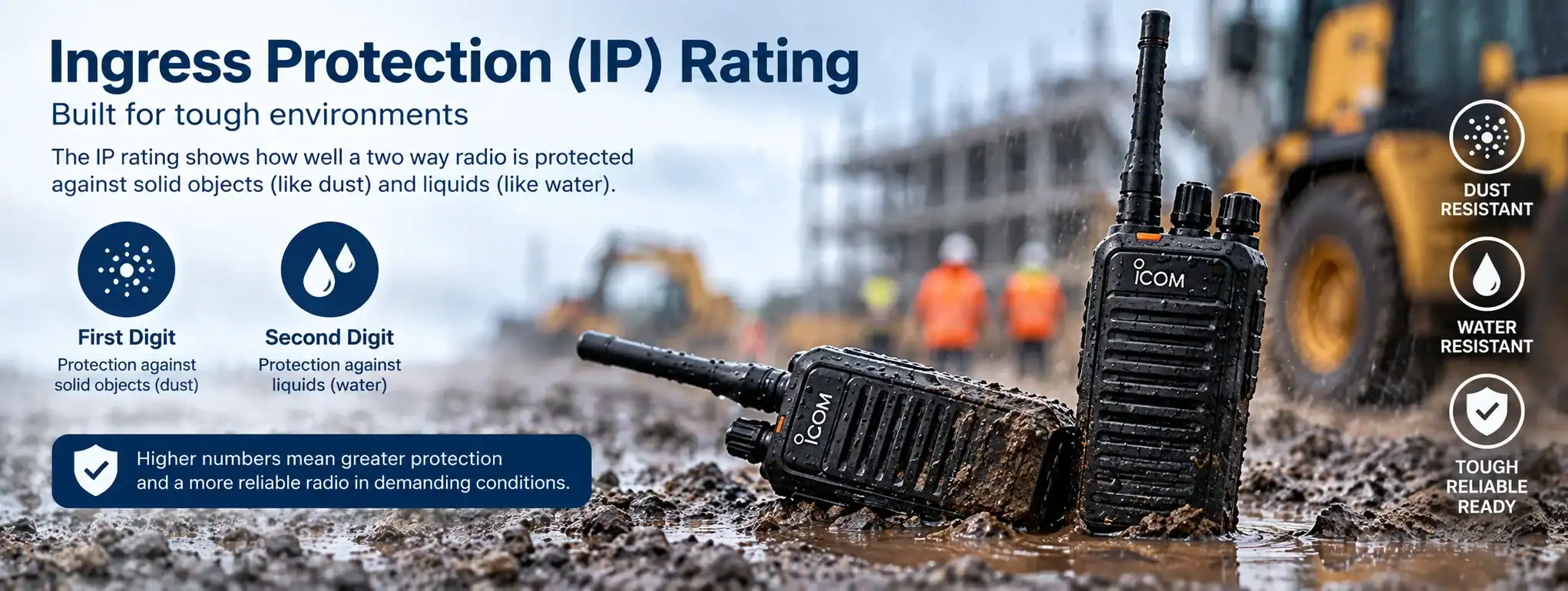
Ingress Protection (IP) Rating
An Ingress Protection (IP) Rating is an internationally recognised classification that indicates how well electrical equipment is protected against the entry of solid objects, dust and water.
For two-way radios, an IP rating provides an indication of how well the radio is protected against environmental conditions such as dust, rain, splashing and temporary immersion.
The rating is normally expressed as IP followed by two numbers, for example IP54, IP55, IP67 or IP68.
The two numbers describe different types of protection.
What do the numbers in an IP rating mean?
The first number indicates protection against solid particles, including dust.
The second number indicates protection against water.
For example:
IP67
- 6 = Dust-tight
- 7 = Protected against temporary immersion in water under specified test conditions
The IP rating therefore provides more information than simply describing a radio as “waterproof” or “dustproof”.
First digit – protection against solids
The first digit of an IP rating indicates the level of protection against the entry of solid objects and particles.
The scale runs from 0 to 6.
| First digit | Protection |
|---|---|
| 0 | No protection |
| 1 | Protection against objects larger than 50 mm |
| 2 | Protection against objects larger than 12.5 mm |
| 3 | Protection against objects larger than 2.5 mm |
| 4 | Protection against objects larger than 1 mm |
| 5 | Dust-protected |
| 6 | Dust-tight |
For professional two-way radios, ratings beginning with IP5 or IP6 are commonly encountered.
Second digit – protection against water
The second digit indicates the level of protection against water.
The scale runs from 0 to 9, although not every level is relevant to every radio application.
Common ratings include:
| Second digit | Protection |
|---|---|
| 0 | No protection |
| 1 | Protection against vertically falling water drops |
| 2 | Protection against vertically falling water drops when tilted up to 15° |
| 3 | Protection against spraying water |
| 4 | Protection against splashing water |
| 5 | Protection against water jets |
| 6 | Protection against powerful water jets |
| 7 | Protection against temporary immersion |
| 8 | Protection against continuous immersion under specified conditions |
| 9 | Protection against high-pressure, high-temperature water jets |
The exact test conditions associated with each rating are important.
IP54
IP54 means:
- 5 = Dust-protected
- 4 = Protected against splashing water from any direction
An IP54 radio is therefore protected against limited dust ingress and water splashes.
It should not automatically be considered suitable for immersion in water.
IP55
IP55 means:
- 5 = Dust-protected
- 5 = Protected against water jets
This provides a higher level of water protection than IP54 under the relevant test conditions.
IP56
IP56 means:
- 5 = Dust-protected
- 6 = Protected against powerful water jets
This can be useful for equipment exposed to more substantial water spray.
It does not, however, mean that the radio is rated for immersion.
IP67
IP67 means:
- 6 = Dust-tight
- 7 = Protected against temporary immersion in water under specified test conditions
IP67 equipment provides a high level of protection against dust and can withstand temporary immersion under the conditions specified by the relevant test.
The rating does not mean that the equipment can remain underwater indefinitely.
IP68
IP68 means:
- 6 = Dust-tight
- 8 = Protected against continuous immersion under specified conditions
The precise depth and duration for an IP68 product depend on the manufacturer’s specified test conditions.
Therefore, two products with an IP68 rating should not automatically be assumed to have identical underwater performance.
IP ratings and two-way radios
An IP-rated two-way radio is designed to provide a defined level of protection against environmental ingress.
This can be particularly important for radios used in:
- Construction
- Agriculture
- Security
- Events
- Transport
- Utilities
- Manufacturing
- Outdoor operations
- Marine environments
The appropriate rating depends on the conditions in which the radio will be used.
IP rating and waterproofing
The term “waterproof” is often used informally to describe equipment with a high level of water resistance.
An IP rating is more precise because it identifies the specific level of protection achieved under defined test conditions.
A radio described as waterproof should therefore still be checked for its actual IP rating and manufacturer’s operating limitations.
IP rating and dust protection
Dust can enter electronic equipment through gaps, openings and connectorsAn antenna transmits and receives radio-frequency signals, allowing a two-way radio to communicate. Antenna type, frequency, height and location can all affect radio performance and coverage..
A higher first digit in the IP rating indicates greater protection against solid particles.
An IP6X rating indicates that the enclosure is dust-tight under the relevant test conditions.
This can be particularly important for radios used on construction sites, farms, quarries and industrial premises.
IP rating and radio connectors
Radio accessory connectors can be potential points of ingress.
A radio may have a high IP rating when its connector covers are correctly fitted, but opening those covers can change the level of protection.
Users should follow the manufacturer’s instructions for connector covers, battery compartments and other seals.
IP rating and audio accessories
A radio’s IP rating does not automatically apply to every accessory connected to it.
For example, a rugged radioA Rugged Radio is a two-way radio designed to withstand demanding working environments, with features such as impact resistance and protection against dust, water and other environmental conditions. with an IP67 rating does not necessarily make a connected headsetA radio headset combines a microphone and speaker or earpiece, allowing two-way radio users to communicate conveniently while keeping the radio away from their face or using hands-free operation., speaker microphoneA Speaker Microphone is a two-way radio accessory combining a microphone, loudspeaker and usually a Push-to-Talk button, allowing convenient radio operation without handling the radio itself. or earpieceAn earpiece is a two-way radio audio accessory that lets users hear radio communications discreetly, often with a microphone and Push-to-Talk button for transmitting. IP67.
The accessory should have its own environmental rating where this is important.
IP rating and batteries
The battery compartment can be an important part of the radio’s environmental protection.
Battery covers, seals and gaskets must be correctly fitted for the radio to achieve its specified protection.
Damaged or incorrectly fitted seals can reduce the actual protection available.
IP rating and radio hire
For Radio HireRadio Hire is the temporary rental of two-way radios and related communication equipment for events, projects and operational requirements, providing professional communication without purchasing the equipment., the appropriate IP rating should be selected according to the environment in which the radios will be used.
For example, outdoor construction or agricultural work may require greater protection from dust and water than an indoor office or conference environment.
Users should tell the radio supplier about the expected working conditions so that suitable equipment can be selected.
IP rating and events
Outdoor events can expose radios to:
- Rain
- Mud
- Dust
- Water spray
- Accidental drops into wet areas
A suitable IP-rated radio can provide greater protection in these conditions.
However, the appropriate rating depends on the actual environment.
IP rating and construction
Construction sites can expose radio equipment to substantial quantities of dust, dirt and water.
A radio with a suitable IP rating can help withstand these conditions.
The IP rating should be considered alongside the radio’s physical durability, drop resistance and operating temperature range.
IP rating and agriculture
Agricultural environments can expose radios to:
- Rain
- Mud
- Dust
- Water spray
- Soil
- Cleaning equipment
A suitably protected radio can be better suited to these conditions than equipment designed primarily for indoor use.
IP rating and industrial environments
Manufacturing and industrial environments can contain dust, moisture, oils, chemicals and cleaning processes.
An IP rating only describes protection against specific types of ingress.
It does not automatically indicate resistance to chemicals, oils, corrosive substances or other environmental hazards.
Additional manufacturer specifications may therefore be required.
IP rating and ATEX
An IP rating and ATEX certification are different things.
An IP rating describes protection against the ingress of solids and water.
ATEX certification relates to equipment intended for defined potentially explosive atmospheres.
An IP-rated radio is therefore not automatically suitable for use in a hazardous explosive atmosphere.
Where ATEX certification is required, the specific radio must have the appropriate certification.
IP rating and waterproof radios
Some professional two-way radios are designed to withstand immersion, while others are intended only to resist rain and splashing.
A radio’s IP rating should be checked before exposing it to water beyond the conditions for which it has been tested.
Even radios with high water-resistance ratings may have limitations relating to:
- Depth
- Duration
- Water temperature
- Salt water
- Chemical contamination
- Damaged seals
- Connector covers
IP rating and salt water
Salt water can be particularly damaging to electronic equipment.
An IP rating does not necessarily mean that a radio is suitable for prolonged exposure to salt water or marine environments.
Marine-use requirements should be checked against the manufacturer’s specifications.
IP rating and cleaning
Radios used in demanding environments may need regular cleaning.
A high IP rating can provide protection against certain water jets, but users should follow the manufacturer’s cleaning instructions.
High-pressure cleaning can potentially damage seals or force water into areas not covered by the equipment’s intended operating conditions.
IP rating and drops
An IP rating does not describe a radio’s resistance to impact or dropping.
These are separate characteristics.
A radio can have a high IP rating but still require additional protection against physical impact.
When selecting professional radios, users may therefore need to consider:
- IP rating
- Drop resistance
- Shock resistance
- Construction
- Screen protection
- Connector protection
IP rating and environmental durability
IP rating is only one part of a radio’s overall environmental durability.
Other specifications can include:
- Operating temperature
- Storage temperature
- Drop resistance
- Vibration resistance
- Shock resistance
- Humidity resistance
- Chemical resistance
A radio intended for demanding environments should be assessed against all relevant conditions.
IP rating and radio maintenance
Maintaining the radio’s seals and covers is important.
Users should check for:
- Damaged seals
- Cracked housings
- Missing connector covers
- Damaged battery doors
- Dirt around sealing surfaces
- Incorrectly fitted components
Damage can reduce the radio’s ability to maintain its specified IP protection.
IP rating and ageing
The environmental protection of equipment can change over time.
Seals and gaskets can deteriorate through:
- Age
- Repeated opening
- Physical damage
- Chemicals
- Temperature extremes
- Poor maintenance
A radio that originally met a particular IP rating should therefore be maintained according to the manufacturer’s recommendations.
IP rating and manufacturer testing
An IP rating is based on defined test methods and conditions.
The rating does not mean that equipment is immune to environmental damage in every real-world situation.
Manufacturers may also specify additional restrictions or conditions for their products.
These manufacturer specifications should be followed.
IP rating and radio system design
When designing a professional radio systemA Radio System is a complete communication solution comprising two-way radios and, where required, equipment such as repeaters, antennas, base stations, mobile radios and network infrastructure., environmental conditions should be considered alongside communication requirements.
For example:
Indoor office → Lower environmental protection may be sufficient
Outdoor construction → Greater dust and water protection may be required
Industrial environment → IP rating plus other environmental certifications may be required
Hazardous area → Appropriate ATEX certification may be required
IP rating limitations
An IP rating does not tell you:
- How far a radio will transmit
- How durable it is against dropping
- Whether it is ATEX certified
- Whether it is resistant to chemicals
- Whether it is suitable for salt water
- How long its battery will last
- Whether its accessories have the same rating
It should therefore be considered alongside the radio’s complete technical specification.
Choosing an IP-rated two-way radio
When selecting a radio, consider:
- Indoor or outdoor use
- Expected exposure to rain
- Dust levels
- Water exposure
- Possibility of immersion
- Cleaning requirements
- Temperature
- Physical impact
- Required accessories
- ATEX requirements
- Manufacturer’s environmental specifications
The correct IP rating should be based on the actual working environment rather than simply selecting the highest available rating.
IP rating and DCS
DCS can advise on the environmental protection required when selecting professional two-way radios for different working environments.
For outdoor, industrial, construction, agricultural and event applications, the appropriate IP-rated equipment can help protect radios against dust and water while maintaining reliable day-to-day operation.