
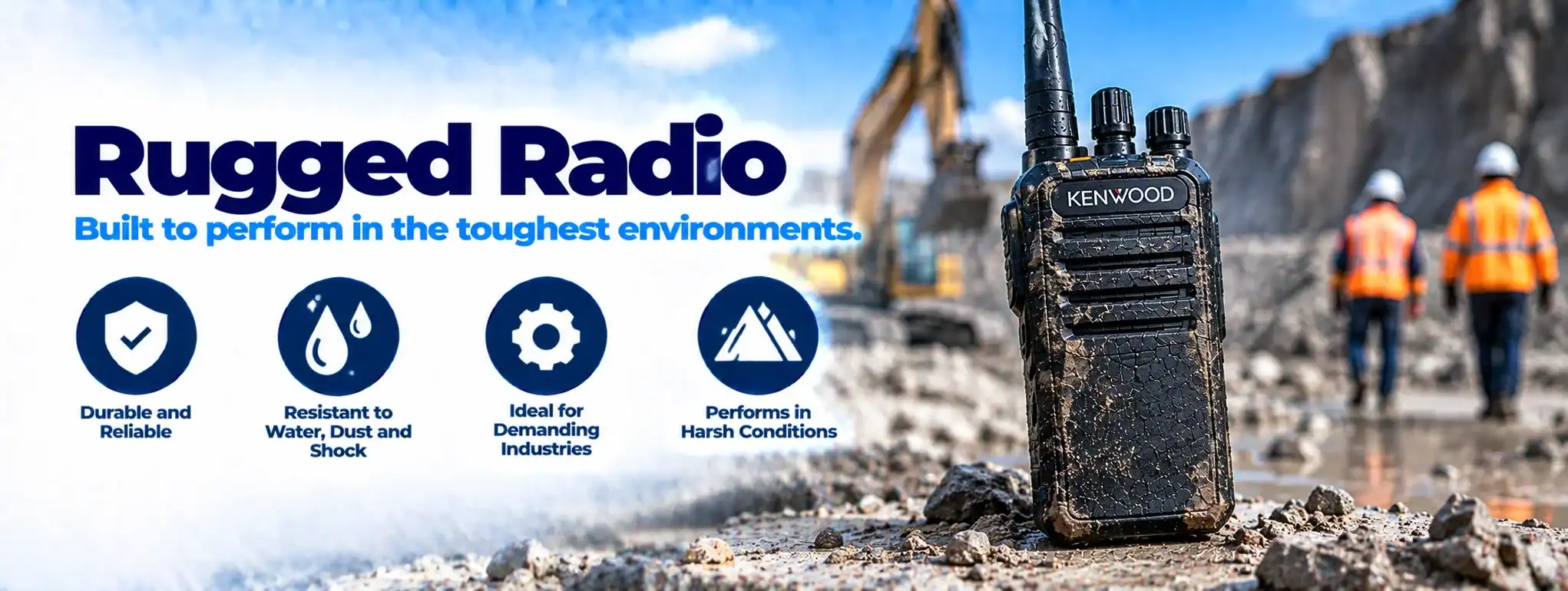
Rugged Radio
A Rugged Radio is a two-way radio designed to withstand demanding working environments where equipment may be exposed to impacts, dust, water, vibration, extreme temperatures or frequent handling.
Rugged radios are commonly used in industries such as construction, security, utilities, transport, agriculture, manufacturing and outdoor events.
The term “rugged” describes the physical durability of the equipment. It does not necessarily refer to a particular radio technology, frequencyAn antenna transmits and receives radio-frequency signals, allowing a two-way radio to communicate. Antenna type, frequency, height and location can all affect radio performance and coverage. band or manufacturer.
What makes a radio rugged?
A rugged radio is typically designed with features intended to improve durability and reliability in demanding conditions.
These can include:
- Reinforced casing
- Sealed controls
- Protected connectorsAn antenna transmits and receives radio-frequency signals, allowing a two-way radio to communicate. Antenna type, frequency, height and location can all affect radio performance and coverage.
- Impact-resistant construction
- Water and dust resistance
- Durable display
- Robust control buttons
- Secure battery attachment
The exact level of protection varies between radio models.
Rugged radio vs standard radio
A standard two-way radio may be suitable for offices, shops or other relatively controlled environments.
A rugged radio is designed for conditions where the equipment is more likely to experience physical or environmental stress.
For example:
Office environment → Standard professional radio
Construction site → Rugged professional radio
The correct choice depends on the working environment rather than simply choosing the most durable radio available.
Rugged radio durability
Durability can refer to several different characteristics.
A rugged radio may be designed to withstand:
- Drops
- Impacts
- Dust
- Rain
- Mud
- Vibration
- Frequent handling
- Temperature changes
Manufacturers may specify particular testing standards or environmental ratings for individual models.
Rugged radio and IP rating
The Ingress Protection (IP) RatingAn Ingress Protection (IP) Rating indicates how well electrical equipment, including two-way radios, is protected against dust, solid objects and water. Higher ratings provide greater protection. is one of the most important specifications to consider when assessing a radio’s environmental protection.
An IP rating indicates the level of protection provided against the ingress of solid particles and water.
For example, a radio with a higher water-resistance rating may be more appropriate for outdoor work than one designed only for limited moisture exposure.
The IP rating should always be checked for the specific radio model.
Rugged radio and waterproofing
Some rugged radios are designed to withstand significant exposure to water.
Depending on the model, this may include protection against:
- Rain
- Water splashes
- Temporary immersion
Water resistance does not mean that every rugged radio is waterproof under all conditions.
The manufacturer’s specified rating and operating limitations should be followed.
Rugged radio and dust protection
Construction sites, agricultural operations and industrial environments can expose equipment to dust and fine particles.
A suitable IP rating can help protect the radio against dust ingress.
The radio’s charging accessories, connectors and other components should also be considered where dust exposure is significant.
Rugged radio and impact resistance
Professional rugged radios can be designed to withstand accidental drops and impacts.
Features may include:
- Reinforced housings
- Protective frames
- Recessed controls
- Impact-resistant materials
However, rugged construction does not make a radio indestructible.
Rugged radio and vibration
Vehicles, machinery and industrial equipment can subject radios to repeated vibration.
A rugged radio designed for these environments can provide greater resistance to vibration than equipment intended for less demanding use.
Rugged radio and extreme temperatures
Outdoor and industrial workers may use radios in environments with significant temperature variations.
Some professional radios have specified operating temperature ranges.
The manufacturer’s stated temperature limits should be checked before using a radio in particularly hot or cold environments.
Rugged radio and construction
Construction is one of the most common applications for rugged two-way radios.
Radios may be exposed to:
- Dust
- Rain
- Drops
- Concrete and building materials
- Heavy machinery
- Vibration
Rugged radios can provide greater durability for these conditions.
Rugged radio and security
Security personnel may carry radios throughout long shifts and in demanding environments.
A rugged radio can withstand frequent handling while providing features such as:
- Large PTT button
- Loud audio
- Emergency functions
- HeadsetA radio headset combines a microphone and speaker or earpiece, allowing two-way radio users to communicate conveniently while keeping the radio away from their face or using hands-free operation. compatibility
- Remote Speaker MicrophoneA Speaker Microphone is a two-way radio accessory combining a microphone, loudspeaker and usually a Push-to-Talk button, allowing convenient radio operation without handling the radio itself. compatibility
Rugged radio and events
Event staff may work outdoors and in changing weather conditions.
Rugged radios can be useful for:
- Festivals
- Sporting events
- Outdoor events
- Security operations
- Production teams
The appropriate environmental protection depends on the conditions expected at the event.
Rugged radio and agriculture
Agricultural environments can expose radios to:
- Mud
- Rain
- Dust
- Machinery
- Vibration
- Outdoor conditions
A rugged radio with suitable environmental protection can be more appropriate than a radio designed primarily for indoor use.
Rugged radio and utilities
Utility workers can operate in outdoor and industrial environments where radios may be exposed to weather, dirt and physical impacts.
Rugged equipment can help maintain reliability under these conditions.
Rugged radio and manufacturing
Manufacturing environments can involve machinery, dust, vibration, noise and frequent movement.
A rugged radio can provide durability while features such as high-output audio and noise cancellationNoise Cancellation is technology used in two-way radios and communication equipment to reduce unwanted background noise and make speech easier to hear, particularly in noisy working environments. can help with communication in noisy areas.
Rugged radio and transport
Transport workers may use radios inside vehicles, outdoors and around loading or operational areas.
Rugged radios can withstand repeated handling and movement between different environments.
Rugged radio and hospitality
Not every hospitality environment requires a rugged radio.
However, radios used outdoors, around kitchens, loading areas or large venues may benefit from additional durability and environmental protection.
Rugged radio and loud environments
Rugged radios used in industrial or outdoor environments may incorporate high-output speakers.
This can make received communications easier to hear in noisy environments.
A Remote Speaker Microphone (RSM)A Remote Speaker Microphone (RSM) is an external radio accessory combining a microphone, speaker and Push-to-Talk button, allowing users to operate a two-way radio without handling the radio itself. or headset can provide additional flexibility.
Rugged radio and noise cancellation
Some professional rugged radios incorporate microphone noise-cancellation technology.
This can help improve the clarity of a user’s transmitted speech when working around machinery, vehicles or other sources of background noise.
Noise cancellation is separate from the radio’s physical ruggedness.
Rugged radio and battery protection
A rugged radio may have a secure battery connection designed to withstand movement and impacts.
The battery itself may also be protected against environmental conditions according to the radio’s specifications.
Rugged radio and accessories
Accessories should be selected to match the intended environment.
These can include:
- Remote Speaker Microphones
- Earpieces
- Headsets
- Carrying cases
- Batteries
- Chargers
- Vehicle chargers
Where environmental protection is important, the accessory should also be suitable for the operating conditions.
Rugged radio and intrinsically safe radios
A rugged radio should not be confused with an Intrinsically Safe RadioAn Intrinsically Safe Radio is a two-way radio designed and certified for use in specified hazardous areas where flammable gases, vapours or combustible dust could create a risk of explosion..
“Rugged” refers primarily to physical and environmental durability.
“Intrinsically safe” refers to equipment designed and approved to limit the possibility of causing ignition in specified hazardous environments.
A radio can be rugged without being intrinsically safe.
Rugged radio and ATEX
Where radios are required in potentially explosive atmospheres, the relevant equipment must have the appropriate certification for the intended hazardous environment.
A normal rugged radio must not be assumed to be suitable simply because it is waterproof or impact-resistant.
The radio, battery and relevant accessories should meet the required certification.
Rugged radio and digital radio
Rugged radios can use either analogue or digital radio technology.
Examples include:
- Analogue professional radio
- DMR
- Other digital radio technologies
Ruggedness is a physical characteristic and is separate from the communication technology used.
Rugged radio and DMR
Rugged DMR radios can provide professional digital communication while being designed for demanding working environments.
Depending on the model, features can include:
- Group calling
- Private calling
- GPS
- Emergency functions
- EncryptionEncryption protects two-way radio communications by converting voice or data into a secure form that can only be understood by authorised radios with the correct encryption capability and keys.
- Data
- Man DownMan Down is a safety feature on some professional two-way radios that can detect a possible fall or unusual radio position and automatically raise an alert if the user does not respond.
The available features depend on the specific radio.
Rugged radio and VHF
Rugged radios are available in VHF versions.
VHF equipment can be useful for many outdoor and open-area applications, subject to the radio system’s frequencyFrequency is the number of cycles a radio wave completes each second, measured in Hertz. In two-way radio, frequency determines where a transmission operates within the radio spectrum. and coverageRadio Coverage is the geographical area in which a two-way radio system can provide reliable communication. Coverage depends on the radios, antennas, frequency, terrain, buildings and system infrastructure. requirements.
Rugged radio and UHF
Rugged radios are also available in UHF versions.
UHF can be particularly useful for many building and urban applications, although actual coverage depends on the environment and system design.
Rugged radio and emergency functions
Professional rugged radios can incorporate emergency features such as:
- Emergency buttonAn Emergency Button is a dedicated two-way radio control that allows users to quickly send an emergency alert to a dispatcher, control room or authorised radio users.
- Emergency callAn Emergency Call is a priority two-way radio function that allows a user to quickly request assistance and, on supported systems, establish an urgent voice communication with a dispatcher or control room.
- Man Down
- Lone WorkerA Lone Worker is someone who works without direct supervision or immediate assistance nearby. Compatible two-way radios can provide safety features such as timed check-ins, emergency alerts and GPS location.
- Priority callPriority Call is a two-way radio feature that gives important or authorised communications higher priority than routine radio traffic, helping urgent messages access the system when channels are busy.
These functions are particularly useful where workers may operate alone or in demanding environments.
Rugged radio and lone worker
A rugged radio may support Lone Worker functionality.
This can allow a system to provide additional protection for employees who work alone or away from colleagues.
The specific implementation varies between radio systems.
Rugged radio and Man Down
Some rugged professional radios include Man Down functionality.
The radio can detect certain movement or orientation conditions and initiate an alert according to its configuration.
The exact operation varies between manufacturers and models.
Rugged radio and GPS
Some rugged radios include integrated GPS.
This can allow authorised systems to monitor the location of radios used by field personnel.
GPS capability is separate from the radio’s physical ruggedness.
Rugged radio and encryption
Professional rugged radios can support Encryption where required.
Encryption protects radio communications from unauthorised interception according to the security technology being used.
The available encryption capabilities vary between radio models and systems.
Rugged radio and radio licensing
Ruggedness does not determine whether a radio requires a licence.
Licensing depends on the radio service and frequencies being used.
In the UK, professional business-radio use is regulated by OfcomOfcom (Office of Communications) is the UK's communications regulator. For two-way radio users, Ofcom manages and regulates access to radio spectrum and the use of radio frequencies in the UK..
Rugged radio and PMR446
Some rugged radios are available for PMR446 use.
PMR446 is a licence-free service subject to specific technical requirements.
A rugged appearance does not automatically make a radio suitable for PMR446; the equipment must meet the relevant technical requirements.
Rugged radio and radio hire
Rugged radios are commonly used for Radio HireRadio Hire is the temporary rental of two-way radios and related communication equipment for events, projects and operational requirements, providing professional communication without purchasing the equipment., particularly where equipment will be used outdoors or in demanding environments.
Typical applications include:
- Construction
- Events
- Security
- Agriculture
- Utilities
- Outdoor operations
For temporary deployments, the required environmental protection should be specified when arranging the hire.
Rugged radio hire
A radio-hire provider may offer different levels of equipment depending on the operating conditions.
For example:
Indoor event → Professional handheld
Outdoor event → Water-resistant rugged handheld
Construction site → Rugged handheld with suitable IP rating
The correct equipment should be selected according to the actual environment.
Rugged radio maintenance
Even rugged radios require maintenance.
This can include:
- Cleaning
- Inspection
- Battery checks
- Connector inspection
- AntennaAn antenna transmits and receives radio-frequency signals, allowing a two-way radio to communicate. Antenna type, frequency, height and location can all affect radio performance and coverage. inspection
- PTT testing
- Audio testing
- Waterproof seal inspection where applicable
Damage to seals, connectors or housings can reduce the radio’s environmental protection.
Rugged radio cleaning
Radios used in dusty, muddy or dirty environments should be cleaned according to the manufacturer’s instructions.
Particular attention should be given to:
- Microphone openings
- Speaker openings
- Connectors
- Controls
- Battery contacts
Improper cleaning can damage equipment or compromise environmental protection.
Rugged radio limitations
A rugged radio is not indestructible.
Environmental protection depends on the specific model and its rated specifications.
A radio’s durability can also be affected by:
- Physical damage
- WearAn antenna transmits and receives radio-frequency signals, allowing a two-way radio to communicate. Antenna type, frequency, height and location can all affect radio performance and coverage.
- Damaged seals
- Incorrect maintenance
- Unsuitable accessories
- Exposure beyond its rated conditions
Choosing a rugged radio
When selecting a rugged radio, consider:
- IP rating.
- Drop and impact resistance.
- Operating temperature.
- Dust exposure.
- Water exposure.
- Required frequency band.
- Analogue or digital operation.
- Battery life.
- Audio output.
- Required emergency features.
- Accessory compatibility.
- Any hazardous-area certification.
Rugged radio vs ruggedised radio
The terms rugged, ruggedised and ruggedized are often used to describe equipment designed for demanding environments.
They are not, by themselves, technical certification categories.
The actual specifications and certifications of the individual radio should always be checked.
Rugged radio and DCS
DCS can supply professional two-way radios designed for demanding working environments.
Where radios are required for construction, security, events, agriculture, utilities or other outdoor applications, equipment can be selected according to the required durability, IP rating, communication technology and accessories.