
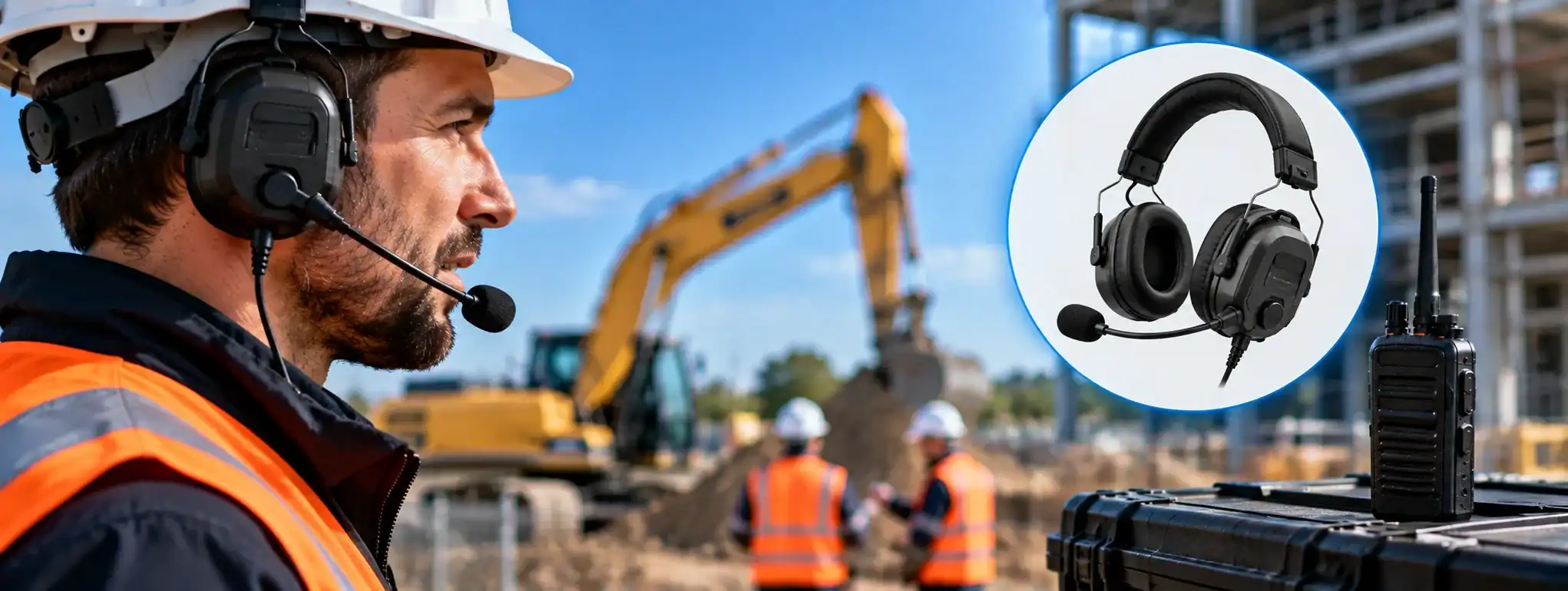
Headset
A Headset is a radio audio accessoryAn audio accessory is an external device such as a speaker microphone, earpiece or headset that connects to a two-way radio to improve or adapt how users send and receive audio. that combines a microphone and one or more speakers or earpieces, allowing a two-way radio user to communicate while keeping the radio away from their face.
Headsets are available in a wide range of designs, from lightweight single-ear headsets to heavy-duty models designed for noisy industrial environments. They can be connected directly to a radio or used with a compatible Remote PTT (Push-to-Talk) control.
Headsets are commonly used in security, construction, manufacturing, transport, events, hospitality and other environments where users need convenient, hands-free or discreet radio communication.
How does a radio headset work?
A radio headset performs two basic functions:
- Microphone: Captures the user’s voice and sends it to the radio for transmissionTransmission is the process of sending voice, data or signalling from a radio using a radio-frequency signal to another radio, repeater or communication system..
- Speaker or earpieceAn earpiece is a two-way radio audio accessory that lets users hear radio communications discreetly, often with a microphone and Push-to-Talk button for transmitting.: Allows the user to hear incoming radio communications.
The headset connects to the radio using a compatible connector, or wirelessly where the radio and headset support a technology such as Bluetooth®Bluetooth® is a short-range wireless technology used with compatible two-way radios to connect accessories such as headsets, earpieces and microphones without a physical cable..
Headsets and two-way radios
A headset can be connected to a handheld or other compatible two-way radio to provide clearer and more convenient audio.
The radio can remain attached to a belt, vest, harness or other carrying position while the headset provides the user’s microphone and listening point.
This can be particularly useful when the user needs to keep the radio readily accessible without repeatedly lifting it to their mouth.
Headsets and Push-to-Talk
Most radio headsets can be used with Push-to-Talk (PTT)Push-to-Talk (PTT) is the button or control used to activate a two-way radio's transmitter. Press it to speak and release it to listen..
The PTT control allows the user to deliberately select when the radio transmits.
Depending on the headset, the PTT may be:
- Built into the headset cable
- Integrated into a remote control
- Mounted separately on clothing
- Located on a vehicle control
- Built into a compatible Bluetooth accessory
The exact arrangement depends on the headset and radio.
Headsets and Hands-Free Operation
A headset can form part of a Hands-Free OperationHands-Free Operation allows two-way radio users to communicate without holding the radio or continuously pressing its PTT button, using features such as VOX, headsets or remote PTT controls. system.
For example, a user can wearAn antenna transmits and receives radio-frequency signals, allowing a two-way radio to communicate. Antenna type, frequency, height and location can all affect radio performance and coverage. a headset while the radio remains attached to their belt.
Hands-free communication can be achieved using:
- VOX
- Remote PTT
- Wireless PTT
- Other compatible radio controls
A headset itself does not necessarily mean that the radio will transmit automatically.
Headsets and VOX
VOX (Voice-Operated Transmission) allows a compatible radio to begin transmitting when it detects the user’s voice.
When used with a headset, the microphone is positioned close to the user’s mouth, which can improve the radio’s ability to distinguish speech from surrounding noise.
However, VOX can still be affected by loud background noise.
Headsets and remote PTT
A Remote PTT allows the user to control the radio’s transmission without reaching for the radio itself.
This is particularly useful when the radio is worn on a belt or body harness.
For example:
Headset microphone → Radio
Remote PTT → Radio
The user hears incoming communications through the headset and presses the remote PTT when they need to respond.
Single-ear headsets
Single-ear headsets use one earpiece, leaving the other ear available to hear the surrounding environment.
They are often useful in environments where radio communication needs to be heard clearly without completely isolating the user from nearby people or equipment.
They can be particularly suitable for:
- Security
- Events
- Hospitality
- Retail
- Site management
Dual-ear headsets
Dual-ear headsets cover both ears and can provide greater isolation from surrounding noise.
They are often used in louder environments where reliable communication is important.
Depending on the design, dual-ear headsets may incorporate hearing protection as well as radio communication.
Heavy-duty headsets
Heavy-duty headsets are designed for demanding working environments.
They can provide:
- Robust construction
- Improved hearing protection
- Noise reduction
- Clear radio audio
- Comfortable long-duration wearing
- Durable cables and connectorsAn antenna transmits and receives radio-frequency signals, allowing a two-way radio to communicate. Antenna type, frequency, height and location can all affect radio performance and coverage.
They are commonly used in construction, manufacturing, industrial and motorsport environments.
Noise-cancelling headsets
Some radio headsets incorporate noise-reduction or noise-cancelling technology.
This can help reduce the effect of background noise on the user’s ability to hear radio communications.
Different technologies work in different ways, so “noise cancelling” and “noise reduction” should not automatically be treated as identical.
Headsets and Digital Noise Suppression
Some professional radios use Digital Noise SuppressionDigital Noise Suppression uses digital audio processing in a two-way radio to reduce unwanted background noise and improve speech clarity, particularly in noisy working environments. to reduce unwanted background noise in the transmitted audio.
A suitable headset can work alongside this technology by providing a microphone positioned close to the user’s mouth.
The combination can improve speech intelligibility, particularly in noisy environments.
Headsets and Audio Gain
Audio GainAudio gain controls the level of an audio signal within a two-way radio system. Correct gain helps provide clear speech while avoiding excessive background noise, clipping or distortion. refers to the amplification or level of an audio signal within a radio or accessory.
Correct audio levels can help ensure that speech is transmitted clearly and incoming communications can be heard comfortably.
The radio, headset and microphone must be compatible with each other for appropriate audio performance.
Headsets and Echo Cancellation
Some communication systems incorporate Echo CancellationEcho Cancellation uses digital audio processing to reduce unwanted echoes caused when sound from a radio speaker is picked up by a microphone and retransmitted. to reduce unwanted feedback or echo in audio.
This can be useful in certain hands-free communication arrangements.
Echo cancellation is a separate function from the physical headset itself.
Headsets and Bluetooth
Some professional radios support Bluetooth® audio accessories.
A compatible Bluetooth headset can provide wireless communication between the headset and radio.
Wireless operation can reduce the number of cables running between the user and the radio.
Bluetooth support varies between radio models, and not every Bluetooth headset will provide every radio-control function.
Wired vs wireless headsets
Radio headsets are generally available as either wired or wireless accessories.
Wired headsets:
- Simple connection
- No separate wireless pairing required
- Generally reliable
- Do not require a separate headset battery
Wireless headsets:
- Greater freedom of movement
- Fewer cables
- Can be more convenient
- Require compatible Bluetooth or wireless technology
- May require separate charging
The best option depends on the working environment and radio equipment.
Headsets and audio connectors
A radio headset must use a connector compatible with the radio or an appropriate adapter.
Professional radios can use different connector designs, including manufacturer-specific and industry-standard arrangements.
The physical appearance of a connector does not necessarily guarantee compatibility.
The radio model should therefore be checked before selecting a headset.
Headsets and accessory connectors
An Accessory ConnectorAn accessory connector is the socket on a two-way radio used to connect external accessories such as speaker microphones, headsets, earpieces and programming equipment. provides the connection between the radio and compatible accessories such as headsets, speaker microphones and remote PTT controls.
The connector can carry audio and control signals between the radio and accessory.
Different radio manufacturers and models may use different connector arrangements.
Headsets and earpieces
An Earpiece is a simpler audio accessory that normally provides a speaker for listening to radio communications.
A headset generally includes both a microphone and listening component.
An earpiece may be combined with a separate microphone or remote PTT depending on the application.
Headsets and speaker microphones
A Speaker MicrophoneA Speaker Microphone is a two-way radio accessory combining a microphone, loudspeaker and usually a Push-to-Talk button, allowing convenient radio operation without handling the radio itself. combines a microphone and speaker in a compact accessory that usually clips to the user’s clothing.
Unlike a headset, it does not normally place the audio directly into the user’s ear.
Speaker microphones can be useful where users need quick access to the radio without wearing a headset.
Covert headsets
Specialist covert or discreet headsets can be used where radio communications need to be less noticeable.
These may use a discreet earpiece, acoustic tube or other low-profile design.
They can be useful for certain security and close-protection applications.
The appropriate accessory should be selected according to the operational requirements and radio equipment.
Headsets and acoustic tubes
An acoustic tube headset uses a small transparent or discreet tube to carry sound from the earpiece toward the user’s ear.
This can provide a low-profile appearance while allowing the user to hear radio communications.
Different acoustic tube designs provide different levels of durability and comfort.
Headsets and hearing protection
Some heavy-duty radio headsets incorporate hearing protection for noisy environments.
This can allow users to communicate while reducing exposure to workplace noise.
The appropriate hearing protection should be selected according to the actual noise environment and relevant workplace requirements.
A standard radio headset should not automatically be considered hearing protection.
Headsets in security
Security personnel frequently use headsets to maintain discreet and convenient radio communications.
A common arrangement is:
Radio + headset + remote PTT
The radio can remain concealed or secured on the user’s belt while the earpiece and PTT remain accessible.
Single-ear and discreet headsets are often useful where maintaining awareness of the surrounding environment is important.
Headsets at events
Headsets are commonly used by event staff who need to communicate while moving around busy venues.
They can be used by:
- Security teams
- Stewards
- Event control
- Production crews
- Venue staff
- Traffic teams
- Hospitality teams
Different teams may require different headset designs depending on their environment.
Headsets in construction
Construction sites can be noisy and physically demanding.
Heavy-duty headsets can help workers hear radio communications while reducing the effect of surrounding noise.
A remote PTT can allow the user to operate the radio without reaching for the radio itself.
Headsets in manufacturing
Manufacturing environments can contain continuous machinery noise.
A suitable industrial headset can improve communication and, where specifically designed for it, provide hearing protection.
Headset selection should take account of the noise level, wearing time and other workplace requirements.
Headsets in transport
Drivers and transport personnel can use radio headsets to communicate without repeatedly holding a handheld radio to their face.
Vehicle-mounted systems can also use compatible headsets or external microphones and PTT controls.
Equipment must be used in accordance with applicable driving and workplace safety requirements.
Headsets in hospitality
Hospitality and venue staff can use lightweight headsets to communicate discreetly while serving customers or managing operations.
Single-ear headsets can allow staff to hear both radio communications and their surrounding environment.
Headsets and radio hire
Headsets can be supplied as part of a Radio HireRadio Hire is the temporary rental of two-way radios and related communication equipment for events, projects and operational requirements, providing professional communication without purchasing the equipment. package.
For events and temporary operations, the appropriate headset can be selected according to the user’s role.
For example:
- Security → discreet earpiece or single-ear headset
- Production → lightweight headset
- Construction → heavy-duty headset
- Event control → professional headset
Providing the correct accessory can significantly improve the usability of a hired radio systemA Radio System is a complete communication solution comprising two-way radios and, where required, equipment such as repeaters, antennas, base stations, mobile radios and network infrastructure..
Headsets and radio battery life
Wired headsets generally draw little additional powerAn antenna transmits and receives radio-frequency signals, allowing a two-way radio to communicate. Antenna type, frequency, height and location can all affect radio performance and coverage. from the radio.
Wireless Bluetooth headsets have their own battery and require charging.
The radio itself may also consume additional power when using Bluetooth or other wireless accessory functions.
Battery requirements should therefore be considered for users working long shifts.
Headsets and waterproofing
A headset’s environmental protection should be considered separately from the radio’s rating.
A waterproof or rugged radioA Rugged Radio is a two-way radio designed to withstand demanding working environments, with features such as impact resistance and protection against dust, water and other environmental conditions. does not automatically make a connected headset waterproof.
Where radios are used outdoors or in wet environments, the headset and connector should also be suitable for the conditions.
Headsets and durability
Professional radio headsets can be subjected to repeated movement, pulling, bending and exposure to dust, moisture and other environmental conditions.
For demanding applications, robust connectors, reinforced cables and durable microphone assemblies can help improve service life.
The appropriate durability level depends on the working environment.
Headsets and comfort
Comfort is important where a headset will be worn for several hours.
Factors to consider include:
- Weight
- Ear pressure
- Headband design
- Ear cushion material
- Cable position
- Microphone position
- Adjustability
- Ventilation
The best headset is not necessarily the most expensive model; it is the one suited to the user’s environment and wearing requirements.
Headsets and emergency communications
A headset can be used during normal and emergency radio communications where it is compatible with the radio.
However, the headset does not replace dedicated emergency controls.
If a radio has an Emergency ButtonAn Emergency Button is a dedicated two-way radio control that allows users to quickly send an emergency alert to a dispatcher, control room or authorised radio users., the user may still need to activate it separately unless the system provides another supported method.
Headsets and encryption
A headset can be used with encrypted radio communications where the radio system supports encryptionEncryption protects two-way radio communications by converting voice or data into a secure form that can only be understood by authorised radios with the correct encryption capability and keys..
The headset simply carries the audio between the user and radio.
Encryption protects the radio communication itself and is not provided by the headset.
Headsets and analogue radios
Headsets can be used with compatible analogue two-way radios.
The radio must provide a suitable accessory connection and support the required microphone and speaker characteristics.
Headsets and DMR
Professional DMR (Digital Mobile RadioA Mobile Radio is a two-way radio designed to be installed in a vehicle. It normally uses the vehicle's power supply and an external antenna to provide reliable communication while travelling or working in the field.) equipment can support a wide range of headsets and audio accessories.
The specific connector, audio configuration and control functions depend on the radio model.
A headset designed for one DMR radio is not necessarily compatible with another manufacturer’s equipment.
Headset selection
When selecting a radio headset, organisations should consider:
- Radio model
- Connector type
- Wired or wireless operation
- Single-ear or dual-ear design
- Noise level
- Hearing protection requirements
- VOX requirements
- Remote PTT requirements
- Durability
- Weather exposure
- Wearing time
- User comfort
- Compatibility with other accessories
Selecting the correct headset can make a significant difference to the effectiveness of a professional radio system.
Headset limitations
A headset does not increase the radio’s transmission range or coverageRadio Coverage is the geographical area in which a two-way radio system can provide reliable communication. Coverage depends on the radios, antennas, frequency, terrain, buildings and system infrastructure..
It primarily changes how the user interacts with the radio and how audio is delivered.
Radio performance remains dependent on the underlying radio equipment, frequencyAn antenna transmits and receives radio-frequency signals, allowing a two-way radio to communicate. Antenna type, frequency, height and location can all affect radio performance and coverage., antennaAn antenna transmits and receives radio-frequency signals, allowing a two-way radio to communicate. Antenna type, frequency, height and location can all affect radio performance and coverage., networkA Network is a connected system of radios, equipment and infrastructure that allows users to communicate across a defined area. Radio networks can range from simple radio-to-radio systems to large multi-site networks. infrastructureRadio infrastructure is the equipment and supporting systems behind a professional two-way radio network, including repeaters, antennas, base stations, network connections, power systems and dispatch equipment. and coverage.
Headsets and system design
Headsets should be considered as part of the complete radio system rather than as a standalone accessory.
The radio, connector, headset, PTT, microphone and any wireless technology must work together correctly.
For larger deployments, users should be provided with accessories appropriate to their individual roles and working environments.
Headsets and DCS
DCS can supply professional two-way radios with compatible headsets, earpieces, remote PTTs and specialist audio accessories.
The appropriate headset can be selected according to the radio model, working environment and user’s communication requirements.
Looking for dependable communications for your team? You can arrange radio hire from DCS for events, projects and temporary operations.