
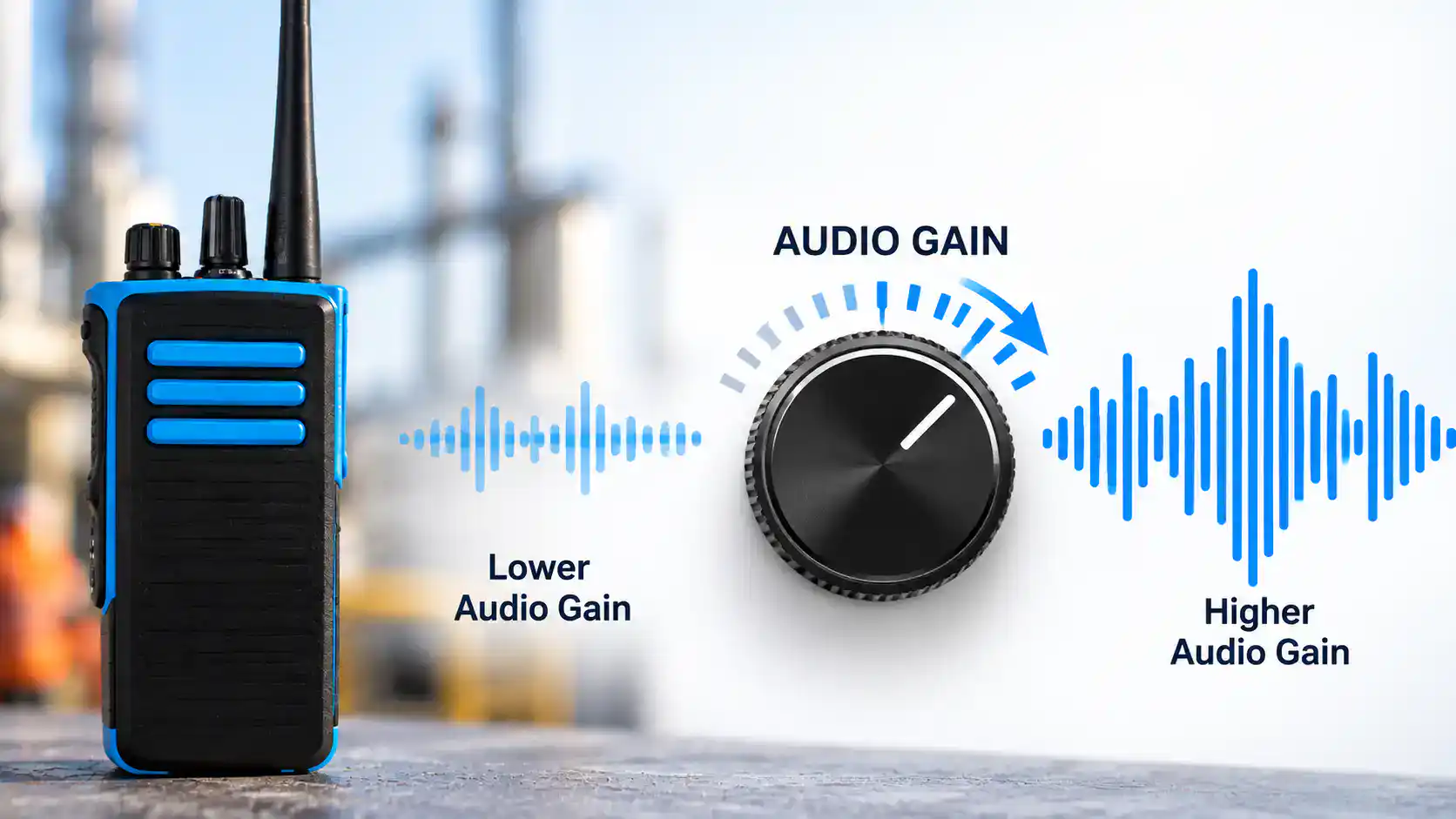
Audio Gain
Audio gain is the amount by which an audio signal is increased or decreased within a two-way radio or other audio equipment. In a two-way radio, gain controls can affect the level of audio entering or leaving the radio systemA Radio System is a complete communication solution comprising two-way radios and, where required, equipment such as repeaters, antennas, base stations, mobile radios and network infrastructure., helping to ensure that speech is loud and clear without excessive distortion or background noise.
Audio gain is different from volume. Volume controls how loud the audio sounds to the person listening, while gain affects the strength or level of the audio signal itself.
How does audio gain work?
When a user speaks into a two-way radio, the microphone converts their voice into an electrical audio signal. The radio processes this signal before it is transmitted.
Audio gain determines how strongly the microphone signal is amplified during this process.
If the gain is too low, the user’s voice may be transmitted at a level that is too quiet. If the gain is too high, the audio signal can become distorted or overloaded.
A correctly adjusted gain level helps the radio produce clear, intelligible speech.
Audio gain and microphone sensitivity
The microphone is an important part of the audio chain.
A microphone converts sound into an electrical signal, and its sensitivity determines how much signal it produces for a given sound level. Audio gain can then be used to adjust the level of that signal within the radio.
This is particularly important in professional radio environments where users may speak at different distances from the microphone or work in areas with significant background noise.
For example, a user speaking very close to a microphone may produce a stronger input signal than someone speaking further away. Appropriate gain settings help accommodate these differences.
Audio gain and transmit audio
On a two-way radio, microphone gain can affect the audio transmitted to other radio users.
If the microphone gain is set too low, other users may have difficulty hearing the speaker. If it is set too high, loud speech and background noise can overload the audio input and result in distorted or unpleasant sound.
Professional radio equipment may provide configurable microphone gain or audio-processing settings to optimise speech for the particular radio and operating environment.
Audio gain and receive audio
Gain can also be involved in the radio’s receive audio path.
Incoming radio signals are converted into audio by the receiverA Receiver is the part of a two-way radio that detects and processes incoming radio signals, converting them into audible voice or usable data for the user. and then processed before being sent to the radio’s speaker or an attached audio accessoryAn audio accessory is an external device such as a speaker microphone, earpiece or headset that connects to a two-way radio to improve or adapt how users send and receive audio..
The radio may use different stages of amplification and processing to produce suitable audio levels.
However, the control available to the user is normally volume, rather than a direct gain control. The exact audio architecture varies between radio models.
Audio gain in noisy environments
Correct audio gain can be particularly important when radios are used in noisy environments.
Construction sites, factories, transport operations, events and industrial facilities can all produce substantial background noise.
Increasing gain does not automatically make speech clearer in these conditions. Excessive gain can also amplify unwanted background sounds or cause distortion.
For noisy environments, the overall audio system may instead use suitable microphones, remote speaker microphones, noise suppression, audio processing and appropriate speaker or earpieceAn earpiece is a two-way radio audio accessory that lets users hear radio communications discreetly, often with a microphone and Push-to-Talk button for transmitting. accessories.
Audio gain and distortion
If an audio signal is amplified beyond the level that the equipment can handle correctly, clipping or distortion can occur.
This can make speech sound harsh, broken or difficult to understand.
The aim of appropriate gain adjustment is therefore not simply to make the signal as strong as possible. It is to provide a suitable signal level that gives good speech intelligibility while avoiding overload and excessive noise.
Audio gain vs volume
Gain and volume are related but perform different functions.
Gain controls or influences the level of an audio signal within the audio system, while volume controls the level at which the received audio is presented to the listener.
A useful simplified example is:
Microphone → gain/audio processing → transmitter → receiver → volume → speaker
The exact signal path differs between radio manufacturers and models, but the distinction between signal gain and listening volume remains important.
Audio gain in radio accessories
External accessories such as remote speaker microphones, headsets and earpieces can have their own audio characteristics.
The microphone in an accessory may require the radio to apply an appropriate input level or gain setting. Some professional radio systems can automatically recognise compatible accessories and apply suitable audio configurations.
Using an accessory that is not designed for a particular radio can sometimes result in poor audio levels or other compatibility issues.
Why audio gain matters in two-way radio
Good audio quality is essential for effective two-way radio communication. Users often need to understand speech quickly, sometimes in noisy or demanding environments where repeating a message is inconvenient or potentially unsafe.
Correct audio gain contributes to clear and intelligible communication by ensuring that speech signals are processed at appropriate levels.
Audio gain is therefore one part of the wider radio audio system, alongside the microphone, speaker, audio processing, radio signal quality and the environment in which the equipment is being used.
Audio gain adjustment
On professional two-way radios, audio gain may be configured during programming or servicing rather than being a setting available to the everyday user.
The appropriate setting depends on the radio, microphone, accessory and intended operating environment.
If users consistently report that transmissions are too quiet, distorted or difficult to understand, the issue may involve gain settings, microphone positioning, accessories, radio programming or another part of the communication system.
A properly configured radio system should provide clear, intelligible audio without requiring users to make technical adjustments themselves.