
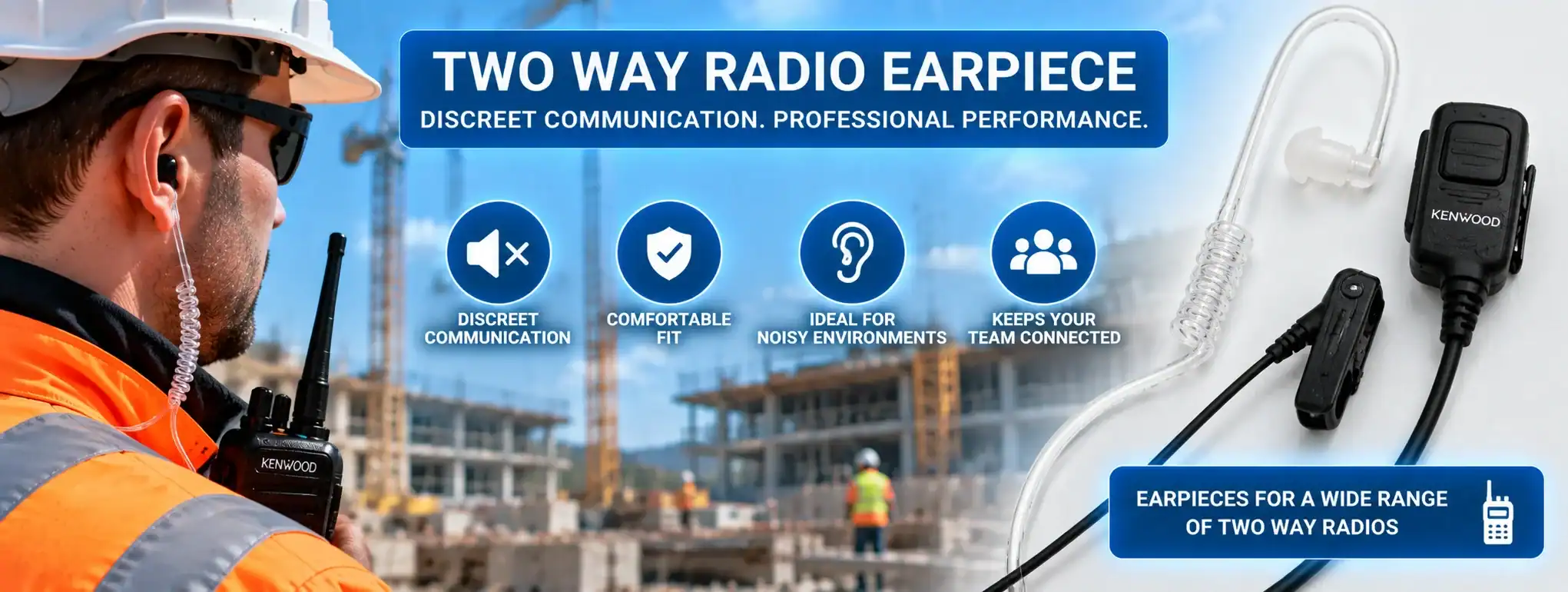
Earpiece
An Earpiece is a small audio accessoryAn audio accessory is an external device such as a speaker microphone, earpiece or headset that connects to a two-way radio to improve or adapt how users send and receive audio. that connects to a two-way radio and allows the user to hear incoming radio communications directly through an earpiece worn in or around the ear. Depending on the design, an earpiece may also include a microphone or be connected to a separate microphone, allowing the user to transmit without holding the radio close to their mouth.
Earpieces are commonly used where users need discreet communications, where the radio speaker would be inconvenient, or where reducing the amount of radio traffic audible to people nearby is important.
They are widely used in security, hospitality, events, retail, transport and other professional environments.
How does an Earpiece work?
An earpiece connects to the radio either directly or through a compatible audio accessory such as a Remote Speaker Microphone (RSM)A Remote Speaker Microphone (RSM) is an external radio accessory combining a microphone, speaker and Push-to-Talk button, allowing users to operate a two-way radio without handling the radio itself..
Incoming radio audio is routed through the earpiece rather than, or in addition to, the radio’s built-in speaker.
A typical arrangement is:
Radio → audio accessory → earpiece → user’s ear
If the accessory includes a microphone, the user can also transmit through the same connected system.
Earpiece types
There are several different types of earpiece used with professional two-way radios.
Common designs include:
- In-ear earpieces
- Over-ear earpieces
- Earbud-style earpieces
- D-shaped earpieces
- Covert acoustic earpieces
- Surveillance earpieces
- Receive-only earpieces
- Earpieces with integrated microphones
The most suitable type depends on the user’s environment and how the radio will be operated.
Earpiece with microphone
Some earpieces incorporate a microphone into the cable or earpiece assembly.
This allows the user to communicate without holding the radio in their hand.
The microphone may include a Push-to-Talk (PTT)Push-to-Talk (PTT) is the button or control used to activate a two-way radio's transmitter. Press it to speak and release it to listen. button, allowing the user to press the button to transmit.
A typical arrangement is:
Earpiece + microphone + PTT → radio
Receive-only Earpiece
A Receive-only Earpiece allows the user to hear radio communications privately but does not normally provide a microphone for transmitting.
The user may continue to use the radio’s own controls or a separate PTT accessory when they need to transmit.
Receive-only earpieces can be useful where discreet listening is more important than hands-free operationHands-Free Operation allows two-way radio users to communicate without holding the radio or continuously pressing its PTT button, using features such as VOX, headsets or remote PTT controls..
Covert Earpiece
A Covert Earpiece is designed to make radio communications less noticeable to people nearby.
It is commonly associated with security personnel, close-protection work, event security and other situations where discreet communication is required.
Some covert earpieces use a transparent acoustic tube running from the earpiece towards the user’s ear.
Acoustic Tube Earpiece
An Acoustic Tube Earpiece uses a small transparent tube to deliver audio from the connected radio accessory to the user’s ear.
The tube can be replaced separately on some systems, which can make the accessory easier to maintain when used regularly.
Acoustic tube earpieces are particularly common in security and event applications.
Earpiece and Push-to-Talk
A PTT button allows the user to control when the radio transmits.
Depending on the earpiece system, the PTT may be:
- Built into the earpiece cable
- Integrated into a microphone
- Located on a remote speaker microphoneA Speaker Microphone is a two-way radio accessory combining a microphone, loudspeaker and usually a Push-to-Talk button, allowing convenient radio operation without handling the radio itself.
- Positioned separately for convenient access
The user normally presses the PTT before speaking and releases it when finished.
Earpiece and Remote Speaker Microphone
An earpiece can be connected to a Remote Speaker Microphone (RSM).
The RSM is normally clipped to the user’s clothing near the shoulder, while the earpiece connects to the RSM.
This provides a practical arrangement where the user can hear communications through the earpiece and use the RSM’s microphone and PTT to transmit.
It can also allow the radio itself to remain secured in a pocket, belt holder or equipment pouch.
Earpiece and Bluetooth
Some modern two-way radios support Bluetooth®Bluetooth® is a short-range wireless technology used with compatible two-way radios to connect accessories such as headsets, earpieces and microphones without a physical cable. audio accessories.
A compatible Bluetooth earpiece can connect wirelessly to the radio or another supported radio accessory.
Wireless operation can reduce the number of cables connected to the user.
Bluetooth compatibility should always be checked because not every radio supports every Bluetooth accessory or profile.
Wired Earpiece
A wired earpiece connects to the radio or audio accessory using a physical cable.
Wired earpieces are widely used with professional radio systems because they are simple and do not require the earpiece itself to have a separate rechargeable battery.
The connector must be compatible with the radio or the accessory being used.
Wireless Earpiece
A wireless earpiece uses a wireless connection, such as Bluetooth, rather than a physical audio cable between the earpiece and radio.
Wireless systems can provide greater freedom of movement, but the earpiece and associated equipment may require charging or battery replacement.
Wireless range and functionality depend on the particular system.
Earpiece and radio connector
Two-way radio manufacturers use different types of accessory connectorsAn antenna transmits and receives radio-frequency signals, allowing a two-way radio to communicate. Antenna type, frequency, height and location can all affect radio performance and coverage..
An earpiece must therefore be compatible with the specific radio model or with the remote speaker microphone to which it is connected.
Using an incompatible connector can prevent the accessory from working correctly and, in some circumstancesAn antenna transmits and receives radio-frequency signals, allowing a two-way radio to communicate. Antenna type, frequency, height and location can all affect radio performance and coverage., can damage equipment.
Earpiece impedance
Earpieces have electrical characteristics such as impedance that need to be compatible with the audio output of the connected equipment.
Professional radio accessories are normally designed to work with the intended radio or audio accessory.
This is one reason it is important to use an accessory specifically designed for the radio model or connector being used.
Earpiece audio quality
The quality of an earpiece can affect how easily the user understands radio communications.
Important factors include:
- Speaker performance
- FrequencyAn antenna transmits and receives radio-frequency signals, allowing a two-way radio to communicate. Antenna type, frequency, height and location can all affect radio performance and coverage. response
- Volume
- Fit
- Background noise
- Microphone quality
- Radio audio quality
A high-quality earpiece cannot compensate for poor radio reception, but it can make received speech easier to hear in suitable conditions.
Earpieces in noisy environments
In noisy environments, an earpiece can make radio communications easier to hear because the audio is directed towards the user’s ear rather than being broadcast from the radio’s external speaker.
However, a basic earpiece does not automatically provide hearing protection or active noise cancellationNoise Cancellation is technology used in two-way radios and communication equipment to reduce unwanted background noise and make speech easier to hear, particularly in noisy working environments..
Where users work around high noise levels, specialist hearing protection or suitable noise-reducing headsets may be more appropriate.
Earpieces for security
Earpieces are commonly used by security personnel who need to communicate discreetly.
A security officer can keep the radio secured on their belt while receiving communications through the earpiece.
A microphone and PTT can allow the user to respond without removing the radio.
This arrangement can be useful where maintaining a professional appearance or discreet communication is important.
Earpieces for events
Event security, stewards and event staff can use earpieces to keep radio communications discreet and reduce audible radio traffic around members of the public.
This can be particularly useful at:
- Concerts
- Festivals
- Sporting events
- Corporate events
- Exhibitions
- Conferences
- Hospitality venues
The choice of earpiece depends on the working environment and the level of discreet communication required.
Earpieces for hospitality
Hotels, restaurants, venues and other hospitality businesses can use earpieces to allow staff to communicate without broadcasting radio conversations throughout public areas.
An earpiece can be particularly useful for front-of-house staff who need to remain in communication while interacting with customers.
Earpieces for retail
Retail staff can use earpieces with two-way radios to communicate discreetly around customers.
For example, staff may use an earpiece to coordinate:
- Customer assistance
- Stock movements
- Security
- Management
- Deliveries
The radio can remain attached to a belt or clothing while communications are heard through the earpiece.
Earpieces for transport
Transport and logistics personnel may use earpieces where radio communications need to be heard while the radio remains secured.
The appropriate accessory depends on the environment, vehicle noise and whether the user needs to transmit hands-free.
Earpiece and hearing protection
An earpiece should not automatically be considered hearing protection.
A standard radio earpiece is designed to deliver communications and does not necessarily protect the user’s hearing from workplace noise.
Where hearing protection is required, a suitable certified hearing-protection solution should be selected.
Some specialist communication headsets combine hearing protection with two-way radio communication.
Earpiece volume
The radio or connected audio accessory normally provides control over the volume delivered to the earpiece.
The volume should be set high enough to understand communications without being unnecessarily loud.
Excessive audio volume can contribute to hearing damage, particularly when used for prolonged periods.
Earpiece hygiene
Earpieces that are worn directly in or around the ear can require regular cleaning.
This is particularly important when equipment is shared between users, such as during radio hireRadio Hire is the temporary rental of two-way radios and related communication equipment for events, projects and operational requirements, providing professional communication without purchasing the equipment. operations.
Disposable or replaceable components may be available for some earpiece designs.
Cleaning procedures should follow the manufacturer’s recommendations.
Earpiece durability
Professional radio earpieces may be designed for frequent use in demanding environments.
Factors that can affect durability include:
- Cable strain
- Moisture
- Dust
- Repeated connection and disconnection
- Physical impact
- Frequent handling
For demanding applications, a heavy-duty accessory may be more appropriate than a consumer-style earpiece.
Earpiece compatibility
Before selecting an earpiece, the following should be checked:
- Radio manufacturer
- Radio model
- Accessory connectorAn accessory connector is the socket on a two-way radio used to connect external accessories such as speaker microphones, headsets, earpieces and programming equipment.
- Audio configuration
- PTT requirements
- Bluetooth compatibility
- Whether a microphone is required
Two earpieces that appear physically similar may not be electrically or electronically compatible with the same radio.
Earpiece and radio hire
Earpieces are frequently supplied with hired two-way radios where discreet communication is required.
For example, a radio hire system for an event may provide earpieces to security personnel while supervisors use remote speaker microphones.
This allows different users to have accessories suited to their individual roles.
Earpiece and DCS
DCS can supply compatible earpieces and other professional radio accessories as part of a two-way radio systemA Radio System is a complete communication solution comprising two-way radios and, where required, equipment such as repeaters, antennas, base stations, mobile radios and network infrastructure..
The appropriate earpiece depends on the radio model, user’s role and operating environment.
For security, events and other applications where discreet communications are required, an earpiece can be combined with a suitable microphone and PTT arrangement.