
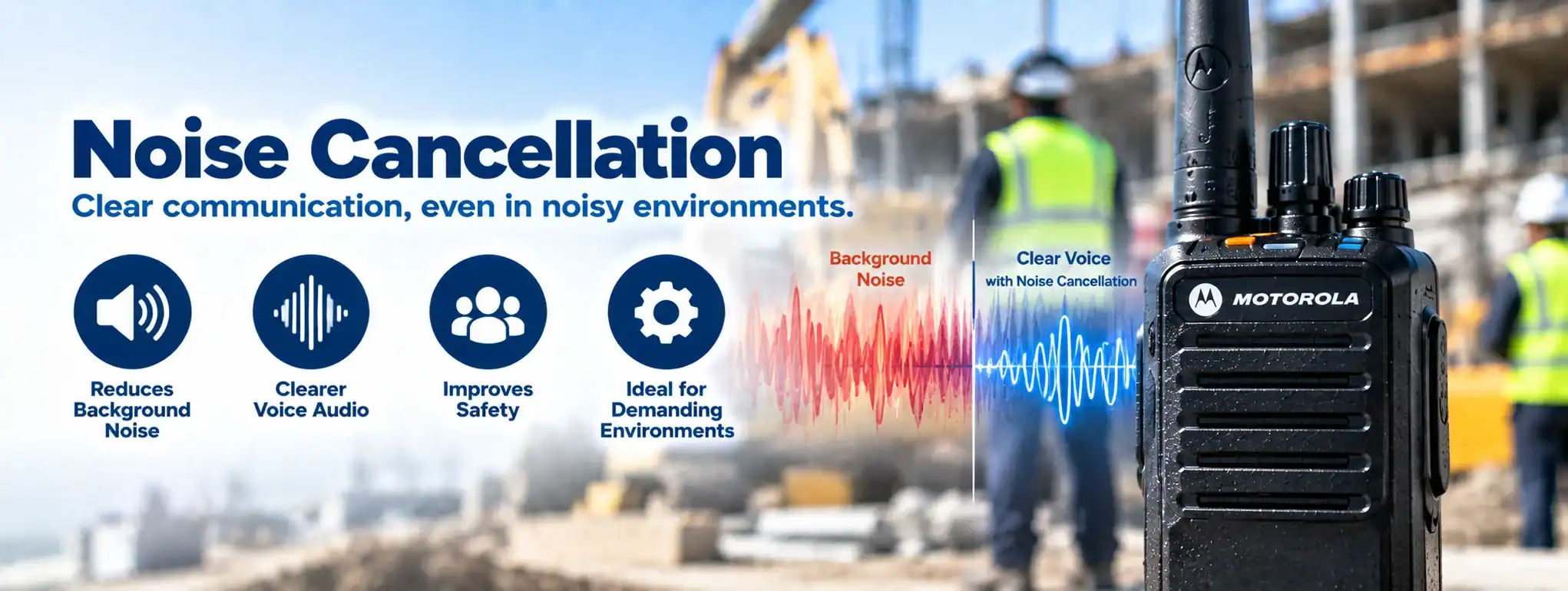
Noise Cancellation
Noise Cancellation is a technology used in two-way radios and communication equipment to reduce unwanted background noise and make speech easier to hear.
It is particularly useful in noisy working environments such as construction sites, factories, transport operations, events and industrial facilities.
What is noise cancellation?
Noise cancellation uses electronic processing to reduce unwanted sounds picked up by a radio’s microphone.
The aim is to make the user’s voice clearer by reducing background sounds such as:
- Machinery
- Engines
- Traffic
- Wind
- Construction equipment
- Crowds
- Industrial equipment
The exact method used depends on the radio and communication system.
Noise cancellation in two-way radios
Modern professional radios can use digital signal processing to distinguish speech from background noise.
The radio processes the microphone signal before transmitting it.
A simplified process is:
User’s Voice + Background Noise → Signal Processing → Clearer Voice TransmissionTransmission is the process of sending voice, data or signalling from a radio using a radio-frequency signal to another radio, repeater or communication system.
The receiving radio then reproduces the processed speech.
Digital noise cancellation
Digital radio systems can use sophisticated Digital Noise SuppressionDigital Noise Suppression uses digital audio processing in a two-way radio to reduce unwanted background noise and improve speech clarity, particularly in noisy working environments. techniques to reduce unwanted background sounds.
Digital processing can analyse the audio signal and reduce frequencies or sound characteristics associated with background noise.
This can improve speech intelligibility, particularly in demanding environments.
Noise cancellation vs noise suppression
The terms Noise Cancellation and Noise Suppression are sometimes used interchangeably, but they can describe slightly different technologies.
Noise suppression generally refers to processing that reduces unwanted background sounds in an audio signal.
Noise cancellation can refer more broadly to technologies designed to counteract or reduce unwanted noise.
In professional two-way radios, manufacturers may use their own terminology for particular audio-processing technologies.
Active noise cancellation
Active Noise Cancellation (ANC) uses an additional sound signal to counteract unwanted sound.
This technology is common in some consumer headphones.
Professional two-way radios more commonly rely on microphone design and digital noise suppression rather than conventional headphone-style ANC.
Microphone noise cancellation
Noise cancellation can be implemented through the radio’s microphone system.
Some professional radios use microphone arrangements designed to distinguish the user’s voice from surrounding noise.
This can help when the radio is being used close to machinery or other loud sources.
Dual-microphone noise cancellation
Some radios use multiple microphones to help identify background noise.
One microphone can primarily capture the user’s speech while another captures surrounding environmental noise.
The radio’s signal processing can then use this information to reduce unwanted background sound.
The exact implementation varies between radio models.
Noise cancellation and speech intelligibility
The main benefit of noise cancellation is improved Speech Intelligibility.
Speech intelligibility refers to how easily spoken words can be understood.
Reducing background noise can make important instructions easier to hear, particularly when radio users are working in loud environments.
Noise cancellation in construction
Construction sites can contain high levels of background noise from:
- Excavators
- Cranes
- Concrete equipment
- PowerAn antenna transmits and receives radio-frequency signals, allowing a two-way radio to communicate. Antenna type, frequency, height and location can all affect radio performance and coverage. tools
- Vehicles
- Generators
Noise cancellation can help radio users communicate more clearly without needing to move away from the source of the noise.
Noise cancellation in manufacturing
Factories can be continuously noisy due to machinery, production lines and ventilation equipment.
Professional radios with effective noise suppression can make communication easier between production, maintenance and supervisory teams.
Noise cancellation in transport
Vehicle environments can generate significant background noise from:
- Engines
- Road noise
- Traffic
- Machinery
Noise cancellation can help improve voice communication between drivers and control rooms.
Noise cancellation in agriculture
Agricultural environments can involve tractors, harvesters and other large machinery.
Noise-reducing radio technology can help operators communicate while working around loud equipment.
Noise cancellation at events
Events can generate noise from crowds, music, generators and production equipment.
Radios with effective noise suppression can help event staff communicate clearly in these conditions.
Noise cancellation in security
Security teams may operate in busy public environments where background noise can make radio communication difficult.
Noise cancellation can improve the clarity of communications between security personnel and control rooms.
Noise cancellation and wind noise
Wind can create significant unwanted noise when a radio is used outdoors.
Microphone design and digital signal processing can help reduce the effect of wind noise.
However, no noise-cancellation system can eliminate every environmental sound.
Noise cancellation and earpieces
An EarpieceAn earpiece is a two-way radio audio accessory that lets users hear radio communications discreetly, often with a microphone and Push-to-Talk button for transmitting. can help the radio user hear incoming transmissions in noisy environments.
Noise cancellation primarily affects the transmitted or received audio processing, while an earpiece can provide additional isolation from surrounding noise.
Using both can improve communication in particularly noisy environments.
Noise cancellation and headsets
A HeadsetA radio headset combines a microphone and speaker or earpiece, allowing two-way radio users to communicate conveniently while keeping the radio away from their face or using hands-free operation. can provide both a microphone and an earpiece or headphones.
Some professional headsets incorporate their own noise-reduction technology.
This can provide additional protection against environmental noise while improving radio communication.
Noise cancellation and speaker microphones
A Speaker MicrophoneA Speaker Microphone is a two-way radio accessory combining a microphone, loudspeaker and usually a Push-to-Talk button, allowing convenient radio operation without handling the radio itself. allows a user to operate a handheld radio from a convenient position.
Some speaker microphones incorporate noise-reduction or noise-cancellation features designed to improve voice transmission.
The capabilities vary between manufacturers and models.
Noise cancellation and digital radio
Digital radio can provide advanced audio processing because the radio can process the voice signal electronically before transmission.
Technologies such as DMR can therefore incorporate digital audio processing alongside digital voice transmission.
Noise cancellation and analogue radio
Noise reduction can also be applied to analogue radioAnalogue radio uses continuously varying radio signals to transmit voice communication. It remains widely used for reliable two-way communication across business, industry, events, security and other applications. systems.
However, the specific technology used will depend on the radio’s design.
Analogue radios may use microphone design, filtering and other audio-processing techniques to improve speech clarity.
Noise cancellation and radio range
Noise cancellation does not increase the physical transmission range of a radio.
It can, however, make a received or transmitted voice signal easier to understand when background noise is present.
Radio range remains dependent on factors such as:
- FrequencyAn antenna transmits and receives radio-frequency signals, allowing a two-way radio to communicate. Antenna type, frequency, height and location can all affect radio performance and coverage.
- Transmit power
- AntennaAn antenna transmits and receives radio-frequency signals, allowing a two-way radio to communicate. Antenna type, frequency, height and location can all affect radio performance and coverage.
- Terrain
- BuildingsAn antenna transmits and receives radio-frequency signals, allowing a two-way radio to communicate. Antenna type, frequency, height and location can all affect radio performance and coverage.
- RepeaterA Repeater receives a two-way radio transmission and retransmits it, usually from an elevated location, to extend the coverage and reliability of a radio communication system. coverageRadio Coverage is the geographical area in which a two-way radio system can provide reliable communication. Coverage depends on the radios, antennas, frequency, terrain, buildings and system infrastructure.
Noise cancellation limitations
Noise cancellation has limitations.
It may not completely remove:
- Very loud machinery
- Sudden noises
- Wind
- Multiple competing voices
- Highly variable background sounds
Performance also varies between radio models and accessories.
Choosing a radio with noise cancellation
When selecting a radio for a noisy environment, consider:
- Noise cancellation or suppression capability.
- Microphone design.
- Digital signal processing.
- Speaker performance.
- Earpiece or headset compatibility.
- Environmental noise levels.
- Radio operating environment.
- Required coverage.
- Battery requirements.
- Availability of suitable accessories.
Testing radios in the actual working environment can be particularly useful where communication takes place around very loud machinery.
Noise Cancellation and DCS
DCS can advise on professional two-way radio equipment designed for use in noisy working environments.
The most suitable radio, microphone or headset depends on the level and type of background noise, the working environment and the communication requirements.