
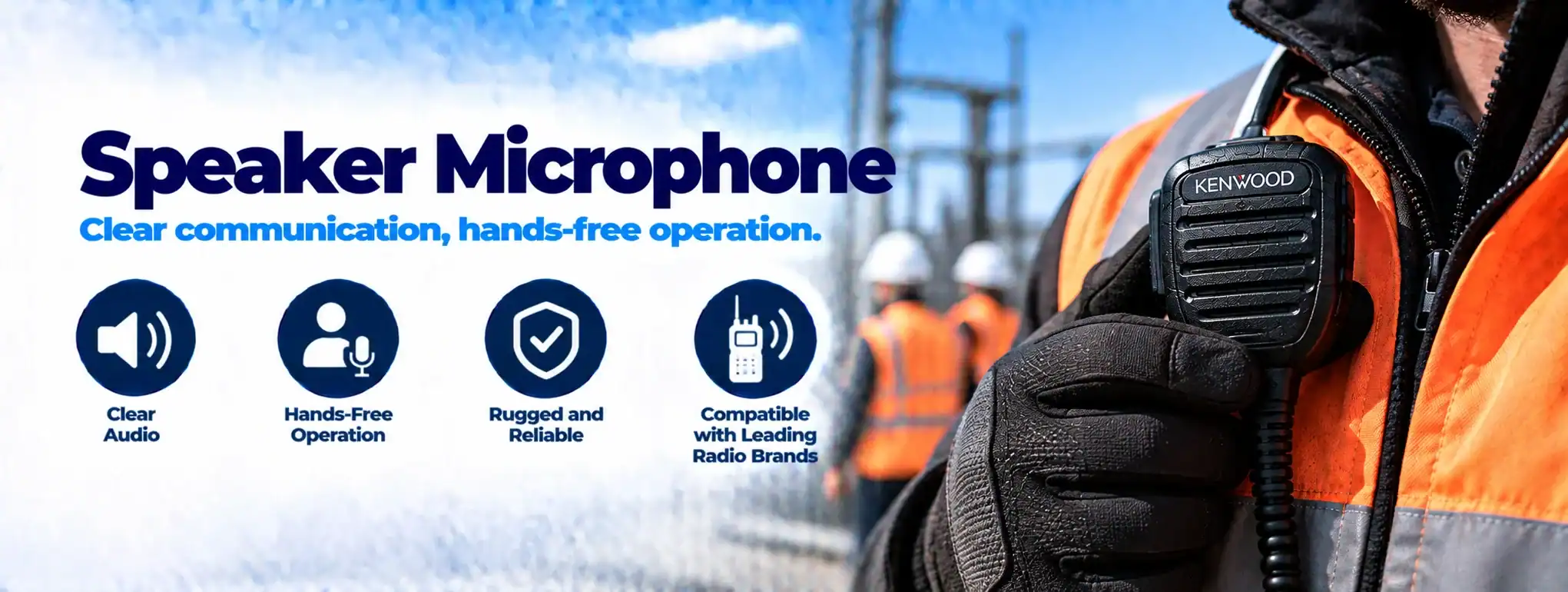
Speaker Microphone
A Speaker Microphone is a two-way radio accessory that combines a microphone and loudspeaker in a compact unit, allowing the user to transmit and hear radio communications without needing to handle the radio itself.
A speaker microphone is normally connected to a portable radioA Portable Radio is a battery-powered two-way radio designed to be carried and operated by an individual, providing mobile communication for professional and operational users. and clipped to the user’s clothing, body armour, belt or equipment.
It is also commonly called a Remote Speaker Microphone (RSM)A Remote Speaker Microphone (RSM) is an external radio accessory combining a microphone, speaker and Push-to-Talk button, allowing users to operate a two-way radio without handling the radio itself..
What is a speaker microphone?
A speaker microphone provides the main audio controls of a handheld radio in a more convenient position.
A typical speaker microphone includes:
- Microphone
- Loudspeaker
- Push-to-Talk (PTT)Push-to-Talk (PTT) is the button or control used to activate a two-way radio's transmitter. Press it to speak and release it to listen. button
- Radio connection
- Clothing or belt clipA belt clip is an accessory fitted to a handheld two-way radio that allows it to be securely attached to a belt, clothing or harness while keeping the user's hands free.
The radio can remain attached to a belt, harness or vest while the speaker microphone is positioned close to the user’s mouth and ear.
How does a speaker microphone work?
The accessory connects to the radio through a dedicated connector.
When the user presses the PTT button on the speaker microphone:
Press PTT → Speak into microphone → Radio transmits
When another user transmits:
Radio receives → Audio plays through speaker microphone
This allows the user to operate the radio without reaching for the main radio controls.
Speaker microphone vs Remote Speaker Microphone
The terms Speaker Microphone and Remote Speaker Microphone (RSM) are often used interchangeably.
“Remote” refers to the fact that the microphone and speaker are positioned away from the radio itself.
The RSM is connected to the portable radio by a cable or, on compatible equipment, through a wireless connection.
Speaker microphone and PTT
Most professional speaker microphones include a large Push-to-Talk (PTT) button.
The PTT is designed to be easy to locate and operate quickly.
This is particularly useful when the radio is attached to:
- A belt
- Security vest
- High-visibility jacket
- Harness
- Workwear
- Body armour
Speaker microphone and audio
The speaker provides received radio audio close to the user’s ear.
This can be more practical than listening to the speaker built into a radio that is attached to a belt or carried inside clothing.
Some speaker microphones have higher audio output or improved audio performance for noisy environments.
Speaker microphone and microphone position
Positioning the microphone close to the user’s mouth can improve voice pickup.
The user normally clips the speaker microphone around the upper chest or shoulder area.
Correct positioning can be particularly important in noisy environments.
Speaker microphone and noise cancellation
Some professional speaker microphones incorporate Noise CancellationNoise Cancellation is technology used in two-way radios and communication equipment to reduce unwanted background noise and make speech easier to hear, particularly in noisy working environments. technology.
This can help reduce the effect of background noise when the user is transmitting.
It can be useful in environments such as:
- Construction sites
- Events
- Stadiums
- Transport hubs
- Industrial facilities
- Warehouses
The effectiveness depends on the specific accessory and radio systemA Radio System is a complete communication solution comprising two-way radios and, where required, equipment such as repeaters, antennas, base stations, mobile radios and network infrastructure..
Speaker microphone and waterproofing
Some speaker microphones are designed to provide protection against water and dust.
Their protection may be specified using an Ingress Protection (IP) RatingAn Ingress Protection (IP) Rating indicates how well electrical equipment, including two-way radios, is protected against dust, solid objects and water. Higher ratings provide greater protection..
The IP rating of the accessory should not be assumed to be the same as the rating of the radio itself.
Speaker microphone and ruggedness
Professional speaker microphones may be designed to withstand frequent handling and demanding working conditions.
Features can include:
- Reinforced cable
- Rugged housing
- Sealed controls
- Strong belt clip
- Water and dust resistance
The appropriate specification depends on the operating environment.
Speaker microphone and earpieces
A speaker microphone can sometimes be connected to an EarpieceAn earpiece is a two-way radio audio accessory that lets users hear radio communications discreetly, often with a microphone and Push-to-Talk button for transmitting..
This allows the user to listen to radio traffic discreetly rather than through the external speaker.
This can be particularly useful for:
- Security personnel
- Event staff
- Hospitality
- Retail security
- Control-room staff
Speaker microphone and discreet communications
Where radio communications need to be heard privately, an earpiece can be connected to a compatible speaker microphone.
The radio can remain concealed or positioned away from the user’s head while the earpiece provides the audio.
Speaker microphone and security
Speaker microphones are widely used by security personnel because they allow quick PTT access while the radio remains securely attached to clothing or equipment.
A security officer can communicate without removing the radio from their belt or vest.
Speaker microphone and event security
At large events, security personnel may need to communicate while moving through crowds.
A speaker microphone allows the user to keep the radio secured while placing the PTT and microphone in an easily accessible position.
Speaker microphone and construction
Construction workers may use speaker microphones when wearing:
- High-visibility clothing
- Gloves
- Harnesses
- Safety equipment
The remote PTT button can be easier to operate than the controls on a radio mounted elsewhere on the body.
Speaker microphone and hospitality
Hospitality staff can use speaker microphones where radios need to remain accessible without being held continuously.
They can be useful in:
- Hotels
- Restaurants
- Venues
- Conference centres
- Stadiums
Speaker microphone and transport
Transport personnel can use speaker microphones for convenient communication while working around vehicles and operational equipment.
The microphone can be clipped near the shoulder while the radio remains secured to a belt or vest.
Speaker microphone and warehouse operations
Warehouse workers can use speaker microphones to communicate while handling equipment or moving goods.
The remote PTT allows hands to remain available for other tasks except when transmitting.
Speaker microphone and agriculture
Farm workers can use speaker microphones where radios are carried while operating machinery, vehicles or working outdoors.
A suitable rugged and weather-resistant accessory may be appropriate for demanding conditions.
Speaker microphone and hands-free operation
A speaker microphone does not normally provide true hands-free operationHands-Free Operation allows two-way radio users to communicate without holding the radio or continuously pressing its PTT button, using features such as VOX, headsets or remote PTT controls..
The user still needs to press the PTT button to transmit.
For genuinely hands-free communication, a compatible radio system may require a headsetA radio headset combines a microphone and speaker or earpiece, allowing two-way radio users to communicate conveniently while keeping the radio away from their face or using hands-free operation., VOX or another hands-free solution.
Speaker microphone and VOX
Some radio systems support VOX (Voice Operated TransmissionTransmission is the process of sending voice, data or signalling from a radio using a radio-frequency signal to another radio, repeater or communication system.).
When compatible equipment is configured for VOX, the radio can transmit when speech is detected without the user pressing PTT.
VOX functionality depends on the radio and connected accessory.
Speaker microphone and full duplex
A speaker microphone does not automatically make a two-way radio Full DuplexFull Duplex allows two-way radio users to transmit and receive simultaneously, providing a continuous, telephone-style conversation rather than requiring users to take turns using Push-to-Talk..
Most professional handheld radio systems remain Half-DuplexHalf-Duplex allows two-way communication in both directions, but users normally take turns transmitting. It is the standard operating method for most Push-to-Talk professional two-way radio systems., meaning users take turns transmitting and receiving.
Speaker microphone and simplex
A speaker microphone can be used with radios operating in SimplexSimplex is a method of two-way radio communication where radios transmit and receive on the same frequency, communicating directly without a repeater. mode.
The accessory simply provides a convenient microphone, speaker and PTT interface; the radio’s underlying communication method remains unchanged.
Speaker microphone and repeater systems
A speaker microphone can also be used with a radio communicating through a RepeaterA Repeater receives a two-way radio transmission and retransmits it, usually from an elevated location, to extend the coverage and reliability of a radio communication system..
The accessory does not affect whether the radio uses direct or repeater-based communication.
Speaker microphone and digital radio
Speaker microphones can be used with compatible digital radio systems, including DMR radios.
The accessory provides the physical audio and PTT interface while the radio handles the digital communication.
Speaker microphone and analogue radio
Speaker microphones can also be used with compatible analogue radios.
The accessory does not determine whether the radio operates using analogue or digital technology.
Speaker microphone and emergency buttons
Some professional speaker microphones include an additional programmable or emergency buttonAn Emergency Button is a dedicated two-way radio control that allows users to quickly send an emergency alert to a dispatcher, control room or authorised radio users..
Depending on the radio system, this may be configured to perform functions such as:
- Emergency alert
- ChannelA two-way radio channel is a programmed set of communication settings, typically including frequency and signalling, that allows compatible radios to communicate with one another. change
- Call function
- Status function
The available features vary by manufacturer and model.
Speaker microphone and channel controls
Some advanced speaker microphones may include additional controls for compatible radios.
Depending on the equipment, these can include:
- Volume
- Channel selection
- Programmable buttons
- Emergency functions
Basic speaker microphones may only provide PTT and audio.
Speaker microphone and radio programming
The accessory’s physical controls may need to be configured through the radio’s programming system.
Programmable buttons can be assigned specific functions depending on the radio model and software.
Speaker microphone connectors
Different radio manufacturers and models can use different accessory connectorsAn antenna transmits and receives radio-frequency signals, allowing a two-way radio to communicate. Antenna type, frequency, height and location can all affect radio performance and coverage..
A speaker microphone designed for one radio may not be compatible with another.
Compatibility should therefore be confirmed before purchasing or hiring an accessory.
Speaker microphone and Bluetooth
Some modern professional radios support Bluetooth accessories.
A compatible Bluetooth speaker microphone can provide wireless audio and PTT functionality without a conventional cable connection.
The radio and accessory must support the required Bluetooth profile and functions.
Speaker microphone and battery
Wired speaker microphones normally draw the required powerAn antenna transmits and receives radio-frequency signals, allowing a two-way radio to communicate. Antenna type, frequency, height and location can all affect radio performance and coverage. from the connected radio.
Wireless Bluetooth accessories have their own battery and therefore need to be charged separately.
Speaker microphone and radio hire
Speaker microphones are commonly supplied as accessories with Radio HireRadio Hire is the temporary rental of two-way radios and related communication equipment for events, projects and operational requirements, providing professional communication without purchasing the equipment. systems.
They can be particularly useful where users need quick access to PTT while keeping the handheld radio secured.
For example:
Radio → Belt or vest
Speaker microphone → Shoulder
This arrangement is common for security, events and operational teams.
Speaker microphone for security radio hire
Security radioA Security Radio is a professional two-way radio used by security personnel to communicate quickly and reliably, with features such as group calling, emergency alerts, Lone Worker and Man Down. hire packages can include speaker microphones for guards and supervisors.
Where discreet communications are required, the speaker microphone may also be paired with an earpiece.
Speaker microphone for event radio hire
Event staff can use speaker microphones to make radios easier to operate while moving around a venue.
They can be especially useful for:
- Security
- Stewards
- Event management
- Production
- Operations
Speaker microphone and radio accessories
A speaker microphone is one of several accessories that can be used with a professional portable radio.
Other accessories include:
- Earpieces
- Headsets
- Spare batteries
- Chargers
- Carry cases
- Antennas
- Programming cables
The appropriate combination depends on the user’s role.
Speaker microphone vs headset
A Headset normally provides both a microphone and an earpiece or headphones, often with an integrated PTT.
A speaker microphone normally provides a microphone and external speaker in a compact body.
Speaker microphone: External speaker + microphone + PTT
Headset: Headphones/earpiece + microphone + PTT
Speaker microphone vs earpiece
An earpiece is primarily intended to provide discreet received audio.
A speaker microphone includes its own loudspeaker and microphone and may also provide a connection for an earpiece.
Choosing a speaker microphone
When selecting a speaker microphone, consider:
- Radio compatibility.
- Connector type.
- PTT size and position.
- Audio output.
- Noise cancellation.
- Waterproofing.
- IP rating.
- Ruggedness.
- Earpiece compatibility.
- Wired or Bluetooth connection.
- Emergency or programmable buttons.
- The user’s working environment.
Speaker microphone limitations
A speaker microphone does not:
- Increase radio range.
- Increase transmitter power.
- Improve radio frequencyAn antenna transmits and receives radio-frequency signals, allowing a two-way radio to communicate. Antenna type, frequency, height and location can all affect radio performance and coverage. coverageRadio Coverage is the geographical area in which a two-way radio system can provide reliable communication. Coverage depends on the radios, antennas, frequency, terrain, buildings and system infrastructure. by itself.
- Replace a repeater.
- Provide encryptionEncryption protects two-way radio communications by converting voice or data into a secure form that can only be understood by authorised radios with the correct encryption capability and keys..
- Automatically provide hands-free operation.
It is primarily an audio and control accessory for a compatible radio.
Speaker microphone maintenance
Speaker microphones should be inspected regularly, particularly when used in demanding environments.
Checks can include:
- Cable condition
- Connector condition
- PTT operation
- Microphone performance
- Speaker output
- Belt clip
- Seals and covers
Damaged accessories can affect radio communications.
Speaker microphone and DCS
DCS can supply compatible speaker microphones and Remote Speaker Microphones (RSMs) for professional two-way radios.
The appropriate accessory can be selected according to the radio model, working environment and requirements for ruggedness, audio performance, discreet communications and ease of PTT operation.