
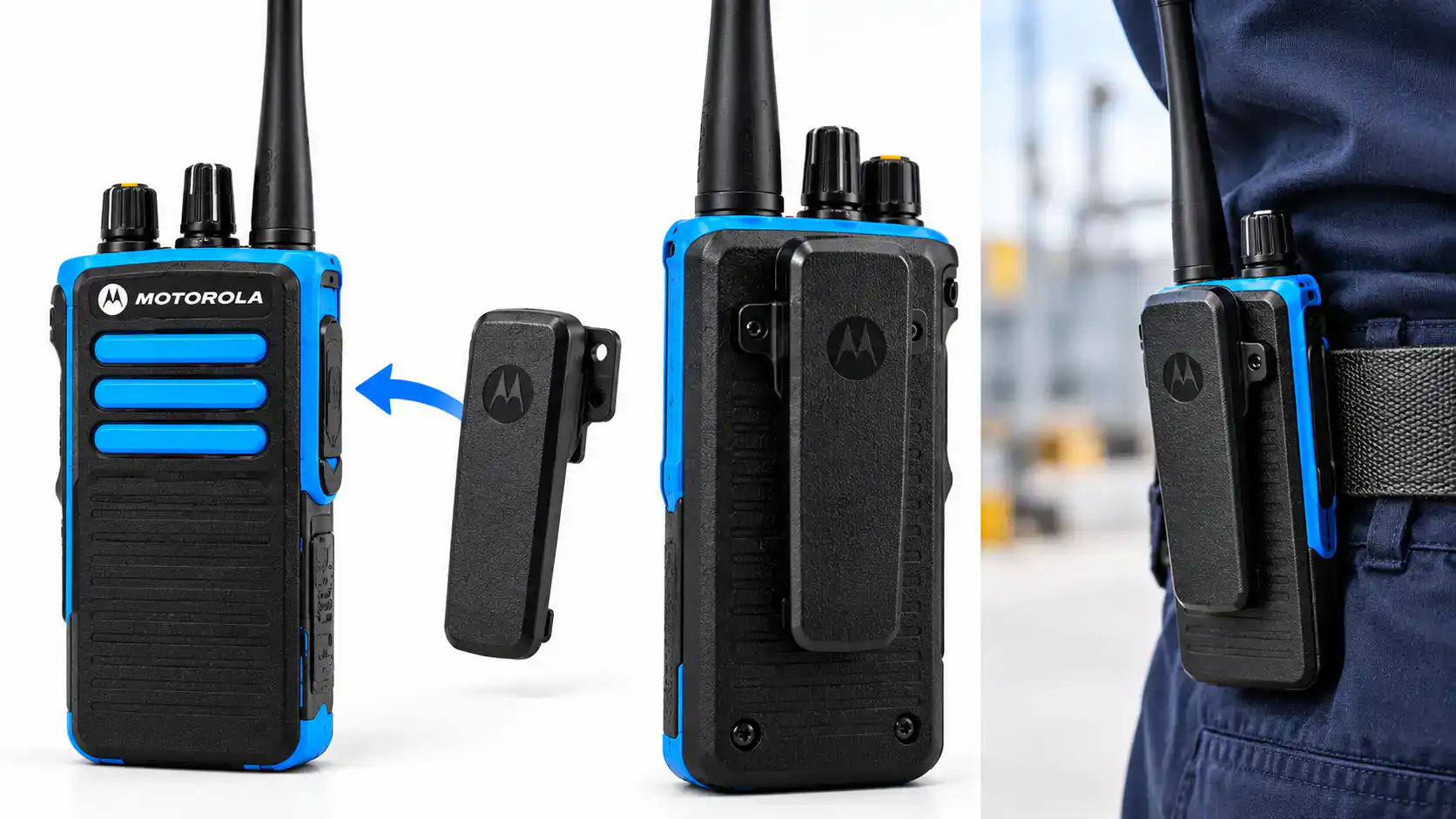
Belt Clip
A belt clip is a mounting accessory fitted to a handheld two-way radio that allows the radio to be securely attached to a belt, waistband, harness or other suitable item of clothing or equipment.
Belt clips are commonly supplied with professional handheld radios and provide a convenient way for users to carry the radio while keeping their hands free. The radio can be removed from the clip when required and returned to the same position after use.
How does a two-way radio belt clip work?
A belt clip is normally attached to the rear of the radio or its battery housing using screws or another manufacturer-specific fixing.
The clip incorporates a spring-loaded or flexible section that grips the user’s belt or clothing. The radio can then be carried securely at the user’s side.
The exact design varies between radio manufacturers and models, so a belt clip designed for one radio may not fit another.
Why use a belt clip?
A belt clip provides a simple and practical way to carry a handheld radio during normal work.
Keeping the radio attached to the user’s belt or clothing means it is readily accessible while leaving both hands available for other tasks.
This can be particularly useful for workers who need to move around while remaining in contact with colleagues, including:
- Security personnel
- Event staff
- Construction workers
- Hospitality teams
- Warehouse staff
- Facilities teams
- Transport workers
- Maintenance personnel
Belt clips and push-to-talk
A belt clip can be used alongside a remote speaker microphone (RSM)A Remote Speaker Microphone (RSM) is an external radio accessory combining a microphone, speaker and Push-to-Talk button, allowing users to operate a two-way radio without handling the radio itself. or other audio accessoryAn audio accessory is an external device such as a speaker microphone, earpiece or headset that connects to a two-way radio to improve or adapt how users send and receive audio..
In this arrangement, the radio remains attached to the user’s belt while the remote speaker microphoneA Speaker Microphone is a two-way radio accessory combining a microphone, loudspeaker and usually a Push-to-Talk button, allowing convenient radio operation without handling the radio itself. is positioned closer to the user’s mouth.
The user can then operate the push-to-talk button on the microphone without removing the radio from the belt.
This can make communication considerably easier for users who need frequent access to their radio.
Belt clips and radio accessories
A belt clip is a carrying accessory rather than an audio or communication accessory, but it can form part of a wider radio setup.
For example, a user may carry the radio on a belt clip while using:
- A remote speaker microphone
- An earpieceAn earpiece is a two-way radio audio accessory that lets users hear radio communications discreetly, often with a microphone and Push-to-Talk button for transmitting.
- A headsetA radio headset combines a microphone and speaker or earpiece, allowing two-way radio users to communicate conveniently while keeping the radio away from their face or using hands-free operation.
- A surveillance-style accessory
- A separate push-to-talk accessory
The appropriate combination depends on the user’s working environment and communication requirements.
Belt clip compatibility
Belt clips are generally designed for specific two-way radio models or ranges.
The mounting points, battery shape and dimensions of handheld radios vary between manufacturers and models. A belt clip that fits one radio may therefore be unsuitable for another.
When replacing a damaged or missing belt clip, the exact radio model should be checked to ensure the replacement is compatible.
Belt clips in demanding environments
A belt clip may be exposed to considerable physical wearAn antenna transmits and receives radio-frequency signals, allowing a two-way radio to communicate. Antenna type, frequency, height and location can all affect radio performance and coverage., particularly when radios are used in construction, security, industrial and outdoor environments.
Repeatedly attaching and removing the radio can put stress on the clip and its mounting points.
A damaged, cracked or loose belt clip should be replaced rather than relying on it to hold the radio securely.
The condition of the clip should be checked periodically, particularly where dropping the radio could damage the equipment or interfere with communications.
Belt clips and ATEX radios
Additional care is required when using accessories with ATEX-certified two-way radios.
A belt clip is normally a mechanical carrying accessory rather than an electrical component, but the clip should still be approved or specified as suitable for the particular radio where required.
Other accessories used with an ATEX radioAn ATEX radio is a certified two-way radio designed for use in potentially explosive atmospheres, with protection against becoming an ignition source in specified hazardous areas., particularly batteries and audio accessories, may form part of the equipment’s certification and must be compatible with the certified configuration.
Belt clips for radio hire
Belt clips are a common accessory supplied with handheld two-way radios for hire.
They allow users to carry the radio securely without needing a separate bag or carrying case and can be particularly useful during events, security operations, construction projects and other temporary activities.
When hiring radios from DCS, suitable carrying and audio accessories can be selected according to how the radios will be used.
Belt clip vs radio holster
A belt clip and a radio holster both provide ways of carrying a handheld radio, but they work differently.
A belt clip attaches directly to the radio and allows it to be clipped onto a belt or similar item.
A holster is a separate holder into which the radio is placed.
A belt clip is generally more compact, while a holster can provide additional protection or make it easier to remove and replace the radio.
The best option depends on the radio model and the user’s working environment.