
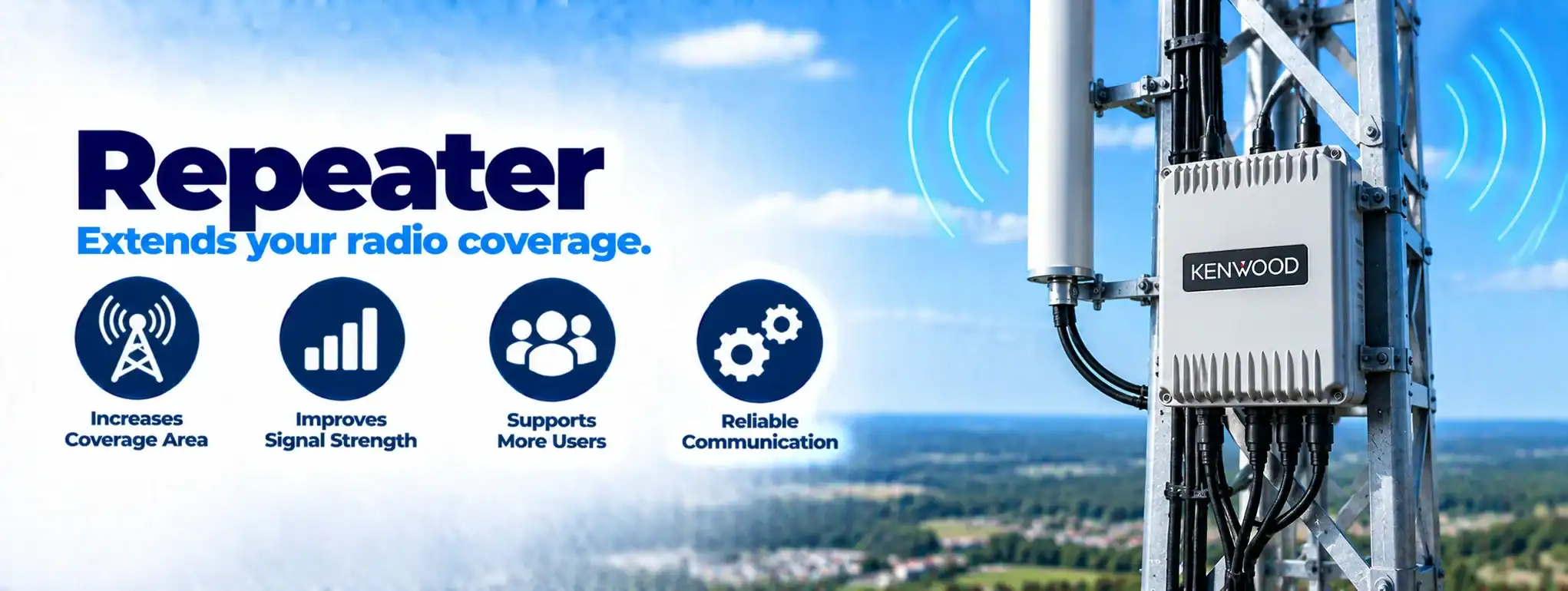
Repeater
A Repeater is a radio-system device that receives a two-way radio transmissionTransmission is the process of sending voice, data or signalling from a radio using a radio-frequency signal to another radio, repeater or communication system. and retransmits it, usually from an elevated or strategically positioned location, to extend the coverageRadio Coverage is the geographical area in which a two-way radio system can provide reliable communication. Coverage depends on the radios, antennas, frequency, terrain, buildings and system infrastructure. of the radio systemA Radio System is a complete communication solution comprising two-way radios and, where required, equipment such as repeaters, antennas, base stations, mobile radios and network infrastructure..
Repeaters are widely used in professional two-way radio systems where direct radio-to-radio communication is not sufficient to cover the required area.
A simple repeater system works like this:
Radio A → Repeater → Radio B
The repeater receives the transmission from Radio A and retransmits it so that Radio B, and other radios within coverage, can receive it.
What is a radio repeater?
A repeater is essentially a relay station for radio communications.
It normally contains:
- Radio receiverA Receiver is the part of a two-way radio that detects and processes incoming radio signals, converting them into audible voice or usable data for the user.
- Radio transmitter
- Controller
- AntennaAn antenna transmits and receives radio-frequency signals, allowing a two-way radio to communicate. Antenna type, frequency, height and location can all affect radio performance and coverage. system
- PowerAn antenna transmits and receives radio-frequency signals, allowing a two-way radio to communicate. Antenna type, frequency, height and location can all affect radio performance and coverage. supply
More advanced repeaters can also include networking equipment, remote monitoring and battery backup.
Why are repeaters used?
The main purpose of a repeater is to improve the usable coverage of a radio system.
A repeater can help overcome limitations caused by:
- Distance
- Hills
- BuildingsAn antenna transmits and receives radio-frequency signals, allowing a two-way radio to communicate. Antenna type, frequency, height and location can all affect radio performance and coverage.
- Terrain
- Low antenna height
- Obstructions
Positioning the repeater at a suitable location can provide a much larger and more reliable coverage area.
How does a repeater work?
A typical repeater receives a transmission on one frequencyAn antenna transmits and receives radio-frequency signals, allowing a two-way radio to communicate. Antenna type, frequency, height and location can all affect radio performance and coverage. and retransmits it on another.
For example:
Radio → Repeater receive frequencyFrequency is the number of cycles a radio wave completes each second, measured in Hertz. In two-way radio, frequency determines where a transmission operates within the radio spectrum.
Repeater → Radio transmit frequency
The radios are programmed to transmit to the repeater and listen for its retransmitted signal.
The frequency separation between the two frequencies is known as the offset or frequency separation.
Repeater frequency
A repeater normally uses separate frequencies for receiving and transmitting.
This allows it to receive an incoming signal while retransmitting it on another frequency.
The exact frequencies used depend on the radio system, frequency band and licensing arrangements.
Repeater input frequency
The Input Frequency is the frequency on which the repeater receives transmissions from radios.
For example:
Radio transmit → Repeater input
Repeater output frequency
The Output Frequency is the frequency on which the repeater retransmits the received communication.
For example:
Repeater output → Radio receive
The radios must therefore be programmed with the appropriate transmit and receive frequencies.
Repeater coverage
The coverage provided by a repeater depends on many factors, including:
- Repeater location
- Antenna height
- Antenna type
- Transmitter power
- Receiver sensitivity
- Frequency
- Terrain
- Buildings
- InterferenceRadio interference occurs when unwanted radio-frequency signals or electrical noise disrupt two-way radio communications, causing distorted audio, broken transmissions, reduced coverage or loss of communication.
A repeater does not guarantee a particular coverage distance.
Repeater location
The location of a repeater is extremely important.
An elevated position can provide a clearer propagation path and allow the repeater to serve a larger area.
Potential locations include:
- Rooftops
- Towers
- Tall buildings
- Masts
- Hills
- High points on large sites
Repeater antenna
A repeater normally uses an external antenna installed at a suitable height.
The antenna system can have a major influence on repeater performance.
The installation may include:
- Antenna
- Coaxial cable
- ConnectorsAn antenna transmits and receives radio-frequency signals, allowing a two-way radio to communicate. Antenna type, frequency, height and location can all affect radio performance and coverage.
- Lightning protection
- Mounting hardware
- Duplexer
Repeater duplexer
A Duplexer allows the repeater’s transmitter and receiver to operate through a shared antenna while using different frequencies.
The duplexer provides the required filtering and frequency separation between the transmitter and receiver.
This is particularly important because the repeater’s transmitter can produce a much stronger signal than the receiver is designed to handle.
Repeater controller
The Repeater Controller manages the operation of the repeater.
Depending on the system, it can control functions such as:
- Transmit activation
- Receive detection
- Timeouts
- Identification
- NetworkA Network is a connected system of radios, equipment and infrastructure that allows users to communicate across a defined area. Radio networks can range from simple radio-to-radio systems to large multi-site networks. connectivity
- Access control
Digital repeaters can perform additional functions according to the radio technology being used.
Analogue repeater
An analogue repeater receives an analogue radioAnalogue radio uses continuously varying radio signals to transmit voice communication. It remains widely used for reliable two-way communication across business, industry, events, security and other applications. transmission and retransmits it.
The voice remains an analogue signal through the radio communication path.
Analogue repeaters can provide straightforward extended-range communication.
Digital repeater
A digital repeater processes digital radio traffic.
Digital repeaters can support technologies such as Digital Mobile Radio (DMR)Digital Mobile Radio (DMR) is an ETSI digital radio standard for professional two-way communications, supporting voice, group calling, data and other features on compatible radio systems..
Depending on the system, digital repeaters can provide features such as:
- Multiple communication groups
- Digital voice
- Data
- Time-slot operation
- Network connectivity
- Call management
DMR repeater
A DMR Repeater is designed to work with compatible DMR radios and systems.
DMR uses two time slots on a 12.5 kHz channelA two-way radio channel is a programmed set of communication settings, typically including frequency and signalling, that allows compatible radios to communicate with one another. in its conventional two-slot configuration.
This can allow two separate conversations to share the same radio-frequency channel under appropriate conditions.
DMR repeater time slots
A DMR repeater can use:
Time Slot 1 → Communication
Time Slot 2 → Communication
The radio system determines which time slot a particular communication uses.
Correct programming of the radio and repeater is required.
Repeater and talkgroups
Digital repeaters can support multiple Talkgroups.
This allows different teams to share the same underlying radio infrastructureRadio infrastructure is the equipment and supporting systems behind a professional two-way radio network, including repeaters, antennas, base stations, network connections, power systems and dispatch equipment. while maintaining separate communication groups.
For example:
Security → Talkgroup 1
Operations → Talkgroup 2
Management → Talkgroup 3
The exact number and arrangement depend on the system.
Repeater and trunked radio
Repeaters can form part of Trunked Radio systems.
In a trunked system, communication resources are dynamically allocated to users according to the system’s control and resource-management architecture.
A repeater in a trunked network can therefore form part of a much larger communication infrastructure.
Repeater and conventional radio
A conventional repeater system generally operates with fixed channels.
Users select the appropriate channel and communicate through the repeater.
This is simpler than a full trunked system and can be suitable for many professional applications.
Repeater and simplex radio
SimplexSimplex is a method of two-way radio communication where radios transmit and receive on the same frequency, communicating directly without a repeater. communication normally means that radios transmit and receive on the same frequency without a repeater.
For example:
Radio A ↔ Radio B
A repeater changes this arrangement:
Radio A → Repeater → Radio B
This can significantly extend the practical coverage of the system.
Repeater and half-duplex
Most professional two-way radio systems using repeaters operate in a form of Half-DuplexHalf-Duplex allows two-way communication in both directions, but users normally take turns transmitting. It is the standard operating method for most Push-to-Talk professional two-way radio systems. communication.
The user transmits by pressing PTT and then releases the button to listen.
The repeater receives and retransmits the communication during the transmission.
Repeater and full duplex
A repeater’s transmitter and receiver operate on different frequencies, but this should not be confused with a conventional full-duplex conversation.
Most two-way radio user communications remain push-to-talk, half-duplex communications.
The repeater’s ability to receive and transmit simultaneously is a characteristic of the infrastructure rather than necessarily the user communication mode.
Repeater and radio frequency
Repeaters operate using specific Radio Frequencies (RF) allocated or authorised for the relevant radio service.
Frequency selection must comply with applicable licensing and regulatory requirements.
In the UK, professional radio frequencies are regulated by OfcomOfcom (Office of Communications) is the UK's communications regulator. For two-way radio users, Ofcom manages and regulates access to radio spectrum and the use of radio frequencies in the UK..
Repeater and Ofcom licensing
Professional repeater systems in the UK generally require appropriate frequency authorisation.
An Ofcom Business Radio LicenceAn Ofcom Business Radio Licence authorises businesses and organisations in the UK to use specified radio frequencies for professional two-way radio communication, subject to the licence conditions. can provide authorised frequencies for professional business-radio use, subject to its conditions.
The exact licensing requirements depend on the service and frequency.
Repeater and PMR446
PMR446 is a licence-free radioA Licence-Free Radio is a two-way radio that can be used without an individual radio licence when it complies with the applicable licence-exempt rules. In the UK, PMR446 is the main licence-free radio service. service with specific technical restrictions.
Standard PMR446 operation is designed for licence-free direct radio communication rather than the installation of conventional high-power business repeaters.
Equipment and system design must comply with the applicable PMR446 requirements.
Repeater and power output
A repeater normally operates at a higher effective system capability than a handheld radio communicating directly with another handheld.
However, increasing transmitter power alone does not determine coverage.
Antenna height, antenna efficiency, terrain and frequency can be equally or more important.
Repeater and antenna height
A higher antenna can provide a significant coverage advantage because it can improve the propagation path between the repeater and users.
This is one reason repeaters are often installed on buildings, towers or other elevated locations.
Repeater and dead spots
A well-positioned repeater can eliminate or reduce dead spots within its coverage area.
However, buildings, terrain and local RF conditions can still create areas of poor reception.
A site surveyA Site Survey is an assessment of a location to determine whether a two-way radio system will provide the required coverage, reliability and performance. can help identify these locations.
Repeater and buildings
Buildings can significantly attenuate radio signals.
A repeater installed at an appropriate location can improve coverage across large buildings, but additional infrastructure may be required for particularly challenging environments.
Repeater and underground areas
Basements, underground car parks and tunnels can be difficult environments for radio communication.
A conventional external repeater may not provide reliable coverage in every underground location.
Specialised systems such as distributed antenna systems may be required for larger or more complex sites.
Repeater and site surveys
A Site Survey can determine where a repeater should be positioned to provide the required coverage.
A survey can assess:
- Signal strength
- Building attenuation
- Terrain
- Interference
- Antenna locations
- Repeater positioning
Repeater and multi-site systems
Multiple repeaters can be connected to provide coverage across several geographical areas.
For example:
Site A Repeater ↔ Network ↔ Site B Repeater
This can allow users at different sites to communicate through a wider radio network.
Repeater and IP Site Connect
IP Site ConnectIP Site Connect links compatible DMR radio sites using an IP network, allowing selected radio communications to be shared between separate buildings, facilities or geographical locations. allows compatible repeaters at different locations to be connected using an IP network.
This can extend communication beyond the coverage of a single repeater site.
The exact functionality depends on the radio technology and equipment.
Repeater and network infrastructure
Networked repeaters can use infrastructure such as:
- Ethernet
- Fibre
- Wireless links
- WAN
- Internet connections
- VPNs
The network must provide sufficient reliability and performance for the radio traffic being carried.
Repeater and Quality of Service
Where repeaters are connected through an IP network, Quality of Service (QoS)Quality of Service (QoS) is the management and prioritisation of network traffic to help important communications receive suitable bandwidth, latency and reliability, particularly on IP-based systems. can help prioritise time-sensitive traffic.
This can be important for larger networked radio systems.
QoS does not compensate for an unreliable or inadequate network connection.
Repeater and failover
Critical repeater installations can incorporate FailoverFailover allows a two-way radio system to switch to backup equipment, infrastructure or communication routes when the primary system fails, helping maintain communications. arrangements.
These can include:
- Backup power
- Battery systems
- UPS
- Generator
- Redundant network connections
- Secondary infrastructure
The appropriate level of redundancy depends on the importance of the communication system.
Repeater and backup power
A repeater is only useful while it has power.
For critical communication systems, backup power can keep the repeater operating during a mains power failure.
Possible solutions include:
- Battery backup
- UPS
- Generator
- Alternative power systems
Repeater and radio hire
Repeaters can be supplied as part of a Radio HireRadio Hire is the temporary rental of two-way radios and related communication equipment for events, projects and operational requirements, providing professional communication without purchasing the equipment. system where the required coverage cannot be achieved reliably using handheld radios alone.
Temporary repeater systems are particularly useful for:
- Large events
- Festivals
- Construction sites
- Sporting events
- Security operations
- Large estates
Temporary repeater systems
A temporary repeater can be deployed for the duration of an event or project.
A typical arrangement might be:
Handheld Radios → Temporary Repeater → Handheld Radios
The repeater can then be removed when the hire period ends.
Repeater and events
Large events can benefit from repeaters when users are spread across a substantial site.
A repeater can help connect:
- Security
- Production
- Event management
- Medical teams
- Transport
- Contractors
Repeater and construction
Construction sites can change considerably as work progresses.
A repeater can provide wider coverage across the site while allowing the radio system to continue operating as the working environment changes.
Repeater and security
Security teams operating across large sites can use repeaters to maintain communication between officers and control rooms.
This can be particularly useful where buildings or terrain restrict direct radio communication.
Repeater and transport
Transport operations can use repeater systems to connect vehicles, drivers, supervisors and control rooms across a defined operating area.
Repeater and agriculture
Large farms and rural estates can have challenging terrain and substantial distances between users.
An appropriately positioned repeater can provide more consistent communication across the property.
Repeater and marine radio
Marine radioA Marine Radio is a two-way radio designed for communication between vessels, shore stations and marine operations. Marine VHF radios are widely used for operational and safety communication on the water. systems use specific frequency bands and system arrangements.
A conventional land-based repeater should not be assumed to be suitable for marine communication.
Marine radio requirements are subject to their own regulatory and technical considerations.
Repeater and emergency communication
A repeater can improve the coverage available for emergency communications where the system has been properly designed.
However, the repeater itself does not guarantee emergency communication.
Emergency features, system capacity, backup power and coverage must all be considered.
Repeater and emergency priority
Compatible digital radio systems can assign priority to emergency communications.
This can allow emergency traffic to receive preferential treatment over routine communication.
The exact behaviour depends on the radio system.
Repeater and encryption
A repeater can carry encrypted digital communications where the radio system supports encryptionEncryption protects two-way radio communications by converting voice or data into a secure form that can only be understood by authorised radios with the correct encryption capability and keys..
The repeater normally relays the communication according to the architecture of the system.
The exact handling of encrypted traffic depends on the technology and equipment.
Repeater and radio system capacity
A repeater can extend coverage but does not necessarily increase the number of simultaneous conversations a system can support.
System capacity depends on factors such as:
- Number of channels
- Time slots
- Trunking architecture
- Traffic levels
- Number of repeaters
Repeater and interference
Repeaters can be affected by RF interference.
Because they transmit from a fixed location, careful frequency planning and antenna installation are particularly important.
Potential issues include:
- Co-channel interference
- Adjacent-channel interference
- Intermodulation
- Poor antenna isolation
- Nearby transmitters
Repeater and duplexer faults
A faulty or poorly configured duplexer can cause serious repeater performance problems.
Symptoms may include:
- Reduced coverage
- Poor receive sensitivity
- Intermittent operation
- Repeater failing to transmit
- Excessive interference
Specialist test equipment may be required to diagnose these faults.
Repeater and antenna faults
A damaged antenna, cable or connector can significantly reduce repeater performance.
Possible symptoms include:
- Reduced coverage
- Weak received signals
- High reflected power
- Intermittent communication
The antenna system should therefore be inspected as part of repeater maintenance.
Repeater maintenance
Professional repeaters should be maintained and tested periodically.
Maintenance can include:
- Radio testing
- Antenna inspection
- Cable inspection
- Duplexer testing
- Power-supply checks
- Battery testing
- Network testing
- FirmwareFirmware is the software built into a two-way radio that controls its underlying operation, features and hardware. Manufacturers may release updates to improve performance, fix faults or add functionality. updates
Repeater monitoring
Networked or professional repeater systems may support remote monitoring.
Depending on the equipment, engineers may be able to monitor:
- Repeater status
- Network connection
- Power
- Temperature
- Alarms
- System faults
Repeater installation
Repeater installation should be carried out by appropriately qualified radio engineers.
The installation can involve:
- Frequency configuration
- Antenna installation
- Duplexer setup
- RF testing
- Power installation
- Network configuration
- Coverage testing
Repeater and RF safety
Repeater transmitters produce RF energy.
A permanent installation should be designed and operated in accordance with applicable safety and regulatory requirements.
Antenna locations should be selected appropriately to control access and exposure.
Repeater limitations
A repeater does not automatically solve every coverage problem.
Performance can still be limited by:
- Poor repeater location
- Incorrect antenna
- Terrain
- Buildings
- Interference
- Insufficient power
- Network problems
- System capacity
A site survey and appropriate system design are therefore important.
Choosing a repeater
When selecting a repeater, consider:
- Required coverage.
- Number of users.
- Number of simultaneous conversations.
- Frequency band.
- Licensing.
- Analogue or digital operation.
- DMR requirements.
- Antenna location.
- Network connectivity.
- Backup power.
- Environmental conditions.
- Future expansion.
Repeater and DCS
DCS can design and supply repeater-based radio systems where direct radio-to-radio communication does not provide the required coverage.
For temporary requirements, repeaters can also form part of radio-hire systems for events, construction projects, security operations and other large sites.
The repeater, antenna, frequency configuration and wider radio system should be designed together to provide the required coverage and reliability.