
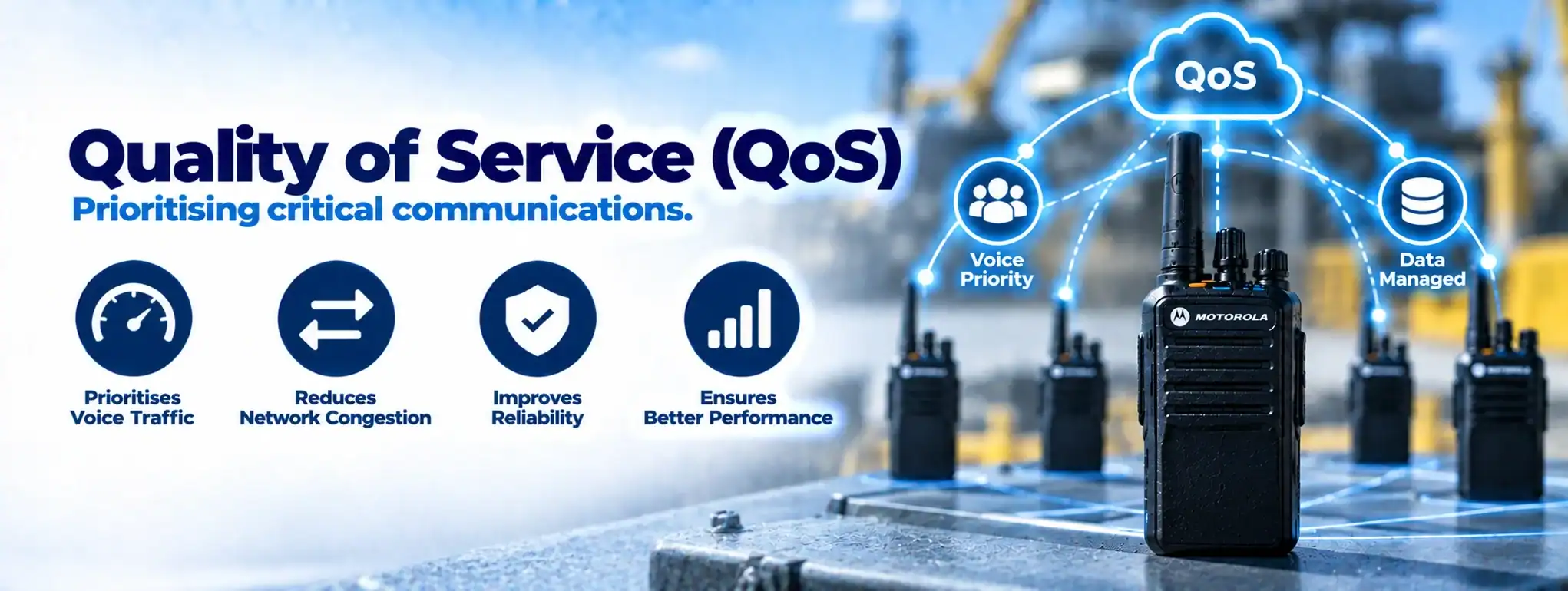
Quality of Service (QoS)
Quality of Service (QoS) refers to the methods used to manage and prioritise networkA Network is a connected system of radios, equipment and infrastructure that allows users to communicate across a defined area. Radio networks can range from simple radio-to-radio systems to large multi-site networks. traffic so that important communications receive the resources they need to operate reliably.
In professional communication systems, QoS can help ensure that voice, video and data traffic are delivered with appropriate priority and acceptable levels of delay, packet loss and network congestion.
QoS is particularly relevant to IP-based communication systems, including Push-to-Talk over Cellular (PoC)Push-to-Talk over Cellular (PoC) provides radio-style push-to-talk communication over cellular or IP networks, allowing users to communicate across wide areas where suitable network connectivity is available., VoIP, broadbandBroadband is a high-speed data connection used by systems such as PoC radio to carry voice, video and other communications over mobile networks, Wi-Fi or IP networks. radio networks and networked dispatch systems.
What is Quality of Service?
QoS is a way of managing network traffic according to its importance and requirements.
For example, a network might give voice communication higher priority than less time-sensitive data.
A simplified example is:
High Priority → Voice Communication
Medium Priority → Operational Data
Lower Priority → General Data
The exact priorities depend on the network and its configuration.
Why is QoS important?
Network congestion can affect the performance of communication services.
Without appropriate traffic management, congestion can result in:
- Delayed communications
- Poor voice quality
- Packet loss
- Increased latencyLatency is the delay between a radio transmission being sent and the resulting voice or data being received. It can be introduced by digital processing, repeaters, IP networks, gateways and cloud systems.
- Interrupted connections
- Reduced reliability
QoS mechanisms can help reduce these effects by managing how network resources are allocated.
QoS and two-way radio
Traditional analogue and digital radio systems do not normally use IP-network QoS in the same way as internet-based communication systems.
A conventional radio systemA Radio System is a complete communication solution comprising two-way radios and, where required, equipment such as repeaters, antennas, base stations, mobile radios and network infrastructure. primarily depends on factors such as:
- Radio coverageRadio Coverage is the geographical area in which a two-way radio system can provide reliable communication. Coverage depends on the radios, antennas, frequency, terrain, buildings and system infrastructure.
- FrequencyAn antenna transmits and receives radio-frequency signals, allowing a two-way radio to communicate. Antenna type, frequency, height and location can all affect radio performance and coverage.
- ChannelA two-way radio channel is a programmed set of communication settings, typically including frequency and signalling, that allows compatible radios to communicate with one another. availability
- Signal strength
- InterferenceRadio interference occurs when unwanted radio-frequency signals or electrical noise disrupt two-way radio communications, causing distorted audio, broken transmissions, reduced coverage or loss of communication.
- RepeaterA Repeater receives a two-way radio transmission and retransmits it, usually from an elevated location, to extend the coverage and reliability of a radio communication system. capacity
However, QoS becomes increasingly relevant when radio systems are connected to IP networks.
QoS and digital radio
Modern digital radio systems can incorporate IP networking for functions such as:
- Multi-site communication
- Dispatch
- Remote repeaters
- Network management
- Data services
- System interconnection
Where IP networks carry radio traffic, network performance and QoS can become important considerations.
QoS and DMR
Digital Mobile Radio (DMR)Digital Mobile Radio (DMR) is an ETSI digital radio standard for professional two-way communications, supporting voice, group calling, data and other features on compatible radio systems. systems can use IP networks to connect radio infrastructureRadio infrastructure is the equipment and supporting systems behind a professional two-way radio network, including repeaters, antennas, base stations, network connections, power systems and dispatch equipment. across different locations.
For example:
Radio → Repeater → IP Network → Remote Repeater → Radio
If the IP connection becomes congested or unreliable, communication between sites can be affected.
Appropriate QoS configuration can help prioritise time-sensitive voice traffic.
QoS and IP Site Connect
IP Site ConnectIP Site Connect links compatible DMR radio sites using an IP network, allowing selected radio communications to be shared between separate buildings, facilities or geographical locations. uses IP networking to connect compatible radio sites.
Because the connection between sites is carried over an IP network, network performance can affect the communication service.
QoS can potentially be used to prioritise radio traffic over other network traffic.
QoS and Push-to-Talk over Cellular
QoS is particularly relevant to Push-to-Talk over Cellular (PoC) because PoC communication relies on cellular and IP networks.
Voice packets must travel through the network between the sender and recipient.
Poor network conditions can increase latency or reduce voice quality.
QoS and latency
Latency is the delay between an action being performed and the corresponding communication being received.
For push-to-talk communication, excessive latency can make conversations difficult because users may not know when the other person has finished speaking.
QoS can help manage network traffic to reduce unnecessary delay where the network supports appropriate prioritisation.
QoS and packet loss
Voice communications are transmitted as packets across IP networks.
If packets are lost during transmissionTransmission is the process of sending voice, data or signalling from a radio using a radio-frequency signal to another radio, repeater or communication system., the received audio can become:
- Broken
- Distorted
- Incomplete
- Difficult to understand
QoS mechanisms can help reduce packet loss caused by network congestion, although they cannot eliminate packet loss caused by every type of network problem.
QoS and jitter
Jitter refers to variation in the time taken for packets to arrive.
Voice communication is sensitive to excessive jitter because packets may arrive irregularly.
Communication systems can use buffering and network-management techniques to reduce the effect of jitter.
QoS and bandwidth
Bandwidth is the capacity available for transmitting data across a network.
Voice communication generally requires less bandwidth than many other applications, but sufficient capacity must still be available.
When many services share the same network, QoS can help ensure that important communication receives appropriate access to available bandwidth.
QoS and network congestion
Network congestion occurs when more traffic is being transmitted than the network can efficiently handle.
For example:
Network Capacity < Traffic Demand
Congestion can lead to increased latency, packet loss and reduced service quality.
QoS can help by prioritising important traffic during periods of congestion.
QoS and voice traffic
Voice traffic is generally considered time-sensitive.
A delayed voice packet may be less useful than a data packet that arrives slightly later.
QoS systems can therefore assign voice traffic an appropriate priority.
QoS and data traffic
Professional communication systems may carry more than voice.
Examples include:
- GPS location
- Messaging
- TelemetryTelemetry is the automatic collection and transmission of information from a remote device, vehicle, machine or radio to another location for monitoring, analysis or control.
- Dispatch data
- Job information
- Device management
QoS can help determine how these different types of traffic are treated when network resources are limited.
QoS and dispatch
A centralised Dispatch system can rely on IP networks to communicate with remote radio sites and users.
QoS can help prioritise dispatch voice traffic and other time-sensitive communications over less critical network traffic.
QoS and control rooms
Control rooms may handle large amounts of communication traffic.
For example, a control centre might simultaneously manage:
- Radio voice
- GPS
- Incident information
- Messaging
- Video
- Business applications
QoS can help ensure that critical communication services receive appropriate network priority.
QoS and emergency communication
Emergency communications may require higher priority than routine traffic.
Some communication systems can assign priority to Emergency CallAn Emergency Call is a priority two-way radio function that allows a user to quickly request assistance and, on supported systems, establish an urgent voice communication with a dispatcher or control room. traffic.
However, emergency priority within a radio system and IP-network QoS are separate mechanisms.
Both may be required in a complex networked communication system.
QoS and priority calls
Priority CallPriority Call is a two-way radio feature that gives important or authorised communications higher priority than routine radio traffic, helping urgent messages access the system when channels are busy. functionality can allow certain radio communications to receive preferential treatment.
QoS can provide a similar concept at the IP-network level by prioritising particular types of network traffic.
The two should not be confused.
QoS and encryption
Encrypted communications can still be managed using QoS.
QoS generally identifies traffic based on network characteristics or configured classifications rather than requiring the network to understand the contents of the communication.
QoS and VPNs
Some radio and communication systems use VPN (Virtual Private Network) connections between sites.
VPN traffic can introduce additional network processing and may affect how QoS markings are handled.
Network design should therefore account for the complete communication path.
QoS and cloud platforms
Modern communication systems may use cloud infrastructure for:
- Push-to-talk
- Dispatch
- GPS
- Fleet managementFleet Management is the process of managing a two-way radio fleet, including equipment, users, programming, maintenance, firmware, security and radio system configuration.
- Device management
- Messaging
QoS can be applied to the network connections used to access these services, although the level of control depends on the network and service provider.
QoS and cellular networks
Cellular operators can use their own traffic-management mechanisms to manage network resources.
A PoC service operating over a public cellular network may have limited control over the underlying mobile network.
This means the service provider may not be able to guarantee the same QoS as an organisation operating a private, managed network.
QoS and Wi-Fi
Professional PoC and IP communication systems can also operate over Wi-FiWi-Fi is a wireless networking technology that connects compatible devices to a local or wider network. In radio systems, it can support programming, updates, data services and IP-based communications..
Wi-Fi networks can use traffic-prioritisation mechanisms to give time-sensitive applications appropriate priority.
Poor Wi-Fi design can nevertheless result in:
- Weak coverage
- Congestion
- Interference
- Packet loss
- High latency
QoS cannot compensate for inadequate Wi-Fi coverage or insufficient network capacity.
QoS and Ethernet
Managed Ethernet networks can use QoS policies to classify and prioritise traffic.
For example, a network administrator could configure voice traffic to receive higher priority than general data.
This can be particularly useful for communication systems operating over dedicated business networks.
QoS and MPLS
MPLS (Multiprotocol Label Switching) networks can provide traffic-management and prioritisation capabilities.
MPLS has historically been used for business networks requiring predictable performance between multiple locations.
Professional communication systems may use managed WAN services with QoS capabilities.
QoS and WANs
A WAN (Wide Area Network) connects geographically separated locations.
For example:
Site A → WAN → Site B
Where professional radio infrastructure is connected across a WAN, QoS can help prioritise communication traffic.
QoS and multi-site radio systems
Large radio systems may connect multiple sites using IP networks.
For example:
Site A → IP Network → Site B → IP Network → Site C
QoS can help maintain appropriate treatment of voice traffic across the network.
QoS and reliability
QoS can improve the handling of network traffic, but it does not guarantee that a communication network will always be available.
Reliability also depends on:
- Network design
- Redundancy
- Connectivity
- Hardware
- PowerAn antenna transmits and receives radio-frequency signals, allowing a two-way radio to communicate. Antenna type, frequency, height and location can all affect radio performance and coverage.
- Coverage
- Backhaul
- FailoverFailover allows a two-way radio system to switch to backup equipment, infrastructure or communication routes when the primary system fails, helping maintain communications. arrangements
QoS and failover
Failover provides an alternative connection or system when the primary service becomes unavailable.
For critical communication systems, QoS and failover can work together.
For example:
Primary Network → QoS-managed communication
Failure → Secondary Network
The exact arrangement depends on the system architecture.
QoS and bandwidth management
QoS can be used alongside bandwidth-management policies.
For example, an organisation could reserve or prioritise network capacity for:
- Radio voice
- Emergency communications
- Dispatch
- GPS
while allowing less-critical applications to use remaining capacity.
QoS and network monitoring
Network monitoring can help identify QoS problems.
Measurements can include:
- Latency
- Jitter
- Packet loss
- Bandwidth utilisation
- Network availability
- Traffic levels
Monitoring can help engineers identify whether communication problems are caused by the network rather than the radio equipment itself.
QoS and radio troubleshooting
If a networked radio system experiences poor audio, engineers may need to determine whether the problem is caused by:
- Radio signal
- Interference
- Repeater
- IP network
- Cellular connection
- Wi-Fi
- Server
- Configuration
QoS monitoring can help identify network-related problems.
QoS and professional radio system design
When designing a networked professional communication system, QoS should be considered alongside:
- Coverage
- Capacity
- Network architecture
- Redundancy
- Security
- Licensing
- Infrastructure
- User requirements
QoS is one component of overall system design rather than a replacement for good network engineering.
QoS and radio hire
QoS can be relevant to temporary Radio HireRadio Hire is the temporary rental of two-way radios and related communication equipment for events, projects and operational requirements, providing professional communication without purchasing the equipment. systems where radio sites, dispatch systems or PoC services use IP connectivity.
For example, a temporary event may require:
Radio Network → IP Backhaul → Control Room
Where the event’s network is shared with other services, traffic prioritisation can help protect communication performance.
QoS for events
Large events can generate significant network traffic.
If radio communication shares network infrastructure with:
- Ticketing
- Wi-Fi
- Streaming
- CCTV
- Administration
- Internet access
QoS can help prioritise operational communication where appropriate.
QoS for security
Security operations may rely on rapid communication between officers and control rooms.
Networked radio and PoC systems can use QoS to prioritise voice traffic where the underlying network supports it.
QoS for transport
Transport organisations may use IP networks to connect control rooms, vehicles and communication systems.
QoS can help prioritise voice and operational data traffic across the network.
QoS for utilities
Utilities may operate communication systems across geographically distributed locations.
Managed network connections with appropriate QoS can help support consistent communication between sites.
QoS and professional mobile radio
Professional Mobile Radio (PMR)Professional Mobile Radio (PMR) describes private two-way radio systems designed for business and professional users, ranging from simple radio networks to advanced digital and multi-site systems. systems can use QoS where IP networks form part of the overall communication infrastructure.
The radio interface itself and the IP network should be considered separately when assessing service quality.
QoS limitations
QoS cannot solve every communication problem.
It cannot create:
- Additional radio coverage
- Cellular coverage where none exists
- Unlimited bandwidth
- Additional radio channels
- More repeater capacity
QoS can only manage the network resources that are actually available.
QoS and service-level agreements
A managed communication or network provider may offer a Service-Level Agreement (SLA) specifying performance or availability targets.
Where communication is operationally critical, organisations may wish to understand:
- Availability guarantees
- Response times
- Network performance
- Support arrangements
- Fault resolution
- Backup connectivity
An SLA and QoS are related but are not the same thing.
QoS and DCS
DCS can assess the network requirements of professional communication systems where IP connectivity is involved.
For systems using DMR, PoC, dispatch or multi-site networking, appropriate network design and traffic management can help maintain reliable voice communication.
The required QoS approach depends on the communication technology, network architecture and operational requirements.