
IP Site Connect
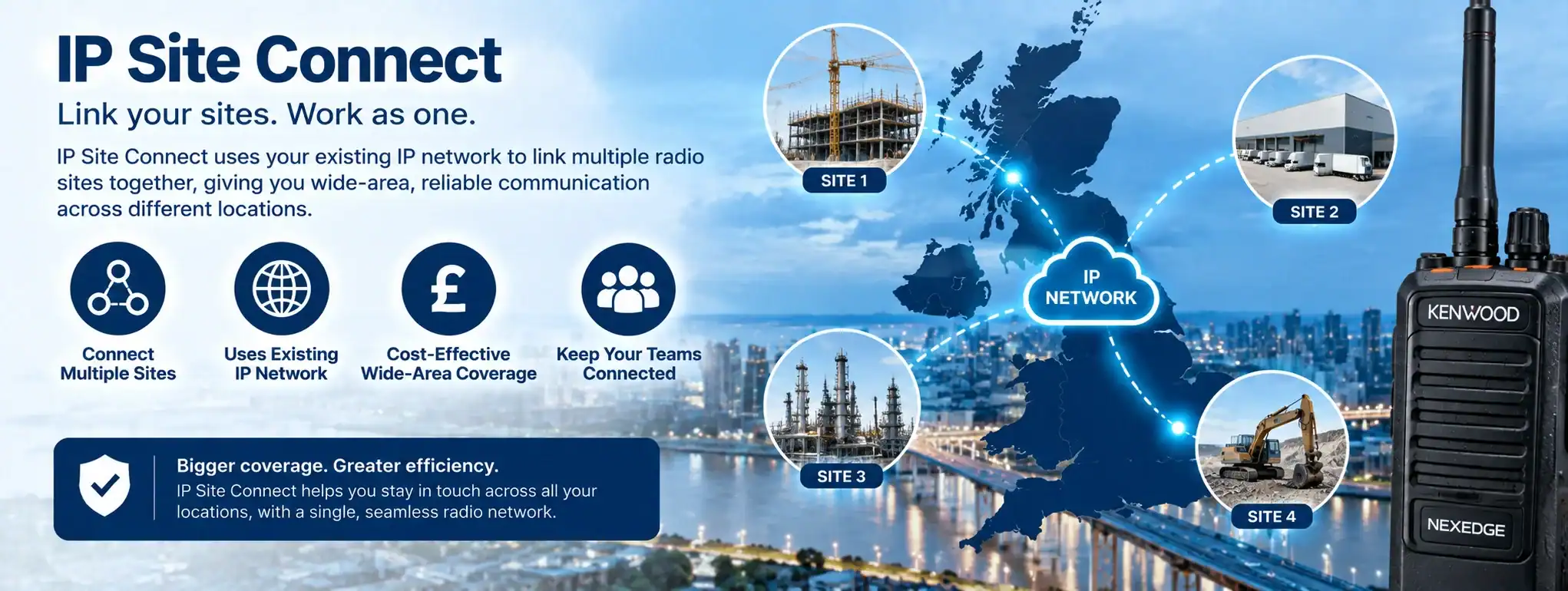
IP Site Connect is a radio systemA Radio System is a complete communication solution comprising two-way radios and, where required, equipment such as repeaters, antennas, base stations, mobile radios and network infrastructure. technology that uses an IP networkA Network is a connected system of radios, equipment and infrastructure that allows users to communicate across a defined area. Radio networks can range from simple radio-to-radio systems to large multi-site networks., such as a private network or the internet, to connect two or more compatible radio sites.
It allows radio users at separate locations to communicate through linked radio infrastructureRadio infrastructure is the equipment and supporting systems behind a professional two-way radio network, including repeaters, antennas, base stations, network connections, power systems and dispatch equipment. without requiring the sites to be physically connected by dedicated radio links.
IP Site Connect is commonly associated with DMR (Digital Mobile RadioA Mobile Radio is a two-way radio designed to be installed in a vehicle. It normally uses the vehicle's power supply and an external antenna to provide reliable communication while travelling or working in the field.) systems and can be used to extend communication across multiple buildingsAn antenna transmits and receives radio-frequency signals, allowing a two-way radio to communicate. Antenna type, frequency, height and location can all affect radio performance and coverage., sites or geographical locations.
How does IP Site Connect work?
A typical IP Site Connect system links radio repeaters at different locations using an IP network.
For example:
Radio → RepeaterA Repeater receives a two-way radio transmission and retransmits it, usually from an elevated location, to extend the coverage and reliability of a radio communication system. → IP Network → Repeater → Radio
A transmissionTransmission is the process of sending voice, data or signalling from a radio using a radio-frequency signal to another radio, repeater or communication system. received at one repeater can be passed across the IP network to another connected repeater.
This allows users at different sites to communicate as though they are using part of the same radio system.
IP Site Connect and DMR
IP Site Connect is particularly associated with DMR systems.
A DMR repeater can be connected to other compatible repeaters over an IP network, creating a wider-area radio system.
This can allow organisations to extend their communication beyond the normal RF coverageRadio Coverage is the geographical area in which a two-way radio system can provide reliable communication. Coverage depends on the radios, antennas, frequency, terrain, buildings and system infrastructure. of a single repeater.
Why use IP Site Connect?
IP Site Connect can be useful when an organisation operates across multiple locations.
It can provide:
- Multi-site communication
- Wider geographical coverage
- Linked repeaters
- Centralised communication
- Communication between separate buildings
- Connectivity between remote locations
It can be an effective way of connecting sites without requiring a dedicated RF link between every location.
IP Site Connect example
Consider a company with three facilities:
Site A → Site B → Site C
Each site has a DMR repeater.
Using IP Site Connect:
Repeater A → IP Network → Repeater B → IP Network → Repeater C
A radio user at Site A can communicate with a user at Site C through the connected system, provided the relevant talkgroup and system configuration allow it.
IP Site Connect vs a single repeater
A single repeater provides coverage around one radio site.
For example:
Radios → Repeater → Local coverage
IP Site Connect adds an IP connection between multiple radio sites:
Radios → Repeater A → IP Network → Repeater B → Radios
This allows communication to extend beyond the coverage area of an individual repeater.
IP Site Connect and wide-area radio
IP Site Connect can be used to create a Wide-Area Radio system.
Multiple repeater sites can be connected over an IP network, allowing selected communications to be shared across the sites.
The geographical area covered depends on the number and location of the repeater sites.
IP Site Connect and IP networks
IP Site Connect relies on IP connectivity between the radio sites.
This may use:
- Private networks
- Business broadbandBroadband is a high-speed data connection used by systems such as PoC radio to carry voice, video and other communications over mobile networks, Wi-Fi or IP networks.
- Fibre connections
- Wireless networks
- Other suitable IP connections
The network must provide the connectivity and performance required by the radio system.
IP Site Connect and the internet
Some IP Site Connect deployments can use internet connectivity to link remote radio sites.
This can make it possible to connect locations that are geographically separated without installing a dedicated private communication link.
Network security and reliability should be considered when using internet connectivity.
IP Site Connect and private networks
A private IP network can provide a controlled connection between radio sites.
This can be useful for organisations with their own wide-area network infrastructure.
The radio system can then operate over the organisation’s existing network where the required connectivity is available.
IP Site Connect and repeaters
Each connected site normally contains compatible repeater equipment.
The repeater provides the local RF interface while the IP connection provides the link to the other radio sites.
For example:
Local radio coverage → Repeater → IP Site Connect
IP Site Connect and antennas
Each repeater site still requires an appropriate AntennaAn antenna transmits and receives radio-frequency signals, allowing a two-way radio to communicate. Antenna type, frequency, height and location can all affect radio performance and coverage. system.
The IP connection does not replace the local RF infrastructure.
A typical site therefore includes:
- DMR repeater
- Antenna
- Coaxial cable
- PowerAn antenna transmits and receives radio-frequency signals, allowing a two-way radio to communicate. Antenna type, frequency, height and location can all affect radio performance and coverage. supply
- IP network connection
The antenna system determines the local RF coverage.
IP Site Connect and coverage
IP Site Connect extends communication between radio sites, but it does not automatically increase the RF coverage of each individual site.
For example, if a user is outside the RF coverage of Site A, IP Site Connect cannot communicate with that radio unless another suitable communication path is available.
Coverage planning remains important at each individual radio site.
IP Site Connect and dead spots
A Dead SpotA Dead Spot is an area where two-way radio communication is weak, unreliable or unavailable. Dead spots can be caused by buildings, terrain, distance, interference or inadequate radio coverage. within the RF coverage of a site remains a coverage problem even when the site is connected through IP Site Connect.
Additional repeater sites or changes to the antenna system may be required to address local coverage problems.
IP Site Connect and talkgroups
DMR systems can use Talkgroups to control which users communicate with one another.
When repeaters are connected through IP Site Connect, selected talkgroups can be configured to operate across multiple sites.
For example:
Talkgroup 1 → Site A + Site B + Site C
while another talkgroup may remain local:
Talkgroup 2 → Site A only
This provides flexibility over how communications are distributed.
IP Site Connect and local communication
Not every communication needs to be transmitted across every connected site.
System configuration can determine which communications remain local and which are shared across the network.
This can help reduce unnecessary traffic and keep local communications separate where required.
IP Site Connect and multi-site communication
A multi-site IP Site Connect system can allow users to communicate across different buildings, facilities or geographical locations.
For example:
Head Office → Warehouse → Distribution Centre
Each location can have local radio coverage while selected communication groups are linked across the sites.
IP Site Connect and roaming
IP Site Connect can be combined with appropriate Auto RoamingAuto roaming allows compatible two-way radios to automatically move between radio sites or channels as users move through different coverage areas, helping maintain reliable communication. functionality on supported radio systems.
This can allow radios to move between coverage areas and select an appropriate site according to the system configuration.
RoamingRoaming allows a compatible two-way radio to move between different radio sites or coverage areas, automatically selecting an appropriate site as the user moves. and IP Site Connect are separate functions, however.
IP Site Connect links the sites; roaming determines how a radio uses those sites.
IP Site Connect and network failure
Because IP Site Connect depends on network connectivity, loss of the IP connection can affect communication between linked sites.
Local radio communication may continue at an individual site depending on the system configuration, but communications requiring the IP connection may no longer be available.
IP Site Connect and failover
FailoverFailover allows a two-way radio system to switch to backup equipment, infrastructure or communication routes when the primary system fails, helping maintain communications. can be incorporated into the wider network design.
Possible measures include:
- Secondary internet connection
- Backup network connection
- Redundant network equipment
- Backup power
The exact options depend on the radio equipment and network architecture.
IP Site Connect and backup power
Repeater sites require power to operate.
If a site loses mains electricity, backup batteries or other power systems can be used where appropriate.
Backup power can help maintain local radio communication and, where network equipment is also supported, the IP connection.
IP Site Connect and latency
IP networks introduce some amount of network delay, known as latencyLatency is the delay between a radio transmission being sent and the resulting voice or data being received. It can be introduced by digital processing, repeaters, IP networks, gateways and cloud systems..
Radio systems need appropriate network performance for reliable communication.
High latency, packet loss or unstable network connections can affect the performance of an IP-linked radio system.
IP Site Connect and bandwidth
Radio voice communications generally require relatively modest network bandwidth compared with many other modern data applications.
However, the network still needs to provide consistent connectivity with sufficient capacity and reliability.
Network requirements depend on the number of connected sites and the particular radio system.
IP Site Connect and network security
Connecting radio sites through an IP network introduces network-security considerations.
These can include:
- Firewalls
- Access control
- Network segmentation
- Secure network configuration
- Authentication
- Monitoring
The appropriate security arrangements depend on the network and radio system.
IP Site Connect and encryption
DMR systems can support EncryptionEncryption protects two-way radio communications by converting voice or data into a secure form that can only be understood by authorised radios with the correct encryption capability and keys. where the relevant equipment and configuration provide it.
Encryption protects the content of communications but does not replace the need for appropriate network security.
Where encrypted communications are distributed across multiple sites, the complete system should be configured and tested accordingly.
IP Site Connect and dispatch
IP Site Connect can form part of a wider system incorporating Dispatch.
A dispatch platform can provide authorised operators with central visibility and control over connected radio users and sites, depending on the system.
This can be useful for organisations operating across multiple locations.
IP Site Connect and cloud management
Connected radio systems can potentially incorporate Cloud ManagementCloud Management uses an online platform to remotely manage and monitor compatible two-way radios, users, devices and communication settings from a central location. alongside IP Site Connect.
Cloud-based management can provide remote administration of supported equipment and users.
The cloud platform and IP Site Connect network perform different functions, although they can form part of the same overall radio system.
IP Site Connect and GPS
Compatible DMR systems can transport GPS information across connected infrastructure.
This can allow authorised users or dispatch operators to receive location information from radios operating at different sites.
The availability of this functionality depends on the equipment and system configuration.
IP Site Connect and emergency calls
Emergency communications can be carried across connected radio sites where the system supports the required emergency functionality.
For example:
Emergency ButtonAn Emergency Button is a dedicated two-way radio control that allows users to quickly send an emergency alert to a dispatcher, control room or authorised radio users. → Radio → Repeater → IP Network → Control / Radio Users
The exact behaviour depends on the radio system configuration.
Emergency functionality should always be tested across the complete network.
IP Site Connect and call recording
Where supported, Call RecordingCall Recording is a two-way radio feature or system function that captures and stores radio communications for later playback, review, incident investigation or record keeping. can be incorporated into a wider IP-connected radio system.
This can allow communications from connected sites to be recorded by an appropriate recording or dispatch platform.
The exact recording capability depends on the radio system and software.
IP Site Connect and interoperability
IP Site Connect primarily links compatible radio infrastructure.
It should not automatically be considered a solution for connecting completely different radio technologies.
Where different systems need to communicate, a suitable Gateway or interoperabilityInteroperability is the ability of different communication systems, devices or organisations to work together and exchange information. In two-way radio, it can connect different radio networks, technologies or users through compatible systems or gateways. platform may be required.
IP Site Connect and hybrid communication
IP Site Connect can form one component of a Hybrid CommunicationHybrid Communication combines two or more communication technologies, such as two-way radio, DMR, cellular, Wi-Fi or IP networks, allowing different systems or users to communicate through a common platform. system.
For example:
DMR radios → IP Site Connect → Radio network → Gateway → Cloud / PoC users
This can connect traditional radio users with other communication technologies where suitable interfaces are available.
IP Site Connect and radio licensing
IP Site Connect does not remove the need for appropriate radio licensing.
Each radio site must operate in accordance with the applicable frequencyAn antenna transmits and receives radio-frequency signals, allowing a two-way radio to communicate. Antenna type, frequency, height and location can all affect radio performance and coverage. and licensing requirements.
Network connectivity between sites does not change the underlying radio-spectrum requirements.
IP Site Connect and site planning
Each connected radio site should be planned for:
- RF coverage
- Antenna location
- Power
- Network connectivity
- Equipment security
- Environmental conditions
- Maintenance access
The IP connection adds another dependency that must be considered when selecting a site.
IP Site Connect and remote sites
IP Site Connect can be particularly useful for remote locations where installing a dedicated radio link would be difficult or expensive.
If a suitable IP connection is available, the remote radio site can potentially be connected to the main radio network.
IP Site Connect for businesses
Businesses operating from several premises can use IP Site Connect to create a connected radio network.
Examples include:
- Manufacturing sites
- Warehouses
- Distribution centres
- Hotels
- Shopping centres
- Transport operations
- Large estates
The system can provide local RF coverage at each location while allowing selected communications to be shared.
IP Site Connect for construction
Large construction projects may use IP Site Connect where several areas or buildings require connected radio coverage.
Temporary or permanent radio sites can potentially be linked through an available IP network.
This can be particularly useful for projects spread across a large area.
IP Site Connect for events
Large events can involve multiple venues, compounds or operational areas.
IP Site Connect can link compatible repeater sites so that selected event teams can communicate across different areas.
The system should be planned around the event’s frequencyFrequency is the number of cycles a radio wave completes each second, measured in Hertz. In two-way radio, frequency determines where a transmission operates within the radio spectrum., coverage and operational requirements.
IP Site Connect for transport
Transport organisations operating across multiple locations can use connected radio sites to provide communication between:
- Vehicles
- Depots
- Control rooms
- Maintenance teams
- Operations staff
The radio network can be extended geographically while maintaining local RF coverage at each site.
IP Site Connect for security
Security operations covering multiple buildings or locations can use IP Site Connect to link radio coverage between sites.
This can allow selected security teams to communicate across a wider operational area.
IP Site Connect and infrastructure
IP Site Connect is an example of Radio Infrastructure being connected through an IP network.
A complete system can include:
Handheld radios → Repeaters → Antennas → IP Network → Repeaters → Handheld radios
Additional dispatch, GPS, recording and management functions can be incorporated depending on the system.
IP Site Connect limitations
IP Site Connect requires compatible equipment and a suitable network connection.
It does not automatically:
- Increase local RF coverage
- Make incompatible radio systems communicate
- Remove licensing requirements
- Provide internet access to radios
- Guarantee communication during network failure
The complete system must be designed around the actual operational requirements.
IP Site Connect vs a radio-to-radio system
A radio-to-radio system communicates directly:
Radio → Radio
An IP Site Connect system uses connected infrastructure:
Radio → Repeater → IP Network → Repeater → Radio
The second approach can provide substantially wider geographical communication where suitable infrastructure is available.
IP Site Connect and system maintenance
Connected radio sites require ongoing maintenance.
This can include:
- Repeater maintenance
- Antenna inspection
- Network monitoring
- Power-system checks
- Battery testing
- FirmwareFirmware is the software built into a two-way radio that controls its underlying operation, features and hardware. Manufacturers may release updates to improve performance, fix faults or add functionality. updates
- Connectivity testing
All connected sites should be included in the maintenance programme.
IP Site Connect and DCS
DCS can design and supply professional DMR radio systems incorporating IP Site Connect where multi-site communication is required.
By linking compatible repeaters over an IP network, organisations can extend radio communications between separate buildings, facilities or geographical locations while retaining local radio coverage at each site.
The appropriate configuration depends on the number of sites, required coverage, network availability and communication requirements.